
A long blue tail reaches up through the stars. Beside it, a fine, colorful streak cuts across the sky. It is tempting to connect the two: did that comet just shed the particle that made the meteor?
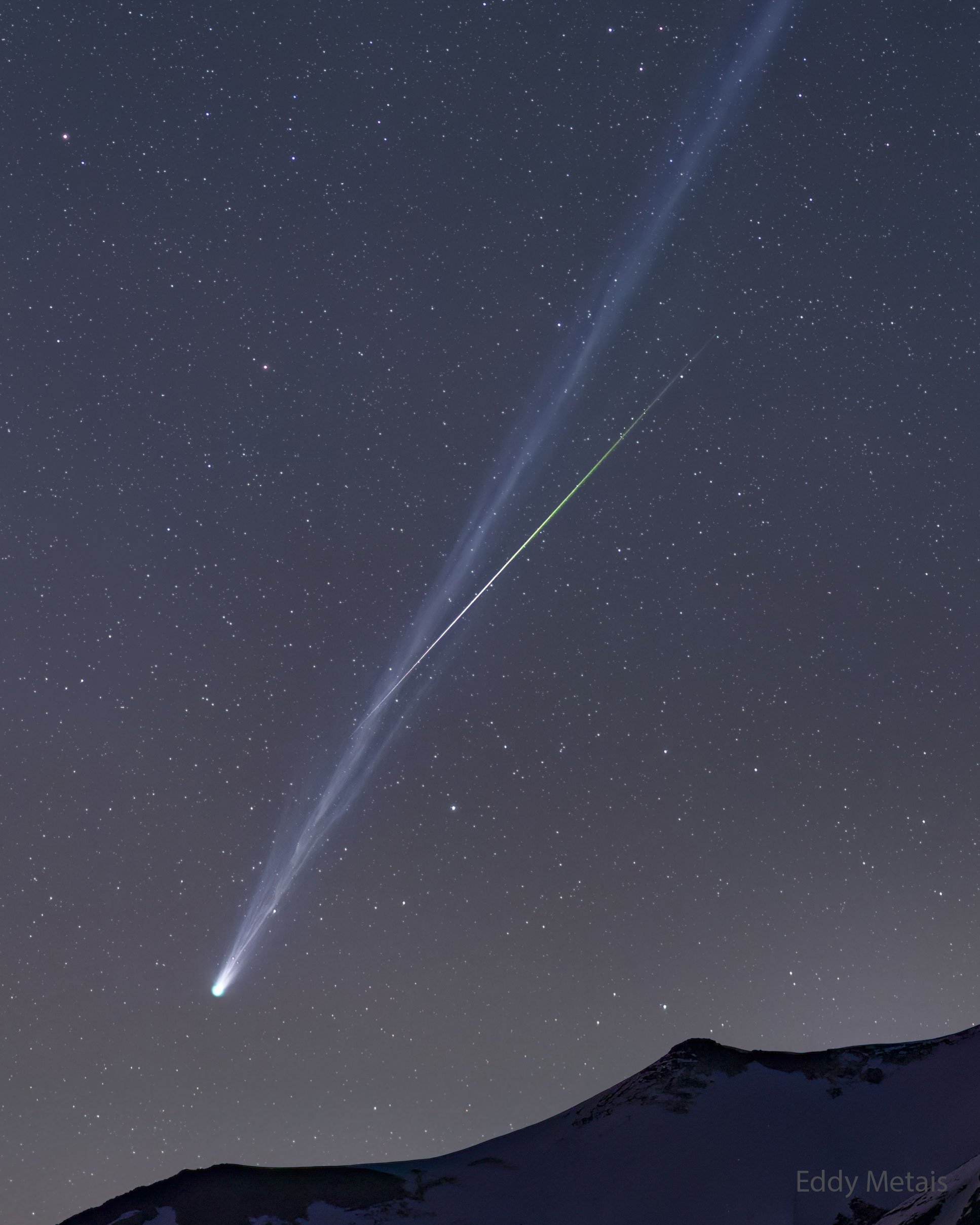
Image: NASA Astronomy Picture of the Day · Credit & copyright: Eddy Metais · Original page
Probably not, says NASA's November 3 Astronomy Picture of the Day. Eddy Metais photographed Comet C/2025 R3 (PanSTARRS) and the meteor from Hautacam, France, in April. They share a patch of the picture, but the comet is far behind the meteor.
Two very different places
As a comet approaches the Sun, ice sublimates, releasing gas and dust. Sunlight and the solar wind help shape the tails. The blue ion tail contains electrically charged gas; it is not smoke left behind as the comet travels.
A meteor happens inside Earth's atmosphere. A small incoming particle makes material along its path glow, producing the brief streak we see. NASA's meteor guide distinguishes the small object before it enters the atmosphere, the luminous event and any meteorite that reaches the ground. The names mark different stages of the journey.
The colors here may reflect a complicated mix of emitting material, but a color photograph alone cannot supply a reliable chemical inventory. Connecting a meteor to a particular comet takes evidence such as an orbit, not just an apparent alignment.
November offers the Taurid and Leonid meteor showers to watch for. Start with NASA's guide to comets, then find a dark place with an open view of the sky. Watch a broad area rather than staring at the comet's position in this photograph. An April picture is no map of tonight's sky.