
A meteor flares beside the Milky Way, then appears a second time in the telescope below, its great mirror assembled from 198 hexagonal segments.
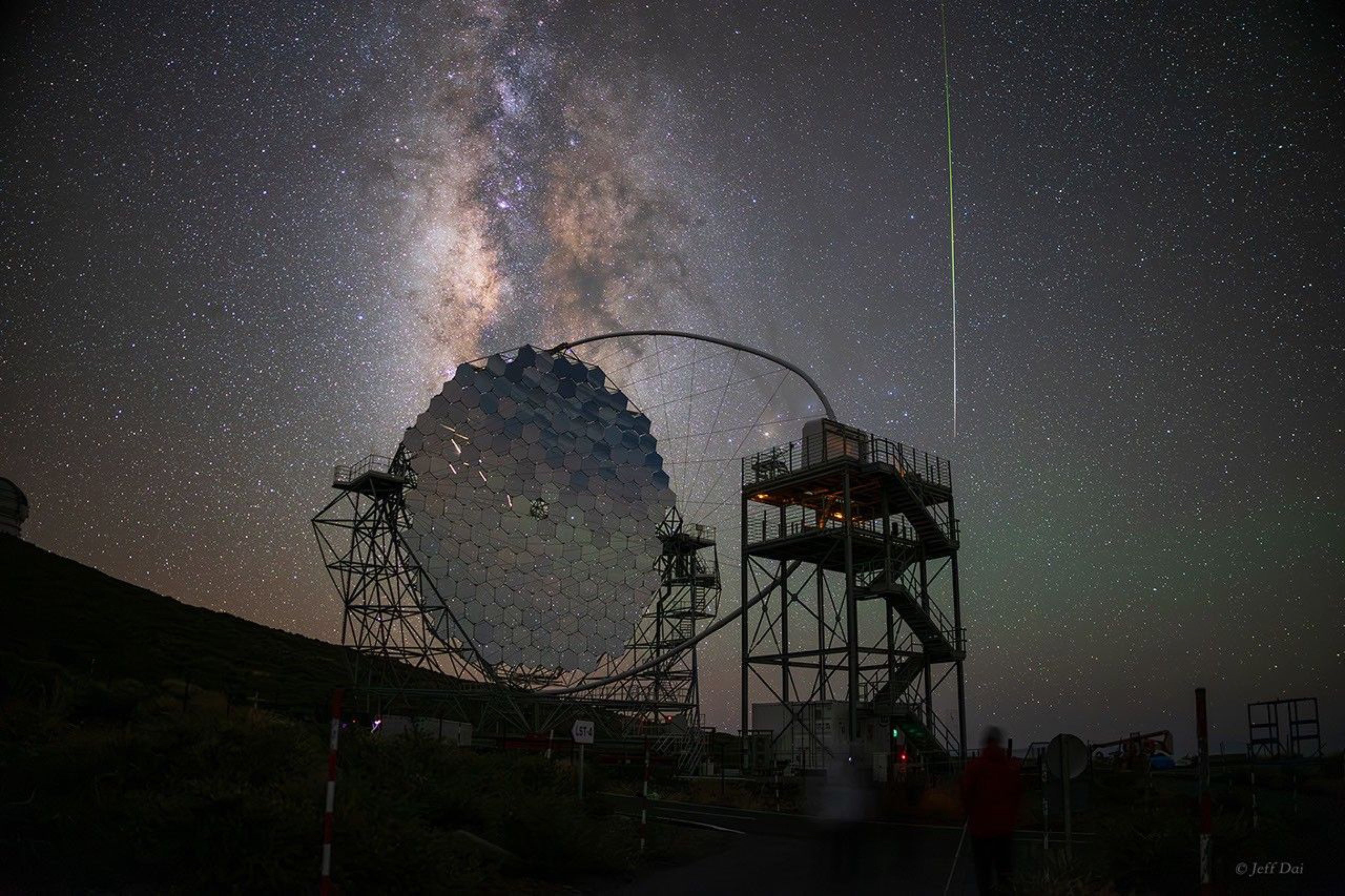
Image: NASA Astronomy Picture of the Day (APOD) | Photography: Jeff Dai (TWAN) | Original page
This photograph was taken on August 15, 2026, at Roque de los Muchachos Observatory on La Palma, in Spain's Canary Islands.
At the top of the frame, a Perseid meteor streaks past the region around the Milky Way's center. Below, the 23-meter-diameter LST-1 telescope points skyward. Some of its mirror segments happen to reflect the meteor's light back toward the camera, putting the same fleeting trail in the picture twice.
One Eye Made of 198 Mirrors
LST-1's primary mirror is assembled from 198 hexagonal segments rather than a single piece of glass. This segmented design makes it possible to manufacture and install a reflector 23 meters across, then align its pieces individually.
It is the first Large-Sized Telescope prototype at the northern site of the Cherenkov Telescope Array Observatory. Large-Sized Telescope is what the initials LST stand for.
Its main subject is not an ordinary meteor glowing in visible light. It is built to study high-energy gamma rays from the cosmos.
The Telescope Does Not See the Gamma Rays Themselves
When a gamma ray enters Earth's atmosphere, it interacts with atoms and molecules in the air, producing a shower of fast-moving secondary particles. Some of those particles travel through air faster than light travels through that same medium, producing an extremely brief flash of Cherenkov light.
This blue-white visible light lasts only about a billionth of a second. LST-1's enormous mirror gathers the faint flash and focuses it onto a high-speed camera. From the shape and arrival time of the light, astronomers can work backward to infer the original gamma ray's direction and energy.
Though it uses mirrors, the telescope studies the highest-energy end of the electromagnetic spectrum. The atmosphere converts gamma rays that it cannot focus directly into visible signals it can photograph.
Two Kinds of Flash in One Frame
Meteors also glow in the atmosphere, but the mechanism differs from a gamma-ray air shower. A meteoroid entering at high speed compresses and heats the air ahead of it, while its own material ablates and becomes ionized, leaving a bright trail visible to the naked eye.
Perseid meteors typically come from dust left behind by Comet Swift-Tuttle. Every August, Earth crosses this dust stream, bringing the reliably recurring Perseid meteor shower.
The photograph brings two timescales together. A meteor's trail lasts long enough to be recorded in a long exposure; the Cherenkov flashes LST-1 normally awaits last only a billionth of a second. The first happened to light up the telescope's mirror. The second is what those 198 segments spend the night watching for.
Sources
NASA Astronomy Picture of the Day, "Mirrored Meteor and Milky Way": Original page.