
All the meteors point toward the same spot—not because they started there, but because you're standing in the middle of the railroad tracks.
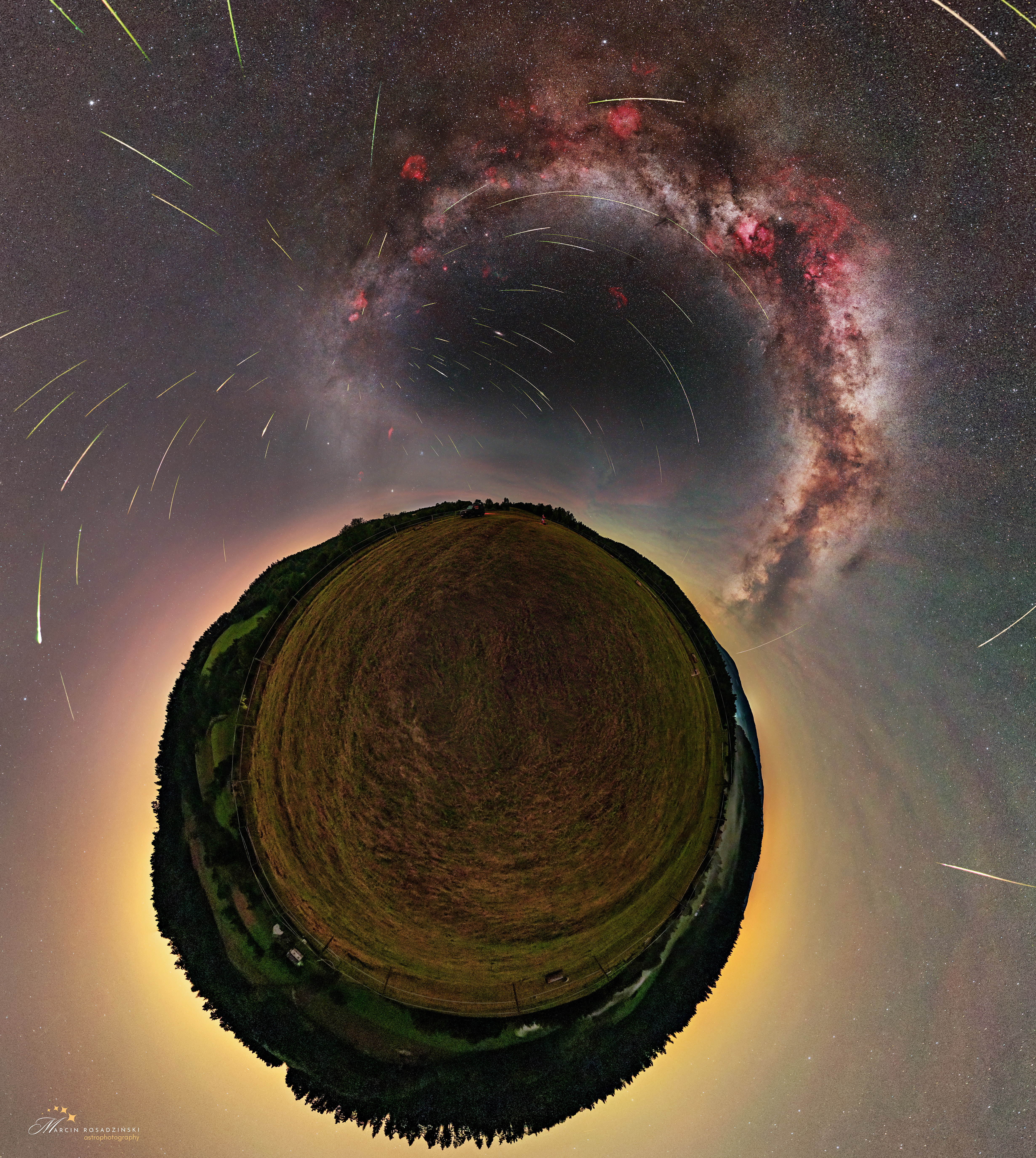
Image: NASA Astronomy Picture of the Day (APOD) · Image Credit & Copyright: Marcin Rosadziński · Page of the day: https://apod.nasa.gov/apod/ap260812.html
Today's NASA Astronomy Picture of the Day looks like a page ripped straight out of The Little Prince: a tiny planet hangs in the night sky, its ridges, forests, and roads all curving along the rounded surface; overhead arches a bridge of Milky Way with patches of red nebulae scattered through it; and then the meteors—over a hundred of them, packed tightly together, all lined up in the same direction.
NASA's description makes it clear: this is a look back, a photograph of the 2024 Perseid meteor shower taken in the Bieszczady Mountains in the far southeastern corner of Poland.
The reason they're resurfacing it today is that tonight is the peak of the 2026 Perseid meteor shower.
How that little planet came to be
Let's address the first question: Earth obviously doesn't look like this.
What the photographer did was rotate his camera in a full circle around himself, capturing a complete set of images and stitching them into a 360-by-180-degree panorama—top to bottom, all directions, nothing left out. Then he used a method called stereographic projection to flatten that spherical image: the point directly underfoot lands at the center of the frame, and the sky overhead gets stretched out to the outermost edges.
The result is what you see. The patch of grass beneath your feet gets compressed into the core of a tiny sphere, the horizon around you curls into a circle, and the entire sky flips to the outside. Photos like these have a nickname: "little planets." Nothing has been added; it's simply a different way of unfolding the world.
Why they all point toward the same spot
Now look at the meteors.
Those hundred-plus streaks aren't flying randomly. Extend the trajectory of each one backward, and they all converge at the same point in the sky—a point in the constellation Perseus, which is why this shower is called the Perseids.
Here's where a common misconception creeps in: there isn't some object sitting in Perseus hurling rocks at Earth. The reality is precisely the opposite—these grains are flying parallel to one another in space, side by side, all moving in exactly the same direction.
So why do they look like they're exploding from a single point?
Perspective. Stand in the middle of a straight railroad track and look into the distance: the two parallel rails converge at a single point on the horizon. Walk into a snowstorm and face forward: the parallel snowflakes seem to rush at you from a point dead ahead. Meteors work the same way. They plunge into the atmosphere in parallel, and your eyes extend those parallel lines until they meet at a vanishing point. That point is called the radiant.
So the constellation astronomers use to name a meteor shower is really just a directional marker—those grains are less than about a hundred kilometers above us, while the stars of Perseus are hundreds of light-years away. They have nothing to do with each other; they just happen to overlap in your line of sight.

Where these grains come from
They come from a comet called Swift–Tuttle, designated 109P.
In 1862, Americans Lewis Swift and Horace Tuttle each independently discovered it—164 years ago. It takes 133 years to orbit the Sun; its last perihelion passage was in 1992, and the next won't come until 2125. Its nucleus is roughly 26 kilometers across—according to NASA, more than twice the size of the asteroid believed to have ended the age of the dinosaurs.
In 1865, Italian astronomer Giovanni Schiaparelli linked this comet to the annual August meteor shower, a significant conceptual shift at the time: for the first time, people realized that meteor showers weren't weather—they were celestial mechanics.
Every time the comet swings close to the Sun, it sheds debris. Over thousands of years, this has laid down a ribbon of dust along its orbit. Each August, Earth passes through that ribbon, and the result is the Perseid meteor shower. Most of the particles entering the atmosphere tonight are no bigger than a grain of sand, yet they travel at 59 kilometers per second—at that speed, you could fly from Beijing to Tianjin in about two seconds. It's precisely this velocity that lets a single grain of sand burn a streak bright enough to make you cry out.
Tonight: a dark sky that comes once in three years
This year's shower keeps getting mentioned because it coincides with an uncommon stroke of luck: peak night falls on a new moon.
No moon in the sky means the background is truly dark. Under ideal conditions, the Perseids' zenithal hourly rate is around 100; NASA's expectation is 50 to 100 visible meteors per hour—but that number always assumes "the sky is dark enough," and in past years, moonlight has often washed away half of them.
How to watch tonight (China)
- Peak time: around 10:00 AM Beijing time on August 13—broad daylight, so we observe during the nights on either side of the peak.
- Best window: after 10:00 PM on the night of August 12, through to dawn on August 13; the night of August 13 is also worth a second look.
- The radiant is in Perseus, in the northeastern sky. It climbs higher as the night goes on, and the later it gets, the more meteors you'll see.
- No telescope needed—a telescope will only shrink your field of view. Lie back, look at a broad patch of sky near the zenith, and don't fixate on the radiant.
- The darker the location, the better. Once you arrive, give your eyes 30 minutes to adapt to the dark, and don't look at a white phone screen in the meantime.
One more thing happening today: the Northern Hemisphere is also getting a total solar eclipse, with the path of totality sweeping across Greenland, Iceland, northern Russia, and Spain. It won't be visible from China. NASA will begin a live broadcast at 1:15 PM U.S. Eastern Time on August 12, which is 1:15 AM Beijing time on August 13—go to nasa.gov/live. If you were already planning to stay up for meteors, it dovetails nicely.
A place where only the stars remain
Finally, a word about where this photo was taken.
The Bieszczady are a stretch of mountains in Poland's far southeastern corner, near the borders with Ukraine and Slovakia. In 2013, the Bieszczady Dark Sky Park was established here, covering roughly 113,846 hectares. What's even rarer is that it links up with Slovakia's Poloniny Dark Sky Park and Ukraine's Transcarpathian Dark Sky Park to form one continuous zone spanning three countries and over 208,000 hectares—the world's first "tri-national dark sky park."
How dark is it? On a clear, moonless night there, the naked eye can see more than seven thousand stars. In an ordinary rural area, that number is about twenty-five hundred. The difference of over four thousand stars isn't because the sky has fewer stars—it's because the ground beneath us has more lights.
If you can get away from the city tonight—even just driving half an hour farther out—you can probably reclaim some of those four thousand. Find a spot with an unobstructed view to the northeast, bring a reclining chair, and then do nothing at all—just lie there, and wait.
Sources: NASA Astronomy Picture of the Day, August 12, 2026; NASA Solar System Exploration entries on "Perseid Meteor Shower" and "109P/Swift–Tuttle"; NASA's "August 12, 2026 Total Solar Eclipse" page; Space.com 2026 Perseid meteor shower observing guide; Tianwentong and Tencent News 2026 Perseid meteor shower China observing guide; Bieszczady Dark Sky Park official information.