
One photograph, three pairs of galaxies. Some merely appear close together on the sky; others are truly crashing into each other. The way astronomers tell them apart will change how you understand what it means to "see" something.
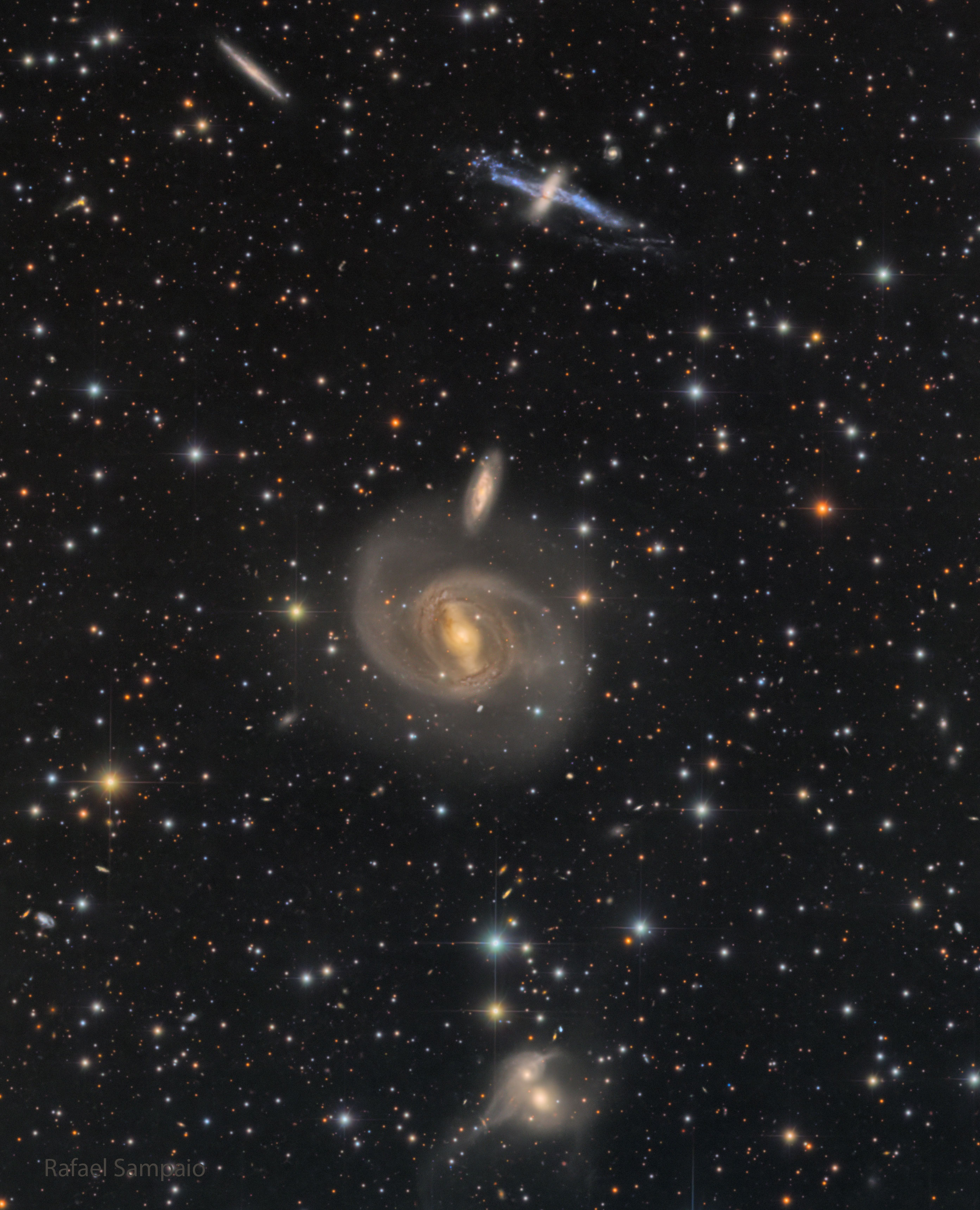
Image: NASA Astronomy Picture of the Day (APOD) · Image Credit & Copyright: Rafael Sampaio · Today's page
Start by doing one thing: scan today's photograph from top to bottom.
You'll count three groups, two fuzzy patches in each. In the top pair, one is crossed by a blue luminous bar—as if someone drew a glowing line across its waist. In the middle pair, the larger one has a bright stellar bar at its center. In the bottom pair, the two nearly overlap, their edges blurring into one smear.
They look like three couples.
But NASA's caption for today's image dismantles that impression in a single sentence: each pair is different. The top pair most likely isn't interacting at all right now; the middle pair looks like mutual tugging, but their relative velocity makes that unlikely; only the bottom pair is truly entangled—by APOD's estimate, in about a billion years they will merge into a single galaxy.
One photograph, three pairs of neighbors, three entirely different fates. And all the naked eye can see is "they're close together."
Close on the sky does not mean related
This point is worth spelling out, because it's the shared trap of nearly every astronomical photograph.
When we look at the sky, we are essentially looking at a projection. Every celestial object is flattened onto a single sphere; all depth information is lost. Two patches of light sitting next to each other might truly be tens of thousands of light-years apart and tearing each other to pieces—or one might be 100 million light-years away and the other 200 million, separated by 100 million light-years of void, just happening to line up along the same sight line.
How do astronomers separate them? By the color of their light.
When a galaxy recedes from us, the light waves it emits are stretched; its spectral lines shift collectively toward the red end—the greater the redshift, the faster the recession, and usually the farther away. Measure the recession velocities of two galaxies individually, and you can judge whether they're truly neighbors. If the velocities differ wildly, it's an illusion; only when they're similar might the two actually be close.
A quick note on a detail that's easy to misread: those catalog numbers in today's image—NGC 4650, NGC 4650A, NGC 4622A, NGC 4622B—the letter suffixes only mean "close to that number on the sky." They do not mean the objects are related. This is a convention from twentieth-century catalog compilation: later surveys found objects the original NGC catalog missed and borrowed the nearest existing number plus a letter. NGC 4650A and NGC 4650 are two completely different galaxies—different morphology, different history—separated by only about 5.6 arcminutes on the sky.
This is perhaps the most useful lesson astronomy teaches ordinary people: proximity does not imply connection.
The top one is a scale for weighing dark matter
Now fix your eyes on the galaxy at the very top of the frame, the one with the blue ring. It's called NGC 4650A, located in the direction of Centaurus, about 130 million light-years from us.
It belongs to a rare class in astronomy: polar-ring galaxies.
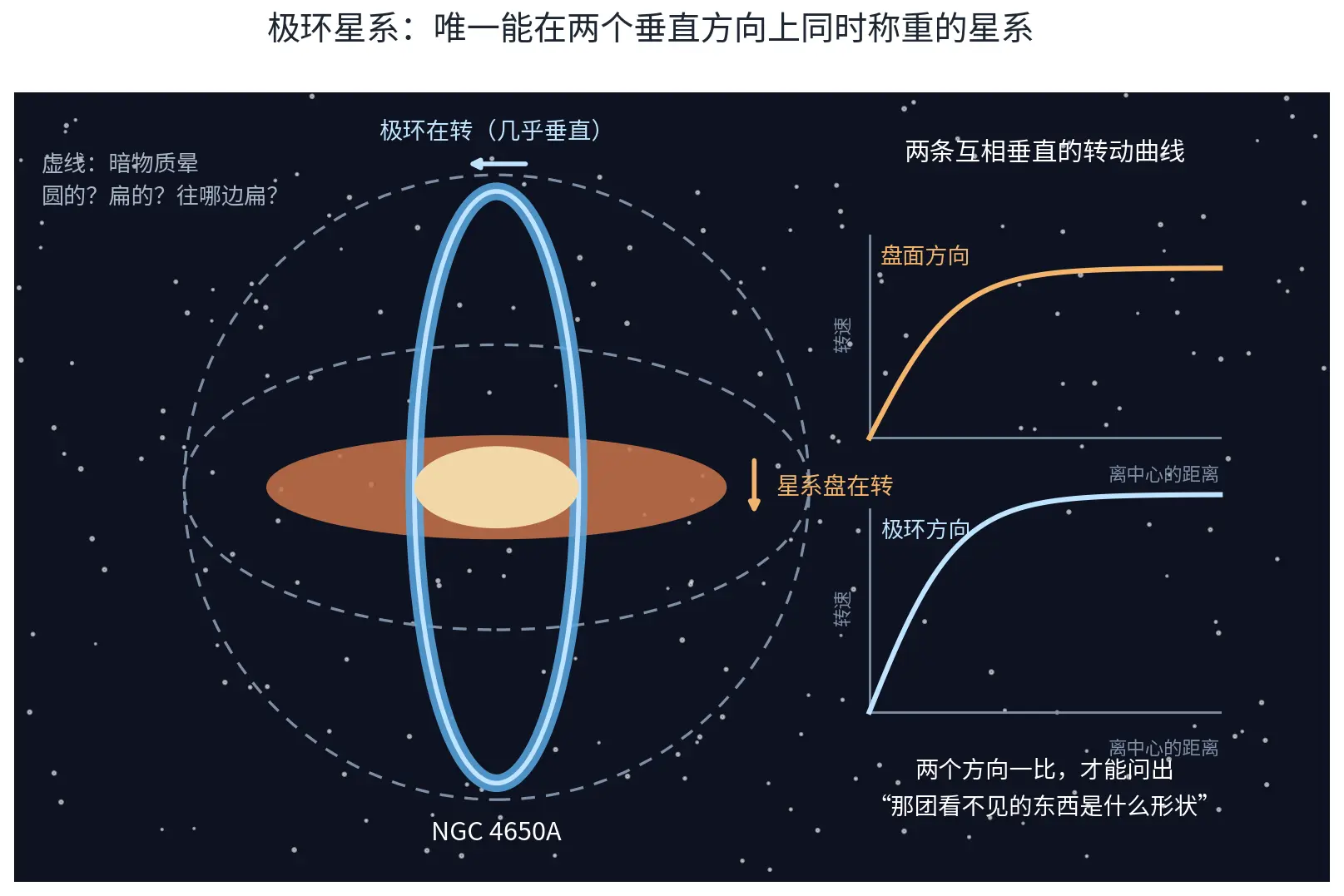
A normal disk galaxy is like a vinyl record—stars and gas all rotating in the same plane. NGC 4650A has two systems, and their planes of rotation are nearly perpendicular: at the center sits a reddish, old lenticular disk; wrapped around it is a ring of gas, dust, and young stars about 60,000 light-years across, oriented almost vertically relative to the disk—like fitting an upright hoop around a plate.
The age difference between the two structures is stark: the central disk stopped forming stars roughly three to five billion years ago, while the stars in the ring are less than a billion years old, the youngest only about six million. On April 27, 1990, a Type Ib supernova (SN 1990I) exploded in this ring—exactly where you'd expect, because massive stars live short lives and exist only in young regions.
So how does a galaxy grow a vertical ring?
One explanation is a major collision: two galaxies smashed together, and material torn from one of them settled into a polar ring. This was the narrative accompanying Hubble's famous 1999 image, and today's APOD uses the same framework. But simulation studies have run the numbers: for a merger to produce a stable polar ring, the impact angle, orbital inclination, and mass ratio must all meet stringent requirements—the success rate is roughly 1%.
The other explanation is slow accretion: this galaxy never collided with anything, but quietly drew in a large stream of gas—oriented in a completely different direction—from a cold filament of the cosmic web, or from a gas-rich neighbor. The gas settled into orbit and formed new stars in place.
The evidence favoring the latter is solid. Researchers measured the chemical composition of the polar disk: its metallicity is only 0.2 times solar, and the gradient is flat—if this material had been flung out of the central galaxy, it should be "dirtier" and should show a gradient. In 2015, the European Southern Observatory's MUSE spectrograph mapped both velocity fields of this galaxy and found two mutually perpendicular rotating disks maintaining independent kinematics all the way to the center. The conclusion leans toward: it was accreted, not produced by a collision.
An honest caveat here: this is not a settled verdict. Work in 2023 based on cosmological simulations found that every polar-ring galaxy produced in the simulations arose from satellite-galaxy interactions; an observational survey the same year revised the occurrence rate of polar-ring structures from the previous estimate of 0.01–0.4% all the way up to about 1.1% (roughly 3% after correcting for projection effects)—far more common than we thought. "Rare freak" is becoming "uncommon but normal."
Why it's a scale
Now for the single most memorable sentence in this article.
We believe the universe contains vast amounts of invisible matter—dark matter—because stars and gas in the outer regions of galaxies rotate too fast to be held by the gravity of visible matter alone. But one question has always been difficult: what shape is that dark-matter halo? Is it spherical, or flattened?
The difficulty is that an ordinary disk galaxy gives you rotation speeds in only one plane. What you measure is the gravitational pull in that plane; you cannot disentangle "how massive the halo is" from "how flattened the halo is"—like pressing a pillow in only one direction and trying to decide whether it's round or flat overall.
Polar-ring galaxies are the sole exception. They give you two rotation curves, and those two curves are perpendicular to each other.
The stars and gas in the disk tell you the gravitational pull in one direction; the gas in the ring tells you the pull in another, perpendicular direction. Compare the two, and whether the dark-matter halo is round or oblate—and in which direction—becomes a measurable question. The literature states it explicitly: polar-ring galaxies are ideal laboratories for studying the three-dimensional shape of a galaxy's gravitational potential, because rotation curves can be measured in two mutually perpendicular planes.
And the result? Here one must be honest, because real science is far more interesting than the pop-science line "scientists measured it."
The only thing everyone agrees on is that NGC 4650A's dark-matter halo is not spherical. As for which direction it's flattened and by how much, the literature is fiercely divided: the classic 1994 work found the dark-matter isodensity surfaces to be quite oblate, with an axis ratio between 0.3 and 0.4, flattened in the same direction as the central disk; a different group in 2003 argued that the elevated rotation speeds of the polar ring can only be explained by a halo flattened along the direction of the polar ring—the exact opposite orientation. Later still, others recovered a nearly spherical result (axis ratio ~0.86), and there is evidence that the halo's shape changes with radius. And then there is yet another camp that argues no dark-matter halo is needed at all—that modified gravity (MOND) naturally reproduces these elevated rotation speeds.
So that unassuming little blue ring at the top of today's photograph actually stands at the center of an unresolved debate.
This is what science actually looks like: not "the answer is X," but "we found a scale that can weigh it, and now we're arguing over the reading."
When two galaxies collide, do stars crash into each other?
Back to the bottom pair—the only two in today's photograph that are truly interacting.
Most people's first reaction: that must be incredibly violent.
The answer is counterintuitive: virtually no two stars will collide.
The reason is scale. Course materials from Ohio State University's astronomy department offer this comparison: the distance between stars is roughly ten million times their own diameter; whereas in a galaxy cluster, the distance between galaxies is only about twenty times their diameter.
Translate that ratio into something you can hold: shrink the Sun to a 1-millimeter grain of sand, and the nearest other grain is ten kilometers away.
Two galaxies colliding is two swarms of such grains—each separated by ten kilometers—passing through one another. They pass through, and nothing hits anything.
But something does collide. Gas does.
The space between stars is terrifyingly empty, but the gas clouds within galaxies are diffuse and contiguous. When two galaxies interpenetrate, gas clouds slam head-on into each other, are compressed, and vast numbers of new stars are born within a few million years—this is called a starburst. The real "violence" in a galaxy collision isn't stars smashing apart; it's gas being squeezed into a millions-of-years-long frenzy of star formation, followed by fuel exhaustion, with fierce galactic winds blowing the remaining gas out.
As for the two galaxies themselves, over hundreds of millions to billions of years they'll be pulled back and forth by gravity, sprout long tidal tails, and ultimately merge into one. What were once two record-like, orderly rotating disks become a scrambled, gas-poor, reddish elliptical galaxy with stars orbiting every which way.
What about us?
At this point there's no avoiding the question: will the Milky Way be hit too?
If what you remember is "in 4.5 billion years the Milky Way will inevitably collide with the Andromeda Galaxy," that statement no longer holds—at least you can no longer say "inevitably."
That number came from 2012 Hubble observations. In June 2025, Nature Astronomy published a paper titled "The collision of the Milky Way and Andromeda is not certain": the authors ran 22 variables through 100,000 Monte Carlo simulations and concluded that over the next ten billion years, there is roughly a 50% probability the two will never merge at all; even if they do, the median timescale is 7.6 billion years from now. Interestingly, the Triangulum Galaxy M33 pushes the merger probability up, while the Large Magellanic Cloud pulls it down—because the LMC's orbit is nearly perpendicular to the Milky Way–Andromeda line, dragging the Milky Way out of its original plane. The final sentence of that paper's abstract: the fate of our Milky Way remains entirely open.
Then in March 2026, the story flipped again. Another team, using the same framework but updated Gaia proper-motion data corrected for systematic biases, recalculated and pushed the merger probability back up to 90%, with a median merger time of about 6.5 billion years—"broadly restoring the classical picture." But they themselves wrote cautiously in the paper: while current measurements favor a high merger probability, the conclusion remains uncertain, spanning 64.7% to 100%. A definitive answer requires proper-motion precision on the order of 2 microarcseconds per year.
In other words, the ultimate fate of our galaxy currently hinges on a precision humans have not yet achieved.
A word on timescales, for perspective: the Sun will render Earth uninhabitable in roughly one billion years and exhaust its fuel in five billion. So whether Andromeda comes or not, this isn't something we need to worry about.
What to look at tonight
First, an honestly disappointing fact: today's galaxies are invisible from the vast majority of China.
They lie in Centaurus at a declination of about −40°43′. From Beijing (latitude 39.9° N), their maximum altitude above the horizon is only about 9.4°; even at 35° N it's just 14.3°. Worse, in mid-August they transit around 3 p.m. local time—by the time it's truly dark, they've long since set. Add in that the targets are around 13th magnitude, and amateur equipment has no hope.
But the night sky has other plans these days.
August 12 (Wednesday) is a new moon—the same day a total solar eclipse sweeps across Iceland and Spain, invisible from China; but that invisible new moon gives the world a gift: from about August 10 to 15, nights are moonless throughout, making this one of the best deep-sky observing windows of the year.
At latitudes 35–40° N in mid-August, here are some "galaxy pairings" worth observing:
- M51, the Whirlpool Galaxy (Canes Venatici)—the best stand-in for today's photograph. It is a pair truly interacting: companion galaxy NGC 5195 is tugging on the main galaxy's spiral arms, and tidal forces are igniting new stars there. Best in the first two hours after dark, in the west-northwest at high altitude—around 20:45 its altitude is still about 44°, but by 22:30 it drops to around 25°—catch it early. Magnitude 8.4, about 31 million light-years away, visible in a small telescope; in dark skies, 10×50 binoculars show a fuzzy blob; a 4- to 6-inch aperture can resolve the two cores; 8 inches or more under sufficiently dark skies is needed to see spiral arms.
- M31, the Andromeda Galaxy (along with M32 and M110)—the other protagonist in that "will they or won't they collide" question. It rises from the northeast, reaching about 30° altitude around 22:00 and 62° by 1 a.m., getting better all month. Magnitude 3.1, 2.5 million light-years away, visible to the naked eye under moderate light pollution, with an apparent diameter roughly six times that of the full Moon. In binoculars, M32 and M110 appear as two "fuzzy stars"—incidentally, M32 itself is very likely a victim tidally stripped by M31, a small-scale merger in progress.
- Stephan's Quintet (Pegasus, HCG 92)—if you have 8 inches or more of aperture and a sufficiently dark night, this is the perfect real-sky teaching tool for today's article. Five galaxies crammed together; four are genuinely colliding; the fifth, NGC 7320, is merely a foreground object aligned along the same line of sight—its recession velocity is about 790 km/s, while the group's is about 6,600 km/s. Same field of view, same appearance of "closeness," physically no relation whatsoever. Nearby NGC 7331 (magnitude 9.5) is visible with a 4-inch scope. The quintet approaches the zenith around 1:20 a.m.—right when an August night is darkest.
To distinguish, in the same field of view, "truly together" from "merely appearing so" with your own eyes—that is the entire point of today's photograph.
If you don't have a telescope at hand, there's something you can do right now: the Galaxy Zoo project on Zooniverse is still running, with its latest batch of images from the Vera C. Rubin Observatory. The judgment you're asked to make is—has this galaxy been disturbed? Are these two merging? It's exactly the same judgment APOD is making today.
Sources: NASA Astronomy Picture of the Day, August 10, 2026; NASA/ESA and European Southern Observatory public materials on NGC 4650A and MUSE; Sackett et al. (1994); Bournaud & Combes (2003); Iodice et al. (2003, 2015); Lüghausen et al. (2013); Khoperskov et al. (2014); Mosenkov et al. (2023); Mieske & Hilker (2003) on Centaurus cluster distances; Sawala et al., Nature Astronomy (2025); Wu et al., The Astrophysical Journal Letters (2026); Ohio State University astronomy course materials on interacting galaxies; NASA Messier catalog pages for M31 and M51; Zooniverse Galaxy Zoo.