
What does a star like our Sun leave behind after it dies? Today's image is the answer, in close-up.
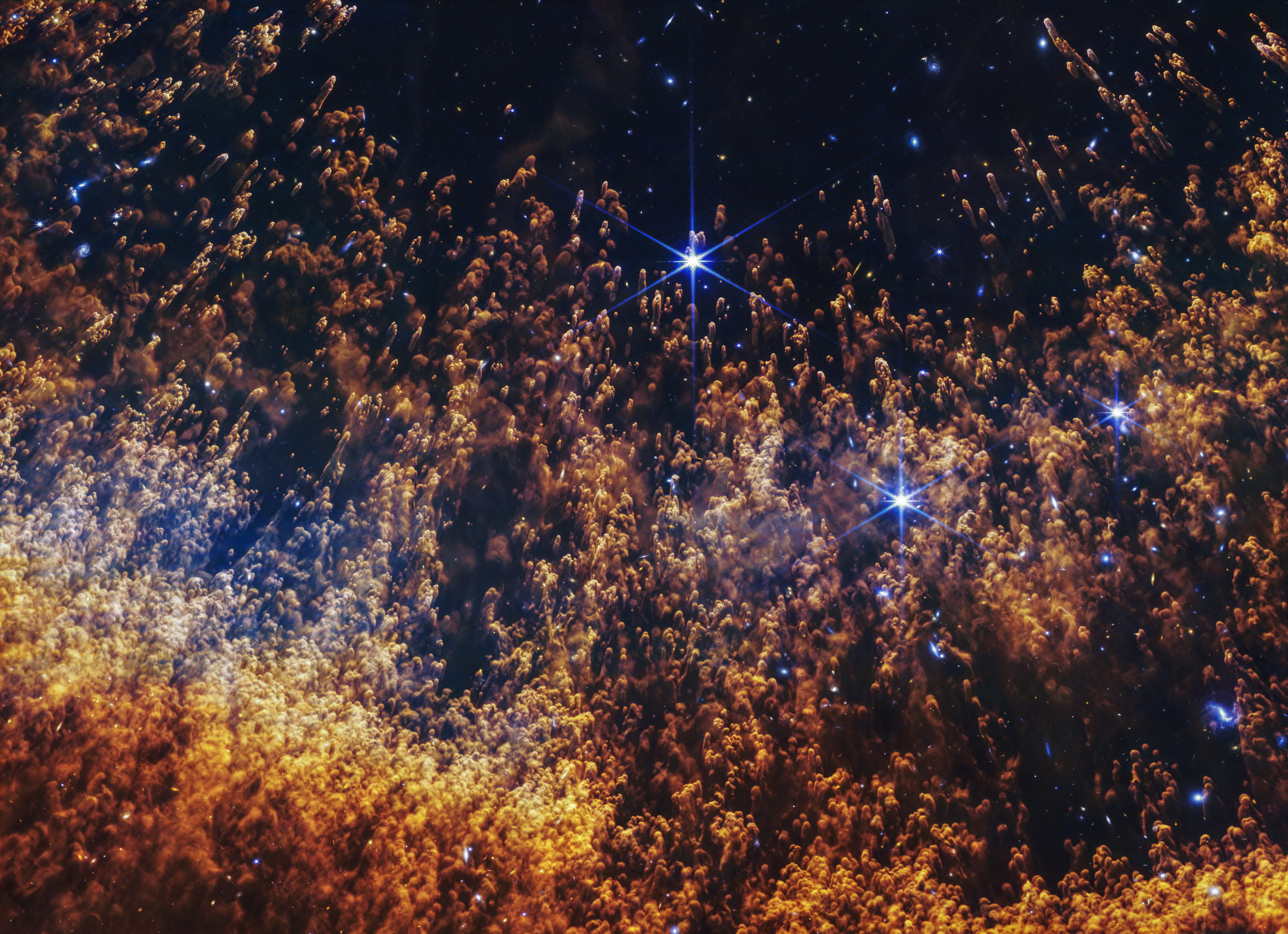
Image: NASA Astronomy Picture of the Day (APOD) · Image: NASA, ESA, CSA, STScI; Image Processing: Alyssa Pagan (STScI) · Today's page
You've probably seen the Helix Nebula before.
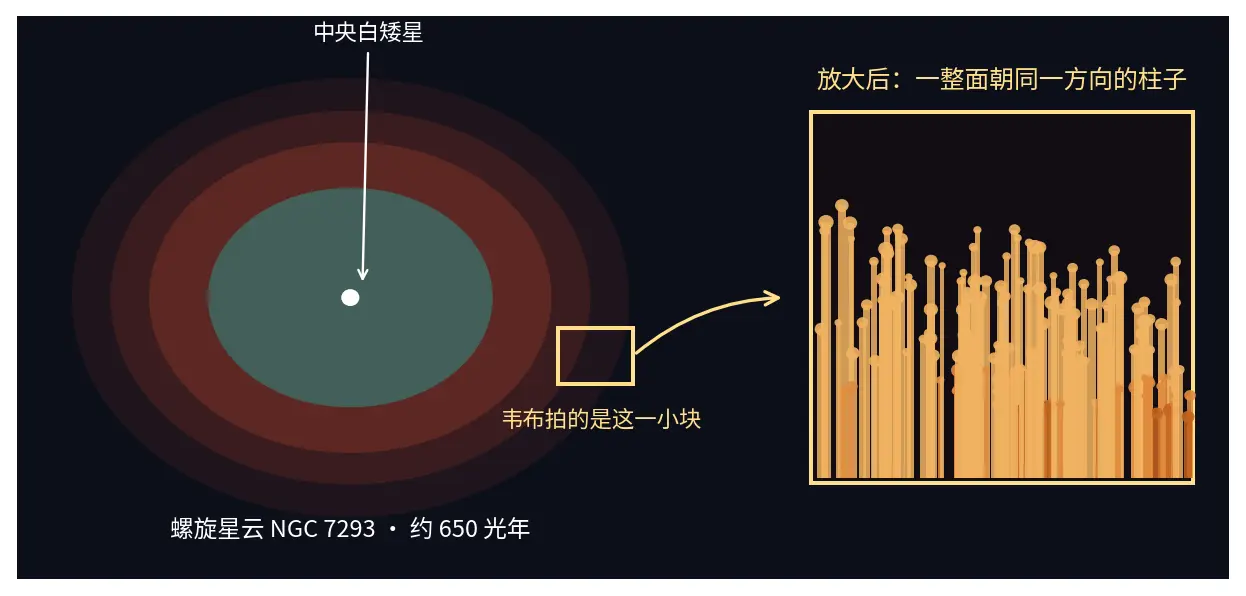
It's one of the most famous faces in astrophotography: a giant eye staring right at you. Red sclera, blue-green iris, usually captioned "the Eye of God." Today's NASA Astronomy Picture of the Day (APOD) doesn't show you that eye again. What it shows you is what a tiny patch of the eye's rim looks like when you zoom in.
Once you zoom in, that soft ring of red disappears. What's left is an entire wall of tadpoles.
The Image
According to NASA's caption, this is a small section of the Helix Nebula, captured by the James Webb Space Telescope's Near-Infrared Camera (NIRCam). Across the bottom of the frame, thousands upon thousands of orange-gold pillars stand upright, all pointing in the same direction, as if someone had blown syrup across a sheet of glass. The pillars at the base are densest and darkest, tending toward deep red; higher up they grow thinner and more golden, and the black of space shows through. A few bright blue stars are scattered among them, bearing Webb's signature six-pointed diffraction spikes.
These pillars have a proper name: cometary knots. They aren't comets—they just look like them: a blunt, rounded head trailing a tail.
Each One Weighs About as Much as Earth
Let's start with scale, because this is the hardest part of this image to believe.
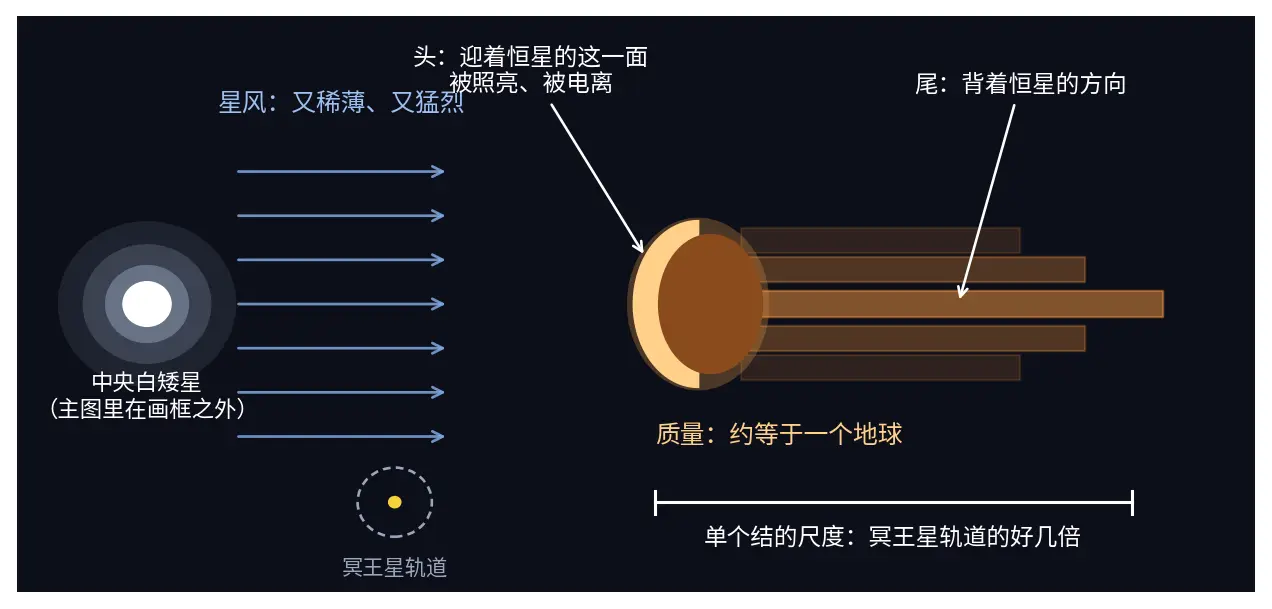
According to the APOD description, each cometary knot has roughly the mass of Earth, yet its physical size is typically several times the diameter of Pluto's orbit.
Put those two numbers together and think about what they mean: an Earth's worth of material spread across a volume several times larger than the entire solar system. What does that give you? Something emptier than any vacuum you could pump in a laboratory.
And yet even this kind of "empty" is still noticeably denser than the surrounding gas—it's precisely that slight excess of density that lets these knots show up as shapes in a photograph. The pillars that look so solid on screen are the "densest" parts of this nebula; and the nebula as a whole is thin beyond imagination.
How to Read This Image
There's a handy rule for cometary knots: the heads point toward the central star; the tails point the other way.
The logic is straightforward. Light from the central star illuminates and ionizes the sunward face of each gas-and-dust clump, turning that face into a bright, crescent-shaped head; the material shielded behind it stretches into a long shadow and wake.
So next time you see an image like this, you can figure out which direction the star lies in—just follow where the heads are looking. In today's image you won't find that star, because Webb photographed the nebula's rim; the central star is off-frame. The APOD text specifically links a wide-field comparison image showing where this Webb frame falls within the full nebula—a small patch on the outer ring.
Where Do They Come From? The Debate Isn't Over
This is the most honest thing about this image: no one fully understands yet.
APOD puts it bluntly—the existence of these knots was not predicted, and their origin remains unclear. Similar structures appear in the Ring Nebula, the Dumbbell Nebula, and NGC 2392, so they're probably a common phenomenon in planetary nebula evolution, only resolvable in the nearest examples.
One current hypothesis invokes a concept from fluid dynamics called the Rayleigh–Taylor instability. The dying central star blows out a thin but extremely violent stellar wind; this "light and fast" wind rams into the "heavy and slow" shell of gas ahead of it.
Here's the key: when a light fluid pushes against a heavy one, the interface can't stay put. It goes unstable, sprouting finger-like protrusions. You've seen the same thing in your kitchen—pour cream into coffee, and the boundary is never a clean line; it's a cluster of tongue-shaped plumes pushing upward. The nebula's scale is trillions of times larger, but the physics is the same.
This Is the Sun's Trailer
The Helix Nebula's formal designation is NGC 7293. It lies in the direction of Aquarius, about 650 light-years away.
650 light-years is a number you can translate: the light you see in this image left the Helix Nebula around 1376 AD—the ninth year of the Hongwu era in the Ming Dynasty. It traveled for six hundred and fifty years before landing on Webb's detectors. Image processing was done by Alyssa Pagan at the Space Telescope Science Institute.
What makes it worth looking at is that it's the nearest example of what a star like our Sun becomes at the end of its life.
The process goes roughly like this: the star exhausts the fuel in its core, swells into a red giant, then sheds its outer layers one by one; the scorching remnant core contracts into a white dwarf, whose ultraviolet radiation lights up the expelled gas. The entire "Eye of God" you see is that discarded overcoat.
According to NASA's educational materials, in a few billion years the Sun will follow the same path. So today's image isn't just someone else's photograph—it's a trailer for the Sun's own final curtain call, screened for you a few billion years in advance.
Practical Info: How to Watch the Night Sky This Month
Aquarius, home of the Helix Nebula, is a late-night constellation in August—it rises in the southeast after dark and climbs higher as midnight approaches. Under the right conditions it's a target worth attempting—but honestly, it's a tough one: large apparent size, low surface brightness, virtually hopeless from a city. To give it a try you need three things: a genuinely dark sky, a pair of binoculars, and a moonless night.
And the best moonless night this month happens to fall eight days from now.
- August 12 (Wednesday): New Moon. This is the darkest window of August's night sky; the nights on either side are also good for deep-sky objects.
- August 12 (Wednesday): A total solar eclipse occurs on the same day. According to paths published by NASA and ESA, the totality track begins in extreme northern Siberia, sweeps near the North Pole, crosses eastern Greenland and western Iceland, traverses the Atlantic, and ends in northern Spain and a small corner of northeastern Portugal; maximum totality lasts about 2 minutes 18 seconds. This will be the first total solar eclipse visible from mainland Europe since 1999. Partial phases will be visible from the rest of Europe, parts of North America, and parts of Africa. It will not be visible from China. To watch via livestream: NASA's official broadcast page nasa.gov/live; for path maps and local times, see NASA's dedicated page Total Solar Eclipse on August 12, 2026 and the NASA SVS global path map.
- Around August 12–13: Perseid meteor shower peak. This year it coincides with the New Moon, making it one of the best viewing opportunities in recent years; watching meteors and hunting deep-sky objects can be part of the same outing on the same night.
Check official pages for exact times; note that many sources list times in U.S. Eastern Time—remember to convert to Beijing Time (U.S. Eastern Daylight Time + 12 hours). NASA also publishes a monthly stargazing guide; the August issue is What's Up: August 2026.
Closing
Around August 12, if you can get away from the city for one night, bring binoculars and look for Aquarius in the southern sky. It's perfectly normal not to see the Helix Nebula—don't be discouraged. Its demands on equipment and sky darkness are genuinely steep.
But that night, the sky will have other things to offer in return: a clean, moonless darkness, plus a Perseid meteor shower under excellent conditions.
And if someday you do recognize that "eye"—in a photograph, or through a telescope—take a moment to think about what you're looking at: a star's discarded overcoat, and what the Sun will look like six billion years from now.
Sources: NASA Astronomy Picture of the Day, August 4 and August 3, 2026 (science.nasa.gov mirror pages); NASA "Total Solar Eclipse on August 12, 2026" dedicated page; NASA Scientific Visualization Studio (SVS) global path map; ESA global eclipse map; National Solar Observatory (NSO) eclipse map; NASA "What's Up: August 2026"; O'Dell C. R. et al. (The Astronomical Journal, 111, 1630, 1996)