
August 4, International Owl Awareness Day. Bing picked an owl that doesn't live in trees.

Image: Bing Daily Wallpaper · Florida Burrowing Owlet, Cape Coral, Florida, USA (© mlorenzphotography/Getty Images), original
Open Bing today and a little owl greets you on the homepage.
It isn't perched on a bare branch in the dark of night, eyes half-shut in theatrical mystery. It's just standing on the ground. Bing's Chinese title for this image is "Hoo hoo, awesome!" The UK edition is more blunt—roughly "Hoo-hoo-ray." This little fellow is a Florida Burrowing Owl, a juvenile, photographed in Cape Coral, Florida, USA.
An owl that walks
There are around two hundred species of owl, and nearly all follow the same playbook: go out at night, hide in a tree hole by day. The Burrowing Owl rewrote both rules.
It lives underground. Not in a rock crevice, not in a gap beneath tree roots—in a proper tunnel, angled downward for over a meter, turning a corner at the end and opening into a bedroom. The Florida subspecies (Athene cunicularia floridana) digs its own; the western U.S. subspecies is lazier, moving into abandoned prairie dog and ground squirrel burrows—ready-made real estate.
Why go underground? The answer is buried in its homeland. The Burrowing Owl's native habitat is the dry prairies of central Florida—flat, open, and almost treeless. For a bird barely 20 centimeters tall and weighing a few ounces, no trees means no tree holes; and without tree holes, the only safe darkness left is underfoot. So it digs.
It also shows up regularly in broad daylight. Not because it doesn't mind the light, but because the small insects and lizards on the ground are most active during the day. That's why you can get today's photo—an owl, photographed head-on in full sunshine. Try that with an Eagle Owl and you'd mostly get a dark blur.
One city, two accidents
Cape Coral today has more Burrowing Owls than anywhere else in Florida: over a thousand breeding pairs, more than 2,500 burrows across the city. That achievement is the product of a complete accident.
In the 1950s, developers bought a hundred square miles of land on Florida's southwest coast to build a "City of Canals." The first thing they did was flatten the terrain—clearing vast stretches of flat, open, treeless ground—then waited to sell lots. Houses sold slowly. The empty lots stayed empty for years.
For Burrowing Owls, this was a godsend—home delivered from above. They migrated in from central Florida, where development had all but erased their habitat, and settled into the unbuilt parcels.
Then the script flipped. Cape Coral is now one of the fastest-growing cities in America, and those empty lots are sprouting houses one by one. The owls have been squeezed onto sidewalk edges, parking-lot planting strips, and road medians—easier to photograph, harder to live. Cars, cats, dogs, and pedestrians who cave in burrow entrances with a single step. In 2016, Florida upgraded the species from "Species of Special Concern" to "State-Threatened."
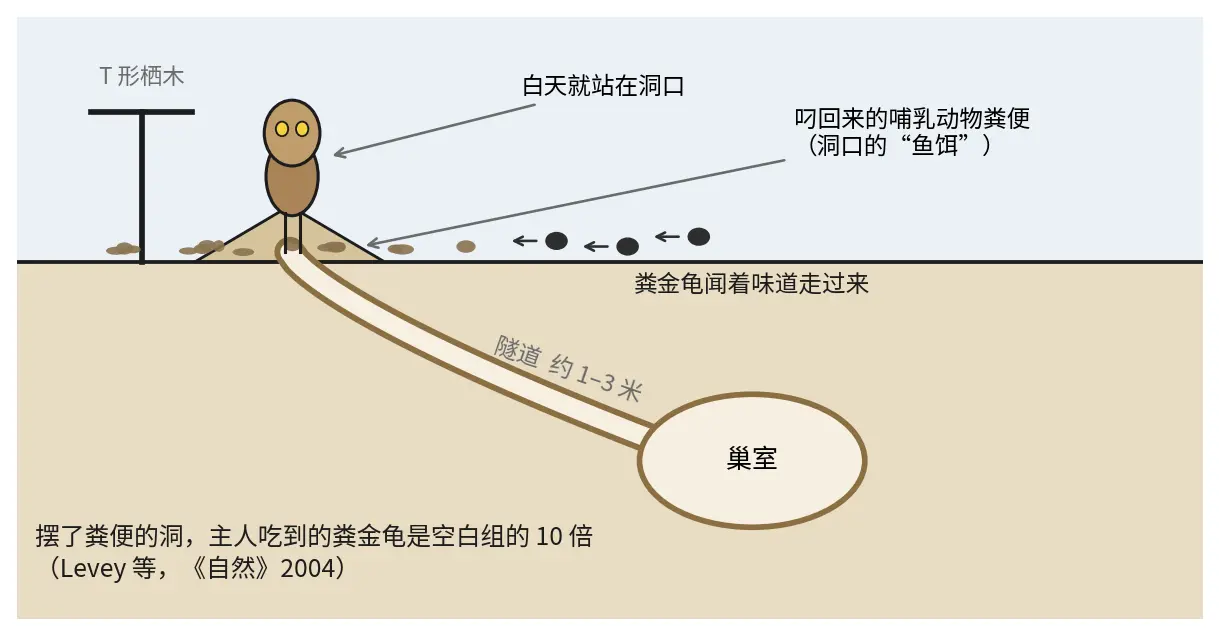
What's interesting is how locals responded: dig a hole in your own yard. The technique is called a "starter burrow"—dig an angled pit, stick a T-shaped perch beside it, and wait. Wait for a passing owl to fancy your backyard and extend the tunnel downward on its own. Local wildlife organizations say residents have dug around two hundred of these over the years. Volunteers mark active burrows one by one with PVC stakes, reminding people not to step on them.
Under Florida regulations, no ground may be disturbed within ten feet of a burrow entrance, expanding to thirty-three feet during breeding season. In other words, in Cape Coral you can build a house next door to an owl's home, but not on top of it.
It baited its own doorstep
Now for the one thing this article really wants you to remember.
In 2004, Douglas Levey of the University of Florida and colleagues published a one-page paper in Nature. They had noticed something long dismissed as mere slovenliness: Burrowing Owls collect pieces of nearby mammal dung—from cattle, horses, dogs, cats—carrying them back piece by piece to spread around and inside their burrow entrances.
The previous assumption was that the smell served as camouflage for the chicks. Levey wanted to test a different hypothesis. They cleared all dung from ten burrow entrances, then placed fresh cow dung back at half of them, leaving the other half bare. Four days later, they collected food remains and regurgitated pellets from the burrow entrances and counted the beetle shells inside.
The result: owls at dung-baited burrows consumed ten times more dung beetles than the control group.
It wasn't decorating. It was fishing. Set the bait, stand at the entrance, and let the beetles walk over on their own, following the scent. Levey himself put it plainly: he didn't think the owls knew what they were doing—it was more likely a habit that happened to work and was then preserved by natural selection.
Subsequent research complicated the picture: the dung may simultaneously serve to signal "this burrow is occupied," and various explanations remain unsettled. But "burrows with dung yield ten times more beetles"—that was demonstrated through a controlled field experiment.
A bird weighing less than half a pound got into Nature for tool use. And its tool was a lump of cow dung.
Why this owl today
August 4 is International Owl Awareness Day. Bing barely hid the clue this time: the French edition's search redirect for this image explicitly says "International Owl Awareness Day," and the Japanese title flatly states "Today is International Owl Day."
The occasion is promoted by several owl and raptor conservation organizations, and its point isn't "owls are cute"—it's a set of unflattering numbers: according to assessments by the American Bird Conservancy and Partners in Flight, roughly one-third of North America's native owl species are in decline. The reasons are prosaic—habitat loss, rodenticides entering the food chain, headlights and glass curtain walls blocking flight paths.

China has its cousin
The Burrowing Owl lives only in the Americas; you won't find it in China. But its genus, Athene, does have a member in China—and a widespread one at that: the Little Owl (Athene noctua).
Same genus, uncannily similar temperament. About 20-odd centimeters long, short and stocky, no ear tufts, a pair of bright yellow eyes staring straight at you. It's a resident bird, recorded from Xinjiang, Inner Mongolia, and the Northeast to Hebei, Shanxi, Shaanxi, Shandong, and northern Jiangsu. The Chinese Academy of Sciences' Institute of Zoology describes its habits as "partially diurnal"—most active at dawn and dusk, but often visible during the day. It likes to perch on fences, wires, and the tops of utility poles; when nervous it bobs its head and swivels its body; its legs are longer than most owls', and when chasing prey it runs across the ground on two feet. It is a Class II National Key Protected Wild Animal in China.
So this little Florida owl has an almost identical relative in northern China.
If you live in northern China, try walking along field edges or village outskirts around dusk over the next few days—don't just scan the treetops. Look at the tops of utility poles and fence posts for those "squat little lumps." If you spot one that bobs its head, keep your distance and watch quietly. That's the Burrowing Owl's cousin, clocking in for its evening shift.
Sources: Bing Daily Wallpaper zh-CN/de-DE/en-GB/fr-FR/ja-JP metadata, Levey D. J. et al. "Use of dung as a tool by burrowing owls" (Nature, 2004), Nature News, Science, Science News, Cape Coral Friends of Wildlife, City of Cape Coral "Burrowing Owls FAQ," Cape Coral Wildlife Trust, National Wildlife Federation National Wildlife, American Eagle Foundation, International Owl Center, Chinese Academy of Sciences Institute of Zoology National Animal Specimen Resources Sharing Platform, Chinese National Geography, Wikipedia