
One gesture, two hands, a thirty-five-year age gap. And the real starting point of the story is a family rule about tools.
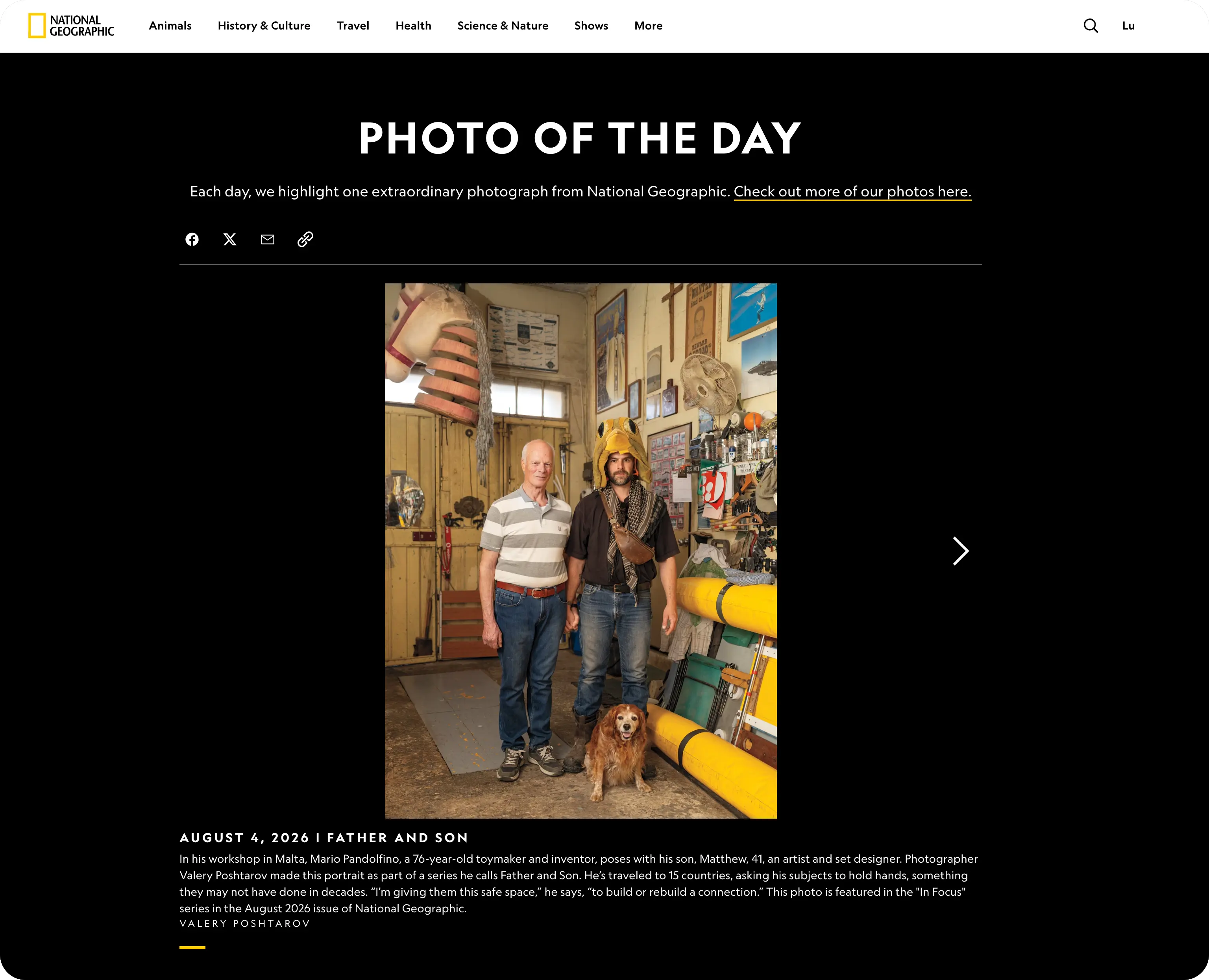
Image: National Geographic Photo of the Day · Photography by Valery Poshtarov · Original page.
National Geographic's Photo of the Day for August 4 isn't a landscape or an animal—it's two men standing in their family workshop.
The one on the left wears a grey-and-white striped polo shirt, jeans, and a brown belt; his hair has gone white. The one on the right is dressed all in black, a checked scarf looped around his neck, a leather hip bag slung across his body, and on his head… a massive yellow bird head, pushed back to reveal his face and beard. At their feet sits a golden-red dog, tongue out, looking straight at the camera.
Their hands are clasped together in the middle.
On the left is Mario Pandolfino, 76, toymaker and inventor. On the right is his son Matthew, 41, artist and set designer. The location is Malta. The photo's title is simply Father and Son.
Look at the background first—that's the family's real introduction
More than half the information in this photo is in the background.
Upper left, a huge wooden horse head hangs from the ceiling—pale-colored, fitted with red reins and a grey-white mane. Behind it is a yellow old wooden door. The wall is crammed with things: a crucifix, a "WANTED · dead or alive" poster, pinups of warplanes and spaceships, a vintage electric fan, a whole row of glass jars filled with hardware, a pile of pliers and wrenches, and a corkboard pinned with notes. On the floor to the right, coils of bright yellow inflatable boat are stacked in loops.
This isn't a "workshop." It's one man's decades-long sediment layer of craft.
And that yellow bird head—that's the set designer's job site.
A family rule that would make most parents wince
There's an excellent piece of supporting evidence about this father and son: in February 2016, FIRST magazine, published by Malta's The Malta Independent, ran a profile by Albert Delia on a then much younger Matthew Pandolfino.
The article opens with a frank admission: the journalist had expected to write about a "young blacksmith," only to find the subject didn't fit that frame at all. Friends call him "Pan." The reporter describes him as a cross between Leonardo da Vinci and MacGyver from MacGyver, with a dash of elf and pirate thrown in.
His workshop sits at the end of a dirt road outside the village of Żebbuġ, surrounded by fields. The article says the place itself resembles an antique shop, organized by what the reporter calls the strangest yet most methodical storage system he'd ever seen: one shelf for brass instruments, another for high-voltage equipment, below that reclaimed metal parts and metal light fixtures, and so on down. During the interview, Matthew sat in a steel rocking chair welded together from dismantled railings, balcony components, and a short length of I-beam. Behind him stood an unfinished large iron seahorse, made from metal offcuts riddled with rivet holes.
The most crucial passage in the interview is where he explains where his creativity comes from.
He says his parents lit the spark. And what his parents did, in the article's own words, would unsettle most parents today: their reasoning was that rather than forbidding a child from touching tools to prevent injury, it was better to do the opposite—teach him properly how to use them, which actually made injury less likely.
So the tools were never put away. As children, Matthew and his brother made their own toys: whatever they saw on TV that they liked, they'd replicate it by hand—not just for themselves, but for the neighborhood kids too.
He later studied fine art at Darlington College of Arts in England, specializing in kinetic sculpture, and earned a formal degree. But in that interview he's very clear: the most important learning experiences came from what his parents taught him and what he figured out on his own.
A toymaker's son who made his own toys as a child grew up to become an artist who builds kinetic sculptures. That massive yellow bird head in the National Geographic photo now has a context—Matthew's line about how "today you might be sewing costumes for a play, tomorrow you're building a giant fiberglass cat" describes exactly this way of living.
That fiberglass cat, by the way, actually exists.
Two things you can go and see
If you ever find yourself in Malta, Matthew Pandolfino has two works sitting out in public, no ticket required.
One is that cat. It sits atop the public restroom roof at Independence Garden on Tower Road in Sliema. As he explained in 2016, the cat was originally meant to be a canvas he left for others—he hoped other artists would come and paint, spray, and scrawl on it, turning it into a work perpetually being rewritten. A decade on, hardly anyone has touched it, which he finds rather disappointing.
The other is bigger. In 2016, the Maltese government held a public-vote public art competition; six artists' proposals were selected, and Matthew was among them. His piece is a kinetic sculpture called Dgħajsa tar-Riħ (Maltese for "Wind Boat"): a traditional Maltese ferry boat, the dgħajsa tal-pass, merged with a Zeppelin airship—half boat, half airship.
According to 2019 reports by Maltese television and MaltaToday, the finished work is a nine-meter-long, three-ton metal skeleton, built on and off over roughly three years at J. Lautier's metalwork shop in Qormi. Its "kinetic" element consists of several sets of blades that rotate in the wind, giving it the appearance of flight. The piece was ultimately installed at Dock No. 1 in Bormla (English name: Cospicua), near Birgu Bay.
He chose this subject for a reason: during British rule, the waters off Bormla were once crowded with thousands of these ferry boats, carrying people and cargo—the true everyday transport of this port city. He said he hoped the piece would eventually become a local landmark, and an interactive one at that.
A boy who was allowed to pick up tools from a young age grew up to weld an entire harbor's memory into a three-ton sculpture. That thread is what makes this photograph most worth following to the end.
The hand that makes people a little uncomfortable
Now for the other half: why this photograph exists.
The photographer, Valery Poshtarov, is Bulgarian, born in 1986. His father is an artist; his mother is a poet. He first studied at the National School of Fine Arts in Varna, then went to Paris-Sorbonne to study visual arts.
The project's starting point is deeply personal. He has two sons of his own. One day, walking them to school and still holding their hands, he suddenly realized something very plain: this gesture has an expiration date. One day they won't need him to hold on anymore.
So he started with his own family: he had his 95-year-old grandfather hold hands with his father, and took a photograph.
That image just sat on his hard drive. What turned it into a project was a later commission—a couple came to him; their only son had died a few months earlier, and the father asked him to take a portrait of himself alongside his son's photograph. Poshtarov took that commission as a sign: this shouldn't remain just his own family matter.
From then on, he began asking pairs of fathers and sons to stand before his camera and hold hands.
Why this gesture is so hard
The project's rule is simple to the point of being blunt: two adult males are asked to hold hands once.
That's also where the difficulty lies. By his own account, for many of these fathers and sons, the moment in front of his camera is the first time they've held hands in years—sometimes decades. That instant is often accompanied by hesitation, even resistance. One quote of his gets repeated often: from the moment we let go of our father's hand to the moment we find the courage to take it again, decades pass.
He emphasizes that the project's center of gravity is not the photograph. The photograph is merely a witness to the gesture. In National Geographic's caption, he says what he offers these people is "a safe space" to establish, or re-establish, a connection.
The effort he puts in is substantial. According to Bulgarian National Radio, to get a single pair of fathers and sons in front of his lens, he often has to speak to hundreds of people first. By the end, entire communities get drawn in—someone tells him their son is abroad, then picks up the phone on the spot; someone else says the neighbors have a father and son, maybe go ask them. Some never agree to hold hands.
On his website's homepage, he has placed a quote from Michelangelo: to touch is to give life.
Sixteen countries, and still growing
The project is now considerable in scale.
National Geographic's caption says he has visited 15 countries; the photographer's own website currently lists 16, alphabetically: Albania, Armenia, Brazil, Bulgaria, France, Georgia, Greece, Italy, Malta, Montenegro, North Macedonia, San Marino, Serbia, Slovakia, Switzerland, and Turkey. The two numbers don't match, most likely because the project is still growing—today's photo from Malta is itself a newly added stop.
In 2024, Father and Son won first place in the Portrait category of the Professional competition at the Sony World Photography Awards. The Bulgarian portion of the project received support from the Bulgarian National Culture Fund; the Georgian portion was funded by the European Union. He has also published a photobook of the same name; the first edition contains nearly 200 photographs from 14 countries.
On his website there's a section called "Step Forward as an Ambassador," openly seeking people willing to bring the project to their own country. In other words, where the project goes next theoretically depends on who speaks up.
The thing you can do today
This photograph has one advantage: what it asks of you costs nothing.
What happened in that Maltese workshop comes down to just two steps. The first step was taken decades ago—a pair of parents decided to hand their child the tools instead of locking them away. The second step happened on the day of the shoot—a 41-year-old son and a 76-year-old father, at a stranger's request, held hands once more.
The first step is worth thinking about today if you have children at home: that screwdriver, that pocketknife, that sewing machine—do you put it in a drawer, or spend twenty minutes teaching them how to hold it? The second step is for everyone: how old were you the last time you held your father's hand?
If both steps feel too far away, there's an even lighter version—if you happen to pass Tower Road in Sliema, Malta, today, remember to look up at the roof of that public restroom. There's a cat up there waiting for someone to give it color. It's been waiting for ten years.
Sources: National Geographic Father and Son caption (August 4, 2026, and the August 2026 "In Focus" column), Valery Poshtarov's official website project page and "Step Forward as an Ambassador" page, Sony World Photography Awards 2024 official winners list (World Photography Organisation / Sony Europe press center), LensCulture and Artdoc Photography Magazine features on the project, Radio Free Europe/Radio Liberty (RFE/RL) and Bulgarian National Radio interviews with Poshtarov, Osservatorio Balcani Caucaso Transeuropa interview, The Malta Independent FIRST magazine profile of Matthew Pandolfino by Albert Delia (February 17, 2016), TVMnews.mt and MaltaToday 2019 coverage of Dgħajsa tar-Riħ.