
One month old, and their mother has already gone back to sea. They must learn, in a rock pool, a matter of life and death.
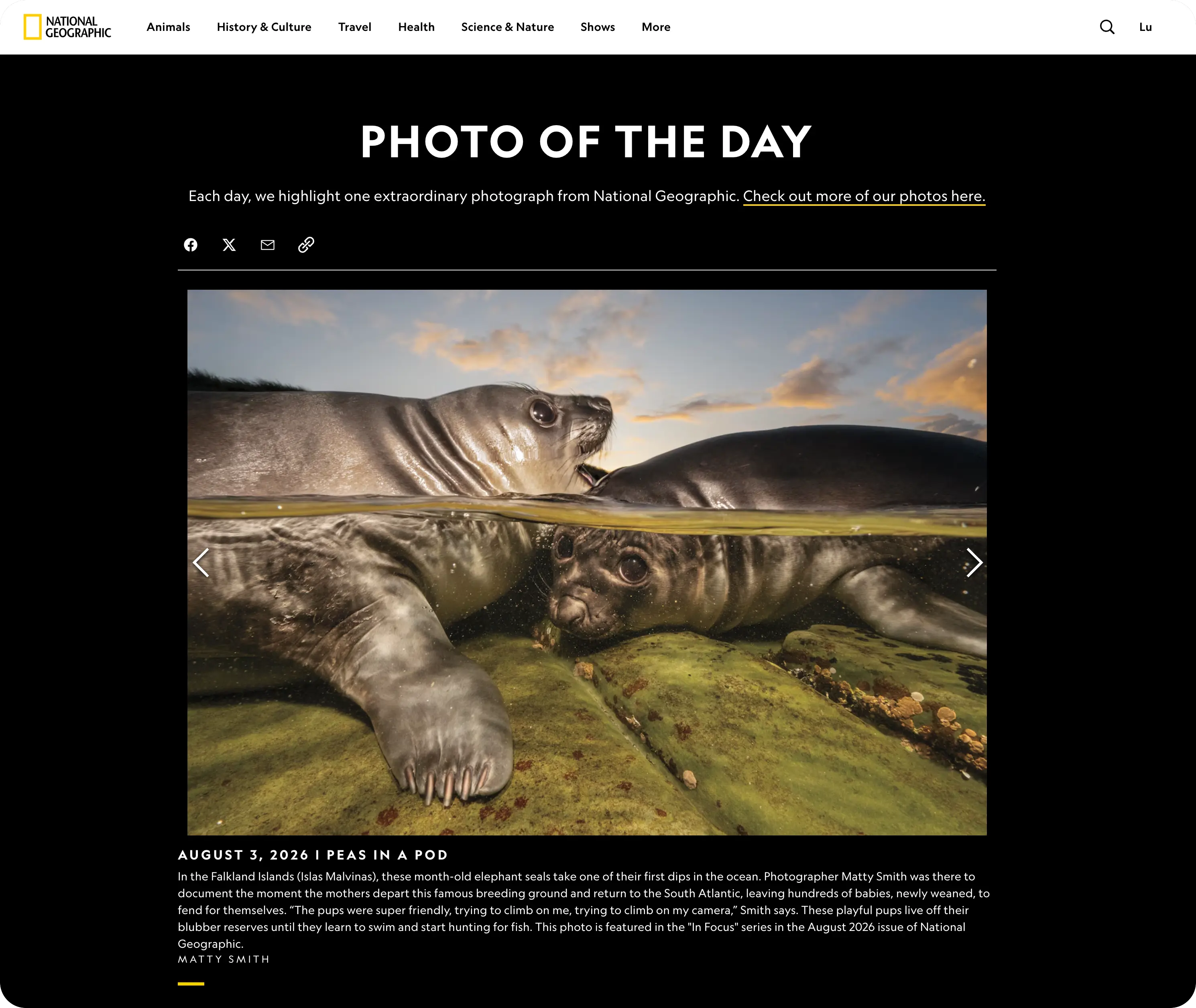
Photo: National Geographic Photo of the Day · Photography by Matty Smith · Original page.
National Geographic's Photo of the Day for August 3 is a picture sliced in two by the waterline.
In the upper half, the sky burns orange, clouds edged by the setting sun; a silvery-grey pup lies on its side in the shallows, neck arched, mouth slightly open, facing the direction of its companion. The lower half is the underwater world: another pup lifts its eyes, staring straight into the lens, the whites barely visible—all black pupil. One of its foreflippers rests on an algae-covered rock, five digits tipped with small claws—and you suddenly realize that is the shape of a hand.
These are two southern elephant seal pups, one month old. The location is Sea Lion Island, off the southeastern corner of the Falkland Islands (known to Argentina as the Malvinas), in a shallow tidal rock pool. National Geographic titled this photograph Peas in a Pod—two peas from the same shell.
But the most important piece of information in this photograph isn't actually in the frame: at the moment the shutter fired, their mother was no longer on this island.
A nursing period that lasts just three weeks
The way elephant seals do motherhood is among the most extreme in the animal kingdom.
According to Falklands Conservation, the breeding season on Sea Lion Island begins around the second week of September: adult bull elephant seals haul out first, fighting and carving up territories; cows arrive roughly a week later, clustering into harems. Pupping peaks in early October, with an average of 500 to 550 pups born on the island each year.
For the next 23 days, the mother does not enter the sea, does not eat—she does only one thing: converts her body's reserves into milk and feeds it to her pup. Elephant seal milk has an astonishingly high fat content; the result is that pup weight quadruples in those three weeks. For comparison: a human infant takes roughly a full year to triple its birth weight.
Around day 23, the mother mates with a bull, then turns and heads back into the South Atlantic to replenish her depleted body. She will not look back, and she will not tend to this pup again.
From that moment, the youngster has a new name: weaner. It has never been in the water, has never eaten a single thing it found on its own—and within weeks, it must learn both.
A knee-deep swimming pool
The problem is this: an elephant seal must dive to eat; to dive, it must first learn to swim. And learning to swim out in the open Southern Ocean is far too risky.
So the weaners find an alternative—shallow rock pools in the intertidal zone.
These are nature's kiddie pools: shallow enough that the pups can prop themselves up at any time, yet deep enough to let them experience what "floating" feels like. In his award statement, photographer Matty Smith wrote that he watched dozens of pups clambering over one another in Sea Lion Island's rock pools, clumsily learning to swim. In National Geographic's caption, he also mentioned that the pups show no wariness of humans and will try to climb onto him—and onto his camera.
What's interesting is the timing of these swims. Weaners spend most of the day hauled out onshore—they use 97% of their time on land lying perfectly still, because lying still lowers their metabolic rate and conserves fuel. The real swimming sessions are concentrated around dusk and dawn.
So the blazing sky in this photograph is not merely good light chosen by a photographer. It is these pups' own schedule. You see them in the water at this moment precisely because this is the only moment they go in.
A fuel tank on countdown
This swimming lesson has a deadline, and it's a hard one.
The time ashore after weaning is technically called the "post-weaning fast." The name is literal: not a single bite. Southern elephant seal pups remain near shore for 21 to 66 days, surviving entirely on the layer of blubber their mother left them—and during this period, they lose more than 30% of their weaning mass.
In other words, that layer of fat is three things at once: fuel, an insulating wetsuit for diving, and a countdown timer. Heavier pups can afford a few more days ashore, a few more practice sessions; lighter ones must head to sea earlier, gambling that they've learned enough. Researchers believe the decision of when to leave shore is essentially a trade-off—stay and get more practice, but burn more fuel; leave early while reserves remain, but with less skill.
And first-year mortality at sea, across different populations, ranges from 30 to 50 percent. Some studies put the figure even higher.
Someone is waiting outside the rock pool
There is one more thing this gentle photograph does not say.
Sea Lion Island is the only place in the Falklands where orca pods patrol on a regular basis. According to the Marine Mammal Protected Areas Task Force (IMMA), orcas are present in these waters primarily from September through April, the same family groups returning year after year for decades. The Elephant Seal Research Group (ESRG), using shore-based observation and drones since 2013, has built a photo-identification catalog of 45 living individuals, 15 of which are residents.
What the orcas prey on includes breeding female elephant seals, molting adults, and—weaners.
At another southern elephant seal breeding site, subantarctic Macquarie Island, a study collating sighting records from 1986 to 2015 found that 79% of identifiable nearshore prey taken by orcas were pinnipeds; and of observed nearshore predation events, weaned southern elephant seal pups alone accounted for more than a quarter. The seasonal peak of orca presence is November to December—exactly when weaners begin dispersing from shore.
The shallow rock pool is "the safest stretch of sea" precisely because orcas are too large to enter. But Sea Lion Island's pool has a narrow opening to the open ocean, and that narrow opening is not a secret kept only by seal pups.
In ESRG's records there is a female orca called Puma. According to local observation logs, since 2004 she has been repeatedly documented threading through that narrow entrance into the shallow pool to hunt elephant seal pups—only a handful of orcas on the island have mastered this technique. She is also teaching the skill to her offspring. The island's lodge tells guests that the best window to witness this is mid-November to mid-December, often at first light.
So the two pups in this photograph are practicing during the one window of their lives when the water is shallow enough to be relatively safe. Once they swim out of this pool, that line of defense is gone.
What they will become
It's worth adding what these two little creatures, floundering in knee-deep water, will one day turn into.
An adult male southern elephant seal can exceed 4 meters in length and weigh up to 3.5 tonnes—roughly two and a half small cars. They are the deepest divers of all seals: routine foraging takes them to 400–800 meters for 20 to 30 minutes at a stretch; the deepest recorded dive was a bull that reached 2,388 meters—stand the Shanghai Tower on end and it wouldn't reach a third of that depth. They can hold their breath for two hours by suppressing heart rate to extreme lows and shunting blood flow almost exclusively to the heart and brain.
In other words, the pup in this photograph lifting its eyes to the lens—if it survives—will become a biological machine capable of diving two kilometers. And right now, it is learning how not to roll over in half a meter of water.
How this photograph was made
Matty Smith is an Australian underwater photographer. This "half above, half below" split composition relies on a custom-made dome port of his own design—it cuts the water surface cleanly, rendering both worlds sharp simultaneously.
By his own account, he traveled to Sea Lion Island specifically for this moment. On his very first evening the sky caught fire; he pulled on a drysuit and plunged in, capturing a few frames before the light died. Looking back afterward, that was the single most critical instant of the entire long journey. His gear specs are public: Nikon Z9 with a 14–30mm f/4 lens, Aquatica housing, two Ikelite DS230 strobes, f/16, 1/60 sec, ISO 200. The jury chair, marine ecologist Alex Mustard, singled out exactly this: using a homemade dome port to achieve the split perspective while balancing strobe light on the pups' fur with the sunset behind them.
One of those "few frames" won the overall title at the 2026 Underwater Photographer of the Year awards in February, under the title Rockpool Rookies, chosen from 7,934 entries submitted from 28 countries. Today's National Geographic image is by the same photographer, from the same rock pool; comparing the two descriptions they are remarkably similar (the same tri-part composition, one pup facing the other with mouth open, the underwater pup gazing at the lens), but National Geographic did not assign a title to the work, so that is where we'll leave it.
In his comments, Mustard added a piece of history: elephant seals were once hunted to the brink of extinction; their rendered blubber was used to fuel lamps and to make margarine. Today Sea Lion Island is a national nature reserve; ESRG has been conducting long-term research here since 1995—this year marks their 31st season—tagging nearly every cohort of newborn pups. According to their published estimates, the population between 1995 and 2009 was broadly stable, averaging around 1,890 individuals aged one year and older.
A photograph that makes you want to say "how cute" has behind it a curve that burned its way back from the age of whale-oil lamps.
If you want to go see them
Elephant seal season in the Falkland Islands runs through the Southern Hemisphere's spring and summer, and the 2026 season is about to begin:
- Around the second week of September: adult bulls begin hauling out to claim territories; cows arrive roughly a week later
- Early to mid-October: peak pupping; Sea Lion Island hosts more than 2,000 elephant seals at the height of the breeding season
- Mid-November to mid-December: weaners practice swimming in the rock pools; also the period of peak orca activity, with early morning offering the best chances
- Late November onward: most adult bulls finish molting and leave the island
(Dates above are Southern Hemisphere seasons; the Falkland Islands are 11 hours behind Beijing.) Sea Lion Island has a single lodge with fewer than 20 beds; according to the owners, guests commonly book a year or two in advance.
If flying halfway around the globe isn't in the plan, there are other options: ESRG has published their Sea Lion Island orca photo-ID catalog on their website (eleseal.org)—you can study what Puma looks like on your screen; the notch in her dorsal fin is her ID card. The full gallery of 2026 Underwater Photographer of the Year winners is also available on their official site.
And if you happen to be on the U.S. West Coast some winter, there's a closer alternative: northern elephant seals haul out each winter at Point Reyes and Piedras Blancas in California to give birth, both with official viewing areas and boardwalks. The National Park Service publishes weekly seal counts—including how many weaners are still on the beach, learning to swim.
Those pups on the sand are doing the same thing as the two in this photograph: mother is gone, the ocean is vast—first, learn to float.
Sources: National Geographic Peas in a Pod caption (August 3, 2026, and August 2026 "In Focus" feature), Underwater Photographer of the Year 2026 winners announcement and photographer's statement, CNN and DIVE Magazine coverage of UPY 2026, Falklands Conservation Sea Lion Island factsheet, Elephant Seal Research Group (eleseal.org) long-term monitoring data, Marine Mammal Protected Areas Task Force (Sea Lion Islands Group IMMA) page, Sea Lion Island Lodge wildlife guide, Society for Marine Mammalogy / pinnipeds.org southern elephant seal species page, Conservation Physiology paper on cardiorespiratory physiology of weaned southern elephant seals, Journal of Physiology & Behaviour study on behavioral development during the post-weaning fast, Macquarie Island orca ecology research (1986–2015 sighting record analysis), Discover Wildlife southern elephant seal diving data, U.S. National Park Service Point Reyes elephant seal weekly monitoring reports.