

Image: NASA Astronomy Picture of the Day (APOD) · Image Credit & Copyright: Christa Harbig · Page for the day. Credit includes Copyright; photo copyright belongs to the photographer. This article provides only a linked reference.
Open NASA's Astronomy Picture of the Day today and your first reaction will probably be: that cloud is on fire. A full spectrum slices through the cloud, red on top, blue on the bottom, colors so pure they look like they just spilled out of a prism. The photo was taken near North Fork Mountain in West Virginia, USA. The moment photographer Christa Harbig pressed the shutter, the cirrus overhead was burning at its brightest.
The APOD editors used its most viral nickname in the title — "fire rainbow." It's a catchy name, but both words are wrong: it has nothing to do with fire, and it isn't a rainbow at all. Its scientific name is the circumhorizon arc, an optical phenomenon produced by refraction through ice crystals. And its cause is even more fun than "a cloud on fire."
A Crowd of Tiny Prisms, All Lying Flat
Rainbows are the work of raindrops; the circumhorizon arc is the work of ice. Cirrus clouds several kilometers up are far below freezing, filled with countless hexagonal plate-shaped ice crystals — thin, like miniature hexagonal dinner plates. Here's the crucial step: as these "little plates" drift slowly downward, air resistance holds them horizontally flat, thousands upon thousands floating in neat alignment.
Imagine sunlight entering one of them: it passes in through a vertical "side wall" and exits through the horizontal "floor." The entry and exit faces differ by exactly 90 degrees — equivalent to sending sunlight through a right-angle prism. That extreme bend spreads white light's colors to the maximum, which is why the circumhorizon arc's color band is wider and purer than a rainbow's — so pure that photographers are routinely accused of using filters. A single crystal refracts only a sliver of light, but when every crystal across an entire cloud lies flat and refracts in the same direction, those slivers stack up, and the whole stretch of cloud "catches fire."
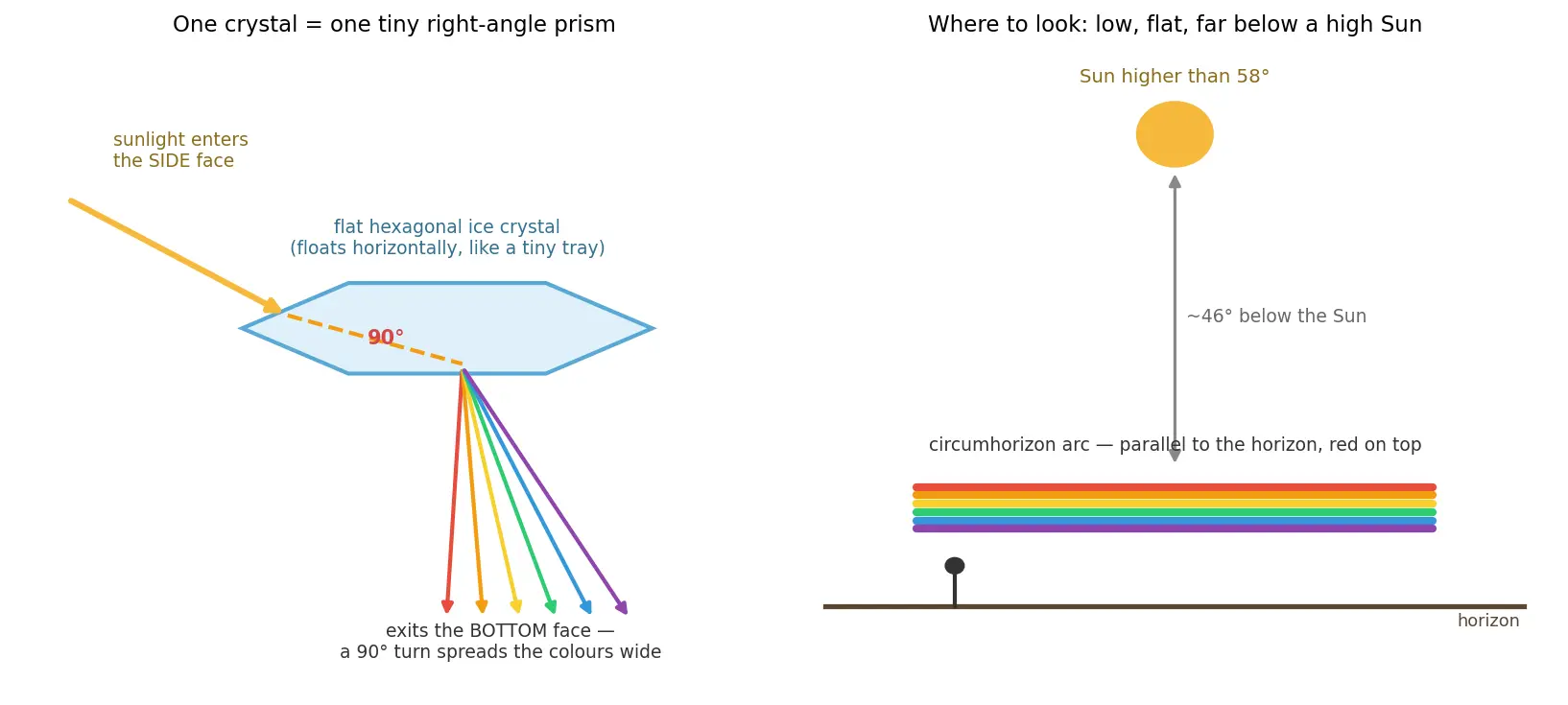
Left: the 90-degree prism light path through an ice crystal. Right: sun above 58°, arc 46° below it. Sunlight enters through the crystal's side wall and exits through the floor, making a hard right-angle turn — spreading colors even wider than a rainbow.
Why It's a Midsummer-Noon Exclusive
Something this beautiful — why have so many people never seen one? Because its appearance conditions are almost capriciously strict: the sun must climb above 58° for light to hit the right angle for that "side-wall-in, floor-out" right-angle traversal. According to the World Meteorological Organization's International Cloud Atlas, the arc is brightest when the sun reaches about 68°. On top of that, a layer of cirrus with plate-shaped ice crystals has to be in the right spot overhead — all three conditions must align for a single sighting.
That 58° threshold cleaves the globe into two worlds by latitude. Beyond 55° north or south, the sun never climbs high enough all year; there, the circumhorizon arc is a legend. The Cloud Appreciation Society puts it vividly: it's a regular visitor in Nairobi, a rare guest in Seattle, and unheard-of in Copenhagen. By one estimate, the sun is above 58° over London for only about 140 hours a year, versus roughly 670 hours in Los Angeles — the same phenomenon, nearly five times the opportunity.
For readers in China, that's good news: almost the entire country is on the "visible" side. Based on today's solar elevation, from Hainan all the way to Harbin, the midday sun clears the 58° line. In other words, right now is the best season of the year to chase it — it's a midsummer-noon exclusive, and once autumn begins, the window narrows day by day.
A note on this photo's date. Today's APOD is an encore: the photo itself was taken in 2021 and first appeared on APOD in late August that year. The editors chose another midsummer Sunday to bring it back to the front page — fitting, since the Northern Hemisphere is right now in the easiest window of the year to spot one.
How to Find It
Just three key points. First, pick the right time: around midday during these weeks, the sun is at its highest. Second, pick the right sky: completely cloudless won't do — you need thin, wispy high-altitude cirrus. Third, don't stare at the sun — it isn't near the sun but about 46° below it, spread flat toward the horizon, red edge on top. Extend your arm; a hand-span covers roughly 20°. Measure just over two hand-spans down from the sun, and that's the height where it might appear. Polarized sunglasses make it easier to spot and protect your eyes in the process: never look directly at the sun.
If the right clouds won't cooperate, there's a home experiment documented over a hundred years ago: find a cylindrical glass, fill it with water, and place it where sunlight strikes the glass wall at a steep angle — a windowsill at midsummer noon, for instance. Light refracts into the water through the wall and back out again, projecting a short, sharply colored spectrum band onto the floor or a sheet of paper. The principle is the same as that arc in the sky: you've built a scaled-up "flat-lying ice crystal" with your own hands.
From today on, every sunny day, spare a glance skyward when you pass a window. That arc doesn't appear often, but when it does, it's the purest color the sky has to offer — and now you know that what lit that cloud isn't fire, but a crowd of transparent little prisms, all lined up and lying flat.
Sources: APOD (August 2, 2026; August 30, 2021), Wikipedia (Circumhorizontal arc), World Meteorological Organization International Cloud Atlas, Cloud Appreciation Society, Atmospheric Optics (atoptics.co.uk)