
Today's Bing Wallpaper: Helsinki coastline at the blue hour, Finland

Image: Bing Daily Wallpaper · Helsinki coastline at the blue hour, Uusimaa, Finland (© Miemo Penttinen/Getty Images).
Open Bing's homepage today and the entire screen is soaked in a single shade of blue. Not the bright blue of a midday sky, nor the near-black blue of deep night—a blue so deep it seems to glow, claiming the sea, the sky, and the silhouette of Helsinki spread along its coastline alike. The English edition of Bing titles the image "Daughter of the Baltic," and what it captures is what photographers call the "blue hour."
Have you ever wondered: once the sun has set, why doesn't the sky simply go dark? Why does it first turn this rich, saturated blue?
A Blue That Doesn't Belong to Daytime
The daytime sky is blue—textbooks explain why: air molecules scatter short-wavelength blue light in every direction, a phenomenon called Rayleigh scattering. Many people assume the blue hour is just the "afterglow" of the same process—it isn't. The deep blue after sunset has a different colourist.
It's the ozone layer. This band of gas hovers twenty to thirty kilometres overhead; we usually remember it only for blocking ultraviolet radiation, yet few people know that pure ozone gas is itself pale blue, because it absorbs the red and orange wavelengths of sunlight—a phenomenon known in optics as the "Chappuis absorption," named after the French chemist who studied it over a century ago. When the sun is directly overhead, sunlight passes through the ozone layer almost vertically and this absorption is negligible. But when the sun drops four to eight degrees below the horizon, whatever light still illuminates the sky above you has to travel an extremely long, oblique path through the upper atmosphere; the distance it traverses through the ozone layer is multiplied many times over. Red and orange are "eaten" along the way, and what scatters back down to the ground is nothing but this pure, deep blue.
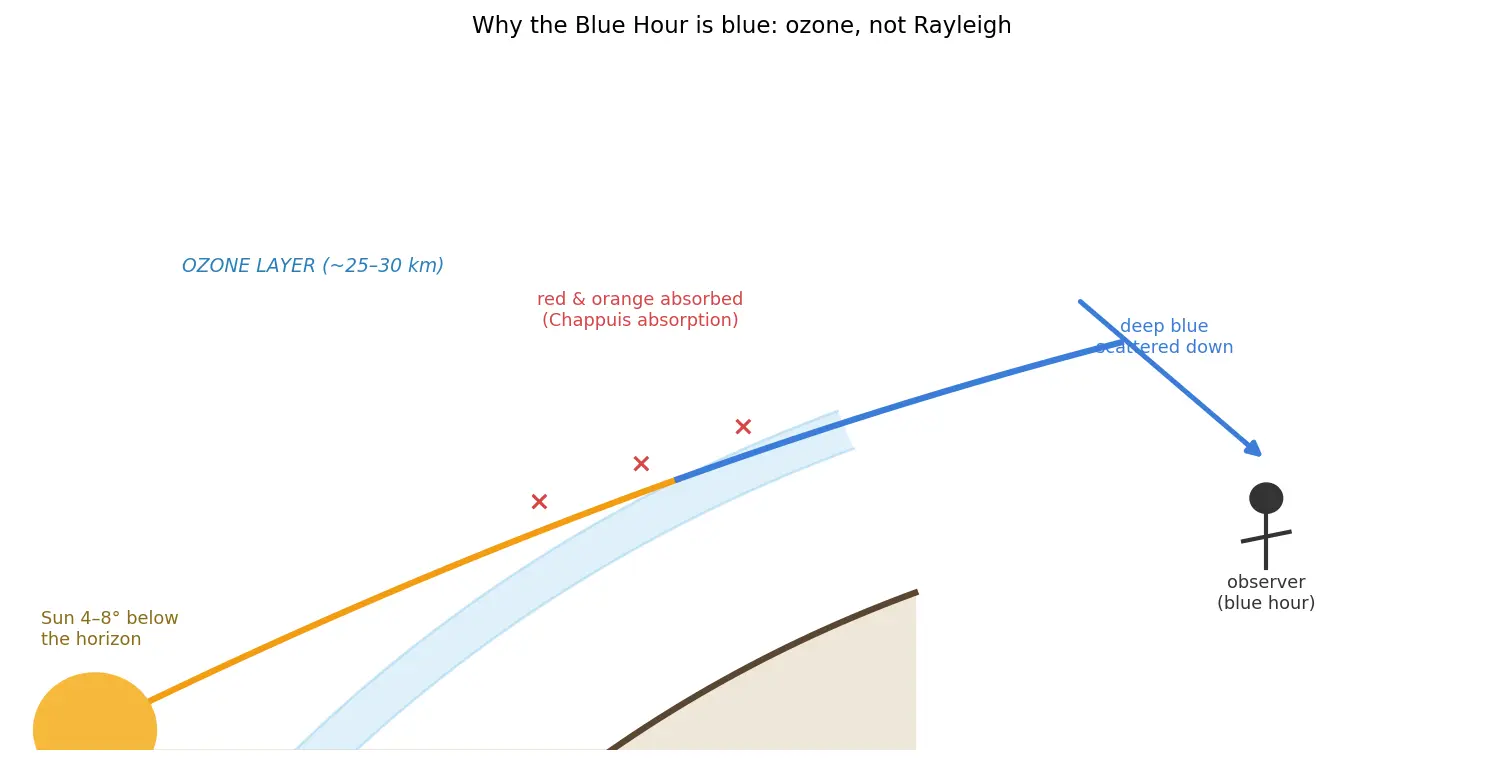
"A blue that doesn't belong to daytime"—after sunset, the residual light illuminating the sky must cut a long, oblique path through the ozone layer thirty kilometres up. Red light is consumed en route; only deep blue makes it back to the ground.
In 1953, American physicist Edward Hulburt did the maths: roughly two-thirds of the blue colour in the sky overhead at sunset is attributable to ozone absorption, with Rayleigh scattering contributing only one-third. A modelling study published in Atmospheric Chemistry and Physics in 2023, using modern radiative transfer models, recalculated the figures and reached a conclusion virtually identical to the one from seventy years earlier. In other words, the blue hour is the ozone layer's solo performance, twice a day—only the vast majority of the audience has no idea who's on stage.
Daughter of the Baltic
Back to the city in the photograph. "Daughter of the Baltic" is not a Bing improvisation; it is Helsinki's long-standing nickname, written in Finnish as Itämeren tytär. In the 1920s and 30s, Finnish author Maila Talvio devoted an entire trilogy of historical novels to old Helsinki's origins, titling it Daughter of the Baltic; later, historians at the University of Helsinki chose the same name for a biography of the city. There is even a bronze memorial sculpture of the same name standing in the city centre. When a nickname gets claimed in turn by novels, histories, and statuary, it must have struck upon something true.
What it strikes upon is probably the city's relationship with the sea. In 1550, Swedish King Gustav Vasa decreed a trading town into existence on the Baltic shore; in 1812, it was elevated to the status of capital. Over more than four centuries, Helsinki has remained a city on a peninsula—sea on three sides, salt air just a few blocks away anywhere in the centre. To call it a daughter of the sea is no exaggeration—it was truly born at the water's edge and raised by it.
Miemo Penttinen, the photographer who took this image, lives in this very city—a Helsinki-based freelance photographer and contributor to Getty Images. To shoot the blue hour of his own city, he probably only needs to glance at the sky and walk a few steps.
A City Where the Blue Hour Lasts All Night
Helsinki and the blue hour, however, share an even more exquisite connection—one hidden in latitude.
The blue hour occurs when the sun sits four to eight degrees below the horizon. Helsinki lies at 60°N—around the summer solstice, the sun at its lowest midnight point dips only just past six degrees below the horizon, staying within that range all night long. In other words, midsummer Helsinki has no true darkness: its deepest "night" is an extended blue hour stretching unbroken from sunset to sunrise. The white nights that Finns take such pride in are, optically speaking, blue nights.
But now it is early August. At midnight the sun already sinks past twelve degrees below the horizon, and genuine darkness has just returned to this city. For Helsinkians, the blue hour has once again become a limited engagement—twice a day, available only to those who watch the clock. Like a guest who stayed the entire summer, noticed properly only at the moment of departure. The timing of this photograph's appearance on the Bing homepage is perfectly chosen.
A side note: the closer you are to the equator, the steeper the sun's angle of rise and set, and the more fleeting the blue hour; the closer to the poles, the shallower the sun's trajectory, and the longer this blue lingers. Helsinki's blue hour is inherently more lavish than in most places on Earth.
Tonight, after sunset, you can try it yourself. No need to go to Finland—find a spot with an open sky, step outside twenty to forty minutes after sunset, and wait for that brief interval when the streetlights come on but the sky hasn't gone fully dark. The whole world will briefly turn the same shade of blue. When it does, look up and consider: this colour is not the sky making do before nightfall—it is a layer of invisible gas thirty kilometres high, carefully mixing it for you, twice a day, every single day.
Sources: Bing daily wallpaper data across markets, Wikipedia (Blue hour, Helsinki), Atmospheric Chemistry and Physics (2023), University of Helsinki 375 Humanists project, HAM Helsinki Art Museum, miemo.net