
A photo that looks like a red dwarf star, but it's the sun above our heads. What turned it red is not good news in itself.
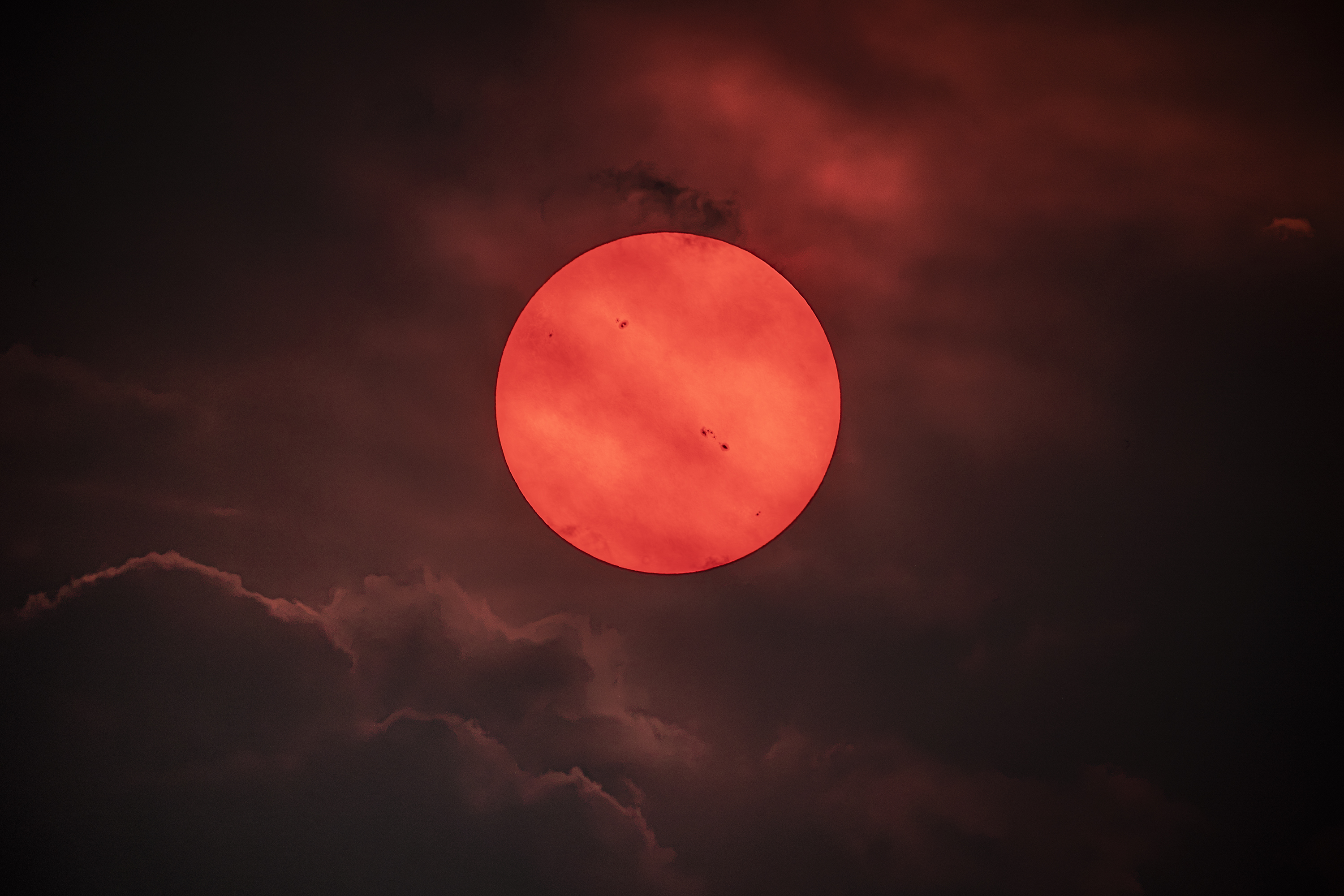
Image: NASA Astronomy Picture of the Day (APOD) · Image Credit & Copyright: Debra Ceravolo · Page for the day
NASA's Astronomy Picture of the Day for July 30 shows a deep red sphere. It hangs quietly in a slightly hazy sky, its surface dotted with a few darker spots, clouds drifting around it.
At first glance, it's easy to mistake it for some distant red dwarf—one of those stars smaller, cooler, and dimmer than our sun, glowing a dark red, the most common type in the universe. If a planet orbited one, the "sun" in its sky would probably look about this color.
But this is our sun.
A Filter a Thousand Kilometers Wide
The photo was taken on July 22, 2026, in the Okanagan region of British Columbia, Canada. At the time, wildfires were burning across the Pacific Northwest, and wind had carried the smoke high into the atmosphere.
Normally, no one can photograph the sun like this. It's too bright—looking at it directly damages your eyes, shooting it directly burns out camera sensors, and professional astrophotography requires thick solar filters. But that day, the smoke served as the filter.
The principle is the same as a red sunset: the extremely fine particles in the smoke are particularly good at blocking and scattering blue-shifted light, while red light passes through. So the sunlight that reached the lens through the smoke layer was both dimmed and reddened. For the same reason, sunrises and sunsets during wildfire season are always exceptionally intense—beauty as a byproduct of disaster.
In the image description, NASA added a parenthetical reminder: even so, never look directly at the sun with the naked eye.
That Dark Spot Could Fit Seven Earths
The dark spots scattered across the photo are sunspots—regions on the sun's surface where the temperature is slightly lower, appearing dark only because they're dimmer than their surroundings. What makes them darker are strong magnetic fields rising from inside the sun.
The cluster just below and to the right of center is designated AR 4493. It was the largest sunspot group on the entire Earth-facing side of the sun at the time, and its growth rate was startling: according to space weather monitoring records, it was barely visible one day and the most prominent feature on the sun the next. It grew into a massive ring shape spanning approximately 100,000 kilometers—the gap in that ring could fit seven Earths.
Over those days it kept firing off M-class flares, its magnetic field structure complex enough that a much stronger eruption could come at any moment. In other words, this impossibly serene-looking photo captures a sun in the middle of a tantrum.
A Rehearsal for Six Billion Years from Now
The image description was written by Cecilia Chirenti, an astrophysicist at NASA's Goddard Space Flight Center. She closed with a sentence that is light in tone but heavy in weight: in about six billion years, the sun really will begin to turn red—entering its red giant phase, expanding, cooling, its color shifting to a deep red.
So this photo is something like a dress rehearsal. Today, what turns the sun red is a few wisps of smoke; in six billion years, what will turn it red is its own age.
The shutter was pressed by astrophotographer Debra Ceravolo. What she captured was a fleeting window of opportunity: smoke thick enough to block the blinding glare, yet thin enough to still reveal detail. A chance like this might not come again for many years—or it might come as soon as the next wildfire season.
Sources: NASA Astronomy Picture of the Day, July 30, 2026, "Red Sun through Wildfire Smoke," image description by Cecilia Chirenti (NASA GSFC / UMCP / CRESST II); information on sunspot group AR 4493's size and activity referenced from space weather monitoring records and the ARRL Solar Activity Report (July 2026). The copyrighted photograph belongs to the photographer; this article references it by link only.