
Nat Geo Photo of the Day: "Sunrise Walk" · July 30, 2026
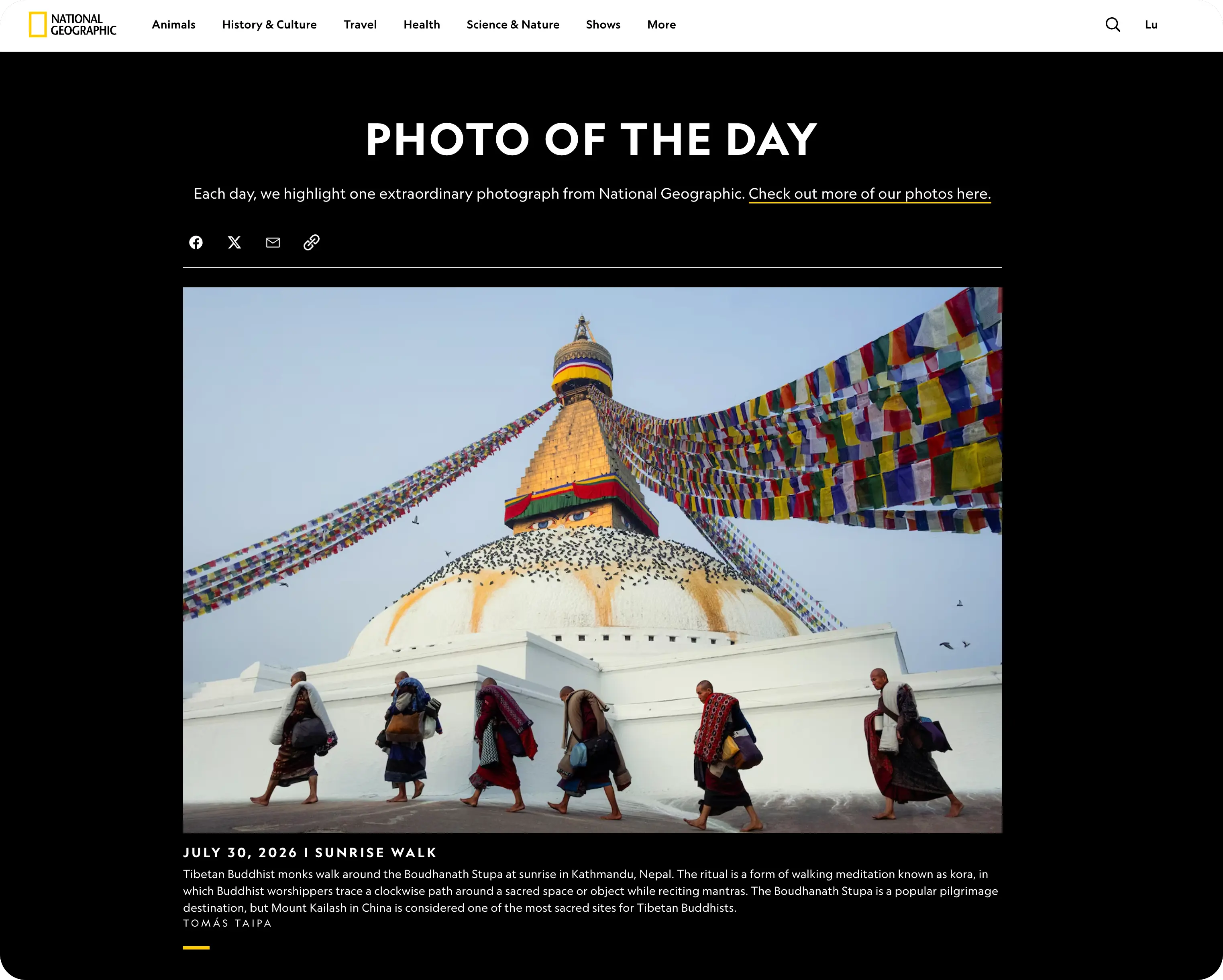
Image: Nat Geo Photo of the Day · Photo by Tomás Taipa · Original page.
When the sun first comes up, the tip of the spire is the first thing to catch the light.
This edition of Nat Geo's Photo of the Day captures precisely that moment. At Boudhanath Stupa in Kathmandu, the massive white dome still sits in the cold shadow of early morning, while the gilded harmika and the tiered pinnacle above it have already turned warm gold. Prayer flags fan out in bundles from the spire in every direction, slicing the pale blue sky into colorful strips. Pigeons crowd the dome so densely they almost blot out the white.
Below the base, six figures walk close to the white wall. They carry bundles and cloth bags, wear deep red and dark robes, and are barefoot. According to National Geographic, these are Tibetan Buddhist monks doing something entirely routine—circumambulating the stupa.
The act is called "kora"
The caption gives it a name: kora—a ritual circumambulation.
The rules are simple: walk clockwise around a sacred site or object, reciting mantras as you go. The most common one is "Om mani padme hum." According to National Geographic, the direction in which Buddhists circumambulate matches the direction a prayer wheel turns—keeping the sacred object on your right side, the position of respect. Bön practitioners walk the opposite way, counterclockwise.
What's interesting is that kora prescribes no fixed scale. A stupa will do, a temple will do, a lake or a mountain will do. It's more like a gesture that can be mapped onto any dimension.
A stupa is a complete blueprint
So why is this stupa worth circling? Because it is itself a text you can "read."
Look from bottom to top: the base consists of several angular terraces laid out in the pattern of a mandala; above sits the snow-white hemispherical dome; atop the dome is a square harmika, each of its four sides painted with a pair of enormous, half-closed eyes—half-closed for a reason: one half gazes outward at the world, the other half looks inward at the self. The symbol below the eyes that resembles a nose is not a nose at all; it is the Nepali numeral "one," meaning there is only one path to liberation. Higher still, the spire tapers through thirteen tiers, corresponding to the thirteen stages on the path to enlightenment; around the base sit 108 niches—that most significant number in Buddhism.
So this stupa requires no literacy. You stand before it, look up, and it has already delivered the entire teaching.
The orange-gold radiating stripes on the dome are not decorative patterns, either. They are saffron water, splashed on bucket by bucket, flowing naturally into a ring of lotus petals. The white underneath must be periodically re-coated with lime wash. A stupa this large depends on people whitewashing it year after year, splashing the petals back on year after year.
As for when it was built, the claims are staggeringly varied—ranging from the fifth century all the way to the fourteenth. What can be confirmed is that it stood along the trade route from Tibet into the Kathmandu Valley from very early on, and in 1979 it was inscribed on the World Heritage List as part of the Kathmandu Valley site.
The same circle, but three weeks apart in duration
The caption closes with a quiet aside: Boudhanath is a popular pilgrimage site, but for Tibetan Buddhists, one of the holiest places is Mount Kailash in China.
Hidden in that sentence is an enormous difference of scale.
One circuit of Boudhanath is a few hundred meters—a matter of minutes; many people fit it in on their way to work. The circumambulation route around Mount Kailash—in the Ngari Prefecture of Tibet, China—runs roughly 52 kilometers at elevations between 4,800 and over 5,600 meters, crossing Dolma La pass along the way. Local Tibetans sometimes complete it in a single day; most outside pilgrims need two or three. There is another way to do it: full-body prostrations the entire distance—dropping flat, standing up, shuffling forward one body-length, dropping flat again. Done this way, a single circuit takes three weeks or longer.
The mountain is simultaneously sacred to Buddhism, Hinduism, Jainism, and Bön. No one has ever reached its summit. Legend holds that completing 108 circuits brings liberation.
The same action, the same direction—from a few minutes to several weeks. It can be a morning stroll or the weightiest undertaking of a lifetime.
One more thing worth remembering: the golden spire in today's photo is not entirely ancient. The 2015 earthquake cracked the pinnacle so badly it had to be dismantled all the way down to the dome. The reconstruction used no government funds—Buddhists in Nepal and around the world donated over two million dollars and more than thirty kilograms of gold; over six hundred monks and nuns conducted a three-day consecration ceremony; and it reopened in November 2016. It was the first major heritage structure in Nepal to be fully restored after the quake. And before that, it had been rebuilt once already, after the great earthquake of 1934.
This photograph was taken by Tomás Taipa. Click through to view the original on the National Geographic website and see those few minutes when the morning light touches only the tip of the spire.
People who walk in circles will not have moved from where they started, even after a whole day. You might think that's pointless. But consider it from another angle: that is probably exactly the point—it leads to no other place, so the walker is left with nothing but the act of walking itself.
Sources: Nat Geo Photo of the Day caption, UNESCO Kathmandu Valley World Heritage entry, Kathmandu Post and South China Morning Post November 2016 reports on Boudhanath's reopening, Himalayan Journal (Himalayan Club) accounts of the Mount Kailash circumambulation route.