
You've seen it a thousand times on cereal boxes, cartoons, and travel posters. But you've probably never really looked into its eyes—and even if you did, you'd get them wrong.
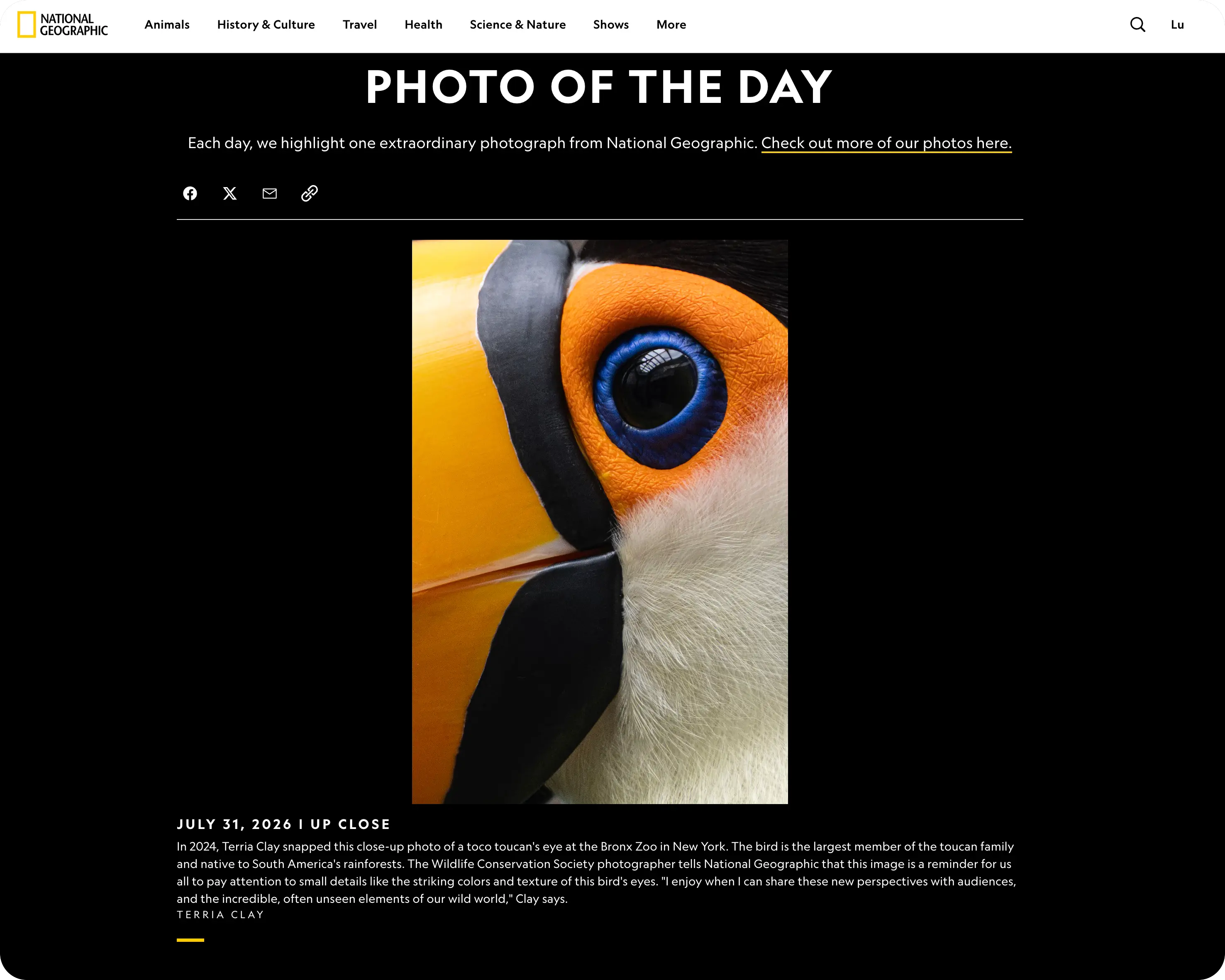
Image: National Geographic Photo of the Day · Photograph by Terria Clay (staff photographer, Wildlife Conservation Society/WCS) · Original page
Open today's National Geographic "Photo of the Day," and the frame holds nothing but a single eye.
A saturated ring of cobalt blue surrounds a jet-black pupil; beyond the blue stretches a wide expanse of orange skin, covered in fine cracks like the peel of an orange left too long in the sun. From the left, a slash of bright yellow cuts in—the bill; in the lower right corner, a tuft of feathers so white they glow. The feature's caption gives the photo just two words: Up Close.
This is a Toco Toucan, photographed in 2024 at the Bronx Zoo in New York.
That ring of blue is not the eye
That blue ring is not its iris. The Toco Toucan's true iris is deep brown—the nearly all-black area in the photograph. The blue encircling it is a paper-thin layer of bare skin; the orange beyond it is bare skin too.
In other words, the two most eye-catching colors on this face grow no feathers and belong to no part of the eye. The bird painted its colors directly onto skin.
And the photo is called, of all things, "Up Close"—because without getting close, you'd never even know you had it wrong.
A bill that sheds heat
It is the largest member of the toucan family, measuring 55 to 65 centimeters in total length, with a bill that can reach 23 centimeters. Relative to body size, this is the largest bill of any bird—roughly a third of the animal's entire length.
It looks heavy but is actually very light: the interior is mostly hollow, held up by a fine lattice of bone and thin membranes. Its tongue is nearly as long as the bill and flat as a brush.
What's a bill this big for? For years there were only two explanations: reaching fruit, or showing off to other toucans. In 2009, a team of scientists published a third answer in Science.
Using thermal imaging cameras on resting toucans, they found the bill works as an adjustable radiator: in the heat, the bird sends blood into its bill and sheds warmth from the surface; in the cold, it constricts the blood vessels and conserves heat. The numbers are striking—in still air at 21 °C, the bill dissipates roughly a quarter of the bird's total heat production; with a breeze, up to four times that amount. Relative to body size, this is one of the most powerful "thermal windows" known in the animal kingdom—outperforming even an elephant's ears.
There was a quieter finding, too: the thermal camera could even tell when a toucan had fallen asleep, because the bill's temperature shifted as it drifted off.
It actually avoids the rainforest
National Geographic's caption says it comes from the rainforests of South America. That isn't exactly wrong, but in the ornithological literature the Toco Toucan is precisely the oddball of its genus—the one that basically doesn't live in forest. It inhabits Brazil's cerrado savannas, the Pantanal wetlands, gallery forests along rivers, and forest edges, actively avoiding the closed, humid interior of dense woodland.
This leads to a conclusion you may not quite know how to feel about: because it prefers open landscapes, large-scale deforestation in South America may actually not be bad news for this species. The IUCN lists it as Least Concern.
The photographer worked here twice
The photo is credited to Terria Clay. She is a staff photographer for the Wildlife Conservation Society (WCS), responsible for documenting New York's five WCS-managed facilities, including the Bronx Zoo and the New York Aquarium.
But according to her published résumé, this is her second stint here. From 2012 to 2020, she did something else at WCS: she cared for hospitalized wild animals and assisted in their rehabilitation. In 2024 she returned as a photographer—and this image was made that same year.
A person who once nursed sick birds before ever picking up a camera, producing a photograph in which you can almost count every line on the skin—that is probably no accident. She told National Geographic she hopes the image reminds people to notice the small things—like the color and texture around a bird's eye.
The Toco Toucan is likely one of the most frequently illustrated birds in the world. You've seen it a thousand times and may never have truly looked. And when you finally do get close, you discover that the most beautiful ring of blue isn't the eye at all.
Sources: National Geographic "Photo of the Day," July 31, 2026, Up Close caption; Tattersall et al., "Heat Exchange from the Toucan Bill Reveals a Controllable Vascular Thermal Radiator," Science, 2009, and National Geographic's coverage of the study; Wikipedia, eBird, and Animal Diversity Web (ADW) entries on the Toco Toucan; Terria Clay's personal website and published professional biography.