
The memory of an old matriarch is the survival infrastructure of an entire herd.

Image: Bing Daily Wallpaper · African savanna elephants in Amboseli National Park, Kajiado County, Kenya (© Ibrahim Suha Derbent/Getty Images)
Today when I opened Bing, the homepage showed a herd of African savanna elephants walking through the dust. The headline: Giants Worth Protecting.
This is Amboseli National Park in southern Kenya, right up against the Tanzanian border. The reason it's today is that August 12 is World Elephant Day—launched on this date in 2012 by Canadian Patricia Sims together with Thailand's Elephant Reintroduction Foundation, now in its fifteenth year. The founders were blunt about what they hoped the day would achieve: get more people to support the organizations actually doing the work—stopping poaching and ivory trafficking, preserving wild elephant habitat, and giving captive elephants a place where they can live free.
A snow-capped mountain on the equator, feeding a swamp from underground
Let's start with the place itself, because by all rights it shouldn't support this many elephants.
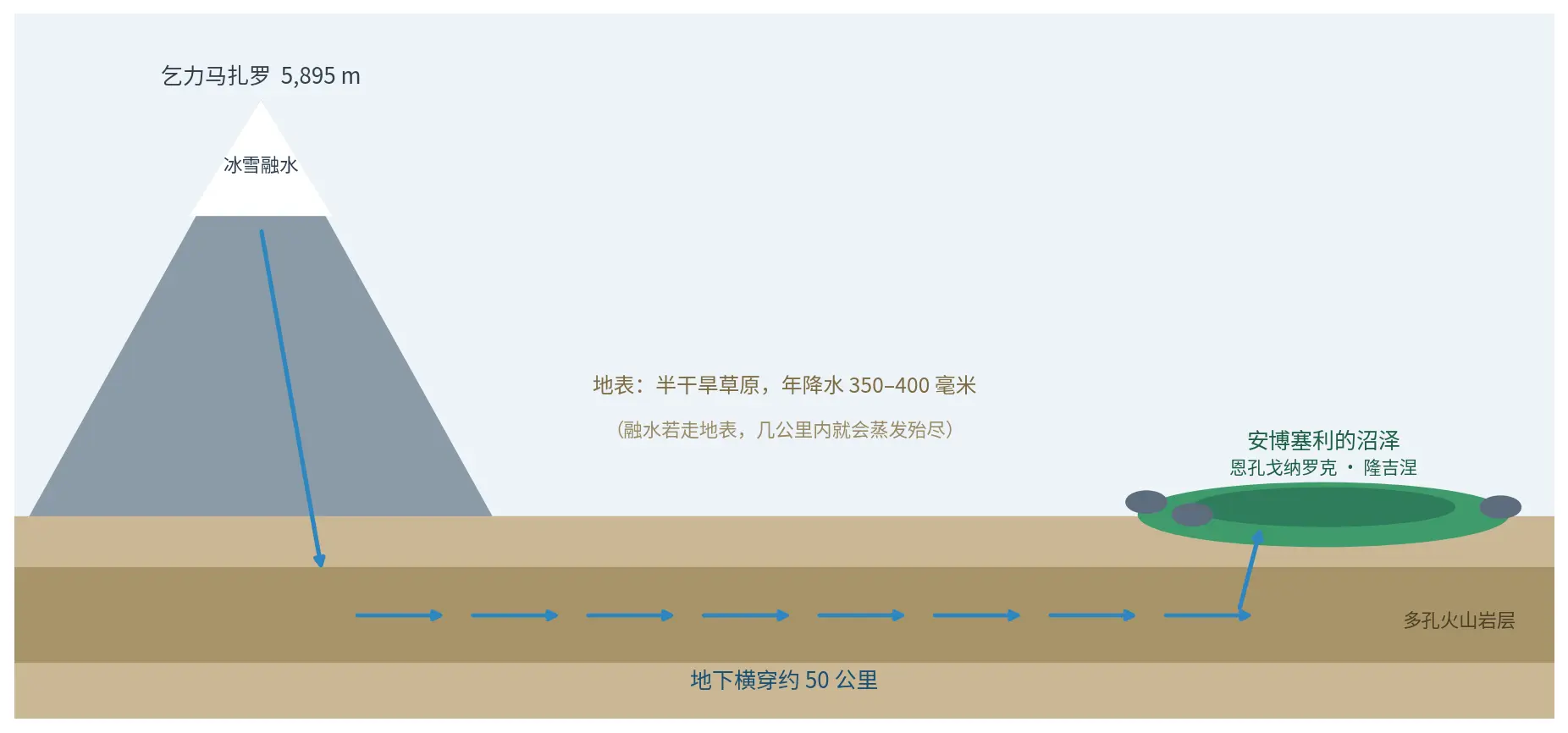
Amboseli covers just 392 square kilometers, sits at an elevation of 1,100 to 1,200 meters, and receives only 350 to 400 millimeters of rain a year—semi-arid land. The Maasai's old name for it is Empusel, meaning "salty, dusty place." It doesn't sound like somewhere that could sustain over a thousand elephants.
Yet it happens to have two swamps that never dry out year-round: Enkongo Narok and Longinye. Where does the water come from? From a snow-capped mountain fifty kilometers away.
This is the most remarkable thing about Amboseli to explain to a child: the meltwater from the summit of Kilimanjaro doesn't flow down along the surface—on semi-arid volcanic soil, that trickle would evaporate within a few kilometers. It seeps downward. The meltwater sinks into porous volcanic rock and travels horizontally underground for dozens of kilometers until it resurfaces in the depression at Amboseli. So the green you see in the photographs is actually delivered beneath the earth by a snow-capped equatorial mountain. The elephant herds, the Maasai's cattle and goats, over four hundred species of birds—all of them cluster around the outlet of this invisible underground pipeline.
Memory isn't a charming folk saying—it's a herd's survival equipment
"An elephant never forgets" has been reduced to a cute proverb. But it is actually a mechanism that can be—and has been—quantified.
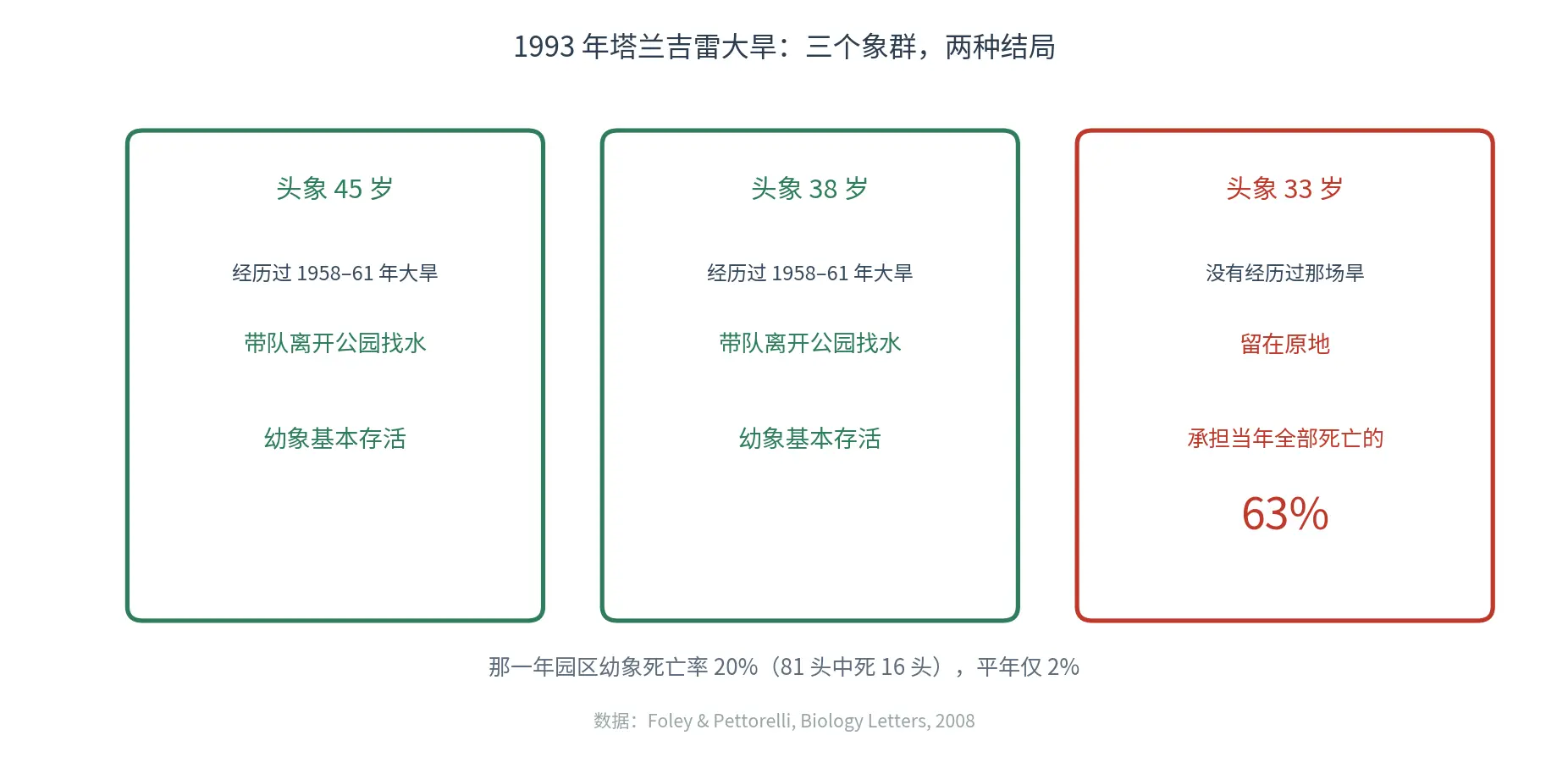
In 1993, a severe drought hit Tarangire National Park in Tanzania. Ecologists Charles Foley and Nathalie Pettorelli later compiled that year's data into a paper published in 2008 in the Royal Society's Biology Letters. That year, 16 out of 81 calves in the park died—a mortality rate of 20%, compared with the normal 2%.
The real finding lay in the distribution of the deaths. Of the three herds in the park at the time, two were led by matriarchs aged 45 and 38 respectively; they led their groups out of the park to find water and forage elsewhere, and nearly all their calves survived. The third herd's matriarch was 33 and stayed put—63% of all the deaths that year came from her group.
The two older matriarchs had one thing in common: both had lived through the great drought of 1958 to 1961. In other words, when the 1993 drought began, they carried in their heads a map laid down thirty-five years earlier, telling them where to go. The younger one did not.
A herd's knowledge isn't written on paper; it's written in the brain of the oldest matriarch. That sounds like a metaphor. It's literal.
Why an old matriarch cannot be replaced
Amboseli itself is the home base of this body of research. In 1972, Cynthia Moss established her elephant research project here; as of this year it has been running for a full 54 years, making it the longest-running wild elephant study ever conducted. The project has cumulatively recorded the lives of over 3,500 elephants—identified by face, named, tracked from birth to death.
In 2001, Karen McComb, Moss, and colleagues published a playback experiment conducted in Amboseli in Science. They played the contact calls of unfamiliar individuals to family groups and observed the responses. The result: the older the matriarch, the more accurately she could determine "is this one of ours or not"; and families led by older matriarchs also showed higher average reproductive success per adult female. The authors spelled out the implication: selectively killing the largest—and therefore oldest—individuals is an extremely serious matter for elephants, whales, and other highly social mammals.
It's not just losing one elephant. It's burning down a library.
They call each other by name
If memory is this species' most underestimated ability, then a study published in June 2024 may be the most startling finding in recent years.
Michael Pardo of Colorado State University and colleagues fed 469 low-frequency calls recorded between 1986 and 2022 from matriarch and calf groups in Amboseli, Samburu, and Buffalo Springs into a machine-learning model for analysis, then ran playback experiments: they took a call "originally directed at a specific elephant," played it to that elephant, and then played it to others. The elephant being addressed responded noticeably more actively.
The key lies in the method. Dolphins and parrots also have "names," but they rely on imitation—to call me, you mimic my signature sound. Elephants don't do that. Elephants use a vocal label that bears no resemblance whatsoever to the recipient's own calls—a purely arbitrary convention, the same logic by which humans name their children. The researchers inferred from this that elephants may possess some form of abstract thinking. Bing's image caption today also mentions this study.
In other words, the elephants walking in that photograph may very well be calling each other by name right now.
Why a day like this matters
The numbers are not comforting. On March 25, 2021, the IUCN for the first time split African elephants into two species and assessed them separately: the savanna elephant was listed as Endangered, its population having declined by at least 60% over the past fifty years; the forest elephant was listed as Critically Endangered, having declined by more than 86% in thirty-one years. The total remaining population across Africa is estimated at around 415,000.
But the reason this day is worth observing is that it has also genuinely delivered results. Kenya's wildlife census announced this year—fieldwork conducted from June 2024 to August 2025—counted 41,952 elephants, roughly 16% more than the 36,280 recorded in 2021. Officials credited strengthened anti-poaching operations and improved habitat protection. China's role is part of the story too: since January 1, 2018, all commercial ivory processing and sales have been completely banned within China, now more than eight years ago.
You don't actually have to go to Africa
China has wild elephants of its own.
Over the past thirty years, Yunnan's wild Asian elephant population has grown from roughly 150 to over 300, and their range has expanded from a few isolated pockets to 3 prefectures, 11 counties, and 61 townships—mainly in Xishuangbanna, Pu'er, and Lincang. To make coexistence workable for both people and elephants, Xishuangbanna has deployed 600 infrared cameras and 177 smart broadcast units; the cameras' identification accuracy reaches 99%—when a herd approaches a village, the broadcast sounds first. The Asian Elephant National Park was formally proposed for establishment in August 2022 and is still under development.
So today's point of exploration isn't in Kenya—it's in Yunnan. If you're planning a trip to Xishuangbanna or Pu'er, schedule your itinerary around observation points on the rainforest edge and follow the local rangers—they can tell you which muddy track has footprints freshly pressed this morning. If you can't go just yet, search for the Asian elephant monitoring videos released by Yunnan's forestry and grassland authorities: in those aerial shots of elephant columns on the move, the one at the very front is usually the oldest member of the group.
She remembers more than the rest of the herd combined.
Sources: Bing Daily Wallpaper official image description, World Elephant Day official website, Amboseli Trust for Elephants project history, Amboseli National Park official materials, Foley & Pettorelli 2008 Biology Letters, McComb et al. 2001 Science, Pardo et al. 2024 Nature Ecology & Evolution, IUCN Red List March 2021 African elephant assessment, Kenya Wildlife Research and Training Institute (WRTI) census bulletin, China National Forestry and Grassland Administration Asian elephant conservation bulletin