
Over a million wildebeest crowd the riverbank, all waiting for the same thing: for one to dare jump in first.

Image: Bing Daily Wallpaper · Migrating wildebeest crossing the Mara River in the Maasai Mara, Kenya (© Manoj Shah/Getty Images) · View original image
Today when I opened the Bing homepage, it was a river full of splashing water.
Bing titled this photo "A Crossing of Life and Death, an Epic of the Brave." The location is the Maasai Mara in the southwestern corner of Kenya. The river is the Mara River. The mass of dark shapes crowding the water are wildebeest. The photographer is Manoj Shah.
That's about all the photo itself can tell us: a migrating herd of wildebeest, crossing the Mara River. It looks like total chaos.
But it's actually one of the most orderly events of the year—it's just that the order runs deep.
They're Not Traveling to a Destination—They're Chasing Rain
First, let's correct a very common impression: the wildebeest aren't "migrating" to some destination. They're going in circles.
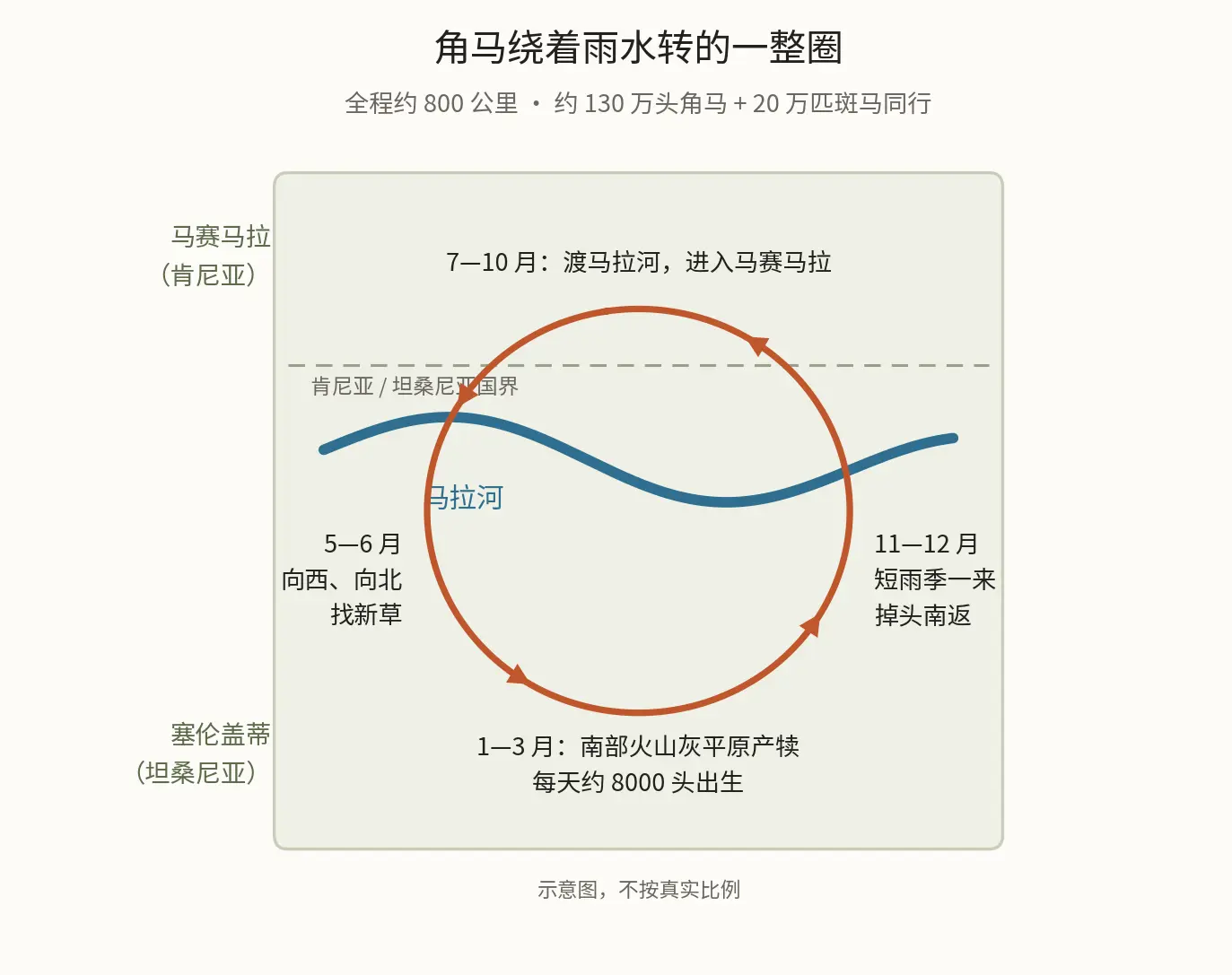
Across the entire Serengeti–Maasai Mara ecosystem, roughly 1.2 million wildebeest, plus 200,000 zebras and large numbers of gazelles, walk a loop of about 800 kilometers every year: from January to March they calve on the volcanic ash plains in the south, with up to 8,000 born in a single day at peak; in May and June they drift west and north; around July they cross the Mara River into Kenya; in November and December, when the short rains arrive, they turn back south.
What are they following? Grass.
More precisely: the fresh flush of grass that sprouts after rain. There's a mechanism here that can be summed up in one sentence—new grass isn't just tender; it has higher phosphorus and nitrogen content. And lactating mother wildebeest need large amounts of phosphorus. So what looks like an aimless flow of animals is actually a herd of mothers chasing a mineral.
How do they know where it's rained? Researchers say they can smell it and see it. The scent in the air when a distant thunderstorm falls, the lightning on the horizon at night—both cause the entire herd to adjust course in that direction.
What's even more interesting is that among these million-plus animals, there is no leader. In aerial photographs, the front of the column shows a wave-like edge—a shape no individual wildebeest could possibly perceive. Biologists call this phenomenon "swarm intelligence": each animal makes decisions based only on what the few nearest to it are doing, and countless local decisions stacked together make the whole herd move like a single organism systematically probing the obstacles ahead.
Who Jumps First
The Mara River is that obstacle.
It's not wide—about 45 meters on average—and in many stretches only just over a meter deep. An adult wildebeest can certainly swim across. The problem is the banks—steep mud slopes carved out by the rainy season. Once tens of thousands crowd down at the same time, those in front haven't climbed the far bank before those behind are already trampling over them. What truly kills isn't the water—it's the crushing and the congestion.
Add Nile crocodiles to that.
So every year at this time, both banks of the Mara River stage the same drama: hundreds of wildebeest walk to the water's edge, pace back and forth, turn and retreat, then walk back again. This can go on for hours. All that waiting is for one thing—for one of them to make up its mind.
The moment that one jumps in, instinct takes over the entire herd. Those behind charge into the water without a second thought, as if someone has opened a floodgate.
This year's drama has just begun. Early August observation reports from the Maasai Mara say that large numbers of wildebeest are pouring into Kenya from the Sand River area, and crossings in the Mara Triangle have only just started. Guides and tourists camp out on the riverbank every day, waiting for that first one. This is why today's photo appears on the homepage in early August—it's not depicting some abstract natural wonder, but something happening right now.
Six Thousand Wildebeest, Eleven Hundred Tons, Feeding a River for Seven Years
Now for the fact this article really wants you to take away.
A group of ecologists began tallying wildebeest drowning events in the Kenyan stretch of the Mara River in 2001. Their findings, published in the Proceedings of the National Academy of Sciences in 2017, are almost unbelievably large:
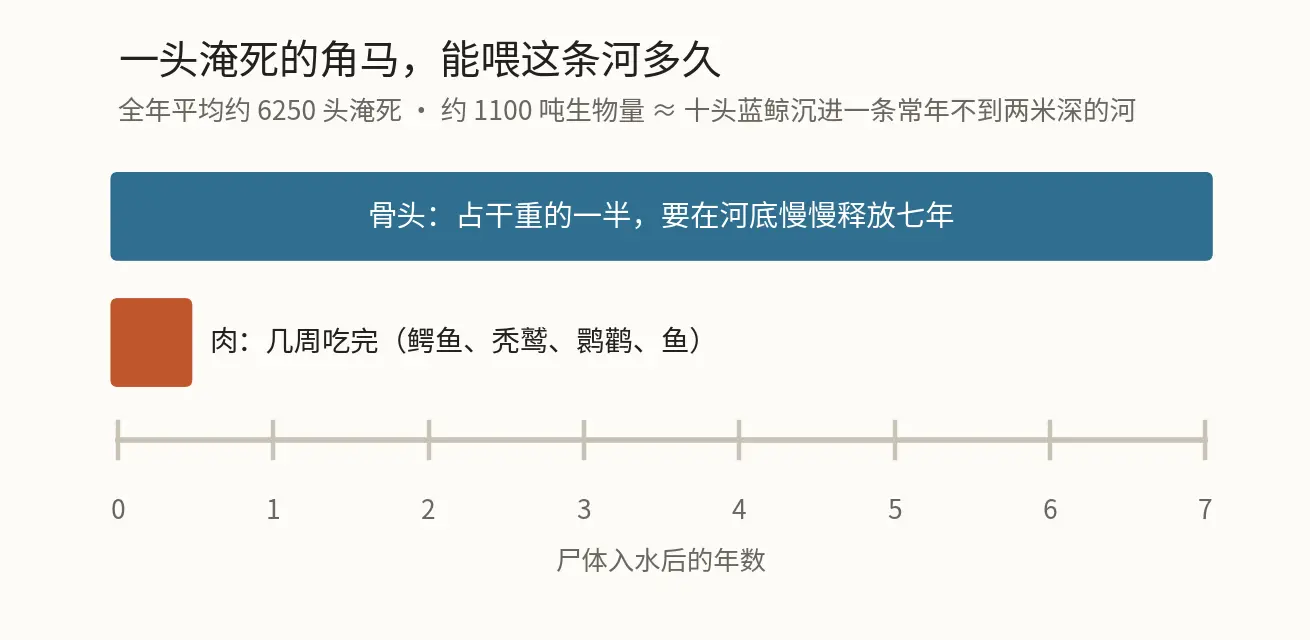
In fifteen years, at least thirteen saw mass drownings of a hundred or more, averaging four to five events per year. Roughly 6,250 wildebeest drown in this river annually, amounting to about 1,100 tons of biomass. One of the paper's co-authors offered an analogy: it's like dumping ten blue whale carcasses into this modest river every year.
On the wildebeest's own ledger, this loss is actually minor—less than one percent of the herd.
But on the river's ledger, it's a fortune.
Carcasses pile up at bends and shallows. Crocodiles, vultures, and marabou storks come first. Isotope analysis by the researchers found that when carcasses are present, nearly half the diet of common fish species in the Mara River comes from wildebeest. This nutrient input is four times greater than the biomass that spawning salmon deaths deliver to rivers in British Columbia.
What really makes you pause is the bones.
Half the dry weight of a wildebeest carcass is bone. And bones take seven years to fully decompose on the riverbed. In other words, the flesh is consumed in weeks, but the bones continue releasing phosphorus, nitrogen, and carbon for the next seven years, and the biofilm that grows on their surfaces itself becomes food for fish.
So the wildebeest that drown in this river in August of this year won't have fully "finished feeding" the river until 2033.
The Last Great Herds Still Running
This research carries another, quieter implication.
The paper's authors note that the Mara River is one of the last few places on Earth where this phenomenon can still be studied. North America's bison, southern Africa's quaggas and springbok—all historically had migratory herds of comparable scale, and all must have experienced the same mass drownings and the same nutrient return. Those herds are now either extinct or reduced to scattered remnants.
In other words, what you see on the Bing homepage today is not merely a natural spectacle. It's a window onto a scene that once existed everywhere on this planet and now survives in almost this one place alone.
Watch Tonight: A Fixed Camera on the Mara River
You don't have to wait until you can afford a trip to Kenya.
The Mara Conservancy and the nonprofit streaming platform explore.org have set up a fixed camera at the main crossing point on the Mara River, streaming 24/7:
- Official stream: explore.org's Mara Main Crossing camera
- Location: the main crossing in the central Mara Triangle, one of the stretches where wildebeest concentrate to cross
- When to watch: East Africa Time (EAT) is five hours behind Beijing time. Local afternoon from 2:00 to 6:00 PM corresponds to 7:00 to 11:00 PM Beijing time—right in the after-work window for Chinese readers, and also the time band when crossings most often occur
- Season: July to October is crossing season, with August and September the peak
To be clear: the stream doesn't guarantee you'll see a crossing the moment you open it. Actual crossings happen on only about fifty days a year, and they happen suddenly. Staring at an empty riverbank for half an hour is itself part of the experience—that's how the guides wait too.
Closing
If you open that live stream tonight, you'll most likely see nothing more than a brown river, a few hippos, and a group of wildebeest pacing back and forth on the bank.
Don't close it just yet.
They're waiting for the one. Waiting for one of them to suddenly stop hesitating and lean its body into the water—and then, within seconds, you'll understand why Bing called this photo "An Epic of the Brave."
That one wildebeest doesn't know it's doing something extraordinary. It just knows the grass on the other side is fresher.
Sources: Bing Daily Wallpaper zh-CN channel entry for the day; Subalusky et al., "Annual mass drownings of the Serengeti wildebeest migration influence nutrient cycling and storage in the Mara River" (PNAS, 2017); Cary Institute of Ecosystem Studies press release; coverage of the study by Science, Science News, Popular Science, and National Geographic; Angama Mara early August 2026 Maasai Mara field observation weekly report; explore.org × Mara Conservancy Mara River live camera official page.