
Wind blowing across water creates waves. This rule was just caught in the act on the surface of the Sun.
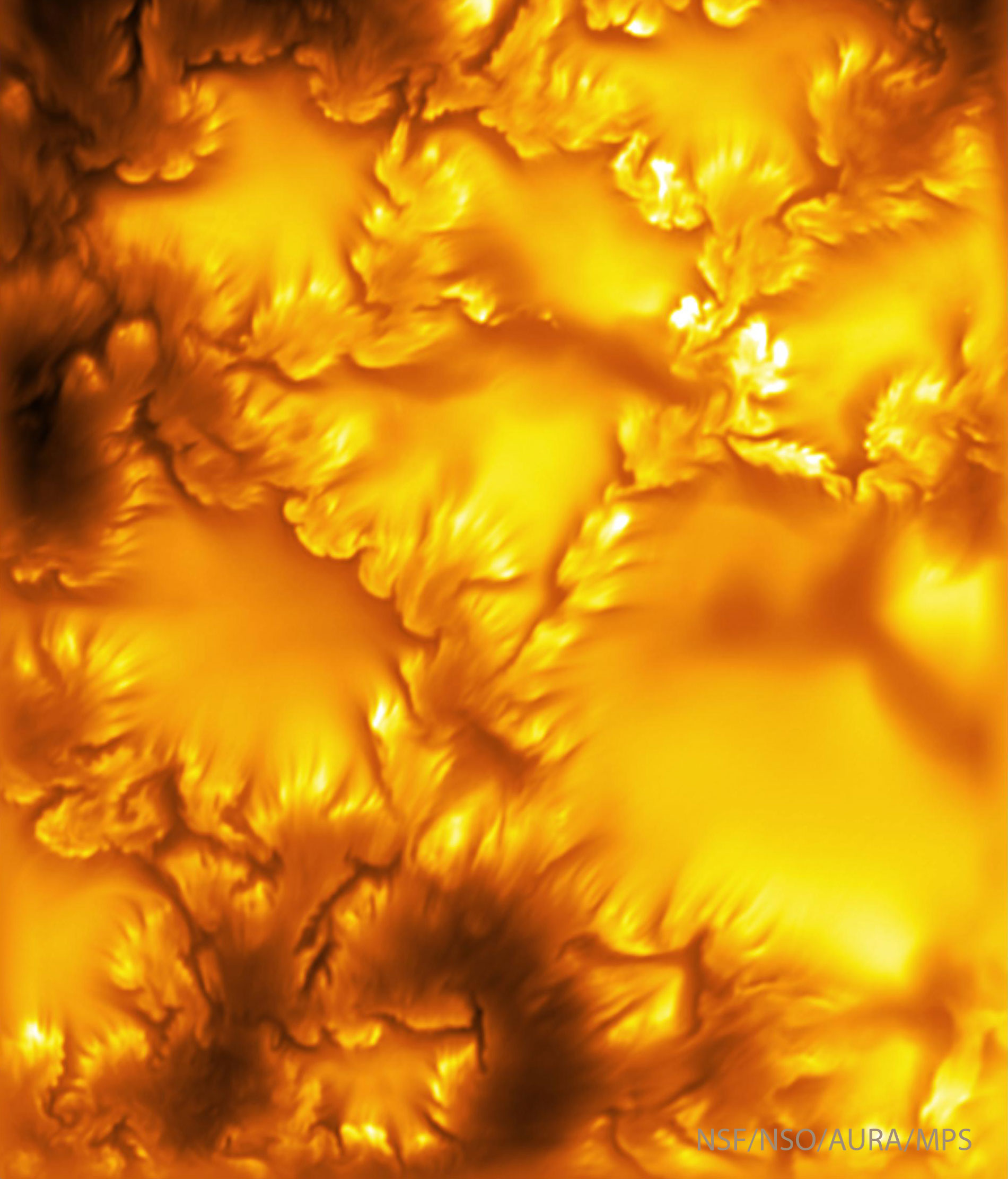
Image: NASA Astronomy Picture of the Day (APOD) · Image Credit: NSF, NSO, AURA, MPS, Inouye Tel. · Page for the day
Today's NASA Astronomy Picture of the Day looks, at first glance, like a flower.
Against a golden background float a cluster of bright, tightly packed cells, each with a smooth bright top and darkened edges. It could be something under a microscope, or a close-up of woven fabric.
It's the Sun. And it is, to date, the sharpest photograph of the solar surface ever taken in visible light.
First, how big this photo is
There's a line in the APOD description that's easy to read past: the area spanned by this image is roughly equal to Earth's radius—yet the finest detail it can resolve is only the size of a city.
Put those two numbers together and you'll understand why it deserves the title "sharpest."
Earth's radius is 6,371 kilometers. Those petal-like bright cells are what astronomers call "granules," each roughly a thousand kilometers across—about the distance from Beijing to Shanghai. The smallest structure this telescope can resolve is approximately 19 kilometers, which happens to be its diffraction limit—the absolute sharpest that the laws of physics allow it to see.
A side note: the yellow color in this photo was added in post-processing. It was actually taken at a wavelength of 416 nanometers—deep blue-violet light.

Hidden at the edges of those petals: vortices
Granules are actually the Sun boiling.
Hot plasma from the Sun's interior surges upward, reaches the surface, radiates away its heat, cools, grows heavier, and sinks back down along the edges of the granules. So every bright cell you see is the center of a convective "pot," and every dark lane is where cooled plasma is draining downward. A single granule lives only about ten minutes—this photograph captures a picture that is being constantly redrawn.
The new discovery hides in those dark lanes.
Along these boundaries, researchers found vast numbers of tiny vortices and an extremely fine, rapidly moving dark striping. Their identity: Kelvin–Helmholtz instabilities (KHI).
A rule you've actually seen before
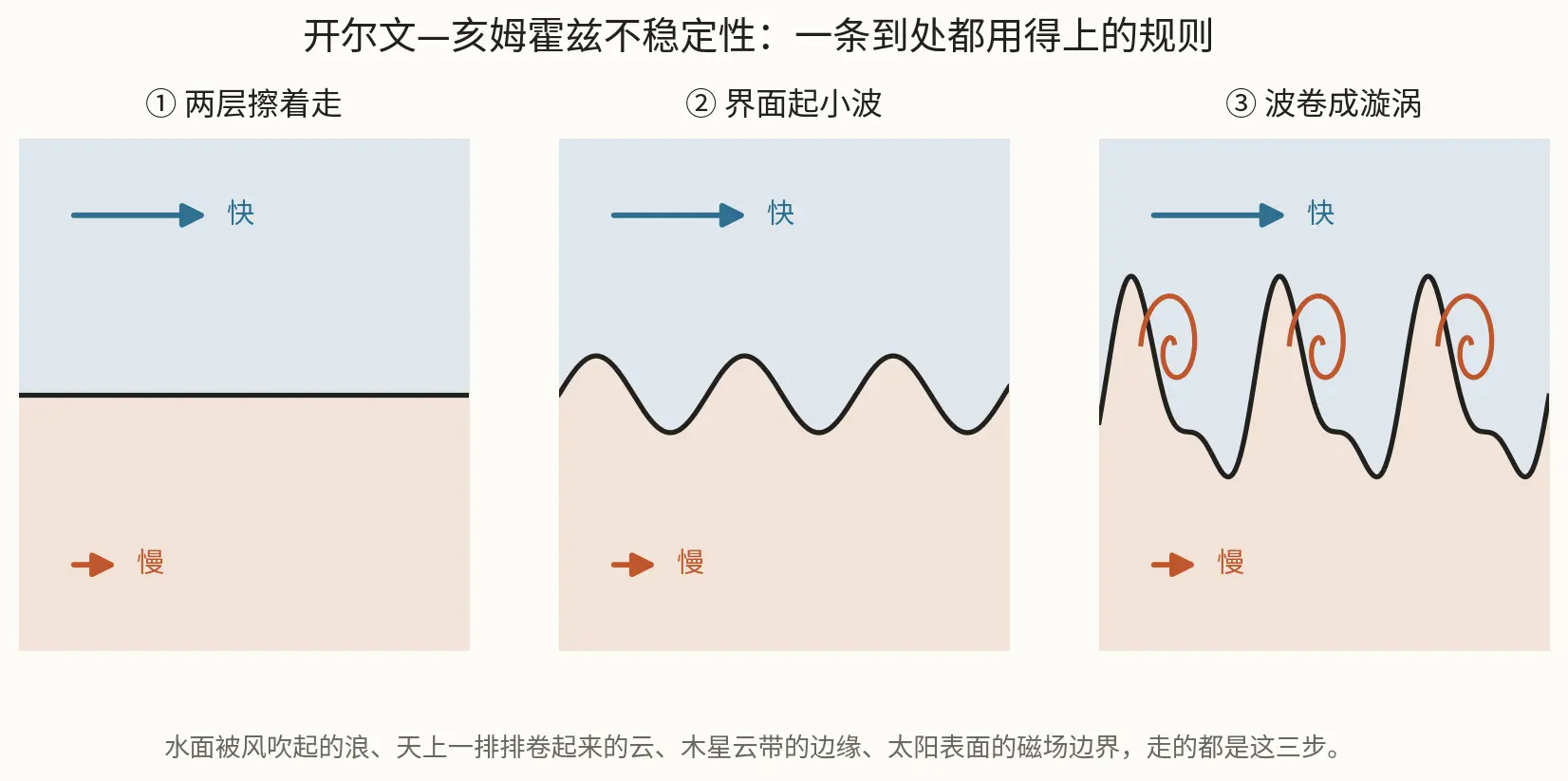
The terminology sounds intimidating, but the mechanism can be stated in a single sentence:
When two layers of fluid slide past each other at different speeds, any tiny ripple at the interface gets amplified—first growing into a wave, then rolling up into a vortex.
This rule was written into equations around 1870 by Lord Kelvin and Hermann von Helmholtz—156 years ago. And you've probably seen examples of it several times a year:
Wind pushing waves across a lake—that's it. Those neatly rolled-up clouds that sometimes appear in rows in the sky, looking like ocean waves frozen in midair—that's it. The strings of vortices at the boundaries between Jupiter's cloud bands—that's it—and the famous Great Red Spot is thought to be the largest member of this family. The solar wind slamming into the boundary of Earth's magnetosphere—that's it too.
Now, the Sun's surface has been added to the list.
This is no minor addition. Astronomers had long predicted theoretically that KHI should exist on the solar surface, but they could never see it—not because it wasn't there, but because previous instruments couldn't resolve structures on the scale of tens of kilometers. Seeing it required a large enough telescope.
That telescope
It's called the Daniel K. Inouye Solar Telescope, perched near the summit of Haleakalā volcano on Maui, Hawaiʻi. Built and operated by the U.S. National Solar Observatory, it is currently the most powerful solar telescope in the world.
Its primary mirror is four meters across, collecting seven times more sunlight than any other solar telescope. The observation data for this discovery were taken in April 2025, when the telescope locked onto a magnetically active region near a sunspot and captured a time-lapse sequence.
After the observations came a crucial step: placing the real data side by side with supercomputer simulations. The research team ran a magnetohydrodynamics code specifically designed to simulate the solar atmosphere, producing "synthetic images," then compared the vortices from both sources—the average spacing between vortices fell between 50 and 65 kilometers in both the real observations and the simulations.
When two completely independent sources yield the same number, that's when scientists dare say "confirmed." The paper was published yesterday (August 5, Eastern Time) in Nature.
Why a bunch of vortices is worth a Nature paper
Because they may be the shared answer to two big questions.
The first question: Why is the corona so hot?
The Sun's surface is around 5,500 degrees Celsius. But the Sun's outer atmosphere—the corona—reaches temperatures on the order of a million kelvins. The farther you get from a fire, the cooler it should be; the Sun stubbornly does the opposite. This paradox has puzzled physicists for decades and is known as the coronal heating problem.
The second question: How does the Sun's magnetic field get wound up so tight?
The current mainstream explanation is called "magnetic flux braiding": magnetic field lines at the solar surface intertwine like a braid, winding tighter and tighter, accumulating enormous tension. When some point can no longer hold, the field lines snap apart and reconnect (magnetic reconnection), releasing the stored energy in an instant—this is the origin of solar flares and coronal mass ejections, and thus the source of "space weather" that can disrupt satellites, power grids, GPS, and communications.
The question has always been stuck at: Who is braiding that braid?
The new discovery offers a candidate answer. The Sun's boiling granules and magnetic field structures squeeze against each other, naturally creating the condition of "adjacent layers moving at different speeds"—so KHI occurs everywhere. If these vortices truly are ubiquitous and constant, they may be precisely the engine that, day after day, winds the magnetic field lines tighter.
The researchers also mention a third point: the Sun's magnetic cycle is only eleven years, which is anomalously fast on cosmic scales, meaning magnetic flux must be "dissipated" with extreme efficiency—and existing models can't produce such a rapid dissipation rate. KHI efficiently churns magnetized and unmagnetized plasma together, and may be exactly that missing piece of the answer.
A swarm of vortices only tens of kilometers wide, connected to three major problems. That's why APOD today didn't choose a prettier nebula.
Practical information: this August, the Sun and sky have plans
August is especially kind to astronomy enthusiasts. The following are all based on NASA's official August Skywatching Tips:
- August 12 (Wednesday): Total solar eclipse. The path of totality crosses northern Russia, Greenland, Iceland, northern Spain, and a small corner of Portugal; partial phases are visible from parts of the U.S. ranging from Alaska to North Carolina. This eclipse is not visible from China.
- Night of August 12 into the early hours of August 13 (Thursday): Perseid meteor shower peak. This one Chinese readers can see. And this year the luck is exceptional—August 12 happens to be a new moon, meaning no moonlight interference all night, making this one of the best Perseid viewing conditions in recent years. Find a spot far from city lights, look toward the northeastern sky, give your eyes at least twenty minutes to adapt to the dark, and don't look at your phone.
- August 14–16: Venus reaches greatest eastern elongation, visible low in the western sky shortly after sunset, brighter than any star around it.
- August 27–28: Partial lunar eclipse, with approximately 93% of the Moon's diameter entering Earth's umbra at maximum. Visible from most of the Americas and parts of Europe and Africa.
Safety reminder for solar viewing (the part you can't skip): NASA's official stance is firm—any time any part of the Sun is still exposed, you must use certified eclipse-viewing glasses or dedicated solar filters; regular sunglasses are not safe; telescopes, binoculars, and cameras without a proper solar filter on the front of the lens must never be pointed at the Sun. This is not a formality—retinal damage is irreversible, and painless while it happens.
Closing
The Sun is the only star whose surface details you can actually see. Every other star, even in the best telescopes, is just a point of light.
And what today's photograph tells us is this: the nearest star to us is constantly churning up waves at a density of one every few tens of kilometers across its surface. These waves obey the same rule as the ones you see on a lake, the ones at the edges of Jupiter's cloud bands, and the ones in those curling clouds you occasionally look up and catch—a rule written 156 years ago.
The universe builds its sentences with the same grammar; it just sometimes sets the font size to the width of a city.
On the night of August 12, if the sky is clear, go outside and sit for a while. This year there's no moon in the way.
Sources: APOD page for August 6, 2026; National Science Foundation's National Solar Observatory (NSF NSO) press release dated August 5, 2026, "NSF Inouye Solar Telescope Enables Major Discovery of a Hidden Solar Process"; Kuridze et al., "Ubiquitous Kelvin-Helmholtz Instabilities Driving Plasma Mixing on the Sun" (Nature, 2026); coverage of the research by Sky & Telescope, CNN, and ScienceAlert; NASA "What's Up: August 2026 Skywatching Tips" and the NASA/JPL video page of the same name.