
A city once called the "Garden City" has lost two-thirds of its green space. What remains is held up by pairs of invisible hands.
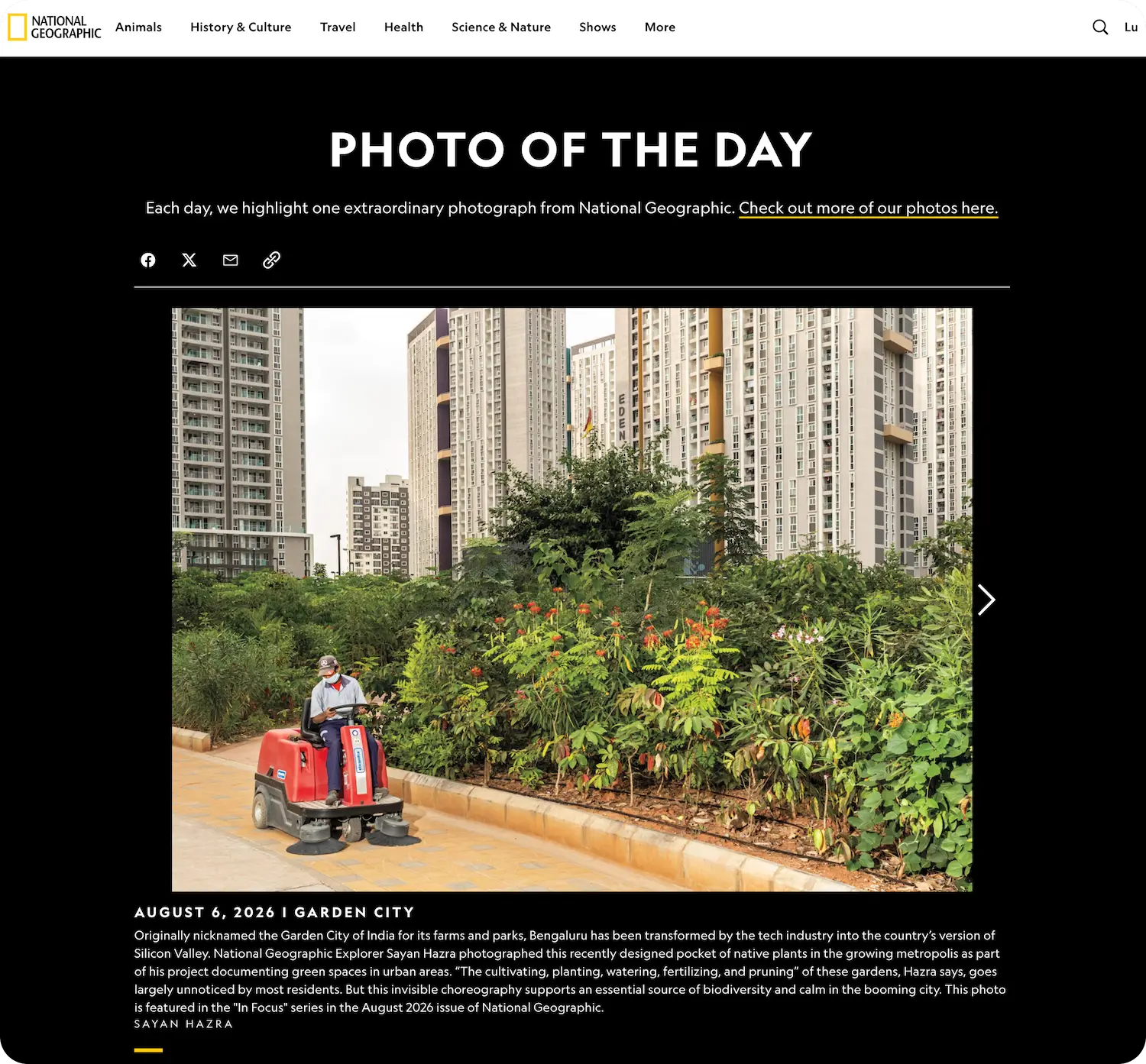
Image: Nat Geo Photo of the Day · Photograph by Sayan Hazra · Original page.
National Geographic's Photo of the Day today is called Garden City.
The scene looks like this: a person wearing a mask and a cap sits on a red ride-on sweeper, driving along a brick-paved path. To his right is a lush cluster of greenery dotted with orange-red flowers. And behind all of this stands a row of white high-rise apartment blocks so tall you can't see the tops—windows packed densely, stretching beyond the edge of the frame.
The location is Bengaluru, India. The photographer is National Geographic Explorer Sayan Hazra.
One City, Two Nicknames
Bengaluru's earliest nickname was "the Garden City of India."
This wasn't a marketing slogan. The city sits at elevation, its climate naturally cool and pleasant, surrounded by farmland and nurseries. In the 1760s, the ruler Hyder Ali established Lalbagh Botanical Garden here; it was later expanded by Tipu Sultan. Today the garden covers about 97 hectares, with over a thousand plant species and a glass house modeled after London's Crystal Palace. In 1831, the British built Cubbon Park in the city—about 80 hectares.
The name "Garden City" became famous starting with Lalbagh.
Green was in this city's bones. Some streets in the old neighborhood of Malleshwaram were named directly after the trees once planted along them: Sampige Road after the champak tree, Margosa Road after the neem. Residents originally grew vegetables and fruit in their own courtyards, and planted trees along the roads as they went.
Later, the city acquired a second nickname: India's Silicon Valley.
From the 1990s onward, the software industry poured into Bengaluru, and glass curtain walls and steel structures began swallowing vast tracts of open land. A research team from the Indian Institute of Science used satellite imagery to compile a count: In 1973, the city's vegetation cover was 68%; by 2012, it was down to roughly 23%.
In forty years, two-thirds gone. The same body of research produced another, more visceral figure: Bengaluru now has approximately one tree for every seven people. For comparison, Gandhinagar in Gujarat has four trees per person.
(Different studies, owing to different methodologies and boundaries, produce varying numbers—some calculate even lower ratios for specific areas. But the trend points in the same direction across all of them.)
The same goes for lakes. The city's undulating terrain historically held a large network of interconnected natural and artificial lakes. Now only a fraction remain; many were filled in and built over.


And so today's photograph gains another layer of meaning: a cluster of flowering native plants and an entire row of high-rise apartments, crammed into the same frame. That's not a background-and-subject relationship. That is the city's entire predicament right now.
Why "Native Plants" Is the Key Phrase
In the National Geographic caption, the photographer specifically notes this is "a recently designed pocket of native plants."
That phrase is worth unpacking.
In urban greening, plant selection is often driven by aesthetics, ease of maintenance, and speed of growth. The result is that landscaping in residential developments worldwide is starting to look increasingly alike—the same few exotic ornamental species that tolerate pruning, stay green year-round, and bloom in tidy rows.
Visually, no problem. Ecologically, it's almost the same as painting green on a wall.
Here's why: Local insects evolved alongside local plants.
For a caterpillar to eat a particular leaf, it first has to overcome that plant's chemical defenses—tannins, alkaloids, latex. Every plant has its own arsenal. This "cracking" requires long coevolution. Replace a tree with one from another continent, and most local caterpillars can't feed on it—so they simply don't come.
The research that quantified this most clearly comes from North America. Entomologist Doug Tallamy compiled the following: A native oak can support over 530 species of caterpillar; another native tree, the tulip poplar, supports only about eight; and many exotic ornamental plants support virtually no native caterpillars at all.
Then comes the next link in the chain.
Most songbirds don't eat seeds during breeding season—they feed their nestlings exclusively on caterpillars: soft, easy to swallow, high in protein and fat. A pair of chickadees raising a brood needs six thousand to nine thousand caterpillars, averaging 350 to 570 per day.
So the chain connects like this: No native plants → no caterpillars → no birds.
No matter how lush a patch of landscaping looks, if it doesn't produce insects, birds won't take up residence. The birdsong you hear is essentially a report on how many insects the greenery underneath is feeding.
(These specific numbers come from North American research; the species and quantities are of course different in India. But the mechanism—local insects recognizing local plants—is universal. And that is precisely why cities like Bengaluru have begun deliberately planting native species.)

The Person the Photo Is Really About
But the true subject of Hazra's photograph is not the flowers. It's the person driving the sweeper.
He notes that the "tilling, planting, watering, fertilizing, and pruning" of these gardens goes almost entirely unnoticed by residents. Yet it is precisely this invisible choreography that sustains an important source of biodiversity—and a rare pocket of quiet—in a city expanding at breakneck speed.
That observation highlights a fact we easily confuse: Almost nothing "natural" in a city grew there on its own.
It is designed—someone decided what to plant, where to plant it, and at what spacing. It is maintained—someone comes every morning to water, prune, sweep fallen leaves, and clear drains. It is even scheduled for replacement—whether a certain tree will be swapped out in a few years is written on a plan.
This isn't to say urban green spaces are fake. Quite the opposite: a thoughtfully designed patch of native plants in a residential compound really can nurture insects, attract birds, and push surrounding temperatures down a degree or two in summer. Researchers in Bengaluru have found that the city's remaining contiguous green areas are indeed one to two degrees Celsius cooler than their surroundings.
It's just that this "nature" comes with a bill. On it: water, fertilizer, labor, and that red sweeper every morning at dawn.
Most residents see that the flowers have bloomed. Hazra's photograph shows why they're still blooming.
Closing
This piece can't give you a "where to go this weekend" recommendation—Bengaluru isn't on most people's itineraries.
But it does suggest something you can do in almost any city.
Tomorrow, when you step outside, find any shrub in your compound or along your usual street. Stand still. Look for thirty seconds. Check whether the leaves have chewed edges or holes.
Holes are a good sign. They mean the greenery is alive—it's feeding something. And that something will attract birds.
If every leaf across the entire landscaped area is intact, pristine as plastic—that, too, is an answer.
Take it one step further: find someone and ask. What are these trees? Who planted them? Who waters them?
Chances are, someone can answer. And according to Hazra, very few people ever ask.
Sources: National Geographic Photo of the Day entry for August 6, 2026, Garden City, caption; Indian Institute of Science (IISc) Centre for Ecological Sciences satellite imagery studies on Bengaluru's vegetation cover, tree counts, and urbanization, and the Trees of Bengaluru technical report; Mongabay India reporting on Bengaluru community parks and biodiversity; Narango, Tallamy & Marra's research on native plants, caterpillars, and insectivorous bird breeding (Biological Conservation, 2017) and related outreach from the National Audubon Society and the Cornell Lab of Ornithology; historical records of the founding of Lalbagh and Cubbon Park.