
A star's farewell performance, and the two renamings of a nebula.

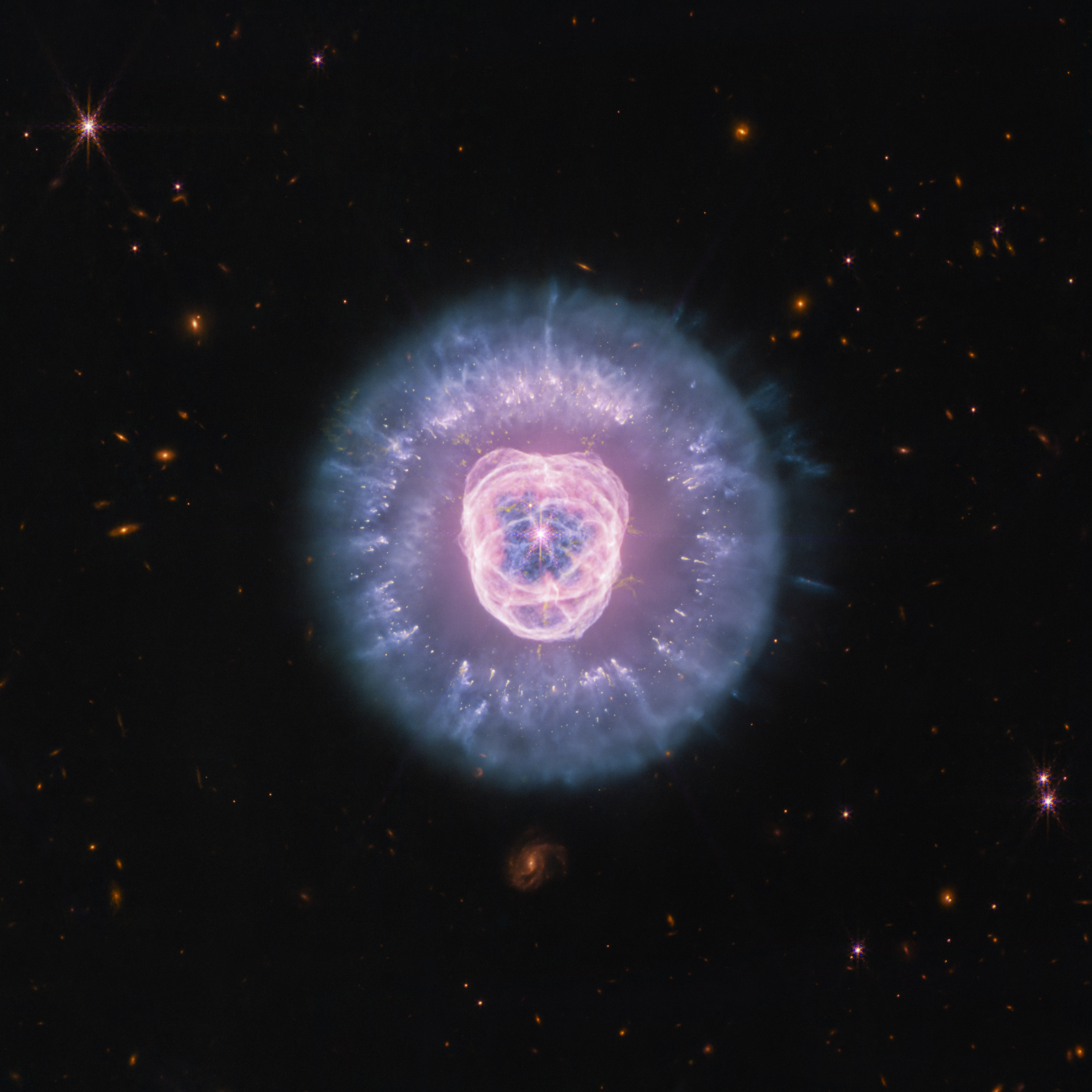
Image: NASA Image of the Day · Image credit: NASA, ESA, CSA, STScI; Image Processing: Alyssa Pagan (STScI) · Image page
Start with that "mane."
Ring after ring of fluff radiating outward from the center, as puffy as a lion just woken from sleep. This is Webb's latest work, released by NASA yesterday (August 10) and featured today on the NASA Image of the Day page: NGC 2392, now known as the Lion Nebula.
But if you look closely at those "hairs," you'll find they aren't hairs at all—each strand is a clump trailing a tail, like a swarm of comets flying outward.
What's in the picture
According to NASA's official description, Webb captured this nebula using its Near-Infrared Camera (NIRCam) and Mid-Infrared Instrument (MIRI), producing an image far sharper than Hubble's earlier visible-light photograph. That mane is actually the inner wall of a vast dust shell, lit from within by the white dwarf star at its center—what you're seeing isn't a lion's fur, but a lamp shining outward from inside a hollow sphere. And those comet-like strands are dense knots of dust that have withstood the central star's radiation: the radiation blew away all the loose material around them, leaving only these sturdy clumps behind, each trailing a "shadow tail" cast in its wake.
In one sentence: this photograph captures a demolition in progress, and the last pillars in the rubble that refuse to fall.
This isn't a place—it's a moment
NGC 2392 is a planetary nebula. The name is a misnomer from start to finish—it has nothing to do with planets. It's just that telescopes from over two hundred years ago had such poor resolution that these objects looked round like Jupiter or Uranus, and the name stuck.
What it truly is: the farewell performance of a star roughly the size of our Sun.
Stars like this burn steadily for billions of years. When their fuel runs low, they swell into red giants and begin puffing off their outer layers in successive waves—in its final red-giant phase, a star can shed half to seventy percent of its total mass. Once the outer garments are gone, the scorching core is laid bare, becoming a white dwarf whose intense radiation lights up all the gas and dust just cast off. And so we see a glowing cloud with a tiny bright dot at its center.
The key is how brief this act is. A planetary nebula shines for only tens of thousands of years—the gas keeps expanding and thinning, the white dwarf keeps cooling and dimming, and in roughly ten thousand years the lamp goes out. For a star that lived over ten billion years, a few tens of thousands of years is equivalent to a few hours in a human lifetime. So a planetary nebula isn't a place—it's a moment. Every one we see means we happened to catch it in time.
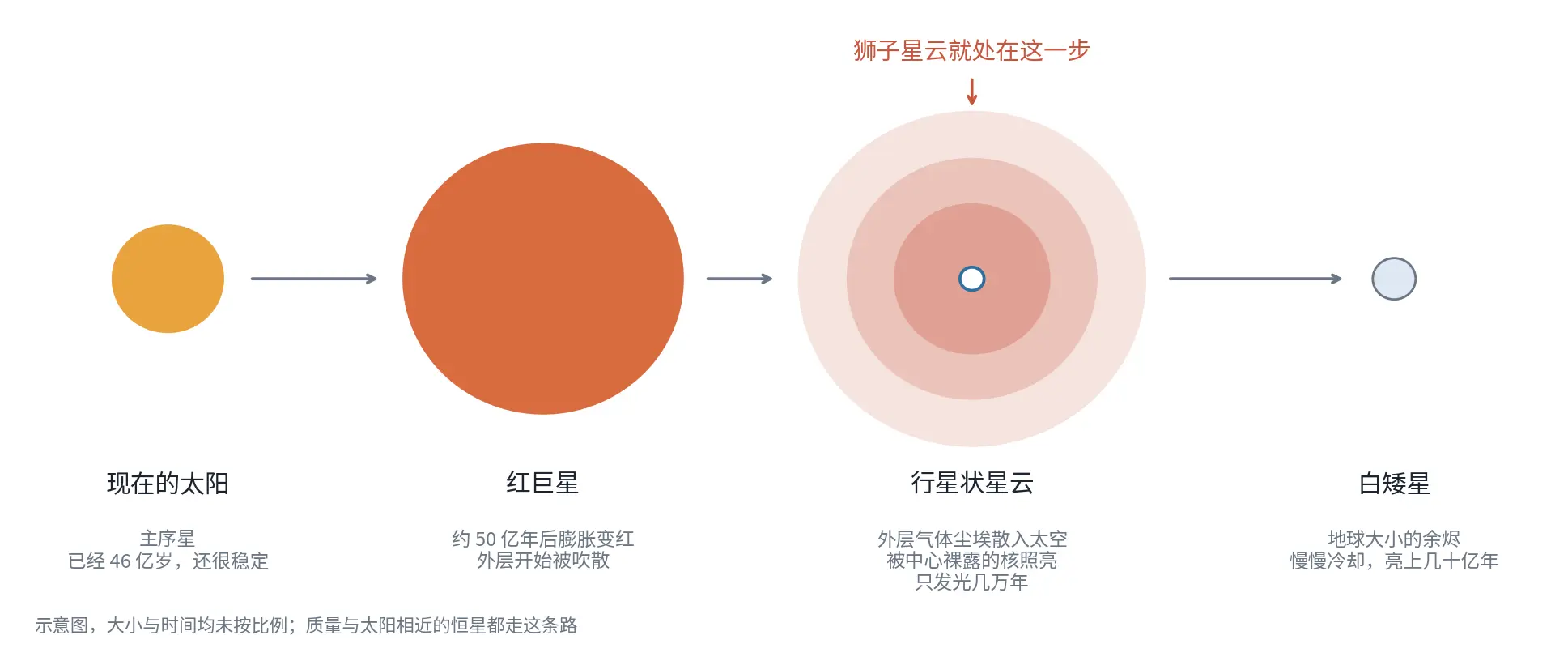
This isn't someone else's story, either. The Sun is exactly this kind of star—46 billion years old this year, still in its stable middle age. In about five billion years, it will go through the very same sequence. That ring of mane in today's photograph is a trailer for the solar system's future.
There's an even closer connection. Stars in this phase are the universe's primary dust factories—NASA specifically noted in this release that a significant portion of observable dust in the universe was produced by dying stars like these. The dust and gas carry carbon, nitrogen, and oxygen synthesized over the star's lifetime, drifting back into interstellar space to become raw material for the next generation of stars and planets. The calcium in your bones and the iron in your blood may not have come from NGC 2392, but they certainly came from some farewell like this one.
A nebula renamed twice
Now for the matter of names—perhaps the most "cultural" part of today's image.
On January 17, 1787, William Herschel first observed it from Slough, England, noting in his log: "A star of the 9th magnitude, pretty bright in the middle, nebulosity equally dispersed all around." Later observers, seeing its layered rings, gave it two nicknames: the outer ring looked like a fur-lined parka hood, so they called it the "Eskimo Nebula"; the inner ring resembled a painted face, earning it the alternate name "Clown Face Nebula."
In August 2020, NASA announced it would no longer use nicknames like "Eskimo Nebula"—the word "Eskimo" carries colonial-era derogatory connotations, and Inuit and other Arctic Indigenous peoples do not accept the term. According to Wikipedia, on August 11 of that year, the IAU's Working Group on Star Names and two major astronomical databases officially retired the old names, recommending the designation NGC 2392 instead.
From that day to today: exactly six years.
For those six years it went by nothing but a string of catalog numbers. Then, with this new Webb image release, NASA's headline used "Lion Nebula" outright—the same dust shell that last century's observers saw as a fur-lined hood, this era's observers see as a lion's mane. Where exactly the new nickname "Lion" originated, we could not trace to a definitive source; what we can confirm is that the Wikipedia entry now lists it among the object's alternate names. The star itself hasn't moved a single millimeter. What moved is the people looking at it.
For explaining this to a child, one sentence will do: Nothing in the sky has a name. Every name is something people on the ground lent it—and anything lent out can, of course, be taken back and replaced with something better.
You can see one tonight
NGC 2392 lies in Gemini at magnitude 10.1—a small telescope can find it, but you'll have to wait. Gemini is a winter constellation; at this time of year it barely peeks above the eastern horizon before dawn, and won't climb back into the high evening sky until winter.
However, if you want to see a planetary nebula with your own eyes tonight, there's a more convenient one hanging overhead right now: M57, the Ring Nebula in Lyra. On August evenings around nine or ten o'clock, Vega sits almost directly overhead, and M57 lies on the short side of Lyra's small parallelism beside it—through a small telescope, it's a tiny, grayish-white smoke ring. That, too, is the shell left behind by a dead star. With no Moon these next two nights (August 12 is the new moon, and the Perseid meteor shower is at its peak), watch the meteors first, then swing your telescope toward the zenith.
In a single night: the meteors are solar-system dust burning up; the smoke ring is the entire outer garment left behind by another sun. Both are farewells—just on different scales.
Sources: NASA Image of the Day "Lion Nebula Roars in Webb's Sights", NASA Science "Lion Nebula Roars to Life With NASA's Webb", ESA companion release page, Wikipedia "Eskimo Nebula" & "Planetary nebula", NASA 2020 statement "NASA to Reexamine Nicknames for Cosmic Objects"