
A city built on a plateau at 4,150 meters, a market where you can buy anything, and blood rewritten for thin air.
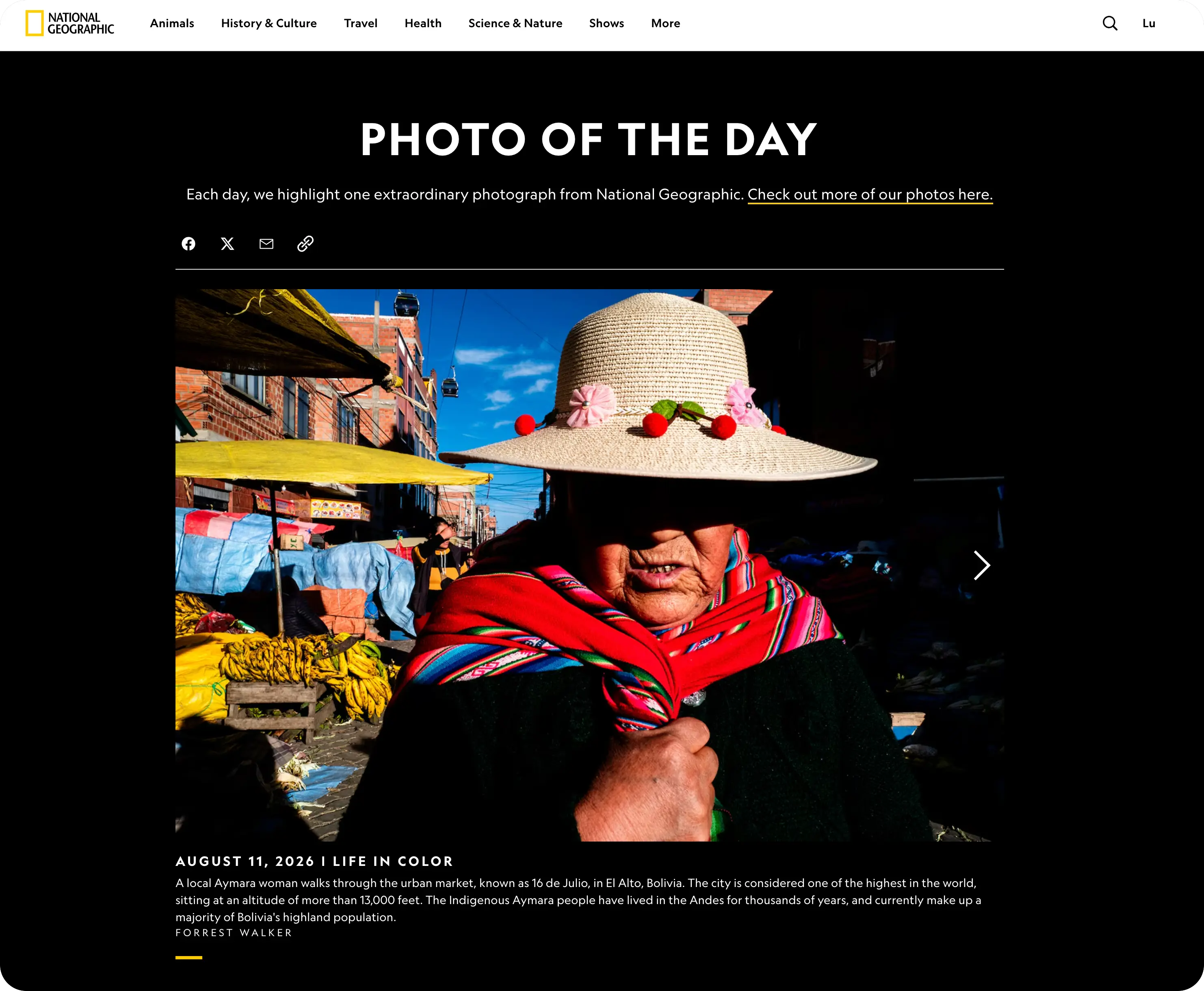
Today's National Geographic Photo of the Day is titled Life in Color. In the photograph, a local Aymara woman walks through the 16 de Julio market in El Alto, Bolivia. You can view the original on the National Geographic website.
Take a Deep Breath First
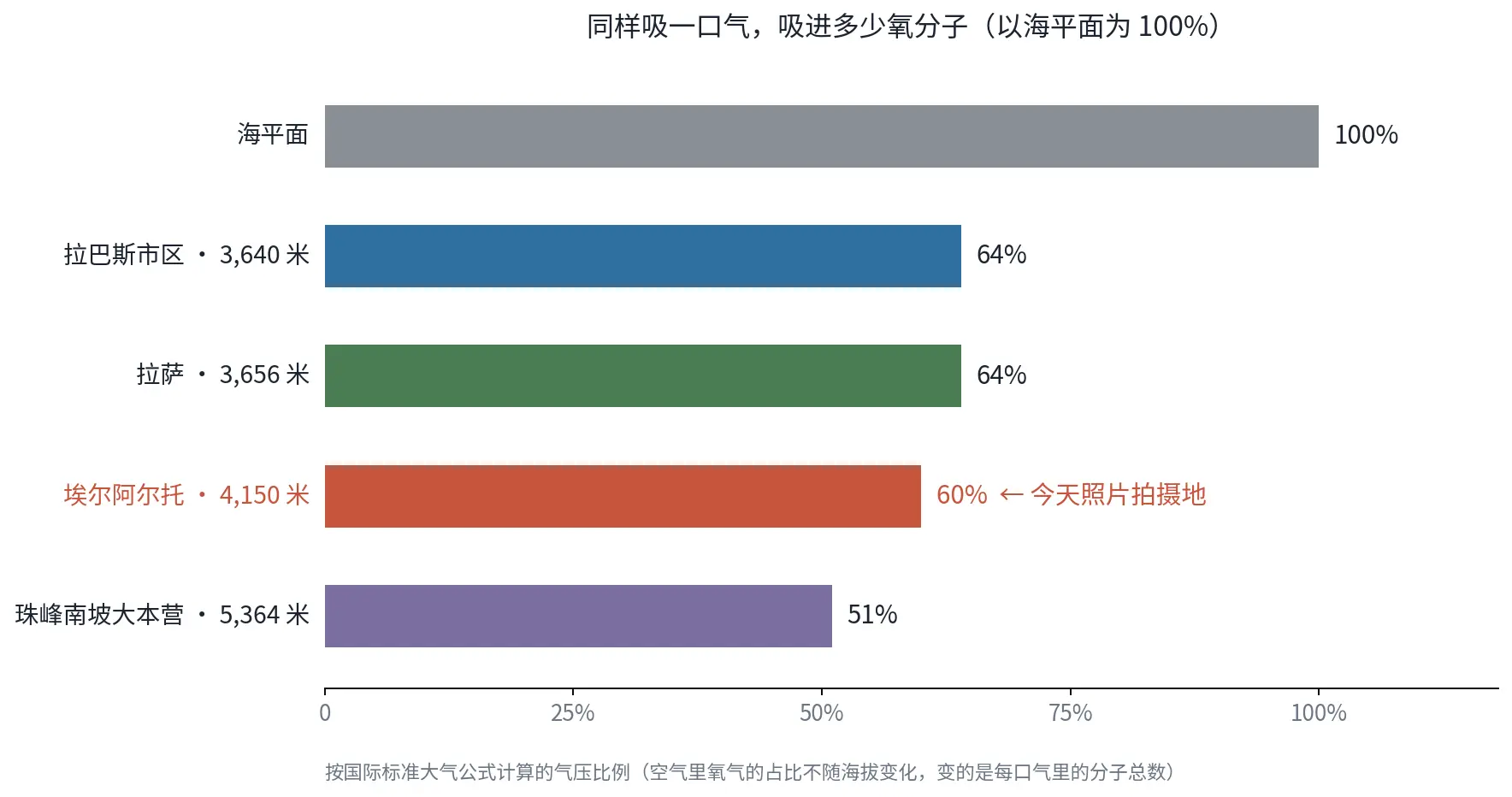
El Alto (Spanish for "the heights") sits at an elevation of 4,150 meters. To put that in perspective: Lhasa is at 3,656 meters—this city is a full 500 meters higher than Lhasa. With a population of 885,000 (2024 census), it is Bolivia's second-largest city and what is commonly called "the highest major city in the world."
At this altitude, the proportion of oxygen in the air is exactly the same as at sea level—still 21%. What changes is that the air itself is thinner. By the standard atmospheric formula, air pressure at 4,150 meters is only about 60% of what it is at sea level. In other words, when you take a breath in El Alto, the oxygen molecules entering your lungs are only about 60% of what you'd get from the same breath at the coast. For unacclimatized visitors, this means headaches, breathlessness, and a heart pounding like a drum after just a few steps.
And yet the people in this photograph were born here, grew up here, and haul goods through the market every day. How?
It's in the blood. The photo caption's line about "the Aymara having lived in the Andean highlands for thousands of years" is not a throwaway remark—archaeological evidence shows that humans have been hunting and gathering on the Andean plateau for up to 11,000 years. Ten thousand years is enough time for evolution to start remodeling a body. Classic research by Case Western Reserve University anthropologist Cynthia Beall produced a hard set of numbers: the average hemoglobin concentration in Aymara men is 19.2 grams per deciliter, while Tibetan men living at a comparable altitude average only 15.6 g/dL—close to the normal value for sea-level populations. In other words, Aymara blood is essentially a "concentrated formula": the same liter of blood carries more oxygen.
Interestingly, Tibetans took a different evolutionary path: their hemoglobin isn't elevated, but their resting ventilation rate is about 50% higher than that of the Aymara—instead of thickening the blood, they speed up the breathing. Faced with the same exam question—"only 60% of the air"—the Tibetan Plateau and the Andean Plateau handed in two entirely different answers, and both passed. Evolution has no standard answer, only answers that keep you alive.
A City "Squeezed" Up into the Sky
El Alto's origin story is unlike that of most cities: no one chose this patch of high ground. Rather, the city below ran out of room, and people spilled upward.
Neighboring La Paz is built inside a massive canyon at about 3,640 meters. In 1903, the railroad reached the canyon's rim; over time, buildable land in the canyon grew scarcer and more expensive, and people had no choice but to move up, layer by layer. On that dry, sloping plateau atop the cliff, a city grew. In March 1985, it was administratively separated from La Paz; in 1987, it was formally incorporated—by municipal age, it's not yet forty years old, yet it is already the country's second-largest city, with a predominantly Aymara population.
Between La Paz and El Alto lies a steep slope of about 400 meters, where buses crawl in traffic along switchback roads. The city's solution is unique in the world: build a cable car system as if it were a metro. On May 30, 2014, the first line of Mi Teleférico ("My Cable Car") opened; today it is the world's longest urban cable-car network, with the Red, Yellow, and Green lines alone carrying 80,000–90,000 passengers a day—roughly three times faster than the bus. Here, commuting doesn't mean passing through the city; it means flying over the canyon.
A Market Where You Can Buy Anything from a Forklift to a Rifle
The 16 de Julio market in the photograph opens every Thursday and Sunday. Stalls spread along the streets as far as the eye can see—travel guides call it "one of the largest markets in the world," and Fodor's puts it more bluntly: here "you can buy everything from a forklift to a Kalashnikov." Used cars, auto parts, kitchenware, clothing, furniture, phones—one section after another. More than a market, it's a temporary city assembled twice a week.
The market takes its name from the neighborhood it occupies: Villa 16 de Julio. That date carries enormous weight in this valley: on July 16, 1809, Pedro Domingo Murillo launched an uprising against Spanish colonial rule in La Paz below, establishing one of South America's earliest autonomous governments. The revolt was crushed six months later; before his execution, Murillo left behind his famous words: "The torch I have lit shall never be extinguished." Today, July 16 remains La Paz's civic anniversary.
As for the "color" in the title—in El Alto it isn't confined to market stalls. The city has a collection of buildings that architects from around the world come to see. Locals call them cholets: local builder Freddy Mamani takes the geometric patterns of the ancient Tiwanaku civilization and high-saturation colors and applies them to street-facing façades—shops on the ground floor, banquet halls upstairs—built expressly for the rising Aymara middle class. Mamani once said something deeply moving, to the effect that he put "the colors of the awayo—the woven cloth mothers use to carry their children on their backs"—into his architecture. Andean color migrated from textile to wall.
The Photographer
Forrest Walker is an American street photographer who has spent years on a project documenting major cities around the world, and has published the street photography book Populace. Markets are among the places he frequents most—street photographers love markets because life there doesn't pose.
Final Thought
Next time you visit Lhasa and find yourself gasping and slowing down on Barkhor Street, consider this: on the other side of the planet there's a city 500 meters higher than the ground beneath your feet, where 880,000 people are born, go to market, hold weddings, and paint their houses in rainbow colors. The body remembers altitude, but life never pays it any mind—it grows color wherever it is.
If you can't get to any high plateau right now, here's a five-minute exploration: open your map app, search "El Alto," switch to satellite view, and look at that ocean of orange-red rooftops spread across the plateau. Then search for Freddy Mamani's cholet photos. You'll understand why today's photograph isn't titled "Life at the Top" but Life in Color.
Image: National Geographic Photo of the Day · Photography by Forrest Walker, Nat Geo Image Collection · Original page (All rights reserved; unauthorized use prohibited. This article does not reproduce the image.)
Sources: National Geographic Photo of the Day page, Wikipedia "El Alto" and "Mi Teleférico," Beall, Tibetan and Andean Patterns of Adaptation to High-Altitude Hypoxia, National Geographic report on Freddy Mamani's architecture, Fodor's Travel Guide entry on the 16 de Julio market, Banjo Tours history of the La Paz July 16 uprising, photographer's website fdwalker.com