
A grain of sand, a volcano and a solar eclipse that proves the Moon is new.
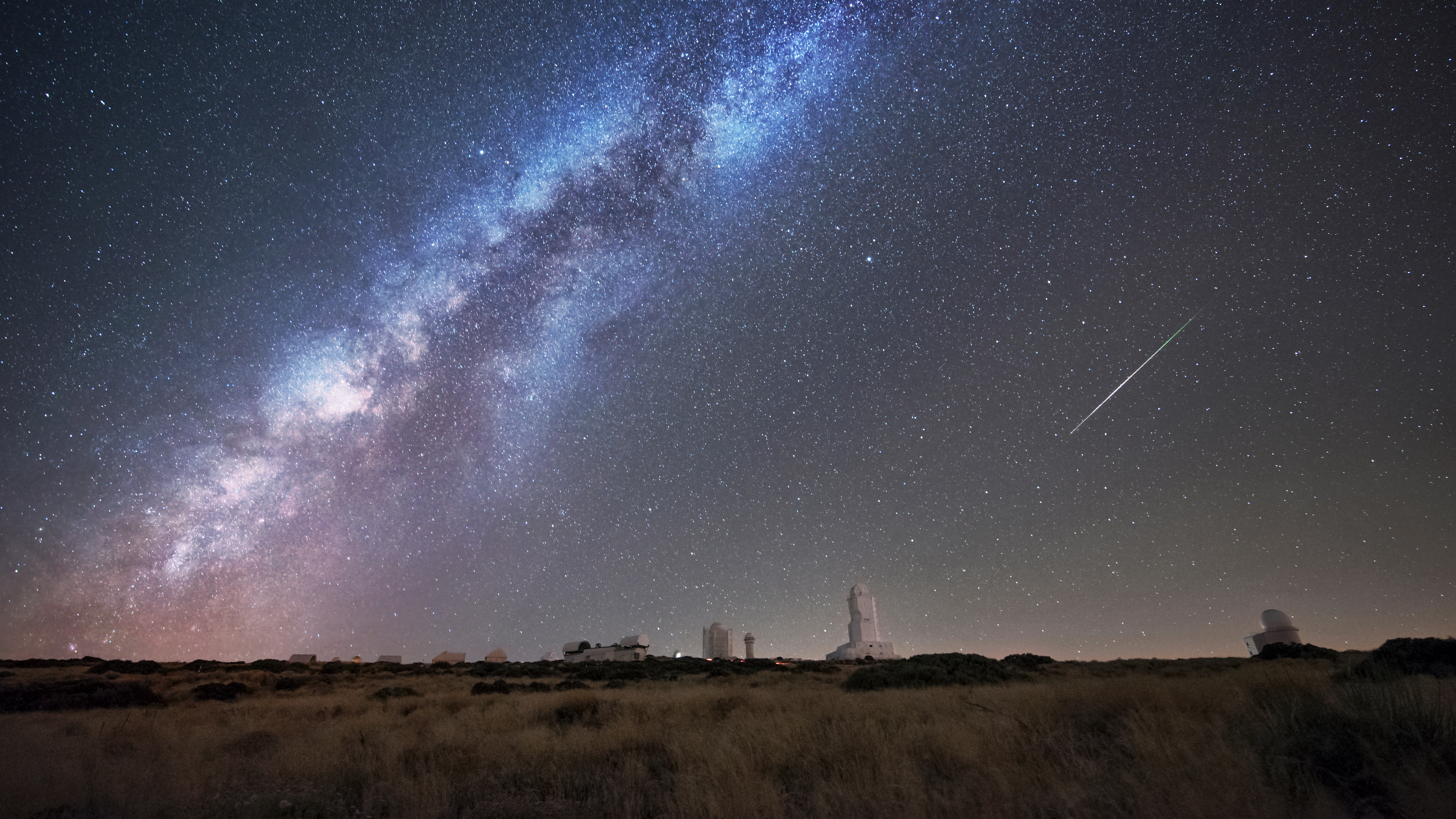
Image: Bing Daily Wallpaper | Perseid meteors over Teide Observatory, Canary Islands, Spain (© Westend61/Getty Images) | Bing homepage
Bing's homepage gave the photograph a two-word invitation: "Make a wish."
The sky is deep blue, split by a short, sharp white streak. Several white domes stand below. They are not resort buildings but an observatory: Teide Observatory on Tenerife in Spain's Canary Islands, 2,390 meters above sea level. The streak above it belongs to the Perseid meteor shower.
That Light Is Not Simply a Rock Burning
The familiar explanation says that a meteor is a rock falling into the atmosphere, rubbing against the air and catching fire. That is not entirely wrong, but it leaves out the most interesting part. Friction is not the main actor.
Imagine striking water quickly with your palm. The sensation is not caused by rubbing the water hot, but by forcing it into a space from which it cannot escape. A meteoroid does something similar on a far greater scale. It enters the thin upper atmosphere at tens of kilometers per second, too fast for the air to move aside, and violently compresses the gas in front of it. Compression heats gas. In a Xinhuanet science article reviewed by Liu Qian, a researcher at the Beijing Planetarium, friction accounts for only part of the heating; aerodynamic compression and the ionization that follows are the crucial processes.
Temperatures reach thousands or even tens of thousands of degrees. That is hot enough to vaporize the meteoroid's surface and strip electrons from nearby atoms, creating plasma. Excited atoms and ions in the plasma emit light. Strictly speaking, the white line in the sky is not a stone in flames. It is a column of air struck into brightness.
The altitude is often misunderstood as well. According to the Taipei Astronomical Museum, meteors generally begin glowing 70 to 120 kilometers above the ground and are largely consumed between 50 and 80 kilometers. Entry speeds range from 11 to 72 kilometers per second, with the Perseids among the faster showers. The streak remains tens of kilometers overhead from beginning to end; it never truly falls to the ground. Most of the objects that produce these streaks are only the size of grains of sand or small pebbles, and about 99.9% vaporize completely at altitude.
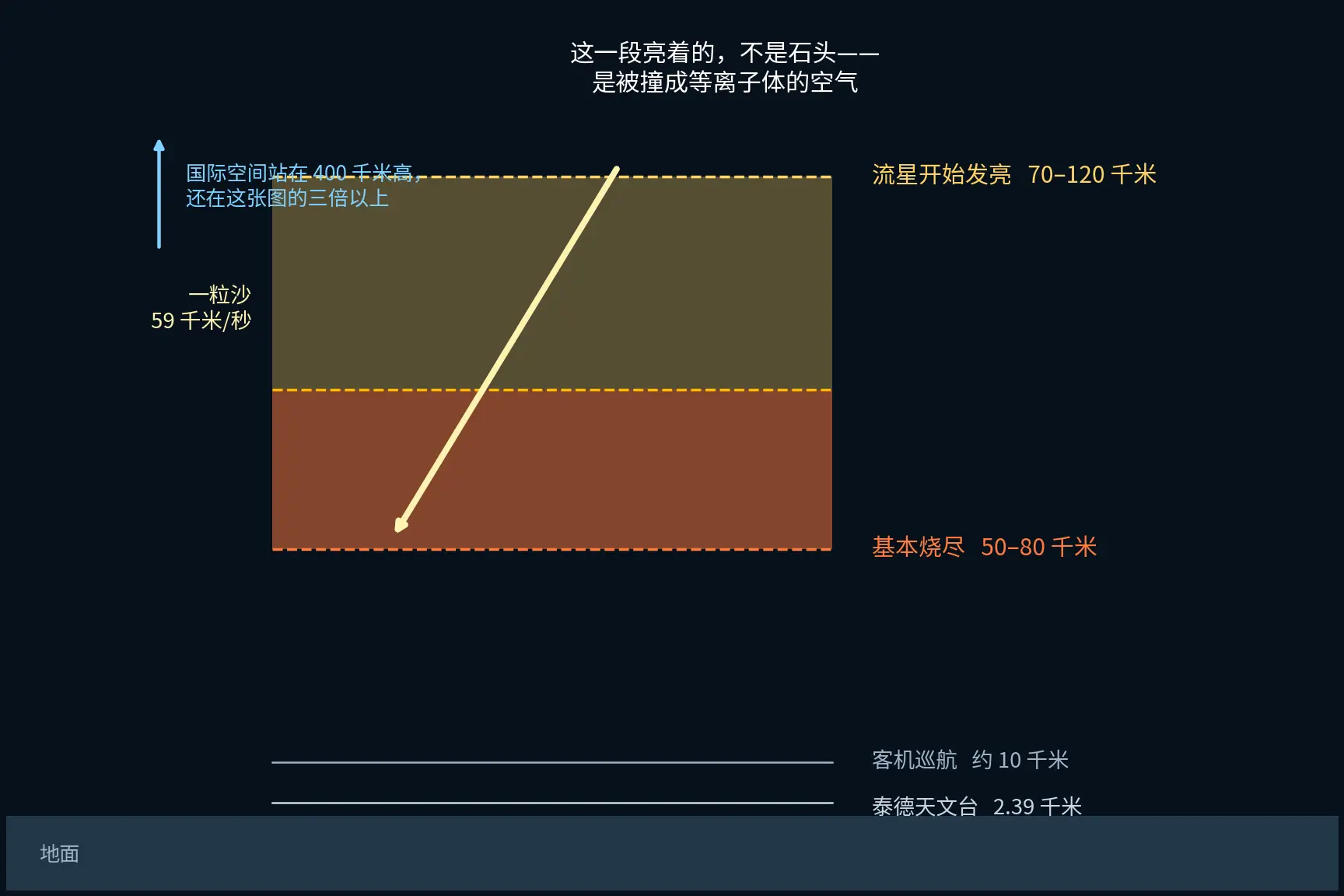
The light remains tens of kilometers up from beginning to end. The meteoroid does not land; it vanishes in the atmosphere.
The apparent origin of the Perseids is another illusion. The meteoroids travel along parallel paths, but perspective makes them seem to diverge from a single radiant in Perseus, just as railroad tracks appear to converge in the distance. The grains come from the trail of debris shed along the orbit of Comet 109P/Swift-Tuttle, which takes about 133 years to circle the Sun.
Why These Nights Were Exceptionally Dark
The Perseids are active each year from mid-July to late August. In 2026, the active period ran from July 17 to August 24, with the peak on August 12 and 13. That timing was the direct reason Bing chose this photograph.
The year also brought an unusually favorable sky, and the proof appeared in the previous day's news. A total solar eclipse occurred on August 12, its umbral path crossing Siberia, Greenland, Iceland, Spain and Portugal. A solar eclipse can happen only when the Moon passes between the Sun and Earth. That position has a simpler name: new moon.
The eclipse was therefore a receipt for the darkness of the Perseid peak. Star Walk listed the Moon's illumination on August 12 as 0%, and the next new moon to fall exactly on August 12 will not arrive until 2045. With no moonlight washing out the background, faint meteors that would normally disappear became visible.
The same alignment produced two apparently unrelated sights: during the day, the Moon covered the Sun; at night, its absence left the sky to the meteors.
The Canary Islands, including the observatory in Bing's photograph, did not lie in the path of totality. The Instituto de Astrofísica de Canarias reported a partial eclipse there, with about 70% of the Sun obscured. Maximum eclipse occurred at 19:53 local time and the event ended around sunset; the path of totality passed farther north.
Why an Observatory Sits on This Volcano
Teide Observatory's first telescope began operating in 1964. The site is now run by the Instituto de Astrofísica de Canarias and hosts a formidable collection of instruments: GREGOR, with a 1.5-meter aperture, is Europe's largest solar telescope; the 90-centimeter THEMIS is the world's third-largest solar telescope; the Vacuum Tower Telescope has operated since 1988; and the site also includes the infrared Carlos Sánchez Telescope, dating to 1972, IAC-80 from 1991, SONG and the QUIJOTE microwave telescope, completed in 2015.
The Canary Islands lie in the Atlantic at roughly the latitude of the Sahara. What makes Tenerife an astronomical site is an invisible lid in the atmosphere.
Northeast trade winds carry cool, moist air across the ocean toward the islands. Between roughly 600 and 1,800 meters, a temperature inversion places warmer air above cooler air. The warm layer presses down like a lid, trapping moisture and haze below it and producing the white blanket along the mountainside that local people call the mar de nubes, or sea of clouds.
At 2,390 meters, the observatory sits securely above that lid. The air is dry and stable, clouds are rare, and 83 of the 88 constellations can be identified from the site. The Izaña Atmospheric Observatory describes the setting more technically: it lies in the free atmosphere, above the inversion layer and below the descending branch of the Hadley cell. In practical terms, an exceptionally clean and steady column of air passes over the volcano's shoulder.
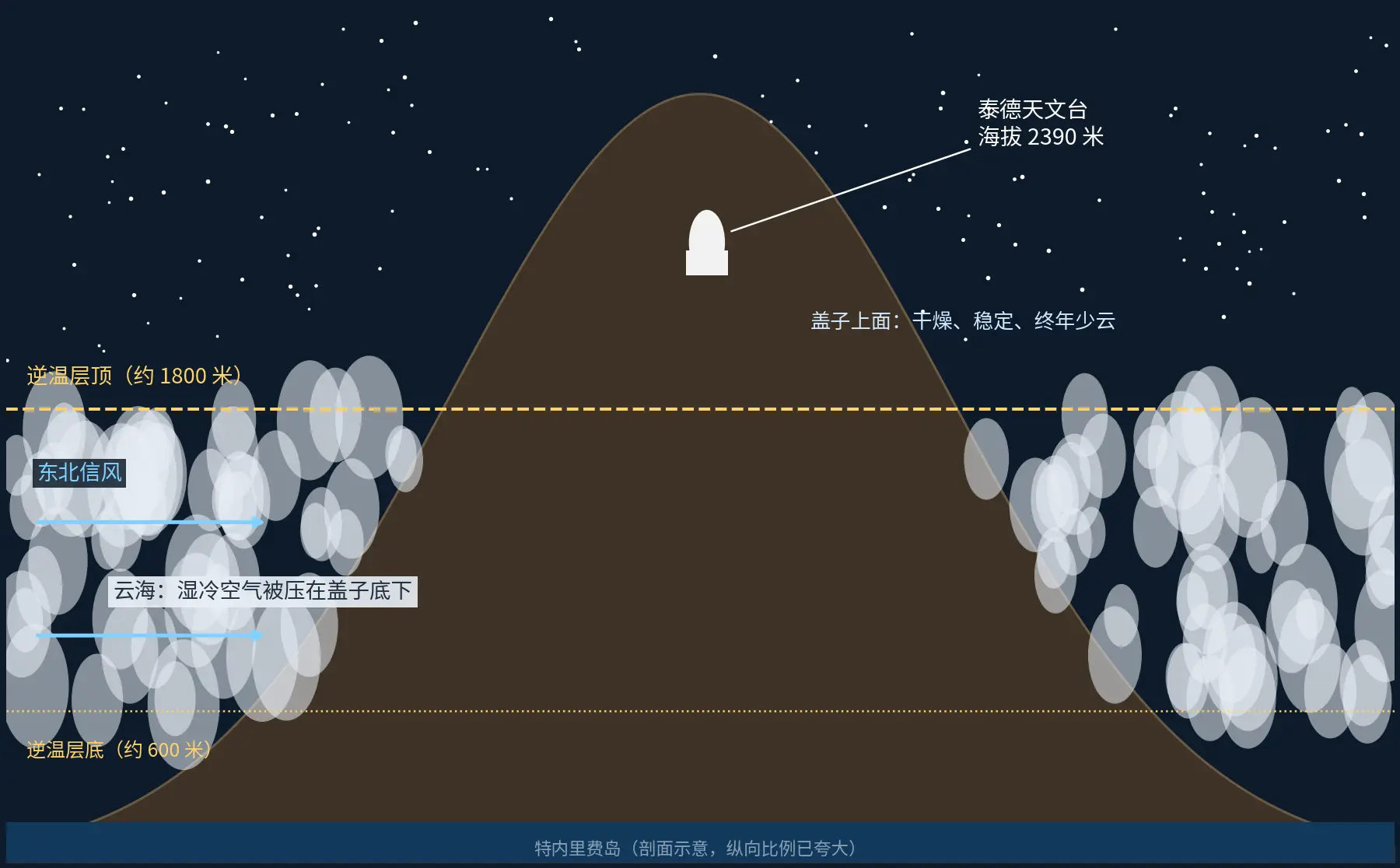
Trade winds trap moist air below the inversion layer, where it condenses into a sea of clouds. The observatory stands above it.
Clear air is natural; a dark sky must be protected. On October 31, 1988, Spain passed a law safeguarding the astronomical quality of the IAC's observing sites, with detailed regulations taking effect in March 1992. Known locally as the "Sky Law," it covers outdoor lighting, electromagnetic interference, atmospheric pollution and, since 1998, restrictions on flight paths above the observatories, with exceptions for military and humanitarian flights. The IAC describes it as the only law in the world to protect all four at once. Its effects are measurable: light pollution after midnight was projected to fall by 84%, while outdoor-lighting energy use was expected to decline by 45%.
In 2014, Teide National Park received Starlight Tourism Destination certification from the Starlight Foundation, becoming the first World Heritage Site to earn the designation. A volcano, a sea of clouds and a protective law together produced the sky in Bing's wallpaper.
The 2026 peak occurred on the morning of August 13 Beijing time, but meteor activity did not stop at that instant. The International Meteor Organization calendar's model put the maximum zenithal hourly rate at about 43, more conservative than popular claims of more than a hundred meteors an hour, and activity continued through August 24 with diminishing nightly rates.
The old habit of wishing on a shooting star has its own history. A belief attributed to Ptolemy held that a meteor meant the gods were looking down from the heavens, making words spoken at that moment more likely to be heard. The idea survived into Disney's Pinocchio and the song associated with it. The physical event is less supernatural but no less striking: tens of kilometers overhead, a grain of sand can make a column of air shine for a few thousandths of a second.
Sources: Bing Daily Wallpaper homepage API; Xinhuanet, "Is a Meteor's Light and Heat Caused by Friction with Earth's Atmosphere?"; Taipei Astronomical Museum, "Formation and Characteristics of Meteors"; Star Walk, "2026 Perseid Meteor Shower"; Volcano Teide, "Teide Observatory and the Sky of Teide"; Izaña Atmospheric Observatory (AEMET); Instituto de Astrofísica de Canarias, "30 Years Protecting the Canary Sky"; Instituto de Astrofísica de Canarias, "2026 Solar Eclipse Observation Guide"; Mental Floss, "Why We Wish on Shooting Stars".