
One photograph holds a whole night of sky and 1,706 streaks of light. Sorting them depends not on where they appear, but on where they point back to.
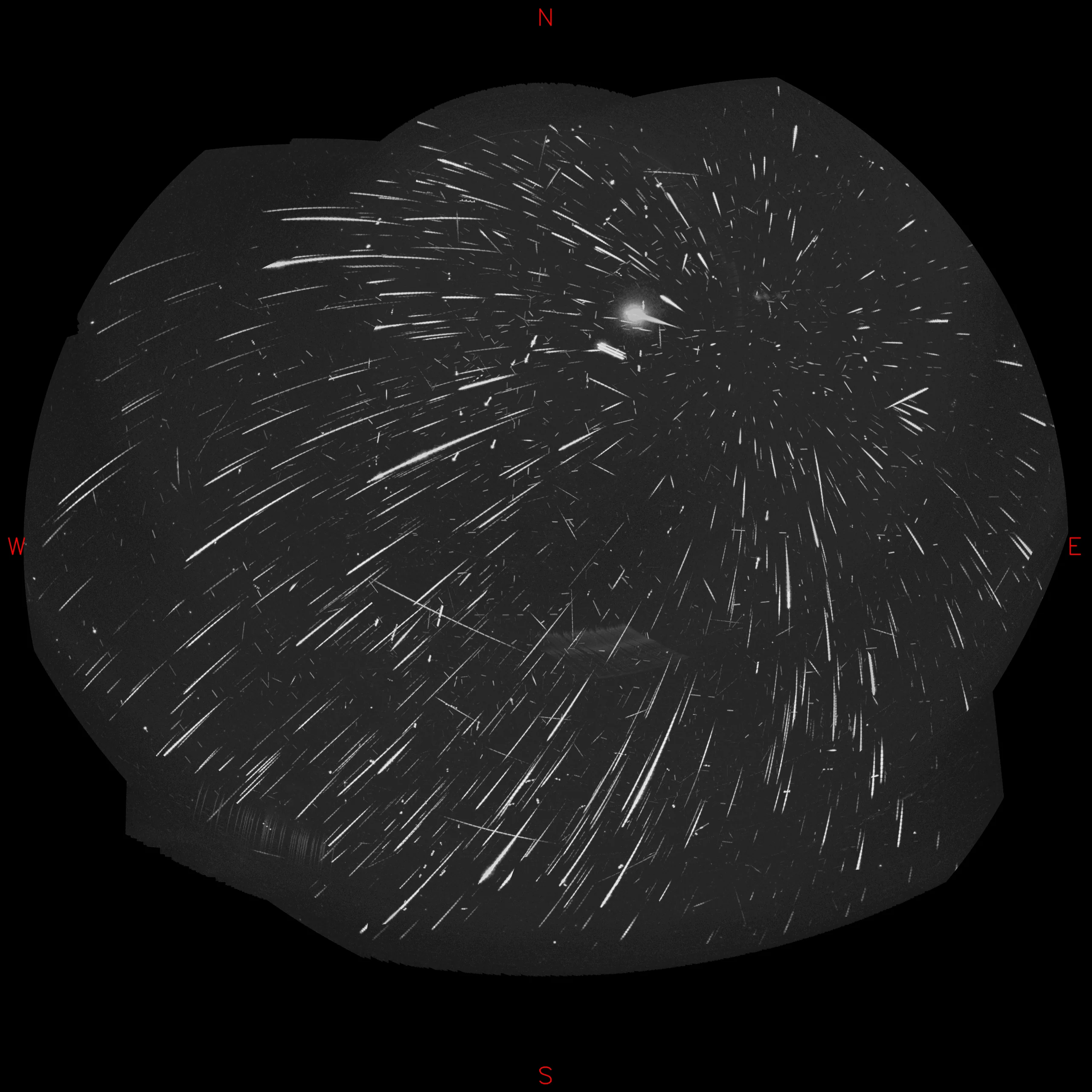
Image: NASA Astronomy Picture of the Day (APOD) · Image Credit & Copyright: Jakub Koukal (Valašské Meziříčí Observatory) · Today's page
Today is Saturday, August 22. This year's Perseid maximum passed nine days ago.
NASA's Astronomy Picture of the Day returns to that night, August 12 to 13. At the Valašské Meziříčí Observatory in the Czech Republic, four dedicated meteor cameras watched without sleep. Their frames were aligned, stacked, and compressed into one all-sky image spanning the entire night. Together they counted 1,706 meteors.
A Whole Night in One Photograph
According to APOD, most of the trails are Perseids. The image was made on the night of the 2026 Perseid maximum, and their overwhelming numbers make the shower easy to recognize. Trace them backward and they all point to one spot in the upper right of the picture. That spot lies in Perseus, which gives the shower its name.
But the picture contains other populations. Some streaks cut diagonally across the Perseids and point back not to Perseus but to Cygnus. They are Kappa Cygnids, a separate shower. Lower down, near Aquarius and the part of the sky opposite the Sun, faint traces of another source can also be found.
One photograph, three origins. How can they be told apart?
A Radiant Is Not a Place in the Sky
This is the most elegant step in the story, and one of the best lessons naked-eye astronomy has to offer.
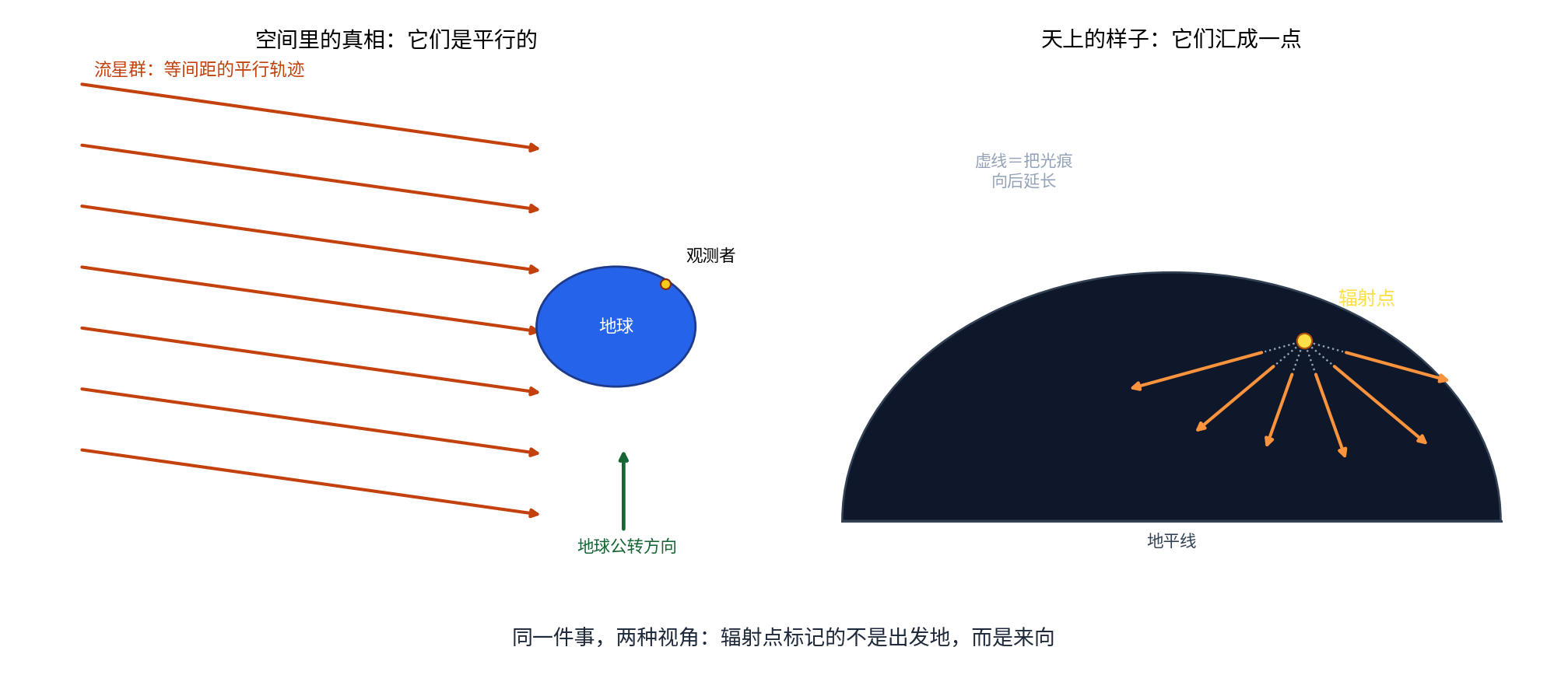
The grains that produce the Perseids do not fly outward in all directions from a point in Perseus. Their paths through space are nearly parallel: a broad procession of debris moving in the same direction at roughly the same speed. Earth runs head-on into that stream. What we see overhead is the projection of parallel lines onto the dome of the sky.
In perspective, parallel lines converge. Railroad tracks meet in the distance; sunlight passing through gaps in clouds appears to fan out from a point behind them. The Wikipedia article on meteor-shower radiants uses the latter comparison: the geometry is the same as crepuscular rays, in which parallel sunlight appears to spread apart. From a moving car in snowfall, flakes also seem to fly from one point straight ahead. They do not originate there. It is simply the direction the car is moving.
So a radiant is not the place meteors fly out of, but the direction they come from. Parallel grains in space are squeezed into a point by perspective.
Once that is clear, the image opens up. Meteors are not classified by the part of the sky in which they appear; the 1,706 trails cover the whole sky. They are classified by where they point back to. Extend each line backward: those meeting at the point in Perseus are Perseids, those meeting in Cygnus belong to the other shower, and those that meet neither are sporadic meteors. The cameras did not merely record 1,706 attractive streaks. They recorded 1,706 lines available for geometric reconstruction.
There is a detail anyone can verify: a radiant moves. Earth advances by about one degree along its orbit each day, shifting the angle at which it meets the stream by roughly one degree. By late August, the Perseid radiant has drifted out of Perseus. The International Meteor Organization's weekly outlook places it at right ascension 4h 04m, declination +58 degrees, in southern Camelopardalis for August 22-28. The shower is still called the Perseids even when its radiant is no longer in Perseus.
Fast and Slow Are the Same Story
If a radiant gives the incoming direction, that direction also determines something else: speed.
The Perseids enter geocentrically at 59 kilometers per second, according to the International Meteor Organization's 2026 meteor-shower calendar. They are so fast because their parent comet follows a retrograde orbit. The JPL Small-Body Database gives Comet Swift-Tuttle an orbital inclination of 113.45 degrees. Anything beyond 90 degrees travels around the Sun in the direction opposite Earth. When two bodies meet head-on, their speeds add. Earth orbits at 29.8 kilometers per second; a frontal collision with retrograde debris produces 59 kilometers per second. According to Encyclopaedia Britannica, meteoroids can reach 72 kilometers per second relative to Earth, the physical limit for a head-on encounter. The Perseids are not far below it.
How fast is 59 kilometers per second? Beijing and Shanghai are about 1,200 kilometers apart. At that speed, the trip takes 20 seconds.
Now consider the Kappa Cygnids crossing diagonally through the image: 23 kilometers per second, less than 40 percent of the Perseids' speed. Their candidate parent, asteroid 2008 ED69, has an inclination of 36.3 degrees and moves prograde. Earth does not strike this debris head-on; it is more like overtaking traffic in the same lane. For grains of equal mass, a 2.6-fold difference in speed means a 6.6-fold difference in kinetic energy.
Two apparently separate properties - which radiant a meteor belongs to and how quickly it crosses the sky - are therefore two sides of one answer: the direction and speed of the debris relative to Earth. The IMO calendar is practical about this. The Kappa Cygnids have a complex radiant structure stretching into Draco and Lyra, so identification requires both the isolated radiant position and the shower's low speed. The diagonal trails in the photograph show those criteria working together.
The Comet That Returns Every 133 Years
Perseid debris comes from Comet 109P/Swift-Tuttle.
Lewis Swift and Horace Tuttle independently discovered the comet in 1862. Three years later, in 1865, the Italian astronomer Giovanni Schiaparelli identified it as the source of the annual August shower. This was the first time a meteor shower had been tied to a particular comet. The discovery was 164 years ago.
JPL's orbital solution supplies vivid numbers. Swift-Tuttle's period is 133.3 years. Its perihelion is 0.96 astronomical units, just inside Earth's orbit, and its aphelion is 51.22 astronomical units, about 70 percent farther from the Sun than Neptune. It dives almost to Earth distance and swings out to the edge of the Kuiper Belt, taking 133 years for the round trip. Its last perihelion was December 12, 1992, more than 33 years ago. NASA's page for 109P says it will next return in 2125.
That deserves a pause, because the numbers conflict. Elsewhere on the same NASA website, an overview of meteor showers says the comet returns every 135 years, while NASA's 109P page and the JPL database say 133. The firmer source is JPL's orbital solution: 133.3 years, based on 652 observations made from 1737 to 1995.
The year of the next return has the same problem. NASA's 109P page says 2125, but adding JPL's own 133.3-year period to the late-1992 perihelion gives the first half of 2126, which is also the year given by most astronomical sources. A one-year discrepancy is minor, but it illustrates something important: every astronomical number online rests on a particular calculation, and that calculation can be traced. The JPL Small-Body Database is public; search for 109P and anyone can inspect the 652 observations, the orbit, and the date of the solution.
The comet's nucleus is about 26 kilometers across. NASA says that is more than twice the size of the object thought to have caused the dinosaur extinction. There is no reason for alarm. The comet's next return lies early in the next century, and its orbit is well calculated in a public database.
What happens every year is different. Each time the comet approaches perihelion, solar heating releases dust and grains. They do not follow it as a compact cloud, but spread around its entire orbit into an extraordinarily thin ring. Earth's orbit crosses that ring. Each August, Earth drives through the debris at the same point in its year. The comet has not come back; we have returned to what it left behind.
The Streaks Crossing at an Angle
The Kappa Cygnids deserve a closer look because they receive so little attention.
The IMO's 2026 working list gives shower 012 KCG an activity period of August 3-28, with a maximum on August 17 at solar longitude 144 degrees. Its radiant is at right ascension 288 degrees, declination +55 degrees; its speed is 23 kilometers per second and its zenithal hourly rate is 3. The Perseid entry gives a rate of 100. The diagonal trails in the photograph are normally outnumbered by more than 30 to one. Only an all-night, all-sky image gathers enough of them to reveal the second radiant.
The IMO's annual calendar and its weekly activity outlooks disagree slightly on the maximum. The weekly reports have variously given August 14, 16, and 17. The annual calendar's August 17 at solar longitude 144 degrees is the firmer source.
Their parent has a remarkable history. In a 2008 paper in The Astronomical Journal, volume 136, page 725, Peter Jenniskens and Jérémie Vaubaillon showed that asteroid 2008 ED69 follows an orbit capable of explaining the Kappa Cygnids. The object's absolute magnitude is 16.7 +/- 0.3 and its inclination is 36.3 degrees. They concluded that a parent body broke apart sometime between about 4000 BCE and 1600 BCE. Its debris became today's shower, and 2008 ED69 is one surviving fragment.
The paper includes a startling consequence. Most of the dust from that breakup now travels near the orbit of Venus, so the Kappa Cygnids form a substantial meteor shower there. A shower producing fewer than one meteor an hour on Earth is falling busily in the sky of another planet.
The IMO calendar also notes enhanced activity in 2007, 2014, and 2021, suggesting a seven-year cycle. On that pattern, no enhancement is expected in 2026.
Opposite the Sun
The "antihelion complex" in APOD's final sentence is the least shower-like feature in the image, because it is not really a meteor shower.
It has no parent comet, no radiant named after a constellation, and cannot even be treated as one stream. It is a direction: the region opposite the Sun.
The IMO calendar defines it as a roughly oval area of sky about 30 degrees wide in right ascension and 15 degrees in declination. Its center lies on the ecliptic around 12 degrees east of the point directly opposite the Sun. Rather than a single shower, it is a region containing the radiants of several weak minor showers that wax and wane. Its zenithal hourly rate is 4 and its speed 30 kilometers per second.
The region circles the sky over a year because it follows the Sun. The calendar traces its path: from southeastern Virgo through Libra in April, across northern Scorpius into southern Ophiuchus in May, through Sagittarius for most of June, then from eastern Sagittarius through northern Capricornus into southwestern Aquarius in July.
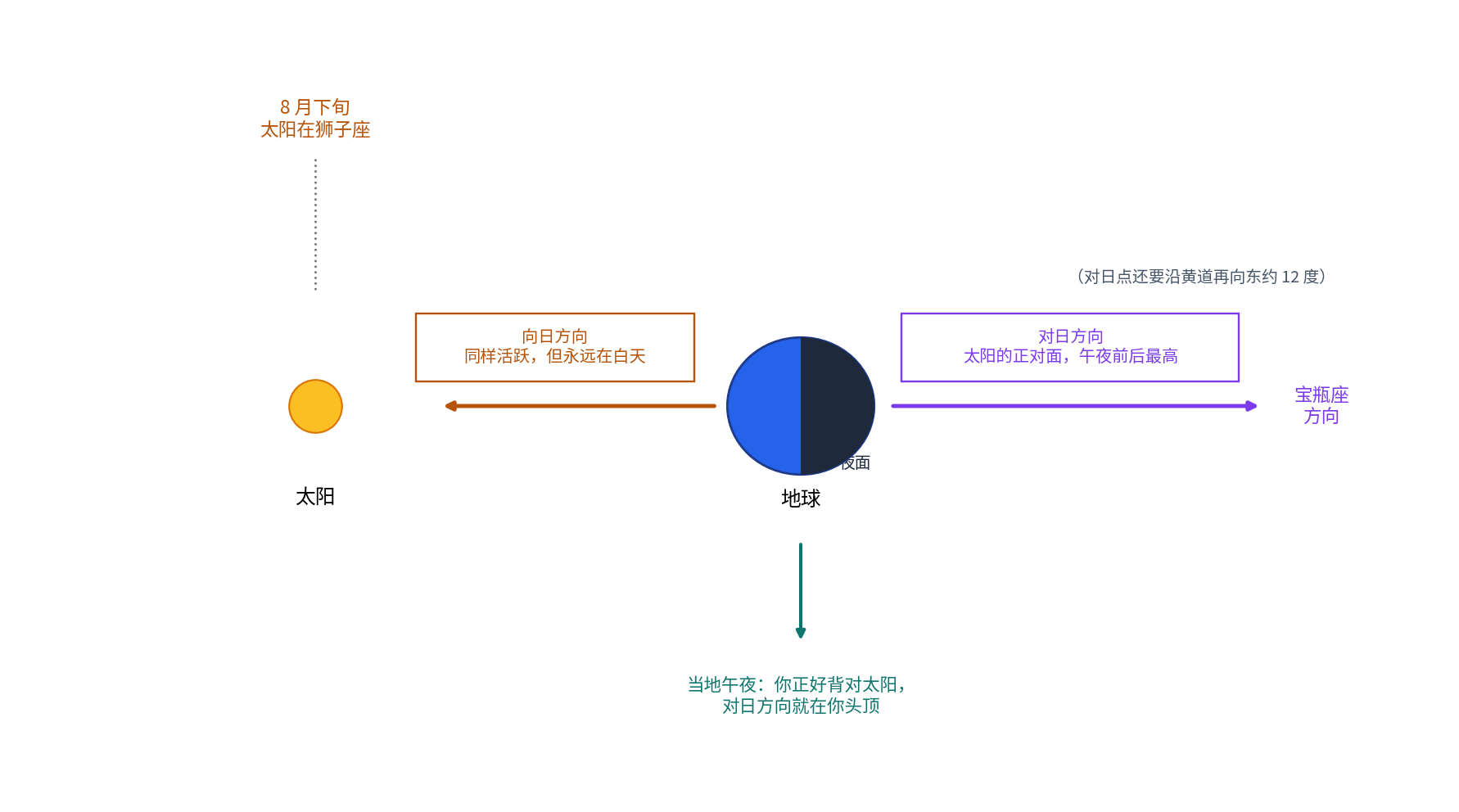
By late August, the Sun is in Leo, so its opposite lies in Aquarius. That is all APOD means by "an area of the sky near Aquarius and opposite the Sun." No additional astronomy is needed beyond knowing where the Sun is this month. The IMO weekly report places the antihelion radiant for August 15-21 at right ascension 22h 24m, declination -8 degrees, in western Aquarius one degree southeast of the fourth-magnitude star Theta Aquarii. For August 22-28 it moves to right ascension 342 degrees, declination -6 degrees.
Once the direction is known, the observing time follows. The point opposite the Sun reaches its highest position around local midnight, when the observer stands in the center of Earth's night side, facing directly away from the Sun. Because the calendar places the complex's center another 12 degrees east of opposition, and 12 degrees of right ascension equals 48 minutes, it technically culminates about three quarters of an hour after local midnight.
Robert Lunsford's Meteors and How to Observe Them (Springer, 2009) adds one last resonant detail. The antihelion source has a symmetrical twin, the helion source, with the same level of activity. But that direction faces the Sun and is permanently lost in daylight to the naked eye. As Earth moves through its orbit it sweeps up debris on both its forward and rearward sides, but we can see only the half turned away from the Sun.
Four Cameras and a Photograph That Can Yield an Orbit
Return now to the place that made the image.
Valašské Meziříčí Observatory lies in the eastern Czech Republic. The Central European Meteor Network, CEMeNt, lists it as the best-equipped station in the network: four wide-field survey systems and five high-resolution spectrographs. The four dedicated meteor cameras described by APOD are those four wide-field systems.
CEMeNt was founded in 2010 by Roman Piffl of Slovakia and Jakub Koukal of the Czech Republic. The latter is the photographer credited on today's image. Its current station list includes 18 sites, 13 in the Czech Republic and five in Slovakia, operating more than 40 cameras in total.
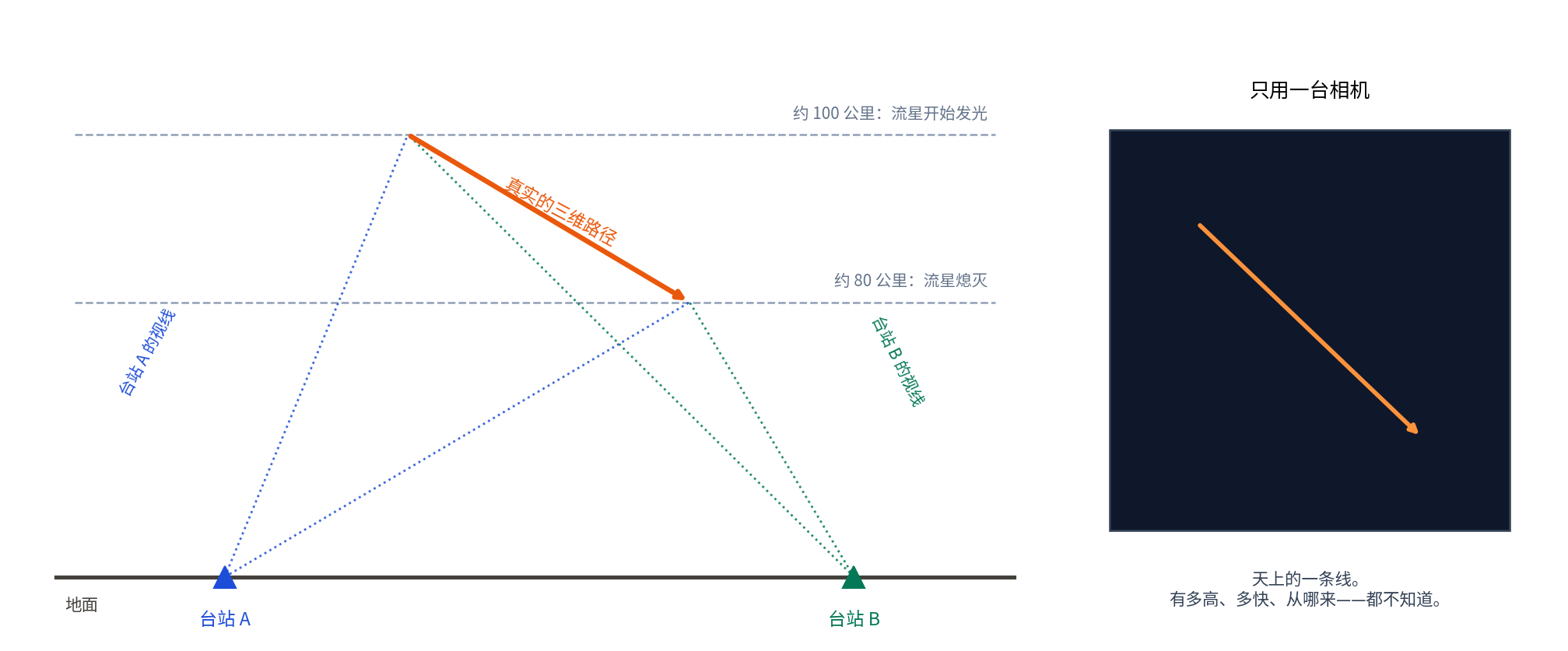
Why are so many stations needed? One camera can show only the line a meteor draws across the sky. When cameras at two different locations record the same meteor, their sight lines intersect in the atmosphere and reveal the grain's true three-dimensional path: entry altitude, direction, speed, and endpoint. From that path and speed, astronomers can reconstruct its heliocentric orbit and determine which stream, and perhaps which comet, it came from.
The cost of that step is revealing. A 2016 review published by the network in the IMO journal WGN reported that CEMeNt detected 147,368 meteors between 2010 and 2015. Only 26,207 were seen from more than one station and therefore yielded an atmospheric trajectory and orbit. Fewer than one in five received an orbit. More than three quarters remained only beautiful streaks.
The solved orbits ultimately enter EDMOND, the European viDeo MeteOr Network Database maintained by CEMeNt. Its latest release, version 6.01, appeared in May 2025 and contains 628,271 precisely computed meteor orbits from 2001 through 2024, all downloadable by year. The destination of every trail in today's image is a row of numbers like these.
China's Network
The same work is being done in China, with equally concrete results.
At 7:40 p.m. Beijing time on January 29, 2024, a bright fireball crossed the sky above Beijing, bursting several times and breaking into fragments before disappearing. A multi-station video meteor network built jointly by the School of Astronomy and Space Science at the University of Chinese Academy of Sciences and the National Astronomical Observatories of the Chinese Academy of Sciences captured it from four sites: NAOC's Xinglong Observatory, Wuqing Observatory, Changshaoying Manchu Township Central Primary School, and Baihuashan National Nature Reserve. Together they covered about 200,000 square kilometers, roughly 12 times the area of Beijing municipality.
Four sites - the same number as the Czech observatory's four cameras, and the same principle.
Doctoral student Li Zhenye reconstructed the trajectory. The fireball entered from east of Beijing, exploded over Pinggu District, and disappeared over Shunyi. Modeling placed the possible fall in an elongated area between Changping and Shunyi. On January 31, a search team followed the calculation into the mountains. According to UCAS, they found nothing, and later searches also failed.
That ending matters. Calculating a trajectory does not guarantee that a stone will be recovered. Real scientific work often ends this way.
China also has an official place for the public to report fireballs. The National Astronomical Data Center launched its fireball reporting system on August 14, 2023. The center led development; Li Guangwei, an associate researcher at NAOC, coordinated the project; and Jia Peng's Intelligent Optical Imaging Laboratory at Taiyuan University of Technology built it. Its goal is a public-participation platform and shared database for studying the origin and evolution of the solar system. Reports must describe a personal observation and give latitude and longitude to two decimal places. JPG and GIF images and MP4 video are accepted, with no more than three files per report and a 10 MB limit for each. A year-end 2024 review displayed real submissions, including records from the Shanghai Meteor Monitoring Network and zenithal hourly rates from 22 stations during the previous November's Leonids: consistently 5 to 10 and peaking at 13.
Chinese records of meteors long predate the telescope. On August 10, 2026, China News Service reported a result from the first phase of the Major Project for the Inheritance and Development of Chinese Civilization through Paleography, included in the Corpus of Oracle-Bone Inscription Facsimiles. One Shang-dynasty oracle bone bears three characters: xing, lü, xi. Huang Tianshu of Tsinghua University's Center for Research and Conservation of Excavated Text explained that xing, "star," looks more angular because it was cut with a knife; lü means "all," indicating a multitude; and xi, "west," is used as a verb describing a fall toward the west after crossing the night sky. Together, the three characters describe meteors falling in groups like rain, more than 3,000 years ago.
Some overseas reports called it the earliest written record of a meteor shower in human history. China News Service made no such claim, describing it only as important astronomical evidence of a meteor shower recorded more than three millennia ago. That is the claim retained here.
It was not an isolated record, but the beginning of an extraordinarily long chain. A 2005 paper by Yang and colleagues, Analysis of Historical Meteor and Meteor Shower Records: Korea, China and Japan, submitted to the International Astronomical Union and available as arXiv:astro-ph/0501216, counted about 5,700 meteor records and 276 meteor-shower records from China through 1911; 3,861 meteor records and 31 shower records from Korea between 57 BCE and 1910; and 431 meteor records and 13 shower records from Japan between 636 and 1867. Arrange those observations by day of the year and the Perseids emerge from the statistics: records cluster conspicuously around day 220, inside the shower's annual activity period.
People a thousand years ago did not know of a comet called Swift-Tuttle or understand radiants. They simply looked up at the same time each year and wrote down what they saw. Plot those records today and the curve peaks in mid-August.
Sources: NASA Astronomy Picture of the Day, Mostly Perseids (2026 August 22); International Meteor Organization, 2026 Meteor Shower Calendar (IMO INFO(3-25)); weekly meteor activity outlooks from the International Meteor Organization and American Meteor Society for August 1-7, 8-14, 15-21, and 22-28; IMO observing FAQ; JPL Small-Body Database orbital and physical data for 109P/Swift-Tuttle; NASA Science pages for 109P/Swift-Tuttle, meteor and meteorite facts, and meteor showers; Encyclopaedia Britannica, "meteor"; Wikipedia, "Radiant (meteor shower)" and "Kappa Cygnids"; Jenniskens and Vaubaillon, "Minor Planet 2008 ED69 and the Kappa Cygnid Meteor Shower," The Astronomical Journal 136, 725 (2008); Robert Lunsford, Meteors and How to Observe Them (Springer, 2009), chapter 2; Central European Meteor Network station list and Central European MetEor NeTwork: Current Status and Future Activities (WGN, 2016, hosted by Valašské Meziříčí Observatory); EDMOND database version 6.01 notes; US Naval Observatory lunar phase calculations; University of Chinese Academy of Sciences, "UCAS Successfully Monitors Fireball Trajectory and Estimates Possible Fall Area"; National Astronomical Data Center fireball reporting system, launch notice, and December 2024 review; China News Service, August 10, 2026 report on an oracle-bone record of a meteor shower; Yang et al., Analysis of Historical Meteor and Meteor Shower Records: Korea, China and Japan (arXiv:astro-ph/0501216); Xinhua's August 10, 2026 astronomy report; and Valašské Meziříčí Observatory.