
For two thousand years, we have used a ruler of position as a thermometer.

Image: Bing Daily Wallpaper · Village fields and a Buddhist pagoda during the End of Heat solar term, Jiangyin, Jiangsu, China (© jia yu/Getty Images) · Original image from Bing's homepage (Microsoft licenses photographs of this kind for wallpaper use only)

Today is Sunday. If you opened Bing's Chinese homepage a little after ten this morning, you saw fields in the Jiangnan region and a pagoda at their far edge. The photograph comes from Jiangyin in Jiangsu Province. Bing titled it The Heat Fades, and Golden Autumn Arrives.
At almost exactly that moment - 10:19 a.m. - something happened without anyone needing to announce it. Earth crossed an invisible mark in its orbit. That mark is called Chushu, the solar term known in English as End of Heat.
First, an Easy Mistake: Solar Terms Are Not Temperatures
Many people think a solar term means that the weather has reached a certain point. It does not.
The twenty-four solar terms measure Earth's position in its orbit. The Hong Kong Observatory puts it plainly: the system divides the ecliptic into twenty-four equal segments, each separated by 15 degrees of solar longitude. End of Heat is the mark at an apparent solar longitude of 150 degrees. It has nothing to do with today's temperature or whether you should carry an umbrella.
That is why the start of a solar term can be timed to the minute. This year's End of Heat began at 10:19 a.m. Beijing time on August 23. The Hong Kong Observatory's 2026 calendar and Xinhua reported the same time. I recalculated it using a standard solar-position algorithm and got 10:18:48, in agreement with the official value.
That precision to the minute has a subtlety. If only the Sun's geometric position is calculated, the result is 10:14, four and a half minutes earlier than the official time. The difference is aberration of light. Sunlight takes more than eight minutes to reach us, and Earth moves during that interval, so the Sun's apparent position differs from its geometric position by about 20 arcseconds. Solar terms use the Sun we see, not where the Sun physically is at that instant. This is where an ancient idea becomes precise to the minute.
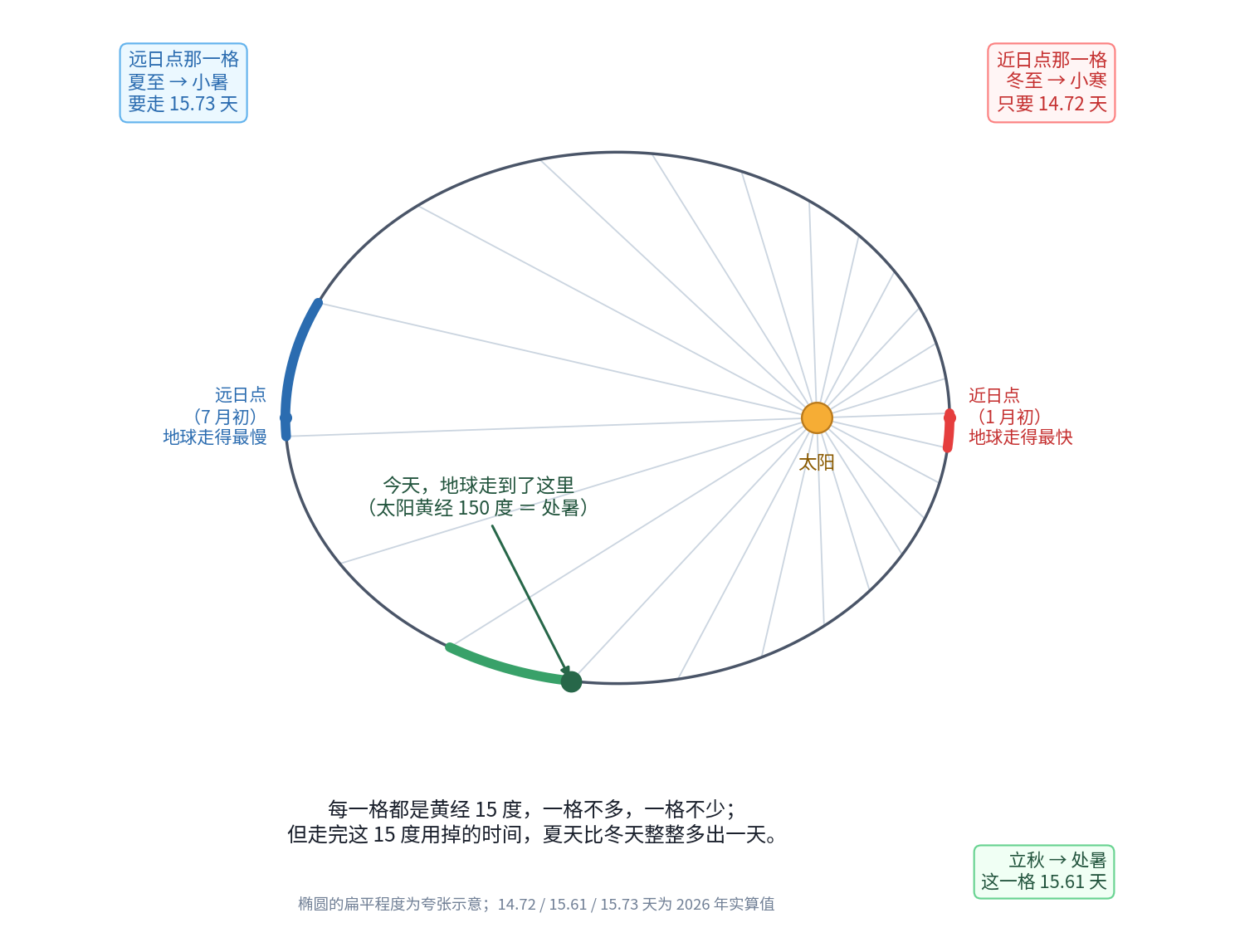
The diagram contains another lovely surprise. If every segment is 15 degrees, should every interval between solar terms be equally long? No. Earth's orbit is elliptical. It moves faster near perihelion in early January and slower near aphelion in early July. I calculated all twenty-four intervals in 2026. The longest, from the June solstice to Minor Heat, lasts 15.73 days. The shortest, from the December solstice to Minor Cold, lasts 14.72 days. The same 15 degrees takes a full day longer in summer than in winter. This year's interval from the Start of Autumn to the End of Heat lasted 15.61 days, on the downward slope as the intervals begin to shorten.
That is why Chinese astronomers eventually abandoned the older method of dividing the year into twenty-four equal periods. According to the China Meteorological Administration, Zhang Zixin discovered in the sixth century that the Sun's apparent motion was uneven: it slowed after the spring equinox and accelerated after the autumn equinox. Liu Zhuo of the Sui dynasty consequently proposed locating the terms at 15-degree intervals along the ecliptic. But the method did not enter the official calendar until the Shixian Calendar was promulgated in the early Qing dynasty. A thousand years passed between discovery and adoption.
The Name Means the Heat Stops
Wu Cheng's Yuan-dynasty Collected Commentaries on the Seventy-Two Pentads of the Monthly Ordinances defines Chushu in ten Chinese characters: "Chu means to stop; at this point, the heat comes to an end."
Here, chu is a verb: to halt, to cease. The China Meteorological Administration glosses the term as "the heat departs." End of Heat does not mean that heat is everywhere. It means that the heat ends here.
The ancients also divided the term's fifteen days into three five-day pentads, each with a name. First, eagles offer up birds: eagles begin hunting in greater numbers and lay out their prey as though making an offering before eating it. Second, heaven and earth begin to grow austere: temperatures fall, plants begin to wither, and an air of severity spreads. Third, the grain ripens: millet, rice and other crops mature; "grain" is the collective term, and the final verb means to ripen.
One name looks up at the sky, one scans the open land, and one looks down at the earth. They are not poems. They are headings in a record of observation.
Then Why Is Tomorrow Still So Hot?
Because End of Heat describes a position, not the air.
What actually controls late-August heat in eastern and southern China is the western Pacific subtropical high. The China Meteorological Administration describes it as a warm high-pressure ridge active near 30 degrees north and south, "constantly present but not fixed in position." Beneath it, air descends. Descending air is compressed, warmed and dried; clouds disperse, unimpeded sunlight reaches the ground, and the stable layers suppress convection. Instead of thunderstorms, muggy heat accumulates day after day.
In late July and early August, the ridge reaches its northernmost position of the year, sometimes extending beyond 30 degrees north. In late August and early September, it begins retreating south. But even as it retreats, it occasionally pushes north again. This year's China Meteorological Administration feature on End of Heat describes it precisely: the retreating subtropical high may briefly move north, bringing renewed heat just as southern China begins to feel autumn's coolness. This is the phenomenon known as the "autumn tiger."
So an autumn tiger is not summer returning. It is a vast clear-sky machine already moving south but making one temporary push northward. The administration formally defines it as a short spell of renewed hot weather after the Start of Autumn, generally occurring around the turn from August to September and lasting about one to two weeks. A caveat: different CMA explainers disagree on the duration. Another says from half a month to two months; I use the definition page's range here.
Interestingly, the National Meteorological Center's medium-range forecast did not mention the autumn tiger at all on this year's End of Heat. Issued at 10 a.m. on August 23, it discussed two rain belts over the coming ten days - one across eastern Northwest China, North China and Northeast China, the other across South China and southeastern Jiangnan - as well as three active typhoons. The words "high temperature" and "subtropical high" did not appear.
That is the relationship between a solar term and the weather: the orbital mark arrives on time every year; the air never follows its schedule.
Only Northeast and Northwest China Are Truly in Autumn
Meteorology uses a firm threshold for the arrival of autumn: the daily mean temperature, or the five-day moving mean, must fall below 22°C without dropping below 10°C. The method comes from the pentad-temperature system proposed by Zhang Baokun in 1934 and is now part of a national standard.
By that standard, China's autumn timetable looks roughly like this: all of Northeast China enters autumn by the end of August; the North China Plain waits until the first half of September; the northern lower and middle reaches of the Yangtze until the second half; the belt through Changsha, Nanchang and Hangzhou until around National Day; Guangdong and Guangxi until the second half of October; and southern Hainan Island until December. The China Meteorological Administration is direct: during End of Heat, only Northeast and Northwest China have truly entered autumn.
Cooling is real, just uneven. The administration supplied a persuasive figure this year: China issues 81% fewer high-temperature warnings during End of Heat than during the Start of Autumn. South China is about 1.5°C cooler. China Weather analyzed 1991-2020 data and found that the major cities with the most hot days during End of Heat are Chongqing with 4.1, Fuzhou with 3.5, Nanning with 2.7 and Guangzhou with 2.6. The heat remains, but only in scattered episodes.
The saying "each autumn rain brings a chill" has a mechanism but no fixed allowance. The China Meteorological Administration explains that southward-moving cold air meets warm southerly air along a boundary and produces cloud and rain. By day, clouds block the Sun and rain carries heat downward; by night, radiative heat loss from the ground combines with cold-air advection. These are the main reasons people feel the chill. The mechanism is clear, but officials give no number for how many degrees one rainstorm removes. Mechanism without quota: that is the saying's proper limit.
Jiangyin: Where the Yangtze Narrows to 1,250 Meters
Return to the photograph.
Jiangyin lies on the southern bank of the Yangtze in southern Jiangsu and covers less than a thousand square kilometers. Its most remarkable feature is outside the frame: here the Yangtze suddenly narrows to just 1,250 meters at its tightest point.
Why? The Jiangsu provincial gazetteer offers a concise explanation: the hills along Jiangyin's riverfront project into the river, narrowing the channel and creating an excellent north-south crossing point. Hard rock refuses to yield, pinching the broad lower Yangtze into a bottleneck. The place consequently became a strategic passage for more than two thousand years, earning names such as "Gateway to River and Sea" and "Stronghold of Navigation." The bed and banks along Jiangyin's 35-kilometer reach are stable, with an average depth of more than 15 meters, making it known as a golden stretch of the Yangtze waterway.
A river's width is decided by the rock beneath it. That is true in the Grand Canyon and on the Yangtze.
There is one point about the field in the photograph that needs to be clear.
The agricultural calendar attached to the solar terms is national in scope. Around End of Heat, mid-season rice begins to mature and be harvested, spring corn reaches the milk stage, and cotton bolls open for picking. That is what "the grain ripens" describes.
Jiangyin is different. The Jiangyin municipal government's own guidance for rice-field management says that transplanting there was only broadly completed in late June. The rice was still tillering in late July; in late August it is elongating and forming panicles as it heads toward grain filling. The real harvest does not begin until after late October. On End of Heat in Jiangyin, the rice is still green and two months from ripeness.
That does not make the photograph's location wrong. It reveals exactly how solar terms should be understood. The twenty-four solar terms arose in the middle and lower Yellow River basin, and "the grain ripens" describes that region's farming calendar. On the same day, at the same 150-degree mark of solar longitude, Henan is harvesting, Jiangyin's grain is filling, Northeast China is already in autumn, and Hainan is still in high summer. A solar term is an astronomical position; phenology is local experience. Confuse the two, and you misread nature.
As for the pagoda in the photograph, Jiangyin has many old pagodas and Buddhist temples. Xingguo Temple Pagoda in the city center is a Song-dynasty brick structure with a damaged top; Wukong Temple stands in Qingyang to the south. The image metadata does not identify this one, and I have no other evidence, so I will not guess.
A Change You Can See in One Week
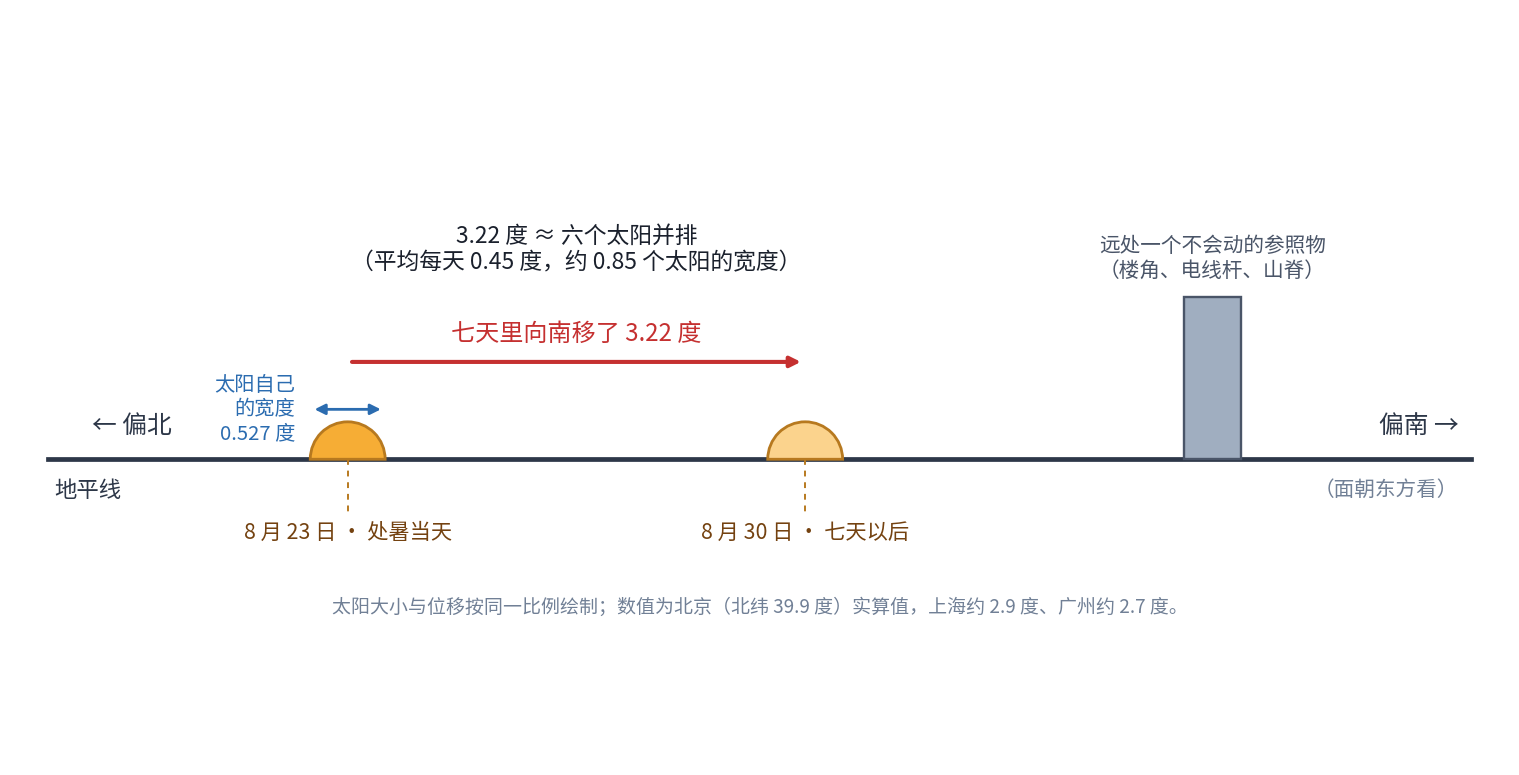
Over the week beginning at End of Heat, Beijing's sunrise point moves about 3.22 degrees south, roughly the width of six Suns side by side. The corresponding shifts in Shanghai and Guangzhou are about 2.9 and 2.7 degrees.
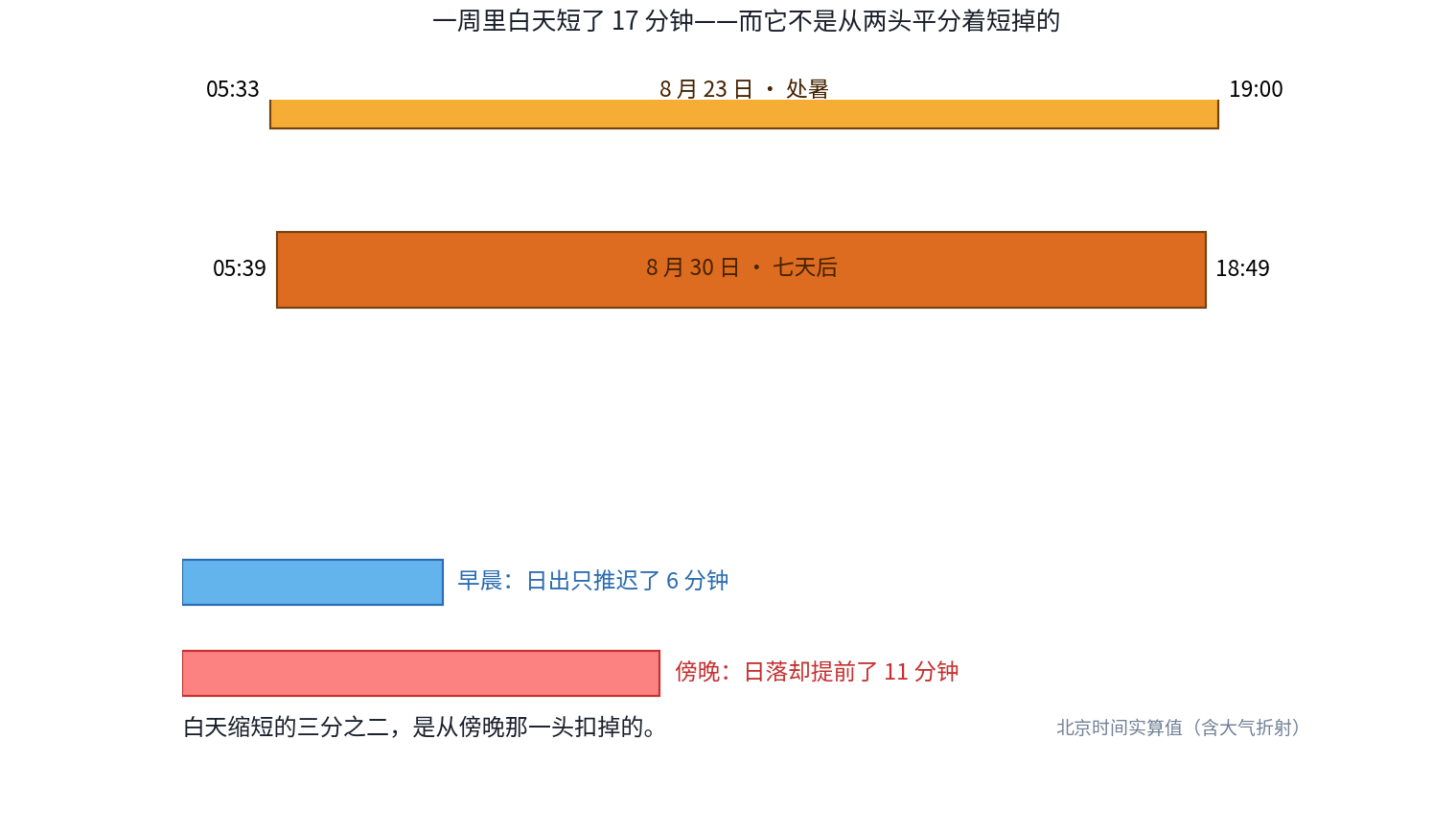
Over the same week, Beijing loses about 17 minutes of daylight: sunrise comes 6 minutes later and sunset 11 minutes earlier, so about two-thirds of the change comes from the evening.
Finally
In 2016, UNESCO inscribed the twenty-four solar terms on the Representative List of the Intangible Cultural Heritage of Humanity. The official name reads like its own explanation: "The Twenty-Four Solar Terms, knowledge in China of time and practices developed through observation of the Sun's annual motion." This November will mark ten years since the inscription.
I like the word "observation" in that name. It acknowledges that no one simply decreed this system. Someone really did look up, year after year, before dividing the Sun's path into twenty-four sections.
At 10:19 this morning, Earth crossed that mark once again. There was no bell or notification, and no cloud changed its mind because of it. But look this evening at where the Sun meets a familiar corner of a building, then look again a week from now, and you will join the people who kept looking up over many years.
The ruler has always been there, waiting for someone to measure with it.
Sources: the Hong Kong Observatory's 2026 table of the twenty-four solar terms and its calendar guide, The 24 Solar Terms; the China Meteorological Administration's 2026 feature The Twenty-Four Solar Terms: End of Heat, and its explainers on the autumn tiger, the western Pacific subtropical high, climate-season classification, and the saying "each autumn rain brings a chill"; the CMA feature Beautiful China, a Myriad Weathers: End of Heat (2026-08-21); the National Meteorological Center's medium-range forecast (2026-08-23, 10:00); Xinhua's quotation from Collected Commentaries on the Seventy-Two Pentads of the Monthly Ordinances and its explanation of the three pentads; China Weather's map of average autumn starting dates and its illustrated guide to solar-term phenology; China Meteorological News on phenology; the Jiangyin Municipal People's Government's overview of Jiangyin and its 2025 technical guidance for mid- and late-season rice-field management; the Jiangsu Provincial Gazetteer Office's history of Jiangyin's Huangtian Harbor; the National Development and Reform Commission's Yangtze Economic Belt site on Jiangyin's riverfront; Acta Ecologica Sinica on advances in plant phenology research; and UNESCO Intangible Cultural Heritage entry No. 00647. Solar-term times and intervals, sunrise directions, and changes in day length were independently recalculated.