
One photograph contains 42 Suns. They form a figure eight above a ring of stones nearly 5,000 years old.
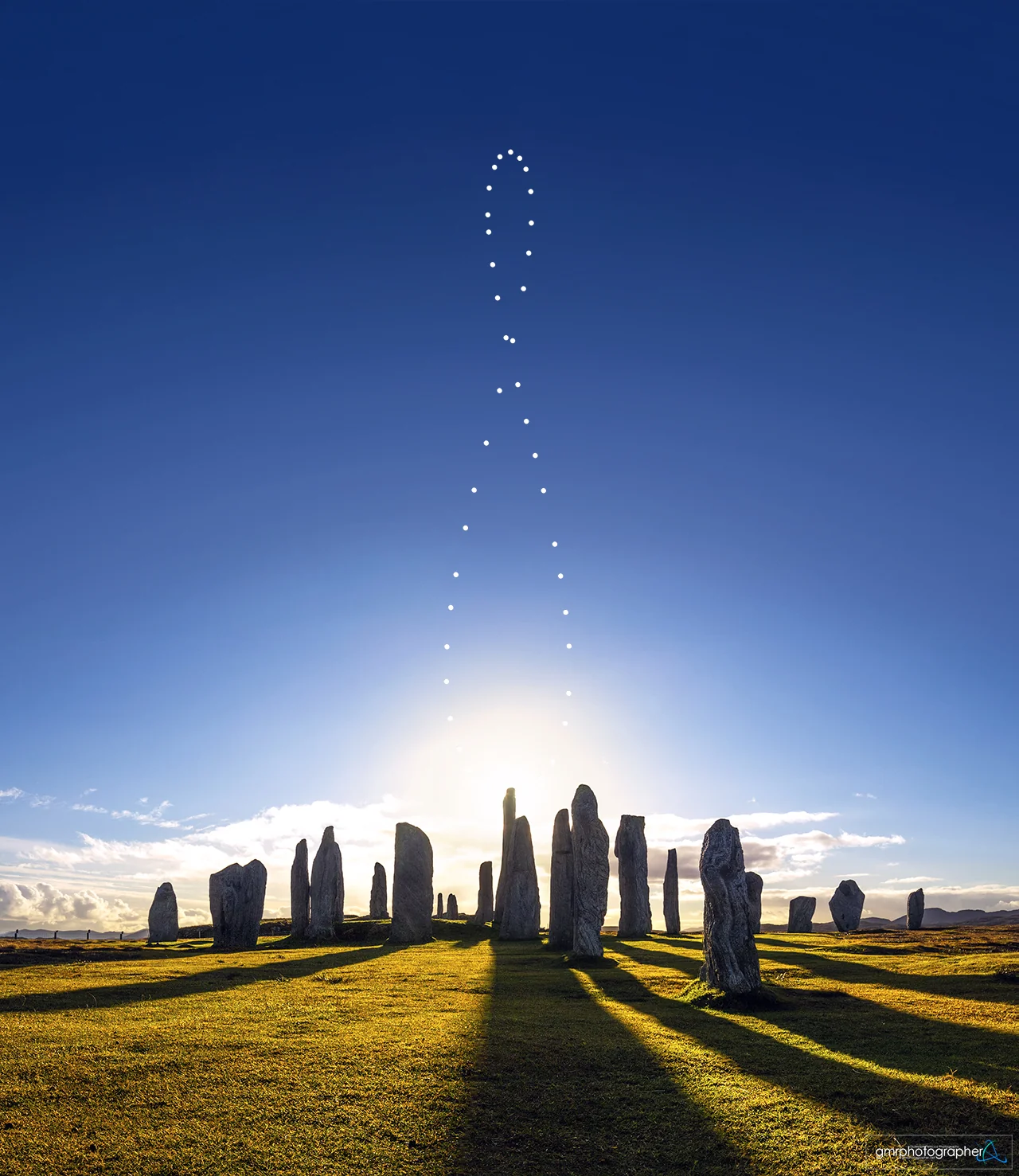
Image: NASA Astronomy Picture of the Day (APOD) | Image credit and copyright: Giuseppe Petricca | Today's page
First, how this photograph was made, because that is a story in itself.
On his website, photographer Giuseppe Petricca says it represents an entire year of work in 2017: 42 exposures of the Sun, plus three frames stitched together for the background. That averages out to one solar exposure about every nine days. His method, he writes, was to shoot "day after day, always at the same clock time." His greatest adversary was the island's unpredictable weather.
The result is the chain of Suns across the sky. The lowest one, in winter, falls directly behind the tallest standing stone at the site.
That Figure Eight Is the Clock's Debt to the Sun
There is an easily missed point here.
Imagine trying to reproduce this photograph: every few days, from the same position, you take another picture of the Sun. What would happen if you waited each time for the Sun to reach due south before pressing the shutter?
You would get a vertical line.
By definition, when the Sun reaches due south it is in the same direction. It can move up and down with the seasons, but never side to side. The width of the figure eight exists precisely because the photographer did not wait.
You must follow a clock. At the same clock time every day, wherever the Sun happens to be, you press the shutter. What you record is how far the Sun is running ahead of or behind the clock. That figure eight is the yearlong account of the difference between clock time and solar time.
Petricca's own phrase matters: "always at the same clock time," not "always at solar noon."
It Takes Both Causes to Draw the Figure Eight
There are two reasons the Sun and the clock fall out of step.
The first is Earth's axial tilt. The rotation axis is inclined by about 23.44 degrees to the plane of Earth's orbit, so the path of the Sun across the sky, the ecliptic, is also tilted. Project that sloping path onto the equator for timekeeping, and the Sun alternately gains and loses time four times a year, completing two full cycles.
The second is Earth's elliptical orbit. Its orbital eccentricity is about 0.0167. Earth moves faster when it is closer to the Sun and slower when it is farther away. This contribution completes only one cycle each year.
Their different rhythms are the key. A curve that completes two cycles in a year crosses itself in the middle, making a figure eight. A one-cycle curve does not cross itself; it can only make a closed loop.
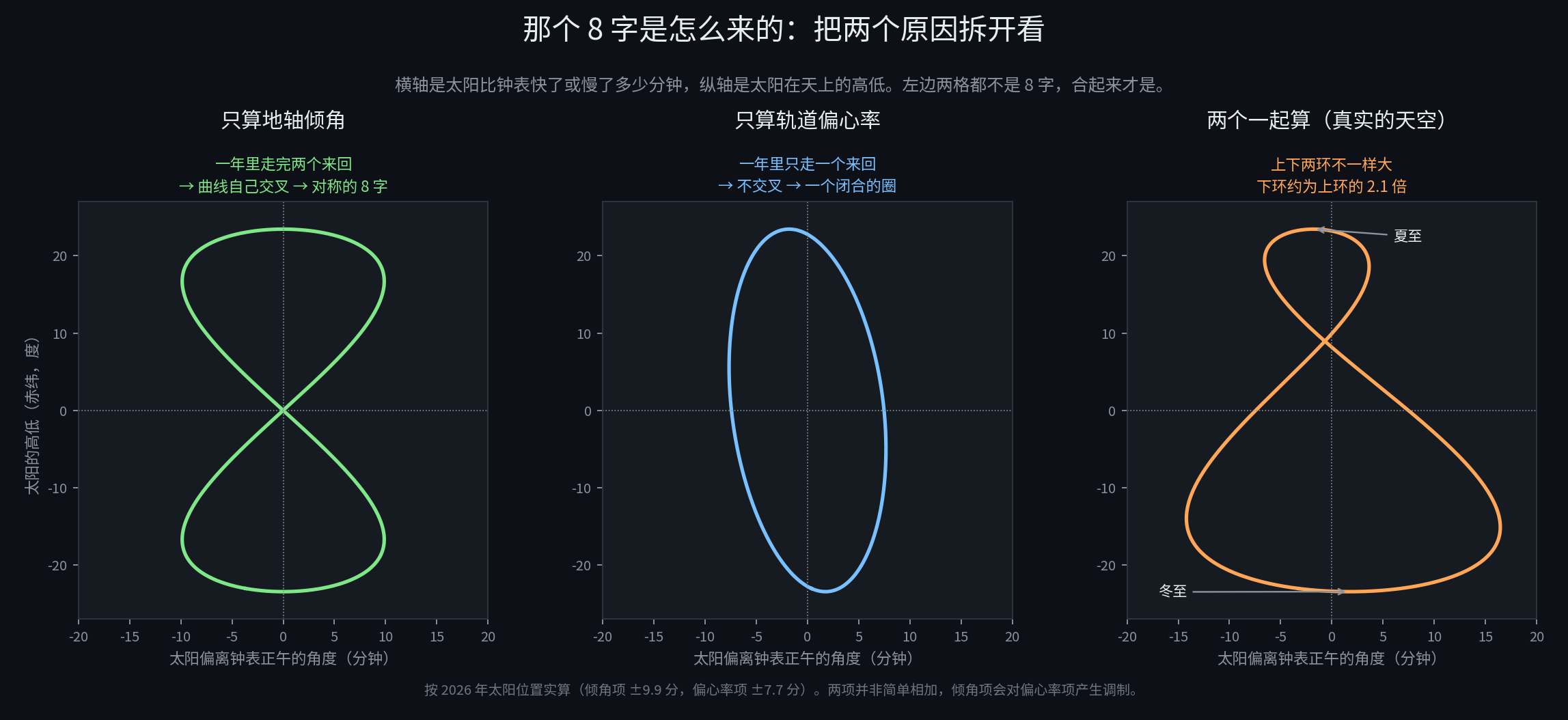
This also corrects a common claim. Chinese popular-science accounts often say the shape is "mainly caused by the elliptical orbit," but the U.S. Naval Observatory is explicit in its official explanation: the two contributions are comparable in size, so neither can be called the main cause. Nor do they simply add together; the tilt contribution also modulates the eccentricity contribution.
I calculated the Sun's 2026 position: the axial-tilt term has an amplitude of +/-9.9 minutes, and the eccentricity term +/-7.7 minutes. Neither dominates the other.
Why the Lower Loop Is Larger
Look at the photograph. The two loops are plainly different in size. The lower one is much broader.
The calculated widths are 14.8 minutes for the upper loop and 30.7 minutes for the lower. The lower loop is 2.1 times as wide.
If only the axial-tilt term remained, the loops would be perfectly symmetrical, each 19.7 minutes wide. The eccentricity term breaks that symmetry.
The reason is hidden in the dates. The December solstice in 2026 falls at 20:50 UT on December 21. Earth reaches perihelion at 02:33 on January 3, 2027. The two events are separated by only 12 days and a little more than five hours.
In other words, Earth's fastest orbital motion coincides with the season when the Sun is lowest in the sky. When Earth moves faster, it travels farther each day, so the true solar day departs farther from 24 hours. The lower half of the figure eight is therefore stretched much wider.
In 2026, the Sun runs fastest on Tuesday, November 3, by about 16 minutes 29 seconds, and slowest on Wednesday, February 11, by about 14 minutes 14 seconds. Clock time and solar time agree on four dates during the year, around mid-April, mid-June, early September and just before Christmas.
A sundial never quite keeps clock time. But its error follows a pattern that can be calculated to the second.
Change the Planet and the Figure Eight Disappears
Alter the balance between those two contributions and the shape changes completely.
Mars has an axial tilt of 25.19 degrees, slightly greater than Earth's. But its orbital eccentricity is 0.0935, 5.6 times Earth's. When the eccentricity term overwhelms the tilt term, the upper loop is squeezed away and the analemma becomes a teardrop.
Best of all, this is not merely a simulation. The Opportunity rover actually photographed it from the surface of Mars over one Martian year corresponding to July 2006 through June 2008 on Earth.
The Ring of Stones in the Foreground
Now for the ground beneath it.
The Callanish standing stones are on the Isle of Lewis in Scotland's Outer Hebrides. Historic Environment Scotland dates their erection to between 2900 and 2600 BC; APOD's "around 2700 BC" is slightly late. The central monolith is 4.8 meters high and weighs about 4.5 metric tons, with perhaps more than another meter buried underground. An 83-meter avenue approaches from the north between two rows of stones, while single rows radiate to the east, south and west. A small chambered tomb was later added inside the circle, roughly 500 years afterward.
One common comparison also deserves untangling. Callanish is not simply "older" than Stonehenge in England. Stonehenge's earliest circular earthwork dates to 3000 BC, before the Callanish stones were raised. But the recognizable Stonehenge of today's photographs - the ring of enormous sarsen stones - was erected around 2500 BC, about 400 years after the Callanish circle.
All the stones are local Lewisian gneiss, quarried within a few hundred meters of the site. This is the oldest rock in the British Isles: the protolith of the Lewis and North Harris formations dates from 3.125 to 2.8 billion years ago.
The people who raised the stones lived about 5,000 years ago. The stones themselves are about three billion years old. The material is 600,000 times older than the monument. Those builders thought they were making something enduring. In reality, they were placing a very recent mark on something unimaginably old.
"We Do Not Know Whether It Had Astronomical Meaning" Is the More Interesting Answer
APOD says that it is not known whether the Callanish layout has astronomical significance.
Historic Environment Scotland's official statement is more precise, and more candid. On one hand, it says the growing body of evidence suggests that monuments such as Callanish were connected to astronomical observation: the balance of evidence weighs heavily in favor of the hypothesis. On the other, it admits that there is currently no objective way to test whether apparent alignments actually influenced the circle's design and erection. We are left to rely on "the persuasiveness of the coincidences themselves."
"We do not know" and "it was probably so, but cannot in principle be proved" are not the same statement. The second is far more interesting.
The best-known proposal concerns the major lunar standstill. Every 18.6 years, the Moon's orbit reaches an extreme, and its declination can approach 28.5 degrees. From Callanish, the Moon then appears to skim the southern ridge. Local tradition calls that ridge the "Old Woman of the Moors"; in English it is also called the "Sleeping Beauty," because its outline resembles a woman lying on her back, with recognizable head, body and knees. These names and this interpretation come from local tradition and research-project descriptions, not an official conclusion. The latest major standstill occurred in 2024-25. Definitions of the "peak" vary, with some placing it in late 2024 and others in January 2025. The next will come around 2043.
The official document, however, says nothing about specific claims such as "aligned to the solstice sunrise" or "aligned to the equinox sunset." This field has a long history of overinterpretation, and the strongest objection is simple: any structure containing this many stones will produce a number of apparent alignments by chance alone.
Yet one detail remains tantalizing. The official record notes that the southern, western and eastern rows point almost exactly toward their respective cardinal directions, too precisely to look accidental. But the two rows forming the northern avenue are neither parallel to each other nor aligned due north. They point north-northeast. No one has explained the irregularity.
Too precise to be chance, yet too imprecise to look designed.
How the Sun Lives at 58 Degrees North
Callanish lies at about 58.2 degrees north, a latitude that produces two extreme numbers.
On the December solstice, daylight lasts only 6 hours 24 minutes. At noon, the Sun rises just 8.36 degrees above the horizon, crawling along its edge all day.
On the June solstice, daylight lasts 18 hours 15 minutes. At local midnight, the Sun descends only 8.36 degrees below the horizon.
The same number. At Callanish, the Sun's distance below the horizon at the darkest moment of summer equals its distance above the horizon at the brightest moment of winter. That is why true darkness never came that June: the Sun did not descend below the boundary of nautical twilight.
That 8.36 degrees also explains why the lower end of the figure eight sits so low in the photograph that it hides behind a standing stone.
Why Today: The Equinox Is Two Days Away
An equinox is an instant, not a day.
In 2026, that instant comes at 00:05 UT on September 23. In local time:
- Beijing: 8:05 a.m. on Wednesday, September 23
- Britain: 1:05 a.m. on September 23
- U.S. Eastern time: 8:05 p.m. on September 22
The same event occurs on the 23rd in China and Britain but on the 22nd in the United States. When APOD says "two days from now," it is speaking to readers on U.S. Eastern time.
For readers in China, 8:05 is an unusually convenient hour. At that moment on the morning commute the day after tomorrow, the Sun will cross the celestial equator.
"Equal Day and Night" Is a Misconception
APOD's description says that day and night are equal worldwide on the equinox.
That is incorrect, and not by a trivial amount.
At Callanish on the equinox, daylight actually lasts 12 hours 10 minutes, ten minutes longer than night. The difference is about the same around Beijing. Nowhere on Earth that experiences sunrise and sunset has truly equal day and night on the equinox.
The reason lies in the definition of "sunrise." The U.S. Naval Observatory defines sunrise or sunset as the moment when the Sun's center lies 50 arcminutes below the geometric horizon. Those 50 arcminutes have two parts:
- 16 arcminutes: the Sun's apparent radius. At sunrise, we watch for its upper edge to appear, not its center.
- 34 arcminutes: atmospheric refraction at the horizon. The atmosphere acts like a wedge-shaped lens, lifting the entire image of the Sun.
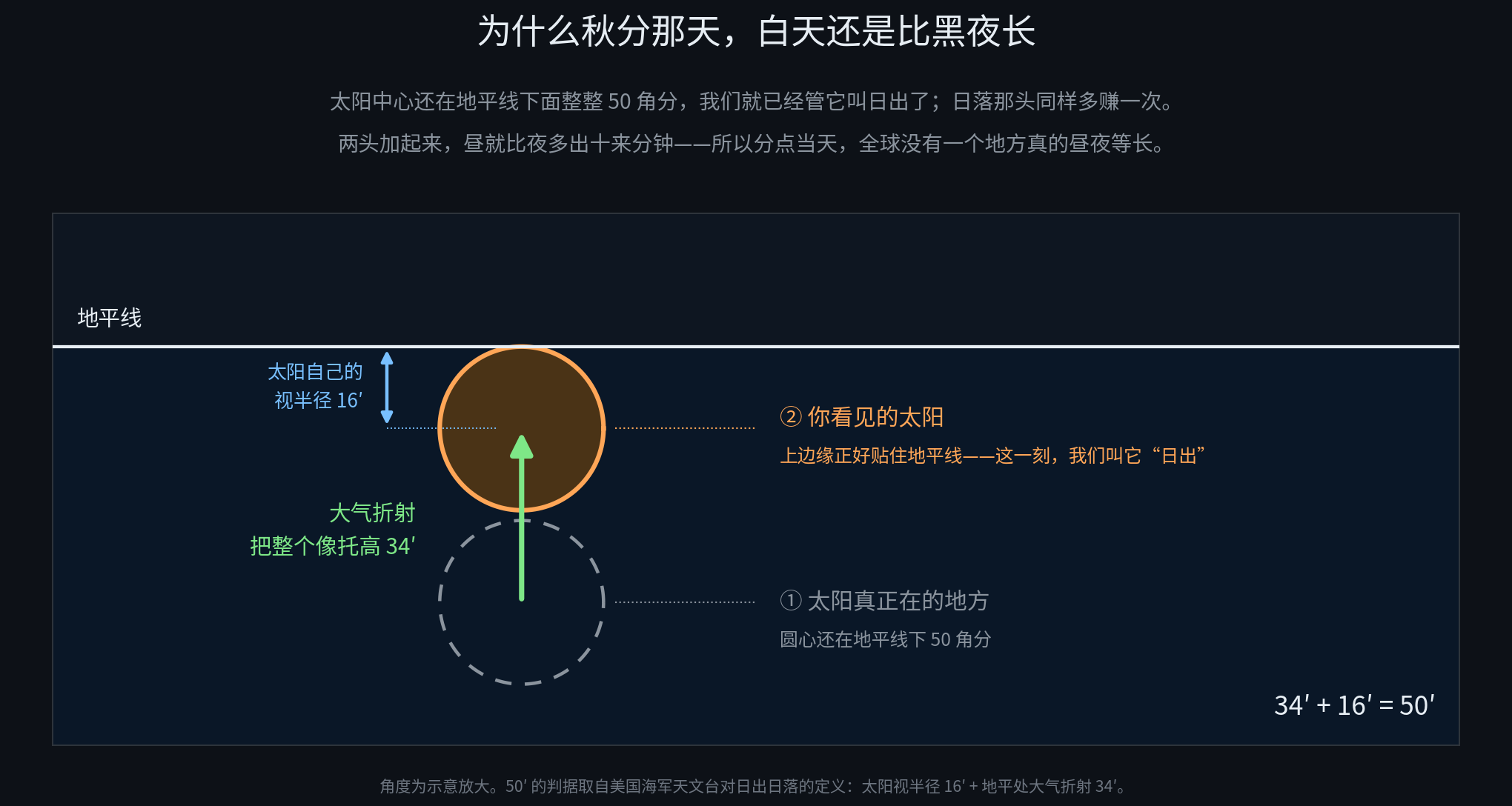
Notice the proportions: refraction contributes more than twice as much as the Sun's apparent radius. The atmosphere, not the Sun's size, does most of the work of lengthening daylight.
We gain a little time at sunrise and gain it again at sunset. Together, the two ends add those ten minutes or so.
The day on which daylight and night are truly equal has its own name: the equilux, and it falls several days after the September equinox. My calculations by latitude put it around September 25 at 50 and 58 degrees north, September 26 at 40 degrees north, around Beijing, and September 27 at 30 degrees north.
Counterintuitively, the higher the latitude, the closer the equilux lies to the equinox. Day length changes quickly at high latitudes, so those extra ten minutes are soon used up. At the equator, day and night are never equal: there are about 12 hours 7 minutes of daylight every day of the year, and the equilux does not exist.
For the same reason, the claim that "the Sun rises due east and sets due west on the equinox" is only a good approximation. At 58 degrees north, the sunrise azimuth is actually about one degree north of east, roughly two solar diameters.
Guo Shoujing Did the Same Thing in Henan
Chinese observers spent centuries measuring exactly where the real Sun stood in the sky, and they did so with remarkable intensity.
At Dengfeng in Henan stands an astronomical observatory commissioned by Guo Shoujing in the 16th year of the Yuan dynasty's Zhiyuan era, 1279. Today it forms part of the UNESCO World Heritage Site known as the Historic Monuments of Dengfeng in "The Centre of Heaven and Earth." In front of the platform lies a 31.19-meter stone scale running exactly north-south, known as the "sky-measuring ruler." A horizontal beam on the platform stands 9.75 meters above it, exactly 40 chi in the units of the time.
Guo grasped a simple principle: the taller the gnomon, the smaller the change in shadow length produced by the same angular error, and therefore the more precise the measurement. The traditional gnomon was eight chi high. He raised it to 40 in one stroke.
But height introduced a new problem. The Sun is not a point source; it has an apparent diameter of about 32 arcminutes. The end of the beam's shadow therefore dissolves into a penumbra. A taller gnomon creates a longer shadow, but also a blurrier edge. No matter how finely the ruler is marked, "where exactly does the shadow end?" remains an ambiguous question.
His solution was called the jingfu.
It was a copper plate pierced by a small hole. Sunlight passing through the aperture projected a sharp image of the Sun onto the stone scale. The observer adjusted it until the shadow of the crossbeam passed exactly through the center of that solar image.
The task had changed. It was no longer "where does this blurred shadow end?" but "do these two sharply defined things line up?"
Making the gnomon taller improved precision but blurred the shadow; with a pinhole, Guo replaced "looking at the shadow" with "looking at the Sun." That was the step that truly raised the accuracy.
He also conducted observations at 27 sites across China. The Shoushi Calendar was completed in 1280 and promulgated the following year. It used a tropical year of 365.2425 days, exactly the same numerical value as the average year of the Gregorian calendar introduced 301 years later. The two are not the same thing: one is a measured year length; the other is the average produced by a leap-year rule of 97 leap years in every 400. But the numbers do match.
Today, the September equinox is defined as the moment when the Sun's apparent ecliptic longitude reaches 180 degrees. It uses the position of the true Sun.
Chinese calendars did not always work that way. Earlier systems used mean solar terms, dividing the tropical year into 24 equal parts. That amounts to assuming that the Sun moves uniformly along the ecliptic - or that Earth's orbit is a perfect circle. China formally adopted true solar terms, placing each term at a 15-degree interval of the Sun's true longitude, only with the Shixian Calendar of 1645, in whose development Johann Adam Schall von Bell participated.
The idea long predates 1645. Liu Zhuo proposed it during the Sui dynasty, while Zhang Zixin of the Northern Qi had already discovered the unevenness of the Sun's apparent motion in the sixth century. About a thousand years passed between recognizing the problem and changing the calendar.
That is the real connection between today's photograph and the Dengfeng observatory. Mean solar terms use the mean Sun; true solar terms use the true Sun. The physics behind their difference is the same physics that gives the figure eight its width. Guo's 9.75-meter beam measured where the true Sun was. The Scottish photograph draws the difference between the true and mean Suns. The same astronomical fact forced a correction in two different civilizations.
Sources: NASA Astronomy Picture of the Day for September 20, 2026, and June 21, 2025; photographer Giuseppe Petricca's website, gmrphotographer.net; U.S. Naval Observatory official explanations and data interfaces for the equation of time, sunrise and sunset definitions, and seasonal event times; NASA planetary fact sheets and Milankovitch-cycle resources; Historic Environment Scotland's history page and Statement of Significance for the Callanish standing stones; English Heritage's Stonehenge timeline; the British Geological Survey monograph on the Lewisian complex; the Royal Observatory Greenwich's 2026 astronomical data; Griffith Observatory's major lunar standstill page; the European Union's INT-ACT project article on Callanish; the Stanford Solar Center; the University of Michigan astronomy department's analemma teaching page; UNESCO World Heritage List entry 1305 and the UNESCO/IAU Astronomy and World Heritage portal; Springer's Biographical Encyclopedia of Astronomers entry on Guo Shoujing; the Historical Astronomy Division of the American Astronomical Society's review of a book on the Shoushi Calendar; and the China Meteorological Administration's page on the 24 solar terms.