
One eclipse, two Suns; a surface at 5,500 degrees and an outer atmosphere at millions.
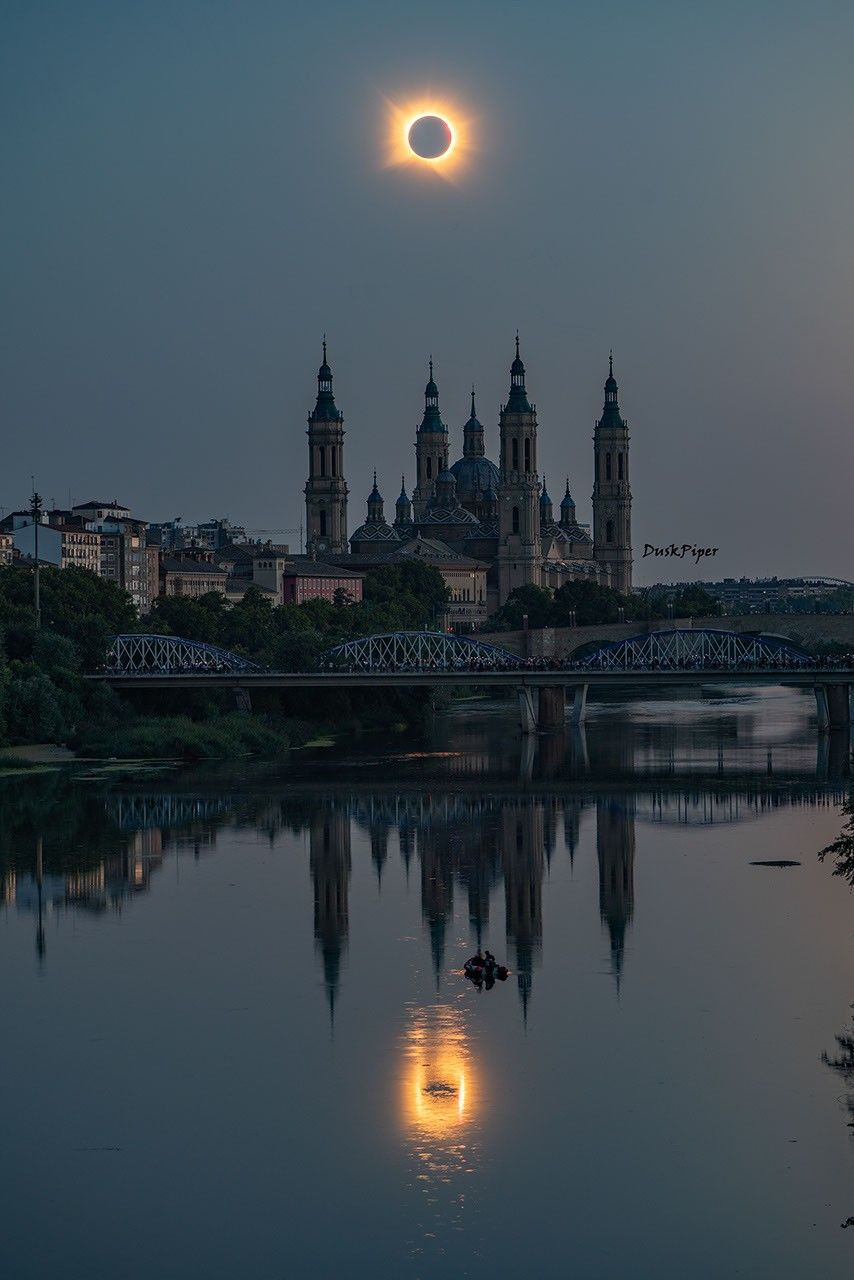
Image: NASA Astronomy Picture of the Day (APOD) | Image credit and copyright: Ruiyu Zhang | APOD page
The photograph contains two eclipses. One hangs above the towers of the Basilica of Our Lady of the Pillar. The other lies on the surface of the Ebro River, where the water repeats the sight.
The photograph was taken in Zaragoza, Spain, on the evening of August 12, 2026.
What Happened That Evening
The Moon's shadow began in Siberia, crossed Greenland and Iceland, then reached Spain and Portugal. NASA's Astronomy Picture of the Day described it as Spain's first major total solar eclipse since 1905, a gap of 121 years.
In Zaragoza, the partial phase began cutting into the Sun's edge at 19:34 local time. The diminished Sun continued sinking toward the horizon until the last sliver of direct light disappeared at 20:29. Local accounts put totality at a little more than a minute; another observing guide gave a precise duration of 1 minute 24 seconds. At that moment, the Sun stood only 8 to 10 degrees above the western horizon, about the height of a fist held at arm's length. The entire eclipse ended at 21:07.
That low altitude shaped the photograph. The silver-white corona was not suspended high overhead but pressed against the city skyline, sharing the frame with the basilica's towers. Figures from Spain's National Geographic Institute show the same geometry in other cities: A Coruña received 76 seconds of totality with the Sun 12 degrees high; Burgos received 104 seconds with the Sun at just 8 degrees. Across the Iberian Peninsula, this was an eclipse at sunset.
APOD's account described the physical experience in unusually immediate terms: the air cooled, birds fell silent, insects began chirping in confusion, and the people nearby shared the same tremor. Zaragoza had prepared on a citywide scale. From August 7 through 12, its tourism office handled 30,798 inquiries, eight times the number during the same period a year earlier. More than 10,200 came on eclipse day alone. Hotels were nearly full, and the city distributed 50,000 pairs of eclipse glasses compliant with the ISO 12312-2 standard.
When the Light Is Blocked, the Corona Appears
The Sun is normally so bright that its own outer atmosphere disappears from view.
That outer layer is the corona: thin, complex and shaped like silver hair blown apart by the wind. It is always present, but the brilliant disk below overwhelms it. The minute or so in which the Moon covers the disk gives the corona a rare chance to become visible.
Its appearance brings with it a problem that physics has not fully solved.
The visible "surface" of the Sun is the photosphere, at roughly 5,500 degrees Celsius. Ordinarily, greater distance from a heat source means a lower temperature. The Sun initially follows that expectation: above the photosphere, the temperature in the chromosphere first falls to about 4,000 degrees.
Then the pattern reverses.
Farther out, in the corona, temperatures suddenly reach 1 million to 3 million degrees Celsius. A region farther from the heat source is two to three hundred times hotter than the source itself. This is the coronal heating problem, a question solar physicists have studied for decades and which, in 2026, still had no universally accepted complete answer.
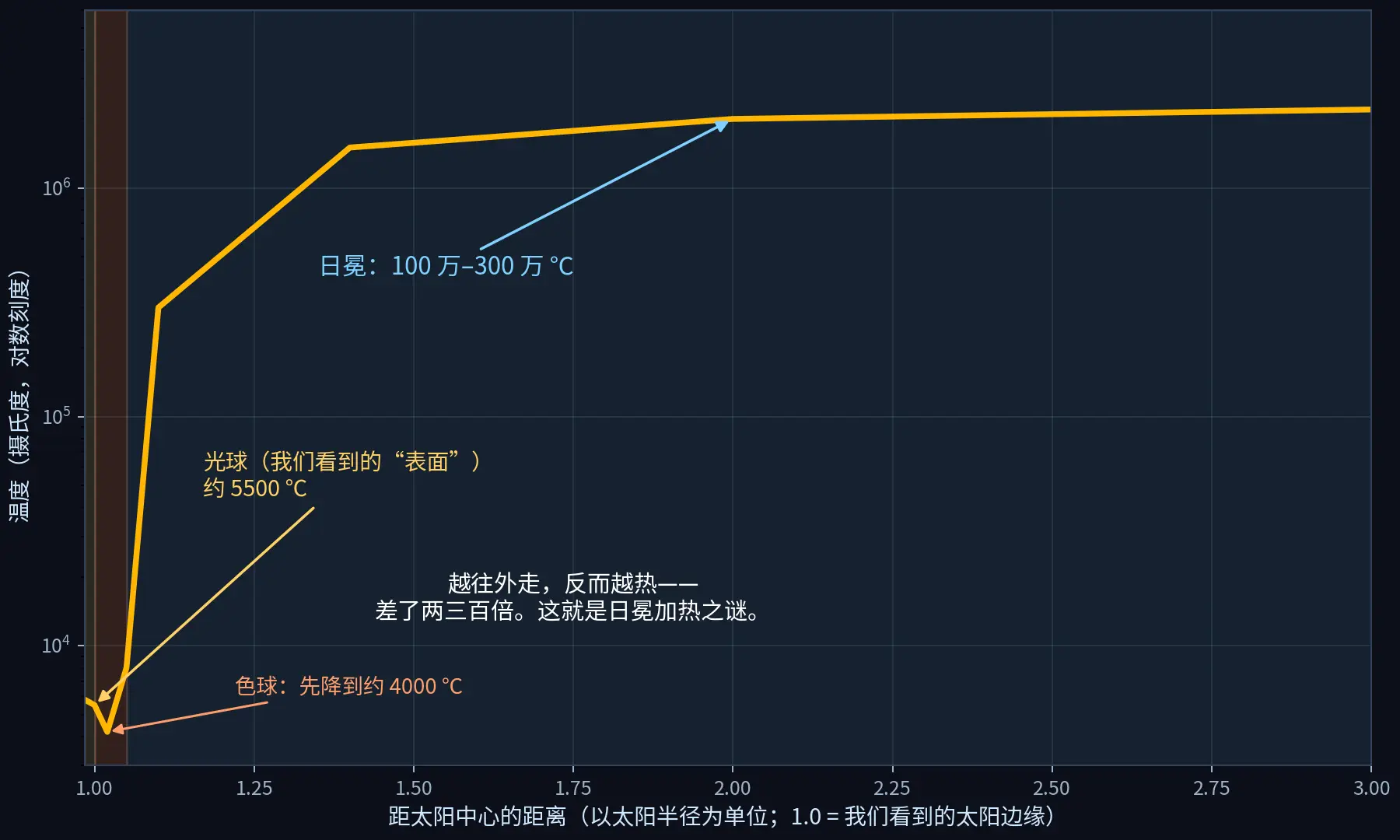
Beyond the photosphere, the temperature rises by a factor of two to three hundred. This reversal is the coronal heating problem.
The main suspects all involve magnetic fields.
One is nanoflares: extremely small magnetic-reconnection events occurring constantly at the solar surface. Each carries only one-billionth the energy of a standard solar flare, but their sheer number may collectively supply enough energy to heat the corona. Data from the NuSTAR telescope have provided preliminary signs of nanoflares.
Another is Alfvén waves. Magnetic field lines oscillate like plucked guitar strings, carrying waves upward. At greater heights, the waves break into turbulence and release their energy. In 2024, the Princeton Plasma Physics Laboratory directly confirmed a key prediction of Alfvén-wave heating theory in a laboratory for the first time.
A third possibility is magnetic reconnection on a larger scale, in which field lines break and reconnect, releasing stored energy. Evidence supports the process, but not as a complete explanation on its own.
The prevailing view is that these mechanisms probably operate together, with each dominating in different parts of the corona. The mystery has not disappeared; it has been divided into parts.
Why an Artificial Eclipse Is Not Enough
Astronomers have long used coronagraphs to block the Sun and study the corona. But placing an occulting disk inside a telescope creates scattered light along the disk's edge. That stray light obscures the most valuable region, the inner corona close to the solar surface. For much of the history of solar astronomy, only a real total eclipse offered a clear view of that ring. Astronomers moved instruments around the world in pursuit of minutes, or sometimes only seconds, of darkness.
The European Space Agency developed a deliberately direct solution: separate the occulting disk from the telescope, place them on two satellites and fly the pair in formation.
That mission is Proba-3. It launched aboard a PSLV-XL rocket from India's Satish Dhawan Space Centre on December 5, 2024. One spacecraft, the Occulter, carries a disk 1.4 meters in diameter. The other, the Coronagraph, carries ASPIICS, a camera with an aperture of only 5 centimeters. The spacecraft fly 150 meters apart and control their relative positions to one-millimeter precision. Across roughly the length of two football fields, their error is no greater than the thickness of a coin.
Proba-3's orbital period is 19.6 hours, and it can create an artificial eclipse lasting as long as 6 hours on each orbit. A natural total solar eclipse, by comparison, occurs about once a year and lasts only minutes.
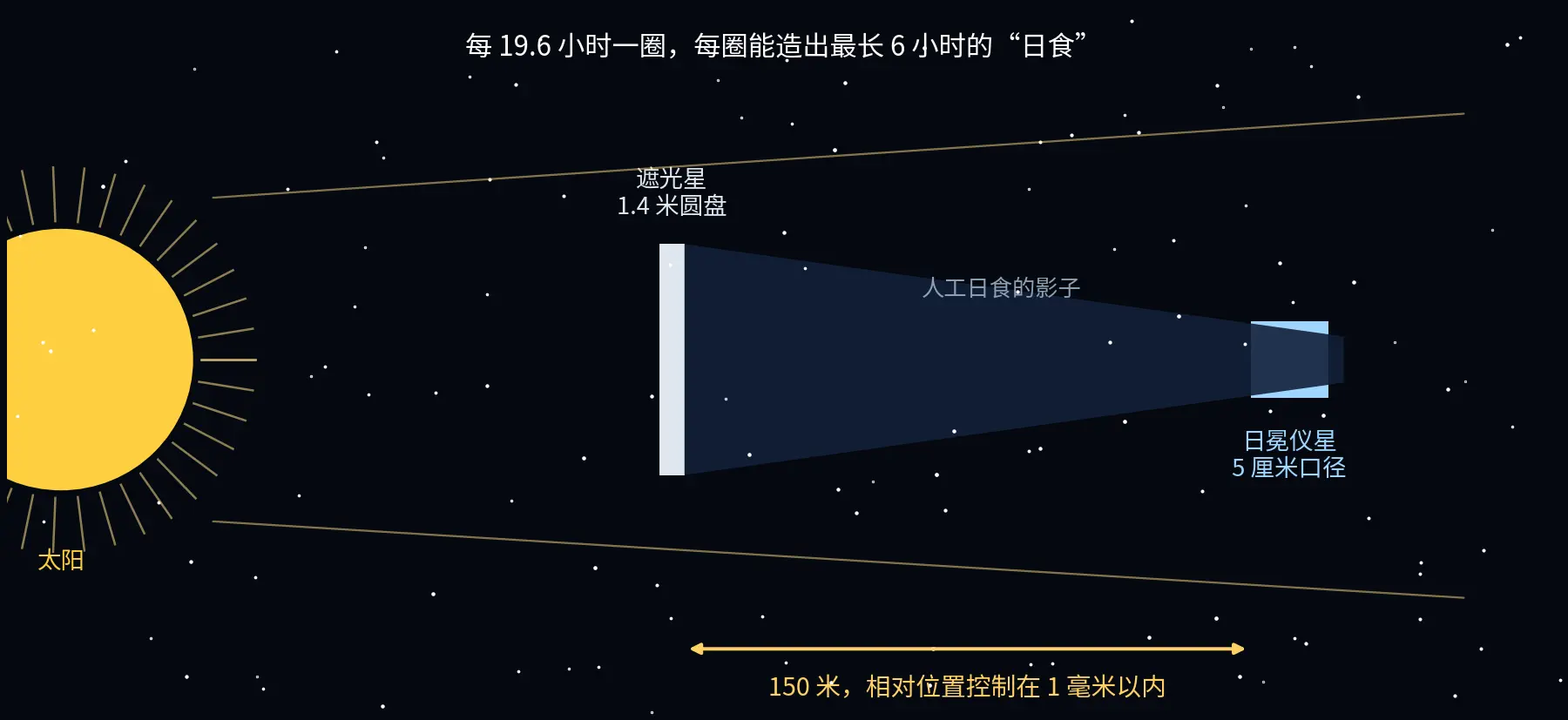
With the occulting disk on one spacecraft and the coronagraph on another, Proba-3 can make an eclipse on demand in Earth orbit.
The mission also had a direct connection to the August 12 eclipse. ESA reported that Proba-3 had completed 62 artificial eclipses during its operational phase, with the 62nd occurring two weeks before August 12. Andrei Zhukov, the ASPIICS principal investigator at the Royal Observatory of Belgium, said that mirroring the resulting image horizontally produced a prediction of the corona's shape during the natural eclipse two days later.
An eclipse manufactured in orbit rehearsed for one that observers on the ground had waited 121 years to see.
Why Citizen Observations Matter
APOD also noted that members of the public could contribute to eclipse research by recording wildlife behavior during totality, photographing the corona, and tracking temperature and cloud cover.
This is more than a gesture toward public participation. Each eclipse path traces only a narrow line across Earth, limiting how many professional instruments can be positioned inside it. The number of observers, however, can be much larger. Records of when birds stopped singing, when insects began calling and how far the temperature fell in two minutes capture local effects that no single satellite can measure.
Spain's next total solar eclipse was due on August 2, 2027. For China, the next total eclipse visible domestically was due on the morning of September 2, 2035, with the path of totality crossing northern China.
The Moon that covered the Sun on August 12 was also a new Moon. The same alignment left the following night moonless during the final strong nights of the Perseid meteor shower. One celestial arrangement revealed the Sun's hidden atmosphere by day and darkened the sky for meteors by night.
Sources: NASA Astronomy Picture of the Day for August 13, 2026 (NASA Science mirror page); Spain's National Geographic Institute, "Total Solar Eclipse of August 12, 2026"; Enjoy Zaragoza, "Zaragoza Eclipse Full Record"; Eclipse Solar, "Zaragoza Observing Guide"; European Space Agency, "Proba-3's First Artificial Solar Eclipse"; European Space Agency, "How ESA Mimics and Models the 2026 Total Solar Eclipse"; ESA Space Weather, "How the Sun's Corona Reaches Millions of Degrees".