
A corona colored by two filters, and one pink prominence that refused to change.
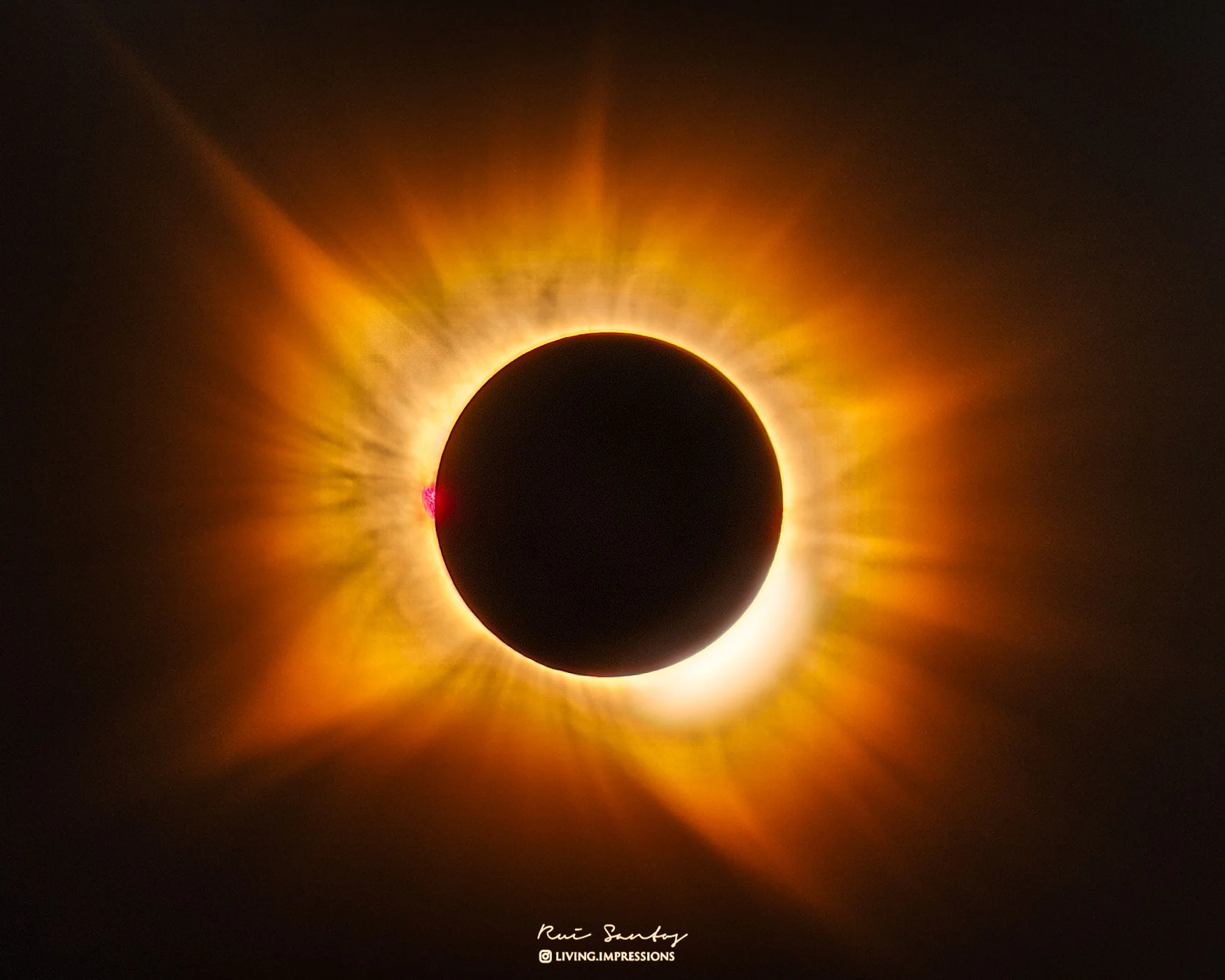
Image: NASA Astronomy Picture of the Day (APOD) | Image Credit & Copyright: Rui Santos (Living Impressions) | Today's page
Today's NASA Astronomy Picture of the Day is five days late by design: a multi-exposure HDR composite of the August 12 total solar eclipse, photographed in Benavente, a small city in Spain's Zamora Province.
At first glance, it is simply beautiful. But if you have seen other photographs of total eclipses, something feels wrong: the corona is gold.
The corona should not be gold. APOD puts it carefully: the corona usually appears white or pearly. So where did this ring of gold come from?
It Is White Because the Thing It Hits Does Not Choose Colors
First, why is the corona normally white?
The corona, the outermost layer of the Sun's atmosphere, emits almost no visible light of its own. Most of the glow visible during totality is light from the Sun's surface scattered by free electrons in the corona and redirected toward your eyes. The process is called Thomson scattering.
The key is that free electrons show almost no preference for wavelength when they scatter light. Red, green, and blue are all deflected in equal proportions. Mixed together in full, the colors look white, with a pearly cast.
The blue sky above your head follows another path. Air molecules scatter short wavelengths, blue and violet, much more strongly than long red wavelengths, spreading blue light across the sky.
The same sunlight looks white after meeting free electrons and blue after meeting air molecules. The color is not really in the light, but in what stands in its way. That is the key to today's photograph.
The First Filter: The Sun Was on the Horizon
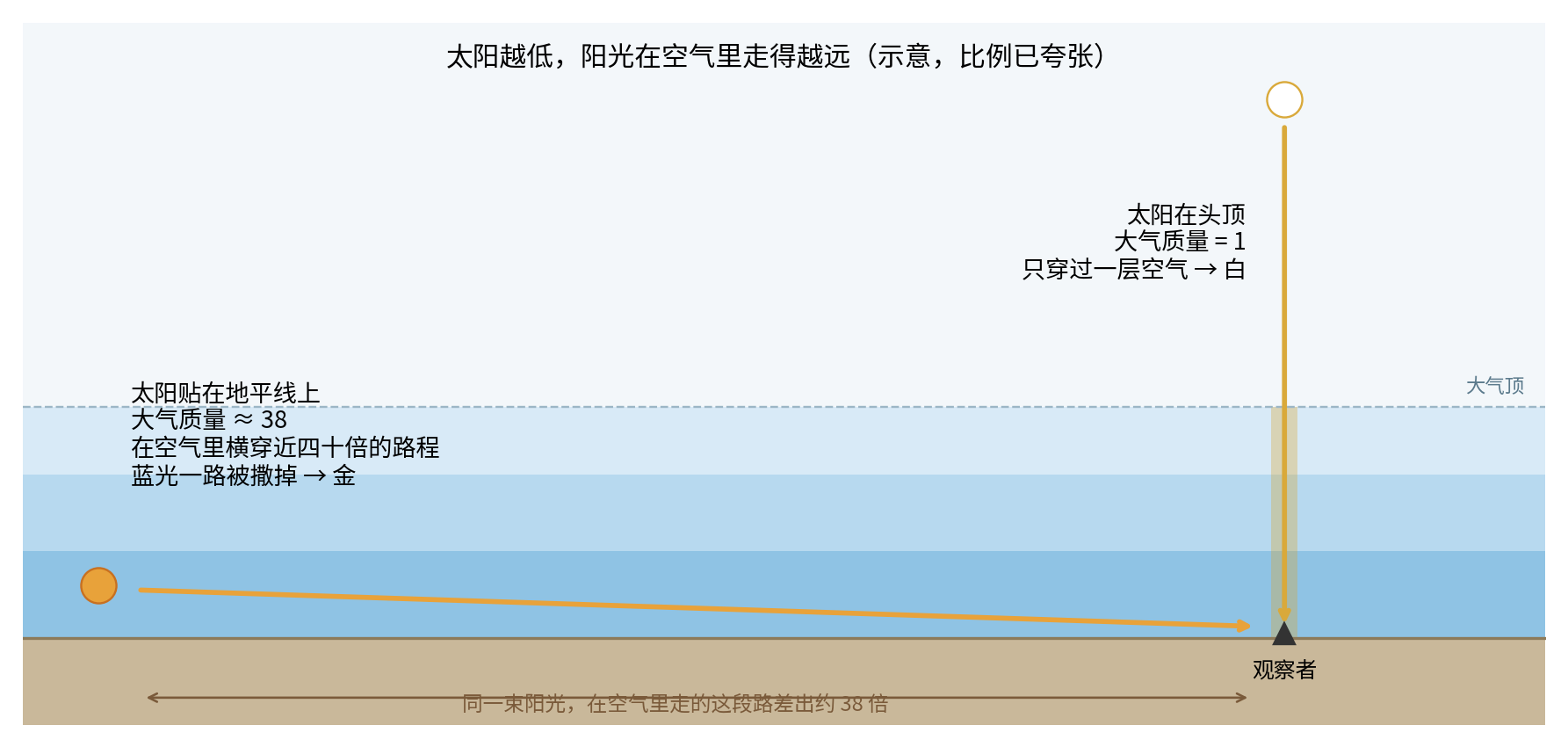
Spain's total eclipse happened in the evening, with the Sun close to setting. This is not a minor detail. It is the principal cause.
Astronomers describe the thickness of air traversed by starlight in terms of "air mass": the value toward the zenith is defined as 1, while the value toward the horizon is about 38. Look up at the Sun overhead and its light crosses one layer of atmosphere. Look at the Sun on the horizon and its light travels through nearly 38 times as much air.
The longer the route, the greater the share of blue light scattered away, leaving the light that reaches the camera naturally redder and yellower. It is the familiar reason sunsets turn red, except this time the colored object is not a cloud but the Sun's outer atmosphere.
How low was the Sun? The Spanish National Geographic Institute's figures for cities in the path of totality show that Burgos experienced 104 seconds of totality with the Sun just 8 degrees above the horizon at maximum eclipse, lower than the roofline of a building. Benavente lies farther west and saw similar conditions. For those two minutes, observers were almost looking straight across at the corona.
The Second Filter: This Summer's Fires
APOD names the second cause explicitly: smoke from nearby forest fires acted as another filter, removing still more blue light and deepening the gold.
The sentence passes quickly, but behind it is the reality of Spain's summer. A late-July report in Time described the country's worst fire season in more than 30 years. By then, more than 150,000 hectares had burned that year, six times the area at the same point in 2025. The fire in Avila had burned more than 50,000 hectares and was described as the largest forest fire in Spain's modern history; the Guadalajara fire exceeded 32,000 hectares. In the same report, air-quality researcher Becky Wagner explained why smoke lingers: its particles can remain in the atmosphere for days or weeks and travel great distances on the wind.
The fire did not need to be next door to Benavente. It could burn hundreds of kilometers away while the wind carried its smoke into the western sky.
The gold in this photograph is not a romantic filter. It holds an entire Spanish summer of fire inside a camera.
Only the Pink Prominence Kept Its Color
Now look at the Sun's left edge.
There is a small pink projection: a prominence, a column of plasma held aloft by magnetic fields. APOD draws attention to the fact that amid all that gold, it kept its naturally bright pink.
Why was it not recolored? Because its light is not reflected. It is emitted, and in one very narrow red wavelength: hydrogen's H-alpha line at 656.3 nanometers. The golden filter works by removing blue light. It can do very little to an emission line already at the red end of the spectrum. The usual explanation for why the prominence looks pink rather than pure red is that this red light mixes with white light from the surrounding corona. Red plus white makes pink.
That small patch of pink also explains why prominences are normally invisible. The Sun's photosphere is about 1,000 times brighter than the chromosphere above it, drowning the prominence in glare. To see one on an ordinary day requires an extremely narrow-band H-alpha filter that admits this one line and blocks everything else.
A total solar eclipse does exactly that, only with the Moon. It does not simply dim the Sun. It removes the brightest layer, allowing everything left behind to appear.
Sources: NASA Astronomy Picture of the Day for August 17, 2026; the Spanish National Geographic Institute's page on the August 12, 2026 total solar eclipse; Time reporting from July 29, 2026; Sky & Telescope on H-alpha filters and prominences; IFLScience on pink prominences during totality; the University of Nevada, Las Vegas astronomy course page on Thomson scattering in the corona; and Wikipedia's "Air mass (astronomy)."