
One anemone, three fish, and a hierarchy written in body length.
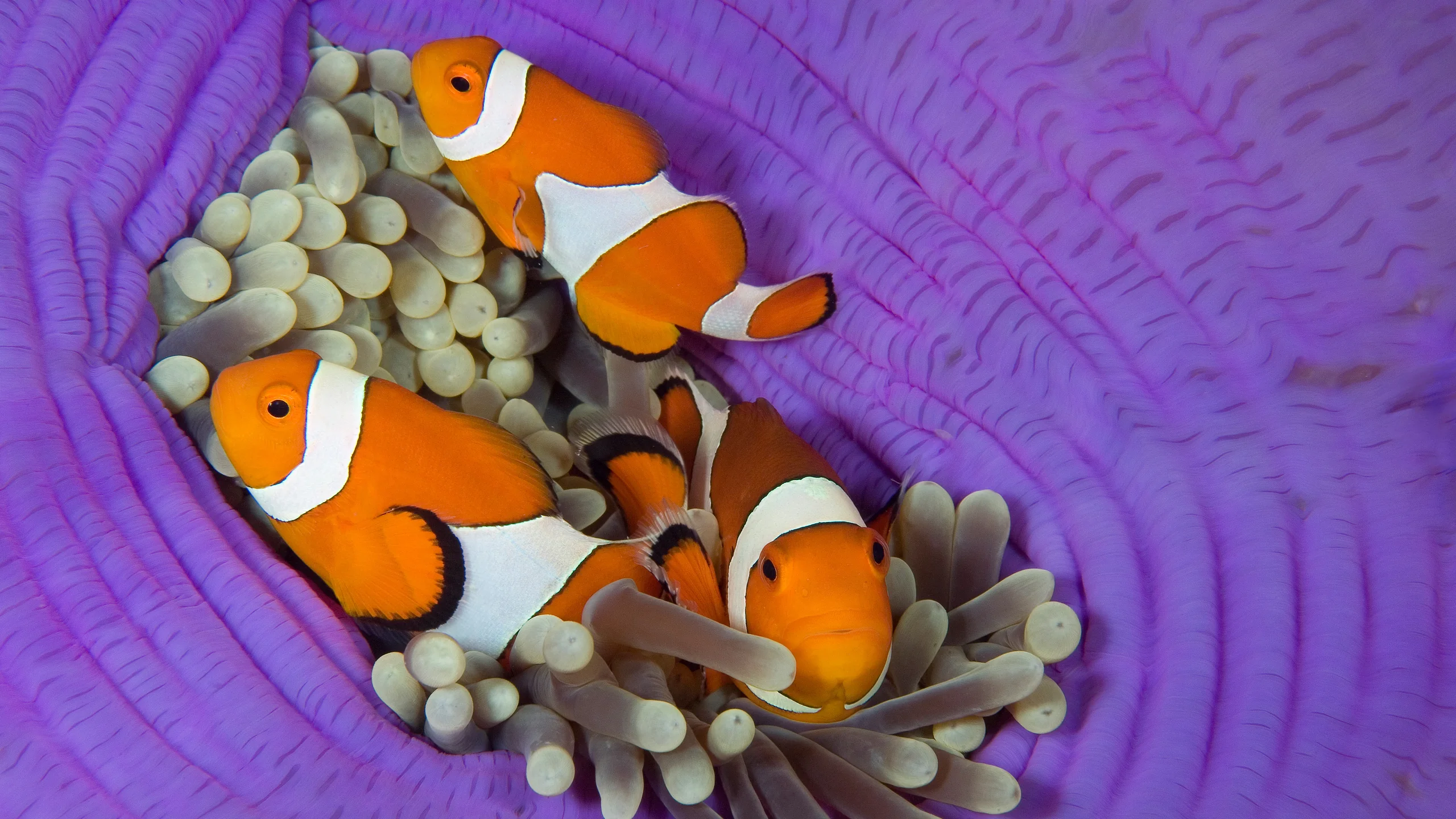
Image: Bing Daily Wallpaper | Ocellaris clownfish in an anemone, Cabilao Island, Bohol, Philippines (© Franco Banfi/Nature Picture Library)
Open Bing today and there is no mountain or coastline on the screen, only a spread-open anemone and three small orange-and-white fish tucked among its tentacles. The camera is so close that you may notice the translucent purple at the tentacle tips before realizing the fish are looking back at you.
They are ocellaris clownfish, the fish children everywhere know as Nemo. The photograph was taken at Cabilao Island off the Philippine province of Bohol. Bing's Chinese title calls the scene "Prime Real Estate on the Reef." Its English copy is more direct: this is "one of the ocean's most successful roommate agreements."
That is putting it politely. The contract comes with rank, promotion prospects, and a clause about sex.
Three Fish, Not Three Neighbors
Bing's caption tells us only that there are three. In the world of these fish, three is a meaningful number.
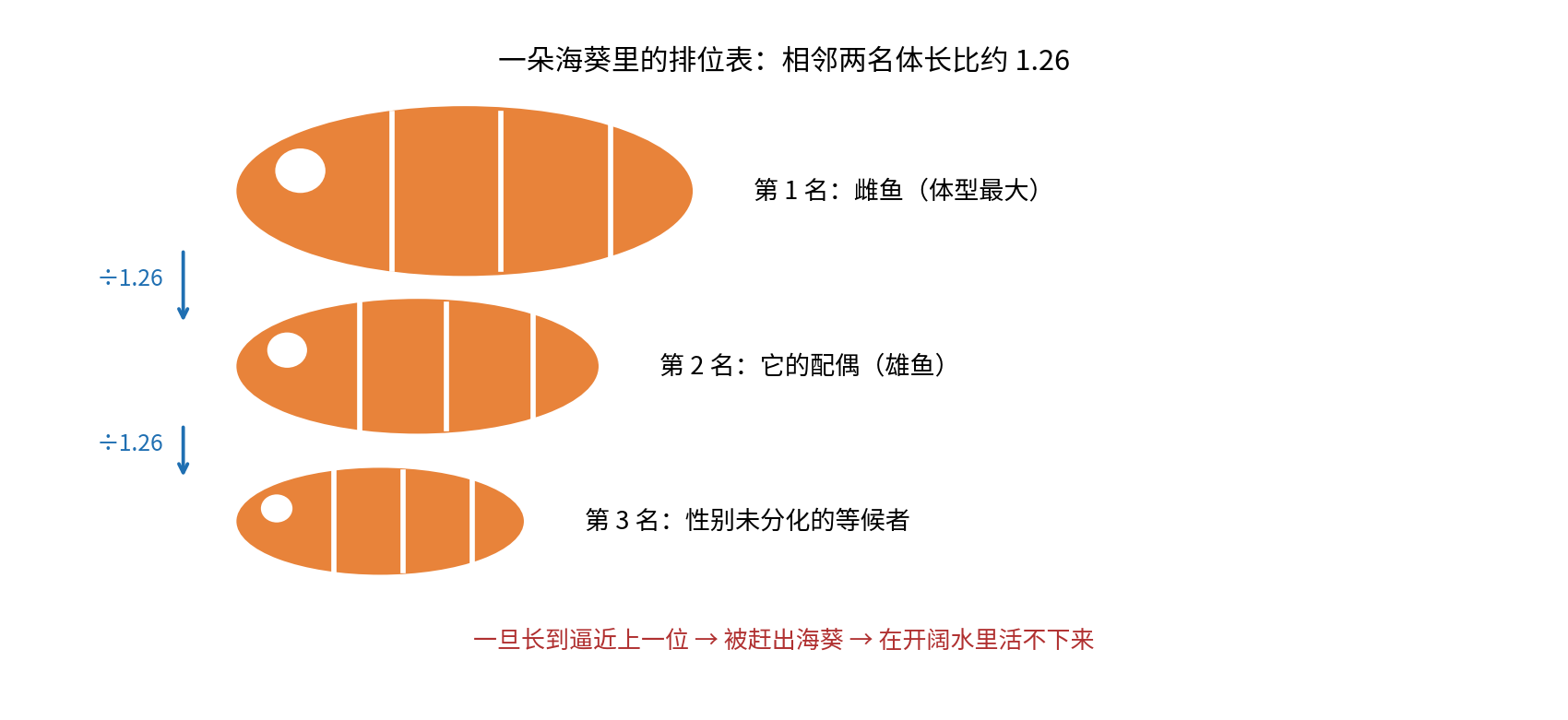
One anemone generally houses one family, arranged in a strict order: the largest fish is female, the second largest is her mate, and all the rest are sexually immature fish waiting their turn. An educational guide produced by the Aquatic Organisms Museum at Guangdong Ocean University and the Chinese Society for Oceanography calls them the "queen mother," the "father," and the children in line. The language sounds domestic, but it is biologically precise.
Then comes the startling part: if the largest female disappears or dies, her mate changes sex and takes her place. The third fish in line then grows and becomes the new mate.
If Finding Nemo had followed the biology, the second act after Nemo lost his mother would have shown his father gradually becoming his mother.
Each Fish Deliberately Stays a Little Smaller
The finer detail is written in their lengths.
Boston University's Peter Buston spent years studying a close relative, the orange clownfish (Amphiprion percula). He measured a number so tidy it seems unnatural: the body-length ratio between adjacent ranks converges at about 1.26 (the measured ratio for nonterminal ranks was 1.26 ± 0.10). In other words, each fish keeps itself at roughly 80% of the length of the fish above it, all the way down the queue.
Why agree to stay small? Because the anemone is the fish's only home. Away from its tentacles, a clownfish does not survive long in open water. If a subordinate grows close to the size of its superior, it becomes a threat and risks eviction. Being driven from the anemone amounts to a death sentence. Each fish therefore slows its own growth to preserve a safe gap.
Buston recorded something even more revealing: these fish average fewer than one aggressive act per fish per hour. The hierarchy is not maintained by constant fighting, but by the fact that a superior can expel a subordinate at any time.
That is the easiest sentence to miss in this photograph: the size differences among these three fish did not simply happen. They were negotiated.
Why Doesn't the Anemone Sting Them?
Clownfish live among venomous needles. An anemone's tentacles are covered in stinging cells that fire on contact and catch fish and shrimp. Why can these three roll around, sleep, and bury themselves in the tentacles?
The most familiar explanation is mucus. The Chinese educational guide describes the process in detail: young fish cautiously touch the anemone a little at a time, rubbing its secreted mucus onto themselves until their entire bodies are coated and they can move freely through the tentacles. Bing's English description today follows the same account, saying that "a specialized mucus coating lets them move safely among the tentacles."
But a 2025 study by Heim and colleagues in Scientific Reports pushed the explanation further and overturned a long-standing assumption. Researchers had thought clownfish simply lacked the molecules that trigger stinging cells, including N-acetylated sugars such as sialic acid. The measurements showed that the molecules are present, but at half the concentration. Fish that live with anemones had total sialic acid levels of 13 to 16 micromoles per liter in their mucus; control fish that do not associate with anemones had 21 to 30 micromoles per liter.
The anemone does not exactly "recognize" the clownfish. A closer account is that the clownfish turns down the volume on the signal that says "sting me" by half. The authors stress that the mechanism is more complex than simple presence or absence and may also depend on how the sugars are arranged on glycoproteins across the fish's surface.
At Night, the Fish Repays the Anemone by Helping It Breathe
What does the tenant contribute to this roommate agreement?
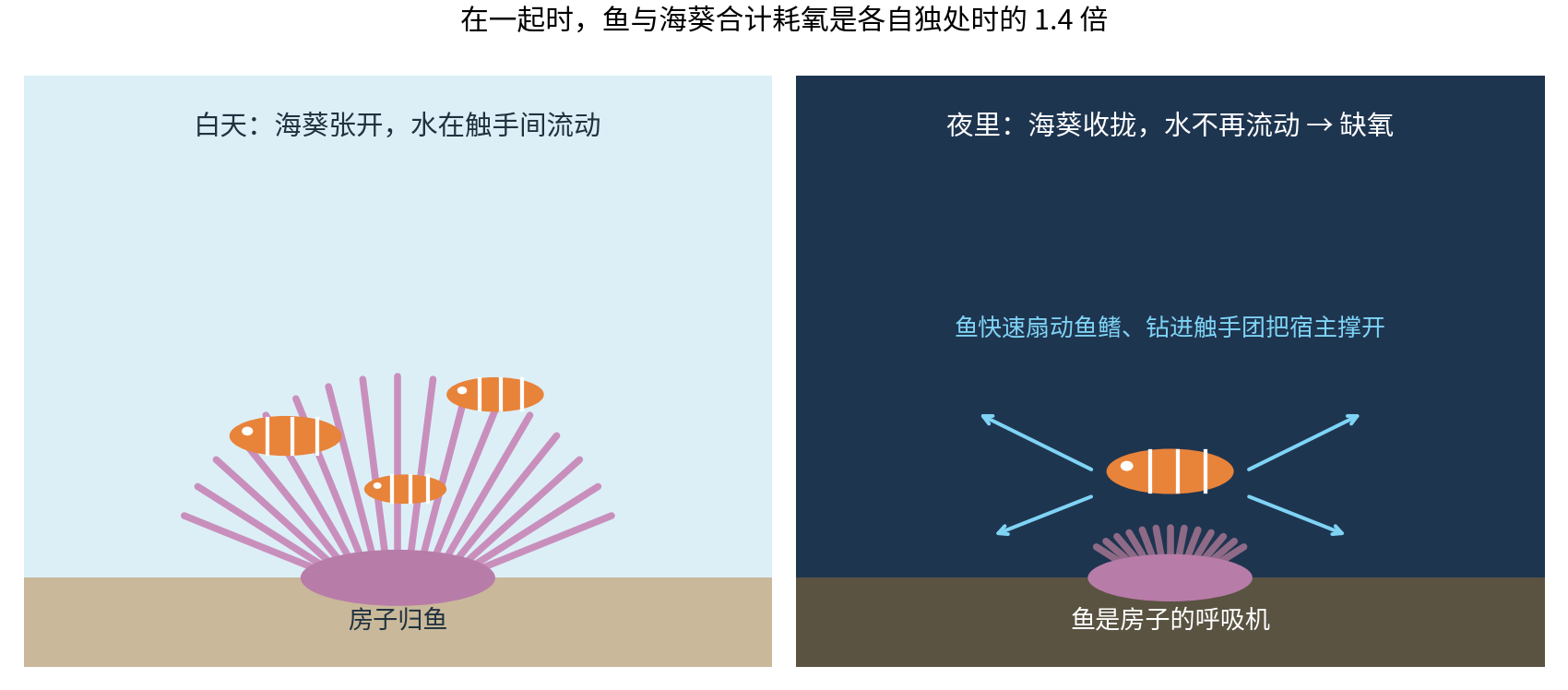
Bing mentions nutrients, cleaning, and protection from intruders. The most striking answer comes from work published in 2013 by Auburn University's Joe Szczebak, Nanette Chadwick, and colleagues in the Journal of Experimental Biology. At the Marine Science Station in Aqaba, Jordan, they measured oxygen consumption first with fish and anemones apart, then with them together. Together, their combined oxygen consumption was 1.4 times the sum recorded when each was alone.
Greater oxygen consumption means a higher metabolic rate. The behavior the researchers observed explained why. At night, the anemone contracts and closes, water stops flowing between its tentacles, and oxygen begins to run low. The clownfish then fans its fins rapidly among the tentacles. It may even plunge deep into the anemone and make a 180-degree turn inside, propping its collapsed host open so that water can flow in.
Remember the photograph this way: by day, the anemone is the fish's house; by night, the fish is the anemone's ventilator.
This Anemone Grows at the Center of the World
The photograph was not taken on just any reef.
Photographer Franco Banfi's library caption gives the location precisely: Lighthouse Reef at Cabilao Island, with a magnificent sea anemone (Heteractis magnifica) as the host. Cabilao belongs to Bohol Province, and just north of Bohol lies Danajon Bank, one of only six double barrier reefs in the world. It is 156 kilometers long, covers 272 square kilometers of reef, contains 40 islands, and accounts for more than 1% of the Philippines' coral reef area. It now has 34 marine protected areas, and a unified management council was established in 2022.
Pull back farther. In 2005, ichthyologists Kent Carpenter and Victor Springer published a paper with a wonderfully visual title: "The Center of the Center of Marine Shore Fish Biodiversity: The Philippine Islands." The Coral Triangle contains the greatest marine biodiversity on Earth, and the Philippines is the most densely diverse patch within that triangle.
In other words, today's three fish do not merely occupy a good anemone. They live in the most crowded neighborhood of species in the ocean.
Sources: Bing Daily Wallpaper's description and image-library caption; "Coral Reef Superstar: The Clownfish" from Science Popularization China, the Aquatic Organisms Museum at Guangdong Ocean University, and the Chinese Society for Oceanography; Buston in Oecologia (2006) and Nature (2003, 424:145); Heim et al. in Scientific Reports (2025); Szczebak et al. in the Journal of Experimental Biology (2013, 216:970); Carpenter & Springer (2005); and materials on Danajon Bank.