
Today's Bing wallpaper comes with a single line of text. Inside it is a misunderstanding, and a slightly brutal truth about crowding together.
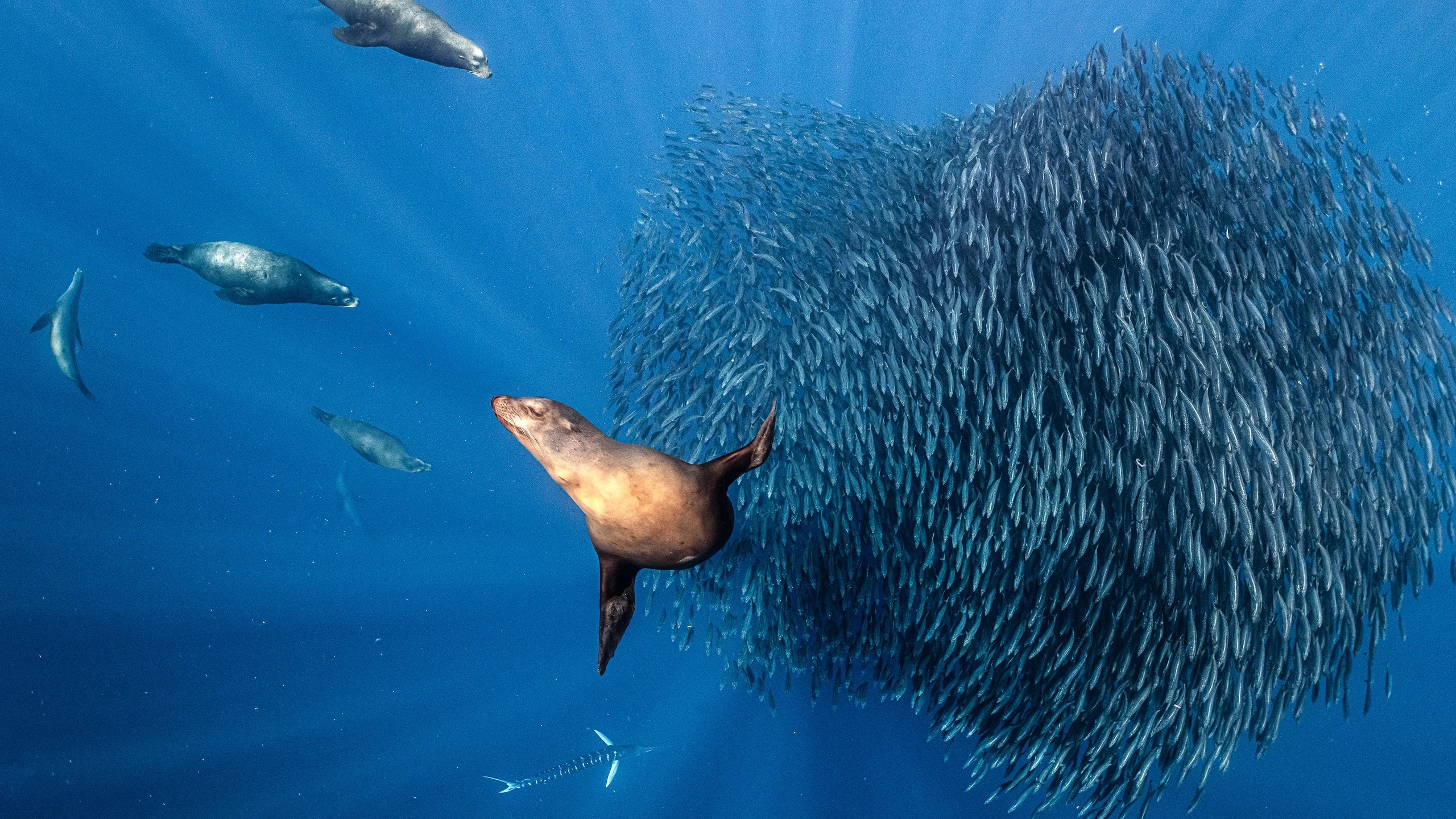
Image: Bing Daily Wallpaper | California sea lions hunting a sardine bait ball in the Pacific off Mexico (© Henley Spiers/Nature Picture Library) | Bing homepage
Open Bing today and the water is filled with a dense mass of silver. Thousands of sardines have compressed themselves into a ball. Around it, several California sea lions circle.
Bing supplies only one line of context: off the coast of Mexico, in the Pacific. There is no particular bay and no date. Yet the most interesting part of this photograph is precisely what it does not tell you: the animals that forced these fish into a ball may not be the sea lions you can see.
First, "Bait Ball" Is Not a Name Scientists Gave It
Divers, underwater photographers and nature documentaries use the English term bait ball constantly. Search peer-reviewed papers, however, and it is almost absent. Scientists write prey school, or simply fish school.
Our familiar term names the scene from the predator's point of view: a ball of bait. For each fish inside it, "being bait" is the exact opposite of what it is trying to do.
How the Ball Forms: Every Fish Hides Behind Another
In 1971, the British biologist W. D. Hamilton published a paper that became a classic: Geometry for the Selfish Herd. Its opening is uncompromising. Hamilton describes his argument as the inverse of the idea that social behavior evolves for the good of a population or species.
He asks us to imagine frogs sitting around a pond. A snake in the water can emerge at any point and eat the nearest frog. Each frog is therefore surrounded by a stretch of shore where, if the snake surfaced, that frog would be the victim. Hamilton called it a domain of danger.
The crucial step follows. The most effective way for one frog to shrink its domain of danger is to move into the gap between two others. Every frog does the same.
No one coordinates and no one acts for the group, yet the ring of frogs spontaneously contracts.
Sardines do the same thing in three dimensions. Each fish drives into a gap between others and toward the center of the school. The result is a ball, with the greatest domains of danger along its outer surface.
That is the truth of the silver sphere. It looks like a disciplined formation, but it is the combined result of thousands of individual escapes. The collective shape is selfish geometry.
Another important explanation is the confusion effect. When thousands of identical-looking fish change position at speed, a predator struggles to lock its gaze onto any one of them. This is a consensus in behavioral ecology, though no primary source suitable for a verbatim quotation was available for this article, so the claim goes no further than that.
Their Silver Skin Is Meant to Make Them Disappear
The most dazzling part of the photograph is the silver flashing from the school. Yet silver's real job is camouflage.
There is nowhere to hide in the open ocean. The best disguise is to reflect the surrounding light, becoming a mirror made of seawater. Sardines and herring carry layers of guanine crystals beneath their scales for exactly this purpose.
An ordinary mirror, however, polarizes reflected light, and many marine predators can see polarized light. A mirror can give itself away.
Researchers at the University of Bristol found not one but two kinds of guanine crystal with different optical properties in the skin of sardines and herring. Together they reflect light without polarizing it, while maintaining high reflectivity. In the researchers' account, these fish have found a way to maximize reflectivity from every viewing angle, matching the light of the open ocean as closely as possible and becoming harder to see.
The glittering mass in the photograph is therefore a suit of invisibility that has been exposed. The camouflage has not failed. But when thousands of such suits are driven into one small patch of water and forced up into direct sunlight, together they become the most conspicuous thing in the sea.
The Real Hunters May Be Outside the Frame
Bing describes "California sea lions hunting a sardine bait ball." But off Baja California, where photographs like this are commonly made, scientific observations point to a more complicated division of labor.
An international team followed these events for years with drones and underwater cameras. In a 2022 study, it found that the striped marlin surrounding a school did not rush in together. They attacked one at a time. The spoils were highly unequal: the half of the marlin that attacked most often ate 70% to 80% of the fish.
The school did not simply wait. The researchers described an elegant countermeasure: under attack, it would split down the middle. Each half traced an arc around the charging predator, then rejoined behind it. Both sides were calculating, and doing so very quickly.
What about the sea lions? In 2023, the same researchers published another paper in Philosophical Transactions of the Royal Society B, with a title that reads almost like a complaint: California sea lions disrupt striped marlin hunting behaviour in multi-species predator aggregations. After analyzing 13 schools and more than 5,000 attacks, they concluded that the sea lions practiced kleptoparasitism. They stole the result of the marlins' work, and their interference reduced both the marlins' attack rate and their capture rate.
In the research institute's news release, the researchers said the marlin appeared to do the initial hard work before the sea lions joined in.
Curiously, the marlin did not fight back. They simply abandoned that school and moved to another.
The more accurate reading of this photograph may therefore be: the animals taking the food are in the frame, while the animals that drove the fish into a surface ball are outside it.
For fairness, this does not mean sea lions never herd fish. The Galapagos sea lion, a different species in a different sea, has been recorded hunting cooperatively. Groups of six to ten animals, usually all female, drove schools 600 to 800 meters from open water into a small cove and even onto shore. Over four years, researchers observed 40 such hunts and found that the females' actions complemented one another.
It Is Not a Seal: Start With the Ears
Since the animal in the photograph is a sea lion, this is a useful moment to clear up a common confusion.
The US National Oceanic and Atmospheric Administration gives a simple distinction: sea lions have small external ear flaps; true, "earless" seals have none. Their hind limbs are even more practical as a clue. Sea lions can rotate their hind flippers forward beneath the body, allowing them to walk on land. A true seal's rear flippers point backward and cannot rotate. It is fast in the water but must wriggle on its belly ashore.
California sea lions range along the Pacific coast from southeastern Alaska to central Mexico. Females weigh about 109 kilograms and reach 1.83 meters; males about 318 kilograms and 2.29 meters. They live for 20 to 30 years, feed on squid, anchovies, mackerel, rockfish and sardines, and forage mainly in upwelling zones.
They possess another skill that almost everyone overlooks: they can "smell" water with their whiskers.
In a German study, a California sea lion tracked the wake of a remote-controlled miniature submarine. It followed a straight wake with considerable accuracy and performed about as well as a harbor seal. The researchers also identified a structural difference. A harbor seal's whiskers have a wavy surface that suppresses noise generated by its own swimming. Sea-lion whiskers are smooth, so as a wake aged, the sea lion's performance fell behind the seal's.
In effect, they follow the footprint a fish left in the water seconds earlier. Sea lions and seals use two different models of nose.
There is a less cheerful number too. California sea lions were once hunted down to fewer than 90,000 animals. After the United States passed the Marine Mammal Protection Act in 1972, the population recovered, peaking above 300,000 in 2012, a textbook conservation success. But the animals are acutely sensitive to ocean temperature. For every 1 degree Celsius of warming, population growth stalls; at 2 degrees, the population falls by about 7%. During El Nino events and marine heat waves, thousands of malnourished pups strand on Southern California beaches.
A species already brought back can still be pushed downward again by one or two degrees of warming.
In Chinese Waters, the Silver Fish Is the Japanese Anchovy
There are no wild sea lions along China's coast. But its seas once held astonishing numbers of fish like the silver school in this picture.
In an account of work decoding the Japanese anchovy genome, the Yellow Sea Fisheries Research Institute wrote that during the 1990s, annual catches in China's Yellow and East China seas reached as much as one million tonnes, making it the largest single-species resource in those waters at the time.
The institute's very next sentence says that since the turn of the century, the resource has declined sharply. The catch has become younger and smaller, school density has continued to fall, and a seasonal fishing boom can now barely form.
Why should a child know this? Because the Japanese anchovy plays the same role in the food web as the sardines in the photograph. In the institute's words, it is a bridge for the transfer of energy. Its rise or fall directly determines whether predators such as Spanish mackerel and largehead hairtail have enough to eat.
When a bridge collapses, both ends are affected.
China's waters do contain pinnipeds, but they should not be called sea lions. The spotted seal is the only pinniped that breeds in Chinese waters. It is under first-class national protection, and Liaodong Bay is the southernmost of the world's eight spotted-seal breeding grounds. According to the National Forestry and Grassland Administration, the population recovered from fewer than 1,000 animals when the reserve was established to about 2,000. The Liaoning Provincial Department of Forestry and Grassland recorded an increase in spotted seals inhabiting and breeding in the Liaohe Estuary wetlands from 181 in 2021 to 393 in 2024.
It has no external ear flaps and cannot rotate its hind limbs forward. It is a true seal.
So What Is Special About Today?
Honestly, nothing.
The United Nations list of international days gives September 12 only one observance: the United Nations Day for South-South Cooperation. It has nothing to do with oceans, animals or nature, nor do the dates immediately before or after it.
It is not even accurate to say that this is bait-ball season. The only scientific observations from that region were made in November, in 2018 and 2019, not September. The scene in today's photograph is probably not happening there now.
Several real dates do fall in the weeks ahead: September 20, a Sunday, is World Cleanup Day, and September 24, a Thursday, is World Maritime Day. World Migratory Bird Day follows in October. During the autumn migration, coastal birds chasing schools of fish are another half of the same story.
Sources: Bing Daily Wallpaper metadata; Hamilton, Geometry for the Selfish Herd, Journal of Theoretical Biology 31:295-311 (1971); Hansen et al., Communications Biology (2022), DOI 10.1038/s42003-022-03951-3; Hansen et al., Philosophical Transactions of the Royal Society B 378:20220103 (2023), DOI 10.1098/rstb.2022.0103; Leibniz Institute of Freshwater Ecology and Inland Fisheries news release; De Roy et al., Ecology and Evolution (2021), DOI 10.1002/ece3.7807; Gläser et al., Journal of Comparative Physiology A 197:141-151 (2011), DOI 10.1007/s00359-010-0594-5; University of Bristol news release and Jordan et al., Nature Photonics; US National Oceanic and Atmospheric Administration, NOAA Ocean Service and NOAA Fisheries California sea lion pages; Yellow Sea Fisheries Research Institute, Chinese Academy of Fishery Sciences, Japanese anchovy genome announcement; National Forestry and Grassland Administration; Liaoning Provincial Department of Forestry and Grassland; Panjin Municipal People's Government; United Nations list of international days; Fujian Provincial People's Government birdwatching routes; Monterey Bay Aquarium official live camera; photographer Henley Spiers's website