
An orca surfaces in a glacial fjord in southeastern Alaska. The part of this photograph most worth hearing is precisely what the image cannot show.
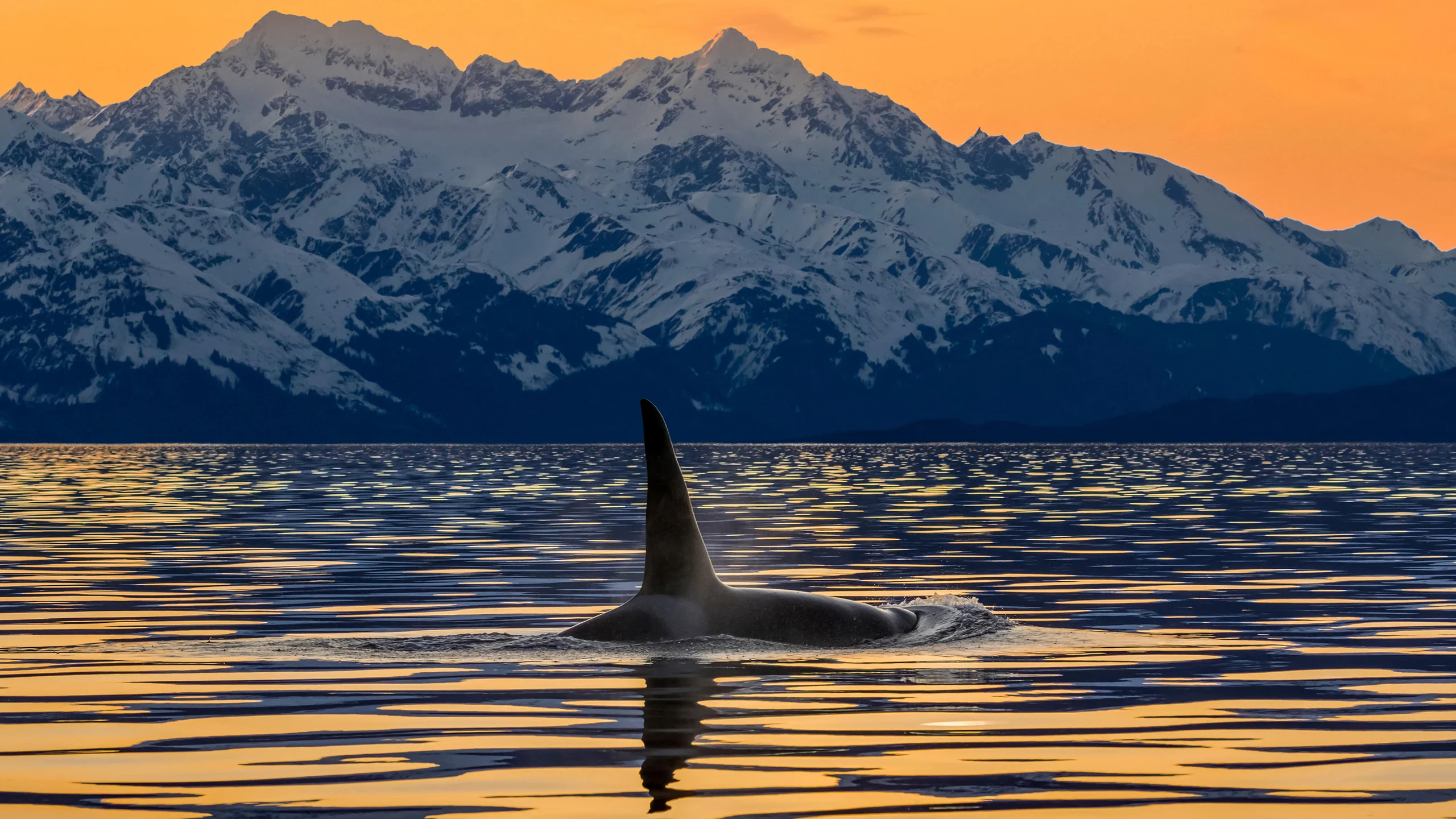
Image: Bing Daily Wallpaper · An orca surfaces in Lynn Canal near the Chilkat Mountains, Alaska, United States (© John Hyde/Alamy)
Today's Bing homepage is a field of dark water. The Chilkat Mountains rise in the distance, their snowline not yet gone. In the foreground, the surface parts as an orca lifts its dorsal fin and half its body into view. The division between black and white looks cut with scissors; the pale patch behind its eye is perfectly clear.
Bing's Chinese title is The Sound of the Pod. It is an apt choice because the photograph contains no sound at all, while nearly everything most remarkable about an orca happens through sound.
First, About This "Canal"
Lynn Canal is not a canal. The British navigator George Vancouver passed through in 1794 and named it after his birthplace, King's Lynn in England. "Canal" was simply the period's customary word for a long, narrow waterway. Nothing here was excavated by people.
It is really a fjord, and its formation is a little more interesting than "a glacier carved it." The Alaska Department of Fish and Game gives the sequence: a strike-slip fault first split the crust and created a zone of weakness; Ice Age glaciers followed that existing fracture downward and ground it into a U-shaped valley; when the ice retreated, the sea flooded in and made the fjord. The glacier was not cutting at random. It followed a crease the Earth had already drawn.
The waterway is about 5 to 10 kilometers wide. Published lengths differ: Encyclopaedia Britannica gives about 100 kilometers, while sources using different endpoints reach 140. Depth estimates also conflict. The fish and game department gives about 300 meters, while other sources say more than 600. The common online claim that it is "North America's deepest fjord" appears only in tourism media and does not withstand scrutiny: Jervis Inlet in British Columbia reaches 670 meters. One thing is certain: Lynn Canal is a deep, narrow glacial fjord, the northernmost reach of the Inside Passage, with ferries, cruise ships and freighters moving daily over the heads of orcas.
The waterway also remembers darker events. On Wednesday, October 23, 1918, the passenger ship Princess Sophia grounded on Vanderbilt Reef in the middle of the fjord. It remained on the reef for forty hours, then slipped off and sank during a storm. All roughly 353 people aboard died. The only survivor was a dog found covered in fuel oil.
Two Families in One Sea
Now to the orcas.
The northeastern Pacific population is not one unified community. It includes several groups that do not associate with one another. The two principal ecotypes are residents and transients, the latter also called Bigg's killer whales after researcher Michael Bigg.
They look almost identical. They swim in the same waters and encounter one another constantly. Yet they eat entirely different prey. Residents eat fish, chiefly salmon and especially the largest Chinook. Transients eat marine mammals: seals, sea lions, porpoises and the calves of other whales.
Stranger still, they never interbreed. NOAA says the two lineages diverged at least 300,000 years ago. Scientist Barbara Taylor has described them as the world's two most different populations of killer whales: immediate neighbors that see each other all the time and never mix.
One frequently misstated point deserves a note. A 2024 study did propose recognizing the two groups as separate species, and NOAA issued a news release about it. But the Society for Marine Mammalogy's taxonomy committee voted down the proposal that year. In its latest list, published in April 2026, their formal status remains three provisional subspecies, not new species. It is therefore still incorrect to say that orcas "have now been divided into two species."
Both ecotypes may visit the Lynn Canal area, and the Alaska Department of Fish and Game specifically notes summer visits by orcas. A single photograph of a dorsal fin cannot identify which ecotype this animal belongs to. What follows describes the difference between the two communities, not this particular whale.
One Family Chatters; the Other Says Nothing
This is the central fact of the story.
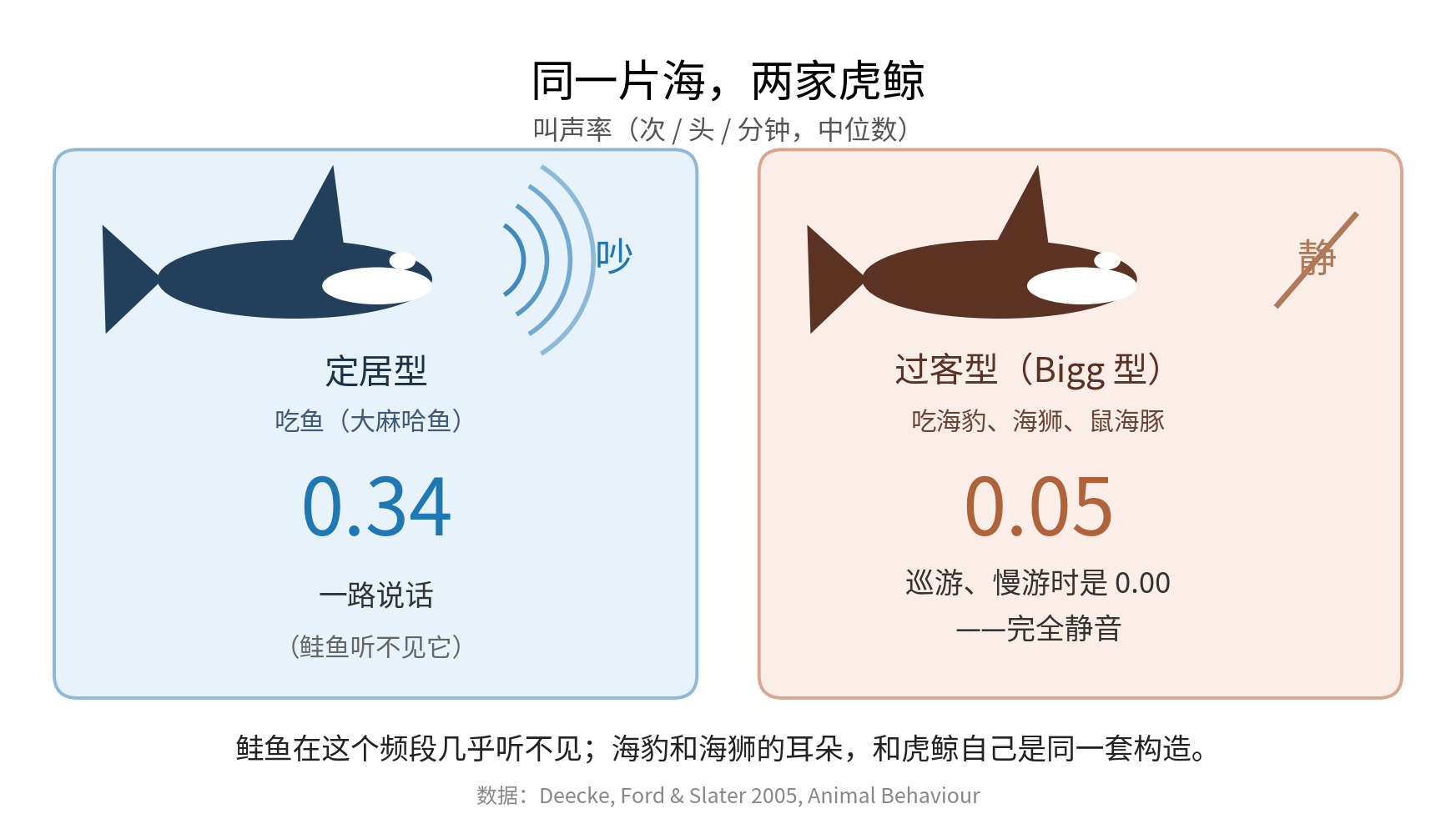
In 2005, Volker Deecke, John Ford and Peter Slater published comparative data in Animal Behaviour. They counted the two ecotypes' vocalization rates:
- Residents, the fish eaters: median calling rate 0.34 calls per animal per minute.
- Transients, the seal eaters: 0.05 calls per animal per minute.
That is a nearly sevenfold difference. The behavioral breakdown is starker. While traveling, slow traveling or milling, transients had a median rate of 0.00: complete silence. They spoke only after successfully killing prey and during vigorous activity at the surface.
Why?
Because salmon cannot hear orcas talking, while seals can.
Fish hear poorly in the frequency range of orca calls. Seals, sea lions and porpoises are mammals with ears built on the same plan as an orca's, and their hearing ranges overlap substantially. For an orca stalking a seal, making a call is like ringing the doorbell.
The difference in "personality" is not personality at all. One family can chat throughout the journey because its dinner is deaf. The other must remain silent because its dinner understands what it is saying.
This also explains another puzzle. Transient groups are especially small, often an adult female with only one or two offspring. Resident pods may sweep along more than twenty strong. Silent hunters need a small party. Noisy fishers do not.
Every Family Has Its Own Accent
For the ecotype free to speak, sound is more than a tool. It is an identity card.
Orcas produce three classes of sound. Clicks are high-frequency signals for echolocation. Whistles serve close-range social contact. Most common are pulsed calls, with most of their energy between 1 and 6 kilohertz: the ordinary language of staying in touch.
In 1991, Canadian biologist John Ford published a paper in the Canadian Journal of Zoology that is still cited repeatedly. He found that every orca pod consistently uses a limited, discrete set of calls. They are not improvising at random; each pod has a fixed repertoire. Ford counted roughly seven to seventeen call types per pod.
More important was his concept of the acoustic clan: several pods that share some call types belong to the same clan. Sharing implies common descent; the pods once branched from the same maternal line. Two clans that share no calls can swim side by side in the same water and have no language in common.
The calls are learned, not innate. Calves learn to speak from their mothers, acquiring the accent of their own family.
Researchers on the US West Coast have numbered every call made by the southern residents. J pod uses S1 most often and also makes an S4 call that sounds like a sheep. K pod has the high-pitched S16 and S17, which sound like a kitten. L pod divides into two subgroups with different calls. Researchers do not need to see a whale. They can lower a hydrophone, listen for a minute and know which family has arrived. The Alaska Department of Fish and Game also notes that a call type unique to one pod can remain unchanged for twenty-five years.
Touching Objects With Sound
Clicks do something different.
An orca does not produce sound in its throat. It originates in a pair of structures in the nasal passages called phonic lips. The sound moves forward through the rounded organ in the forehead, a mass of specialized lipids called the melon. The melon acts as an acoustic lens, focusing diffuse sound into a narrow beam.
The returning echo does not enter through the external ear. Fat-filled cavities in the lower jaw receive it and conduct it directly to the middle ear.
The complete picture is this: the orca does not "see" with sound so much as touch an object's shape with it. It sends out a call, and the returning fragment reveals how large a fish is, where it is swimming and whether it has a swim bladder. The melon is its flashlight; its jaw is its ear.
This touching has its own offense and defense. A 2007 field study of herring-eating orcas in Norway measured clicks only about 90 microseconds long, with source levels as high as 202 decibels. Modeling showed that an orca using low-intensity clicks could detect a herring's echo from farther away than the herring could hear the click itself. It is a stealth contest measured in decibels, with both sides effectively asking: do I hear you before you hear me?
No One Leaves Mother
Resident orcas do something exceptionally rare among mammals: sons and daughters both remain in their natal matriline for life. No one ever leaves. Mating occurs when different groups meet temporarily, but marriage causes no one to move away. In most mammals, at least one sex disperses. Not here.
That makes another unusual arrangement possible. NOAA data put a female orca's average lifespan at about fifty years, with a maximum of at least ninety; males average about thirty and may live at least sixty. Orcas are also one of six animals known to experience menopause. The other five are humans, short-finned pilot whales, narwhals, belugas and false killer whales.
What does an older female do after reproduction ends, when she may still have decades to live?
A 2017 study in Current Biology, using forty-three years of field observations, supplied half the answer. When mothers and daughters reproduced at the same time, the calves of the older generation faced 1.7 times the mortality risk of the younger generation's calves. Older females lose that intergenerational competition for resources.
The other half came in a 2019 paper in Proceedings of the National Academy of Sciences: post-reproductive grandmothers do improve their grandchildren's survival, and the effect grows significantly in years when salmon are scarce. The study gives a specific multiple, but this article was unable to check the wording against the original abstract and therefore reports the direction, not the number.
The direction alone is moving enough: when fish are scarce, a grandmother's memory is the family's map to the pantry.
The Extinction of a Language
Now consider an event not far south of this fjord.
On Friday, March 24, 1989, the tanker Exxon Valdez struck a reef and spilled oil in Prince William Sound. A transient orca group known as AT1 had a stable population of 22 before the accident.
Nine disappeared soon after the spill. Thirty-seven years later, official records from the Exxon Valdez Oil Spill Trustee Council, a joint federal and state body, list 15 of the original 22 as presumed dead and 7 still alive. NOAA gives a range of 6 to 7. There have been no births or deaths since 2010.
The most devastating number is not 7 but another 0: not one calf has been born to the group since 1989.
Transient orcas form closed genetic units and do not mate with other groups. All seven survivors have passed, or are approaching the end of, reproductive age. This is a population counting down its remaining members, with the outcome already known.
Under Ford's framework, AT1 also has its own set of calls. When the last AT1 whale dies, the "language" spoken by no other group will disappear with it. That is more than the death of seven whales. It is the extinction of a language.
For comparison, the fish-eating resident AB pod was also affected by the spill. It numbered 36 beforehand and lost 14 animals in 1989 and 1990. Reproduction later resumed, and officials classify the pod as "recovering," though its birth rate remains only about 70% of that in other resident groups.
In China, Animals Are Counted by Ear Too
Chinese scientists use the same listening method more extensively than many people realize.
The Yangtze is so turbid, and finless porpoises surface so seldom, that a visual count cannot be accurate. But Yangtze finless porpoises produce narrow-band, high-frequency clicks. Measurements published in PLOS ONE in 2015 put their peak frequency at 128 to 133 kilohertz, with pulses only tens of microseconds long. The signal is so distinctive underwater that it is almost impossible to confuse with background noise.
The solution is to tow a hydrophone behind a boat and listen continuously along the route.
The basin-wide survey organized by China's Ministry of Agriculture and Rural Affairs in 2022 ran visual observation and passive acoustic monitoring in parallel, with each checking the other. It counted 1,249 Yangtze finless porpoises: 595 in the Yangtze main stem, 492 in Poyang Lake and 162 in Dongting Lake.
Put that number on a timeline: about 3,600 in the 1990s → about 1,800 in 2006 → about 1,045 in 2012 → about 1,012 in 2017 → 1,249 in 2022.
It was the first recorded increase, up 23.42% from 2017.
But researcher Wang Ding of the Institute of Hydrobiology, Chinese Academy of Sciences, stressed an equally important sentence: "Its critically endangered status has not changed." Both statements must be remembered.
Reliable records of orcas in Chinese waters are scattered. A 2025 study in Frontiers in Marine Science surveyed seventy-one years of cetacean strandings along the Shanghai-Zhejiang coast, from 1953 through 2023: 138 events, 197 individuals and 23 species. Orcas accounted for 3 events and 5 animals. The most common species in the same dataset was the narrow-ridged finless porpoise, with 63 events and 80 animals. Chinese waters have no known resident orca population and no family genealogies tracked for decades as in North America.
Finally
The second or two in which an orca pushes its dorsal fin above the surface is the least important part of its day. Almost all its life happens underwater and in sound: recognizing relatives, following prey, telling others who it is, or deliberately saying nothing.
We see only those seconds. To hear the rest, we have to put our ears in the water.
In the Yangtze, that is already happening. Hydrophones towed behind boats listened out 1,249 porpoises no one could see. It is the same principle: when an animal will not show itself, you have to learn how to listen.
Sources: Bing Daily Wallpaper (zh-CN); the Alaska Department of Fish and Game; NOAA Fisheries; the Exxon Valdez Oil Spill Trustee Council; Deecke, Ford and Slater (2005), Animal Behaviour; Ford (1991), Canadian Journal of Zoology; Simon et al. (2007); Croft et al. (2017), Current Biology; Nattrass et al. (2019), PNAS; Fang et al. (2015), PLOS ONE; Yuan et al. (2025), Frontiers in Marine Science; the Institute of Hydrobiology, Chinese Academy of Sciences; China's Ministry of Agriculture and Rural Affairs; the US National Park Service; OrcaLab; and Encyclopaedia Britannica.