
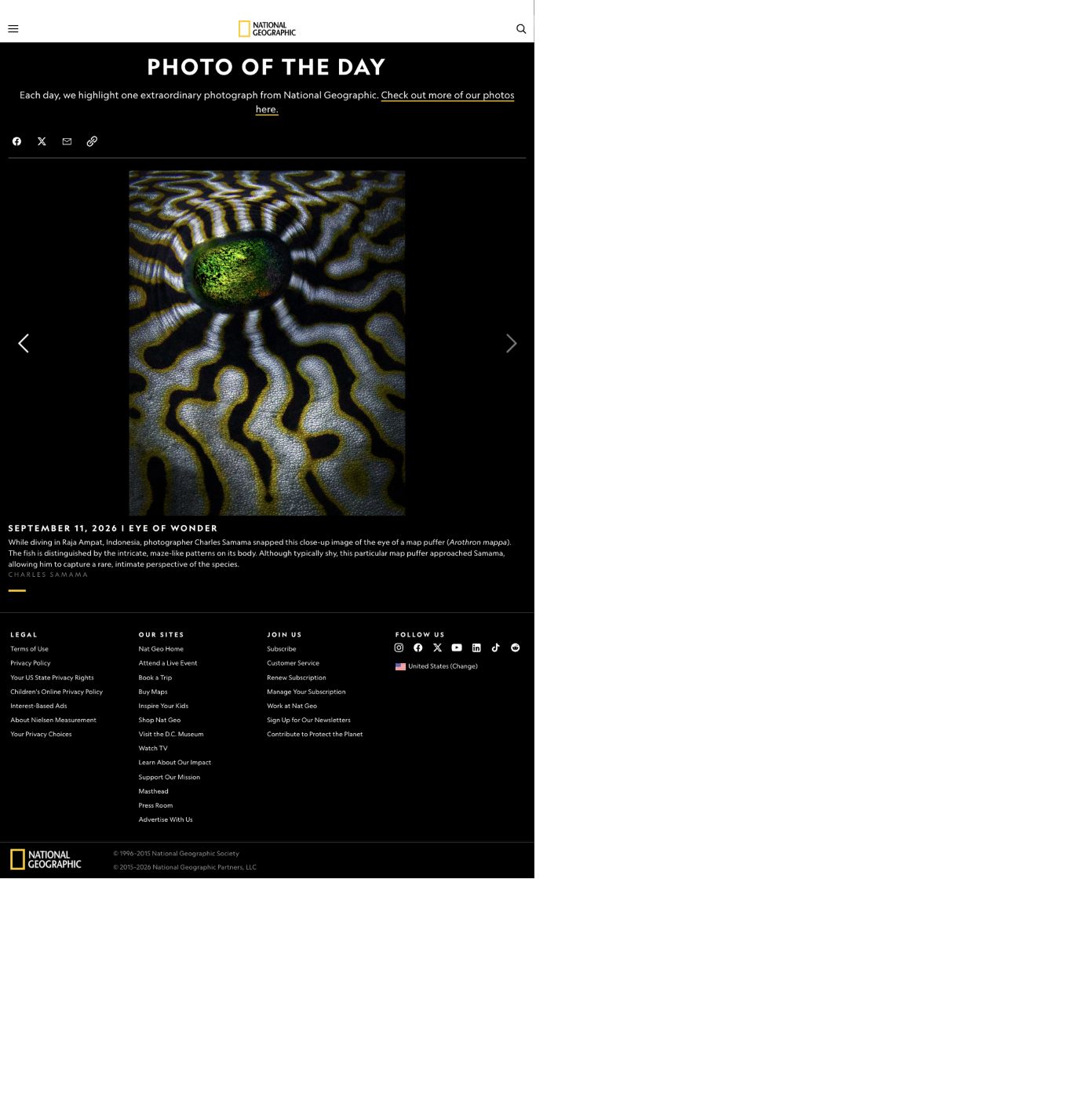
Today's National Geographic Photo of the Day is titled "Eye of Wonder." The wonder is that this eye can close.
Screenshot: National Geographic Photo of the Day · Original page
The frame contains only one eye and the skin around it.
National Geographic's accessibility description calls it "a close-up of an animal's green eye, surrounded by its maze-like skin." The caption says photographer Charles Samama made the close-up while diving in Raja Ampat, Indonesia. His subject is a map pufferfish, Arothron mappa. The species is usually shy, but this individual swam toward him and allowed an unusually close, almost intimate view.
A fish approached a person to have its eye photographed.
That is odd enough. Stranger still, this eye can close.
A Discovery Announced Last Month
Among vertebrates, closing the eyes is less common than you might think.
Research announced this year by Kaikyokan, the municipal aquarium in Shimonoseki, Japan, set out the background: previously, eye closure was known in sea turtles, cetaceans and some cartilaginous fishes. Most fish have no eyelids. They are born with their eyes open, swim with them open and die with them open.
Pufferfish can close theirs.
A 2021 study first reported the behavior and used a precise phrase in its title: "iris-like eye closure." The eye does not shut as upper and lower lids meet. Instead it closes from every direction toward the center, like a camera aperture.
The finding became a better story with a paper published online on August 12, 2026, in the Journal of Morphology. The team did laborious work, dissecting, comparing and analyzing muscles from 51 species representing every family in the order Tetraodontiformes.
They found:
- A thin muscle covering the body, the cutaneous muscle, closes a pufferfish's eye. Around the eye it develops into a ring muscle whose contraction pulls the opening shut.
- Across Tetraodontiformes, this cutaneous muscle occurs only in the pufferfish and porcupinefish families, Tetraodontidae and Diodontidae.
- The ring muscle occurs only in the pufferfish family, Tetraodontidae.
Then comes the sentence that completes the mechanism. Kaikyokan's release says:
The pufferfish eye-closing mechanism arose when an existing muscle was repurposed for the new role of protecting the eye.
Japanese science coverage put it more directly: the pufferfish family's eye-closing behavior probably evolved because the fish could already inflate.
In plain language:
Pufferfish developed a thin muscle around the whole body so they could swell into a ball. Later, that muscle acquired an extra ring around the eye. The result was one of the very few fish in the sea able to close its eyes.
It did not evolve a new part because it "wanted" to blink. It already had a part built for another job, and evolution put that part to a new use in a new place.
Evolution is not a designer. It is a mechanic searching through a pile of old parts. The eye in today's photograph can blink because the fish's ancestors needed to turn themselves into balls.
(For precision, the anatomical work examined species including those in the genus Takifugu, not the individual species in today's photograph. But the ring muscle is a shared feature of Tetraodontidae, and the map puffer belongs to that family.)
How Does It Inflate?
The machinery is worth following because it reveals something more important than the familiar claim that a pufferfish can grow three times larger.
First, what does it swallow? Underwater, a pufferfish swallows water, not air. A 2014 study of the black-saddled toby established that it inflates by swallowing seawater. Only when lifted out of water does it swallow air, and doing so is harmful.
How does the body make room to expand? The unsettling answer is: it removed parts.
A skeletal-staining comparison in a 2004 genomics paper says it plainly:
Pufferfish lack ribs and pelvic girdles and have few vertebrae.
Set the skeleton beside a zebrafish and the difference is immediate. The zebrafish has an orderly cage of ribs. The pufferfish is empty there.
It did not grow an extra air sac. It dismantled the framework of its torso to make an expandable body.
Where does the water go? Into the stomach. The abstract of a 2022 Biology Letters paper describes the deeper cost:
Tetraodontidae and Diodontidae are famous for inflating their bodies threefold by swallowing and retaining large volumes of seawater in a distensible stomach. Inflation provides defense against predators; its cost, however, is the secondary loss of the stomach's digestive function. Alkaline seawater ingested during inflation prevents gastric acidification, possibly driving that loss, which is accompanied by the loss of genes associated with gastric acid and pepsin.
The ability to grow threefold is a familiar piece of popular science. Its real cost is that this fish's stomach is no longer a stomach. It produces no gastric acid and digests no food there; evolution even discarded genes for making gastric acid and digestive enzymes. The stomach's only job now is to serve as a water bag.
To avoid being eaten, the fish gave up ribs, pelvic girdles and digestion in the stomach.
The power to become a ball was purchased with an entire suite of body parts. That is the weight of the adaptation.
Correcting a Myth Makes the Cost More Painful
One of the most widespread claims about inflation is that a pufferfish cannot breathe while swollen and must hold its breath.
The 2014 study directly tested the claim; its title asked whether inflated pufferfish hold their breath. The results were:
- Inflated fish maintained a strong capacity for oxygen uptake.
- Oxygen consumption rose to five times the resting rate.
- The gills remained the primary site of oxygen uptake during inflation; skin respiration contributed negligibly.
The fish is not holding its breath. It is breathing furiously while inflated.
But the same paper gives a number often lost in summaries: after deflation, aerobic metabolism took an average of 5.6 hours to recover.
Five and a half hours.
The myth is false, but its underlying intuition - that inflation is enormously expensive for the fish - was confirmed experimentally, at a greater cost than many people imagine.
Both statements belong together. Disproving a claim does not always make the reality gentler. Sometimes the truth is heavier than the legend.
Why the Eye Is Beautiful, and Whether It Changes
Return to the eye.
National Geographic's accessibility text calls it green. The metallic, oil-slick sheen of many fish eyes, shifting with the viewing angle, is produced by structural color.
A 2014 paper on fish iridocytes explains the mechanism. Inside those cells, thin platelets of high-refractive-index guanine crystals alternate in layers with lower-index cytoplasm. Light enters and reflects from the different layers:
Reflections from different layers undergo constructive interference at some wavelengths and destructive interference at others, producing a particular color. Change the angle of incidence and the wavelengths that interfere constructively change too, so the color changes.
For a child, the explanation can be simpler:
This is not paint but a stack of extremely thin crystal plates. Light reflects between the layers. Some colors reinforce one another and grow brighter; others cancel and disappear. Change your viewing angle and the color changes with it.
Pigment sits still; structural color is active. It is not painted on. It is calculated. A soap bubble's rainbow, the blue of a butterfly wing and the metallic flash in a fish eye all use the same trick.
(No study was found specifically on structural color in pufferfish eyes. The mechanism above is the general mechanism of fish iridocytes. This eye appears green in the photograph, but no experiment has determined how much comes from structure and how much from pigment. Nothing further should be inferred without evidence.)
One related phenomenon has been observed and recorded in the same genus.
A 2024 observational report studied the guineafowl puffer, Arothron meleagris. Researchers found that these fish could make body bands appear or vanish in less than 15 seconds. Pale bands emerged across the back, brow and snout and below the eye, dimming the otherwise vivid white spots. The triggers were disturbance, retreat into shelter and remaining still for a few seconds. Once the fish moved its fins and began swimming, the bands disappeared.
Less than 15 seconds. A fish decides to hide, and the pattern on its face changes.
The authors suggested a defensive camouflage function, but this was a short behavioral report based on five fish. The function remains a hypothesis, not a conclusion.
What does the map puffer's namesake maze pattern do: camouflage, recognition or warning? No research supports any one answer. The species name mappa comes from the Latin for cloth or chart and, according to an etymological source, from mappa mundi, the "cloth of the world," or world map. The original description says countless stripes cross its body and sides in every direction like routes on a map.
Humans saw a map when they named it. What the lines mean to the fish remains unknown.
A Channel on the Reef That Humans Cannot See
A 2008 Journal of Experimental Biology study offered the first behavioral evidence of color vision in coral-reef fish. It also notes:
Many coral-reef fish have body colors with ultraviolet components. Many can see ultraviolet because the media of their eyes transmit it or because they possess UV-sensitive photoreceptors.
(The authors add an important qualification: not every fish with an ultraviolet pattern has UV-transparent ocular media.)
A whole layer of patterns invisible to human eyes may be drawn across the reef. Dive into all that color and, from a fish's perspective, you may still be missing one channel.
This Eye Lives in the Sea with the Most Coral on Earth
Raja Ampat lies in Indonesia's West Papua and consists of four principal islands: Waigeo, Batanta, Salawati and Misool. In marine biology, its name is almost a superlative.
Tourism sites copy one another's figures, so the following numbers come from primary survey reports:
- A 2009 reef-fish checklist records 1,320 known reef-fish species in Raja Ampat, compared with 1,511 across the full Bird's Head Peninsula.
- The Nature Conservancy's 2003 rapid ecological assessment confirmed at least 537 reef-building coral species and expected the islands to contain more than 75 percent of all known coral species.
- A 2009 paper defining the Coral Triangle counted 605 species of zooxanthellate reef-building coral across the region, 76 percent of the global total. Its richest area was the Bird's Head Peninsula, which includes Raja Ampat, with 574 species. A single hectare of reef can hold as many as 280 species.
Two hundred and eighty coral species in one hectare, an area a little larger than a standard football field.
On September 27, 2025, Raja Ampat became a UNESCO biosphere reserve. Its first anniversary comes next week.
But another event in the same year belongs beside that achievement.
On June 10, 2025, Indonesia's Ministry of Energy and Mineral Resources announced that it had revoked nickel-mining permits held by four companies in Raja Ampat because they were found to violate environmental regulations. Four of five permits were withdrawn; one remained. The minister told reporters that supervision of the remaining company would be especially strict, as would its environmental assessment and reclamation, and that coral reefs must not be damaged.
He also gave the reason for retaining it: the site produced three million metric tons of nickel ore a year.
The sea with Earth's richest coral diversity revoked four mining permits only in 2025, and one remains. This is not a story already won. It is a story still being contested.
China: The Science Behind a Rule
Pufferfish in China tell a different story about danger and delicacy.
China imposed a comprehensive ban on the sale of pufferfish in 1990. Twenty-six years later, in September 2016, a joint document from the Ministry of Agriculture and the China Food and Drug Administration, Nong Ban Yu [2016] No. 53, conditionally opened commerce in two species. Its rules were:
The processing and sale of farmed tiger puffer and farmed obscure puffer products may be conditionally permitted first.
Farmed pufferfish must be processed by qualified agricultural-product processors before sale.
Tetrodotoxin in pufferfish products may not exceed 2.2 mg/kg by fresh weight.
The sale of live farmed pufferfish and unprocessed whole farmed pufferfish is prohibited.
The processing and sale of wild pufferfish of every species is prohibited.
Only two species, only farmed fish, and only after processing. Wild fish remain entirely excluded.
Why does the rule have this shape? Because a scientific mechanism lies behind it, and officials acknowledge that the mechanism is not fully understood.
Hong Kong's Centre for Food Safety explains carefully:
Although the source of tetrodotoxin in pufferfish has not been determined, pufferfish are believed to ingest it in food and then accumulate and distribute it rapidly among their tissues.
Tetrodotoxin can be produced by several bacteria, most commonly Vibrio alginolyticus, some of which occur in the pufferfish gut.
It is concentrated in the reproductive organs, especially the ovaries, as well as the liver, intestines and skin.
Tetrodotoxin is heat-stable; cooking, refrigeration and drying do not destroy it.
Read the statements together and the document's logic emerges:
If the fish makes the toxin itself, there is no solution. If it acquires and accumulates the toxin through food, controlling the food can control the toxin.
That is why the rule insists on "farmed." Humans control the feed in an aquaculture pond, not the diet in the open sea. The same species may be conditionally permitted on one side and entirely prohibited on the other; the dividing line is not the fish but what it ate.
The official admission that the source "has not been determined" reveals something else. When the mechanism is not fully understood, rules may properly remain conservative. Regulations do not come from nowhere. Behind them often lies a scientific question that has not yet been solved.
China's own coral reefs also belong in the account. The Ministry of Ecology and Environment says the Sanya Coral Reef National Nature Reserve was established in 1990, covers 4,000 hectares and contains more than 80 species of reef-building coral. The Ministry of Natural Resources' marine ecological monitoring bulletin says China's reef-building stony corals represent 40 percent of known global species, while its reefs contain nearly 600 fish species. A team at the Chinese Academy of Sciences' South China Sea Institute of Oceanology has transplanted 58,000 corals around Hainan Island in recent years.
The Chinese Academy of Sciences gives one proportion worth setting beside the earlier figures:
Coral reefs support at least 25 percent of marine species in 0.25 percent of the ocean's area.
National Geographic Education phrases the point similarly: reefs cover less than one percent of Earth's surface but about 25 percent of marine species live in or near them.
One-quarter of marine species in one four-hundredth of the ocean. The ratio is reason enough.
Why Today? No Reason, but Two Dates Are Close
September 11 has no observance connected to oceans, coral reefs or Indonesia. The United Nations list is empty between September 9 and 12. The photograph is not attached to a newly published feature; editors simply selected a strong image for this day.
(The first related article on the page concerns New York's September 11 memorial lights. That is an editorial association with an American day of remembrance and has no connection to the fish.)
Two relevant dates are close:
- Eight days later, Saturday, September 19, 2026, is International Coastal Cleanup Day, held on the third Saturday of September.
- Sixteen days later, September 27, is the first anniversary of Raja Ampat's designation as a UNESCO biosphere reserve.
Sources
National Geographic Photo of the Day, September 11, 2026; the August 12, 2026 Journal of Morphology paper and Kaikyokan aquarium release; Zoology (2021) paper on iris-like eye closure; Biology Letters (2022) paper on the multifunctional stomach; McGee and Clark, Biology Letters (2014); Amores et al., Genome Research (2004); Gur et al., Journal of the American Chemical Society (2014); Marine Biodiversity (2024) report on color change in the guineafowl puffer; Siebeck et al., Journal of Experimental Biology (2008); FishBase; the Digital Archive of Taiwan Fishes at Academia Sinica; ETYFish; Allen and Erdmann, Check List (2009); The Nature Conservancy's 2003 Raja Ampat rapid ecological assessment; Veron et al., Galaxea (2009); Indonesia's Ministry of Energy and Mineral Resources; Nong Ban Yu [2016] No. 53; Hong Kong Centre for Food Safety; China's Ministry of Ecology and Environment; China's Ministry of Natural Resources marine ecological monitoring bulletin; Chinese Academy of Sciences; United Nations observance calendar; DivePhotoGuide; NOAA Coral Reef Conservation Program; and National Geographic Education.