
A question that looks long settled is one scientists are still arguing about.
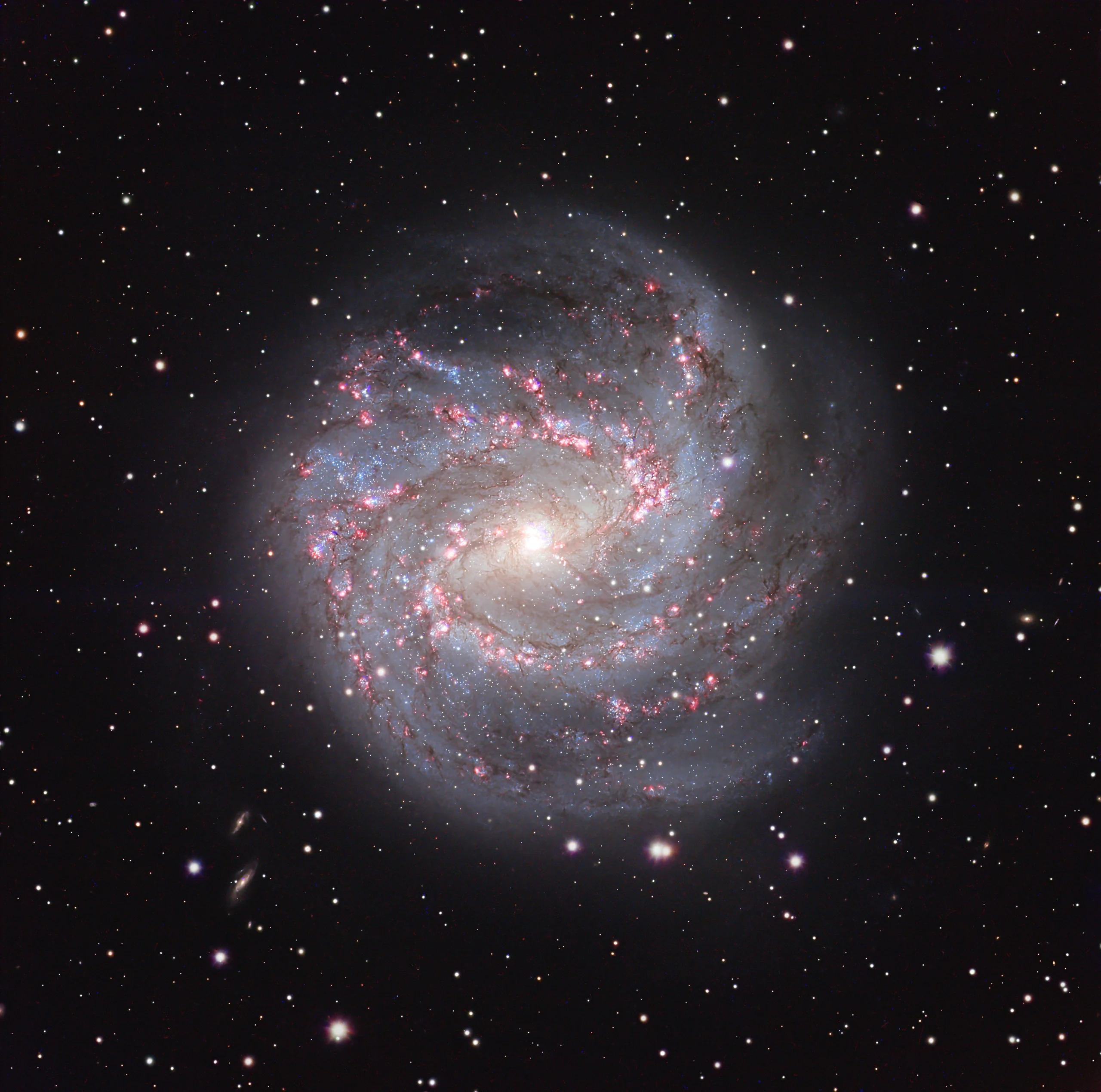
Image: NASA Astronomy Picture of the Day (APOD) | Image credit and copyright: Aldo Zanetti | Today's page (NASA is moving APOD's main site to science.nasa.gov/apod)
Today's NASA Astronomy Picture of the Day is a whirlpool seen face-on.
Two spiral arms sweep outward from the center in widening curves, strewn with blue star clusters, crossed by dark lanes of dust and studded with countless red points. This is M83, nicknamed the Southern Pinwheel Galaxy.
Its beauty feels so self-explanatory that it is easy to skip the most basic question:
What, exactly, are those two spiral arms?
You may think the question sounds silly. Surely a spiral arm is just a collection of stars arranged in a spiral.
It is not. The reason why is one of 20th-century astronomy's most elegant changes in perspective.
The Winding Problem
Imagine first that spiral arms really were fixed rows of stars.
A galaxy rotates, but not like a record. Stars near the center move around it faster than stars farther out. If an arm were made from one fixed set of stars, its inner end would race ahead while its outer end lagged behind. The arm would wind tighter and tighter, like thread wrapping around a finger.
How long would that take? An astronomy course at Case Western Reserve University gives a blunt answer: far too quickly, in only a few rotations, or about 500 million years. The universe is more than 10 billion years old.
If spiral galaxies made their arms this way, every one of them should now be wound tight. We should see no open spiral arms at all.
Yet look up and the universe is full of them, each more expansive than the last.
This is astronomy's famous winding problem. It puzzled the field for decades.
The Answer: A Spiral Arm Is a Pattern, Not a Set of Things
The person who untied this knot was C. C. Lin.
Tsinghua University's official biography records that he was born in Beijing on July 7, 1916, with ancestral roots in Fuzhou, Fujian; graduated from Tsinghua's Department of Physics in 1937 and stayed as a teaching assistant; continued his studies at the University of Toronto in 1940; earned his doctorate from the California Institute of Technology in 1944; and, beginning in 1947, served at MIT as associate professor, professor of mathematics, Institute Professor and professor emeritus. It credits him with creating the density-wave theory of galactic spiral structure, explaining the principal features of spiral structure in disk galaxies and overcoming the winding problem that had troubled astronomers for decades.
In 1964, Lin and his student Frank Shu published a paper in The Astrophysical Journal proposing that gravitational instability could explain the form of spiral arms. Their 1966 sequel in the Proceedings of the National Academy of Sciences formally put the term density wave in its title.
What is a density wave?
The Case Western course gives an analogy worth borrowing nearly intact:
Imagine driving on a highway where two older motorists are traveling at 40 miles per hour, one in each lane, with a long backup behind them. You approach at 60, enter the jam, slow to 40 and carefully make your way through. Once you pass them, you accelerate to 60 again. The traffic jam moves at 40, while the traffic itself ordinarily moves at 60.
Keep your eye on the jam.
Is it a thing? It has no license plate, no driver and no weight. It is a shape temporarily made from cars that are constantly changing. Seen from a helicopter, the jam persists and creeps forward. Look at the individual cars and none stays in it: each enters, bunches up and leaves.
A spiral arm is a traffic jam on a galactic scale.
Stars and gas pass through it. While inside, they crowd together and compress, then move on. The arm's pattern rotates more slowly than the stars themselves. It does not wind ever tighter because the material being "wound" is never the same material.
Swinburne University of Technology's astronomy encyclopedia gives a slightly more technical version: imagine a slow truck on a busy highway. The jam behind it keeps moving forward, but the particular cars inside it continually change.
That is the sentence to remember: a spiral arm is not a ring of stars but a traffic jam. Stars pass through it; they do not constitute it.
But Scientists Are Still Arguing
Ending the story there would make it easy to read and slightly out of date.
The central intuition of density-wave theory is sound: an arm is a pattern, not an object. What remains unsettled is whether that pattern can persist steadily for billions of years.
In 2014, Publications of the Astronomical Society of Australia published an authoritative review by Clare Dobbs of the University of Exeter and Junichi Baba of the Tokyo Institute of Technology. It opened by noting that although a large share of astrophysics concerns spiral galaxies and the stars and planets within them, how spiral arms form and evolve remains a fundamental problem.
Their own position was that spiral arms are transient and recurrent. They repeatedly break apart and are remade by instabilities in the disk, more like waves on the sea than one permanent wave. Barred spiral galaxies may be an exception. When NASA's NED database republished the review, its summary was plainer still: the debate between steady and transient spiral arms has continued since the 1970s.
How can anyone tell? Astronomers devised an elegant test.
If an arm is a stable density wave, gas should be compressed and begin making stars as it enters one side. The upstream side should contain younger stars and the downstream side older ones. Across the arm, there ought to be a clear age gradient.
Then they counted.
In 2018, an international team examined three galaxies. NGC 1566 showed a clear age gradient consistent with steady density-wave theory. M51 did not. Neither did NGC 628. In 2022, another team studied 12 galaxies, including M83 itself, and found support for density-wave theory.
The same test, two groups, two answers.
This is what science really looks like: not a finished answer book, but people measuring different things with the same ruler and arguing over the results. As you look at today's photograph of M83, the origin of its arms is still unsettled.
That is more worth telling a child than any settled fact: you are looking at something humanity does not fully understand. That is not bad news. It means there is still a place to contribute.
The Red Spots Are Not Stars
Now return to the photograph and those ruby-red points along the arms.
They are not red stars.
When the European Southern Observatory released an image of this galaxy in 2008, it called M83 The Thousand-Ruby Galaxy, another of the galaxy's nicknames. Its news release explained that the ruby-red patches are actually vast clouds of glowing hydrogen gas. Ultraviolet radiation from newborn massive stars ionizes the gas, making these enormous hydrogen regions shine red.
Here is what that means.
Inside a cold cloud of hydrogen, a group of large, hot stars is born. Their ultraviolet light is intense enough to ionize the surrounding hydrogen, knocking electrons away from atomic nuclei. The electrons do not stay free for long. Hydrogen nuclei recapture them, and the electrons fall step by step toward their lowest energy state. At every step, they release light. The strongest of those transitions produces red light.
So the red is not the color of the stars. It is the glow of hydrogen struck by their radiation.
Each red patch is therefore a sign outside a stellar nursery. The brighter the red, the more newborn massive stars are present. A string of rubies along a spiral arm is a string of lights announcing that stars are being made.
There is a satisfying echo here: we map the Milky Way's own arms using those same red patches. In a study published in 2025, a master's student at Yunnan University led researchers from the National Astronomical Observatories and Yunnan University in using Gaia data to identify the exciting stars in confirmed ionized-hydrogen regions. Their precise distances allowed the team to reconstruct the Local, Perseus, Carina and Outer arms.
We live inside the Milky Way and cannot see the shape of its arms, so we count red lights.
A Discovery 274 Years Ago, and a Galaxy Barely Visible From Paris
Who discovered M83?
On February 23, 1752, the French astronomer Nicolas-Louis de Lacaille found it at the Cape of Good Hope. The Paris Observatory's Messier database gives it a weighty distinction: the first galaxy beyond the Local Group ever discovered.
Notice the location: the Southern Hemisphere.
Twenty-nine years later, on February 17, 1781, Charles Messier added it to his catalog in Paris as object 83. His notes said that it could be seen only with the utmost concentration.
Why was it so difficult? M83 has a declination of -29 degrees 51 minutes 57 seconds, far to the south, while Paris lies at latitude 48.85 degrees north. The calculation is simple: from Paris, the galaxy climbs no higher than 11.3 degrees above the horizon.
How low is that? At arm's length, a fist spans about 10 degrees. A little more than one fist is all the altitude this galaxy ever gained in Messier's sky. Add 18th-century Parisian stove smoke and the extinction near the horizon, and an already dim galaxy becomes barely perceptible haze.
Lacaille saw the galaxy readily from the Cape of Good Hope; Messier strained to see it from Paris. What you can observe depends not only on your eyes and telescope but also on where you stand on Earth.
There is another revealing detail. Today's APOD places M83 "about 12 million light-years" away, while NASA's own Hubble Messier page, the European Southern Observatory and the Paris Observatory database all give 15 million light-years. A paper published in January 2026 adopted a value equivalent to about 15.3 million light-years.
Four sources offer values spanning a difference of one quarter.
That does not mean someone made a mistake. Measuring the distance to a galaxy is intrinsically difficult. Different methods produce different results, and each source has chosen a different literature value. The next time a popular-science article gives you a precise cosmic number, ask: what is its uncertainty? Knowing to ask that question takes you farther than memorizing the number.
When M83 Is Visible From China
One point needs to be clear: M83 is essentially unobservable from China this September.
Around September 11, the Sun's right ascension is about 11 hours 14 minutes, while M83's is 13 hours 37 minutes, a gap of only a little more than two hours. That means M83 crosses the meridian at about 2:30 p.m. By sunset it is already pressed against the southwestern horizon.
Calculated for several cities:
- Beijing: It sets around 6:39 p.m., almost exactly at the city's sunset of about 6:35. It is completely unobservable.
- Shanghai: It sets around 6:58 p.m. Before the sky is fully dark, it is only a few degrees above the horizon.
- Guangzhou: It sets around 7:50 p.m., while astronomical twilight does not end until 7:55. It is gone before the sky becomes truly dark.
For a galaxy with such low surface brightness, an altitude of five to eight degrees in twilight is effectively zero.
The right window comes next spring. Observing guides recommend evenings in April, May and June, with better conditions farther south: Guangzhou, Hainan and southern Yunnan are markedly better than northern China. This neatly returns us to Lacaille and Messier: M83 belongs to southern skies.
What would you need then? NASA's official page gives M83 an apparent magnitude of 7.5, making it one of the brightest spiral galaxies in the sky, and says it can be observed with binoculars. Amateur guides are more specific. Under a dark enough sky, 7x50 or 10x50 binoculars show "a smudge with a bright nucleus." An 80-millimeter telescope reveals diffuse haze around that core. To see distinct spiral arms and the central bar takes a reflector of at least 250 millimeters.
Sources: NASA Astronomy Picture of the Day for September 11, 2026; Tsinghua University biography of C. C. Lin; Lin and Shu, The Astrophysical Journal (1964) and Proceedings of the National Academy of Sciences (1966); Nature obituary of Frank Shu; Dobbs and Baba, the 2014 Dawes Review in Publications of the Astronomical Society of Australia, and the NASA/IPAC NED reprint; Shabani et al., Monthly Notices of the Royal Astronomical Society (2018); Abdeen et al., Monthly Notices of the Royal Astronomical Society (2022); European Southern Observatory release eso0825, The Thousand-Ruby Galaxy; ESA/Hubble release heic1403; ESA/Webb release weic2509; NASA Hubble Messier page for M83; Paris Observatory Messier database; astronomy course pages from Case Western Reserve University and Swinburne University of Technology; National Astronomical Data Center; Galaxy Zoo