
A galaxy has turned dozens of times. Why haven't its spiral arms wound themselves into a tangled mess? The question troubled astronomers for decades, and the first successful answer came from two mathematicians.
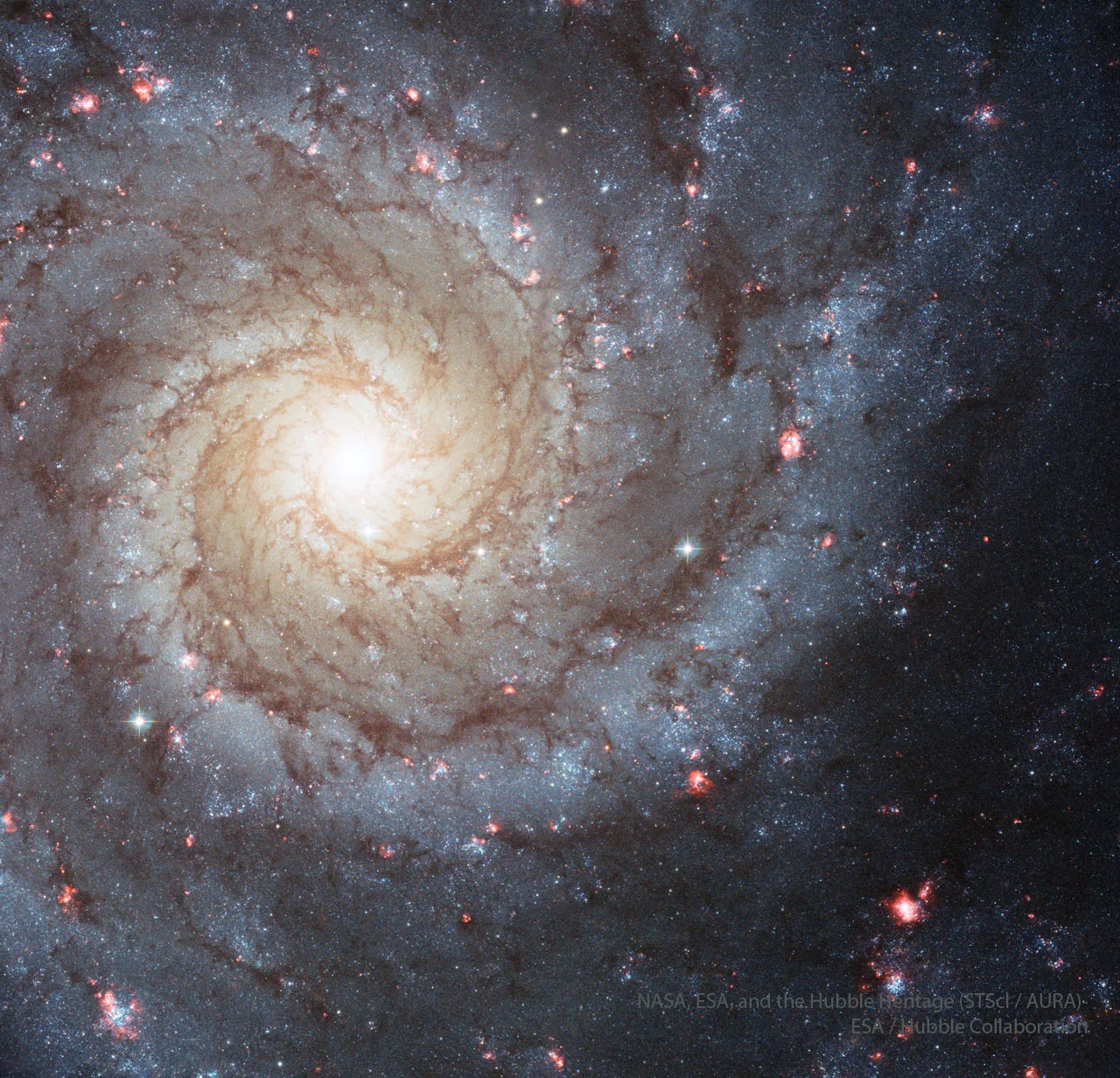
Image: NASA Astronomy Picture of the Day (APOD) | Image Credit & Copyright: NASA, ESA, and the Hubble Heritage (STScI / AURA)-ESA / Hubble Collaboration; Acknowledgment: R. Chandar (U. Toledo) & J. Miller (U. Michigan) | Page of the day: apod.nasa.gov/apod/ap260830.html
Today's NASA Astronomy Picture of the Day shows a spiral galaxy facing us head-on.
The editors begin with a fair assessment: "If not the grandest, then this spiral galaxy is at least one of the most photogenic."
It is M74, roughly 32 million light-years away in the direction of Pisces and made up of about 100 billion stars. Two immense spiral arms unfurl from the center. Clusters of young blue stars dot them, dark dust lanes run between them, and pink clouds of glowing gas mark hydrogen lit by the fierce radiation of young stars, where still more stars are being born.
Now for something deflating but fascinating: through an amateur telescope, this galaxy is almost invisible.
One of the Universe's Most Photogenic Objects, and One of the Hardest to See
M74 has another name: the Phantom Galaxy. Both the European Space Agency and NASA use it on their official pages.
NASA's Messier catalog says M74 "appears as a faint patch of light through small telescopes" and is one of the hardest Messier objects to observe. The reason is its low surface brightness.
The principle is simple. M74's total apparent magnitude is around 9.4 to 10, which does not sound especially faint. But that light is spread across an area of sky measuring 10.5 by 9.5 arcminutes, about a third of a full moon's width and roughly a tenth of its area.
Spread the same amount of light over a larger area and every small patch appears dimmer. That is why, for objects like this, a genuinely dark sky can matter more than a larger telescope aperture.
Its discoverer had already noticed. In late September 1780, Pierre Mechain, a French astronomer and Messier's assistant, found it. When Messier entered the object in his catalog, he copied Mechain's description: "This nebula contains no star; it is quite large, very faint, and extremely difficult to observe."
More than two centuries later, Hubble turned this "extremely difficult" object into a textbook cover.
(One detail can easily mislead. When APOD says this image spans about 30,000 light-years, it means the area covered by the image, not the galaxy's diameter. The European Space Agency's only official statement about M74's size is that it is slightly smaller than the Milky Way. Widely repeated estimates such as 77,000 or 95,000 light-years could not be traced to an authoritative primary source.)
Why Haven't the Arms Wound Tight?
Now for the question at the heart of the article.
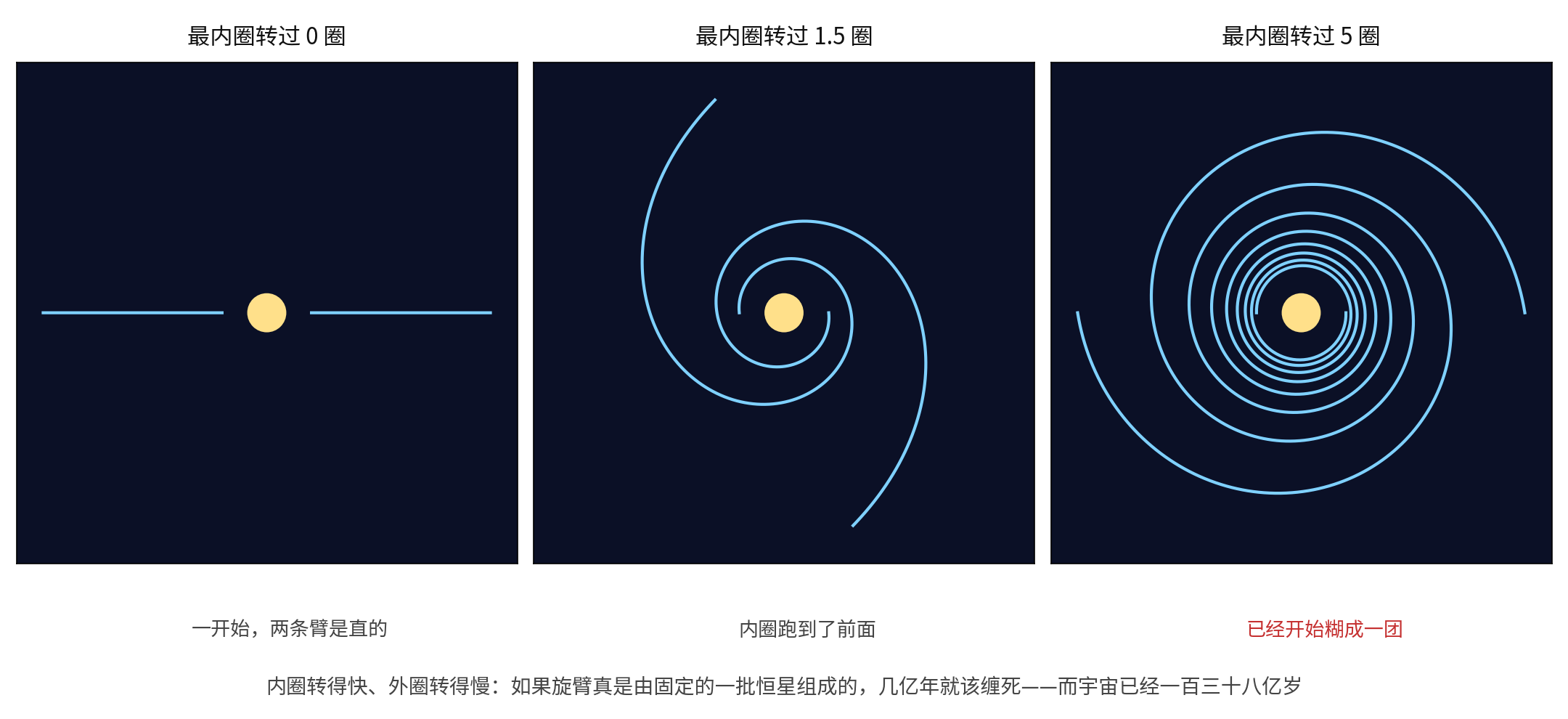
A galaxy rotates, and it does so differentially: matter near the center completes an orbit much faster than matter farther out. NASA puts the Sun's orbit around the center of the Milky Way at about 230 million years. Stars farther from the center take longer.
If spiral arms were physical structures made from a fixed population of stars, the inner portions would race ahead while the outer portions fell behind. After a few turns, the arms would wind tighter and tighter until they blurred into a snarl.
This is astronomy's famous winding problem.
How quickly would it happen? The Case Western Reserve University astronomy course page linked by today's APOD gives a startling estimate:
"It happens too quickly. Just a few rotation periods, say 500 million years. And the universe is something like 10-15 billion years old - if this were how spiral structure was made, spiral galaxies should all be tightly wound by now, and we wouldn't recognize them as spirals at all!"
Something that ought to disappear within 500 million years is visible everywhere in a universe 13.8 billion years old.
Only one conclusion follows: a spiral arm cannot be a 'thing.'
Even a child can follow the proof by contradiction. If it were made of fixed material, it should be gone. It is still here, so it cannot be made of fixed material.
A Traffic Jam
What is it, then?
In 1964, two scholars in the mathematics department at the Massachusetts Institute of Technology submitted a paper titled On the Spiral Structure of Disk Galaxies. They proposed that spiral arms were not fixed groups of stars but waves, regions of higher density. Stars and gas pass through them, becoming compressed before moving on.
The European Space Agency has long used an analogy anyone can understand. A 2020 image caption says:
"As cars move through a traffic jam, the density is highest at the center of the jam because the cars are moving most slowly there."
"Spiral arms work in a similar way; gas and dust move through the density waves, are compressed, linger for a while, and then move out again."
In a May 2025 caption, ESA put it even more directly:
"Spiral arms represent patterns of higher and lower density, rather than physical structures."
A traffic jam can remain in one place, or even creep backward, while each individual car enters, slows and leaves. No car belongs to the jam. The same is true of a spiral arm: no star belongs to it.
The Two Mathematicians
The authors of the 1964 paper were C. C. Lin and Frank H. Shu.
In Chinese, they were Lin Chia-Chiao and Shu Frank Hsia-San.
Lin's official biography at Tsinghua University records that he was born in Beijing on July 7, 1916, with ancestral roots in Fuzhou, Fujian; graduated from Tsinghua's physics department in 1937; earned his doctorate from the California Institute of Technology in 1944; and, from 1947 onward, served at MIT as associate professor, professor of mathematics, Institute Professor and professor emeritus. In 1994 he was elected a foreign member of the Chinese Academy of Sciences.
Tsinghua's official obituary says of this work:
"Beginning in the 1960s, he entered the field of astrophysics and founded the density-wave theory of galactic spiral structure, successfully explaining the principal features of the spiral structure of disk galaxies" and "overcoming the 'winding problem' that had troubled astronomy for decades."
The phrase "winding problem" is not an editorial invention. It appears in Tsinghua's official memorial to the scholar.
What happened later also matters. Tsinghua appointed him professor in November 2001. In August 2002, at age 86, he returned to China permanently and became honorary director of Tsinghua's Zhou Pei-Yuan Center for Applied Mathematics. He died in Beijing at 4:50 a.m. on January 13, 2013, aged 97.
The man who explained the two arms in today's image spent his final years teaching in Beijing.
The second author, Frank Shu, supplies another astonishing detail. He was born in Kunming, China, in 1943 and moved to the United States with his family at age six. The paper was received on March 20, 1964, when he was still an MIT undergraduate in his early twenties. According to Sonoma State University's biography of the Bruce Medal recipient, the density-wave work began as his undergraduate thesis under Lin.
He later became president of the American Astronomical Society, received the Shaw Prize in Astronomy in 2009, and died in California on April 22, 2023, aged 79.
The second author of the paper explaining today's image had not yet graduated from college when he wrote it.
But the Answer Is Beginning to Shift
Ending there would make a satisfying story. It would also leave out the most instructive part.
Density-wave theory has been taught since 1964, but over the past decade or so, astronomers have clearly begun to loosen their commitment to it.
A major 2014 review argues in its abstract that, with barred galaxies as a possible exception, spiral arms are transient and recurrent, excited by instabilities in galactic disks. Unbarred, two-armed grand-design spirals are probably induced by tidal interactions and slowly wind over time. The same paper estimates that arms in flocculent galaxies last only a few hundred million years, while those in grand-design spirals persist longer, on the order of one billion years.
A group of cosmological hydrodynamic simulations published online in April 2026 puts the challenge more forcefully:
"Our results suggest that in the absence of strong external encounters or a strong bar, galactic spiral structure is highly transient and complex, with no clear long-lived underlying wave."
Observations have raised doubts too. A 2019 paper is titled Unwinding the Winding Problem. From the degree to which arms wind across a large sample of galaxies, its authors infer that most arms may not be static density waves at all, but structures that wind over time. The winding problem, they suggest, may be resolved through the continual re-formation of spiral arms, without a static density wave.
This is a lesson in itself. A 2026 paper says there is "no clear long-lived underlying wave," while an official European Space Agency image caption from May 2025 still presents the traffic-jam analogy as the standard public explanation.
No one is deceiving anyone. This is the real pace of science: papers run ahead, textbooks follow, and popular explanations come later still. Even NASA and ESA's public writing is catching up with the literature.
The most honest account has three parts:
What we once thought: In 1964, two mathematicians said a spiral arm was a traffic jam, an elegant solution to the winding problem.
What official explanations still teach: The analogy continues to capture the essential idea in many cases.
Where researchers have moved: Many now think spiral arms repeatedly disperse and reform rather than persisting as a single eternal wave. The question remains open.
How Scientists Test an Idea
Density-wave theory makes a testable prediction, and the test is easy to understand.
If an arm is a traffic jam in which gas enters, is compressed and produces stars, then newborn stars should lie slightly to one side of the arm. Gas is compressed on that side, stars ignite there, and rotation then carries them downstream. Across a spiral arm, in other words, the ages of star clusters should form a gradient.
Astronomers went and counted. They measured the ages and positions of thousands of star clusters in galaxy after galaxy. Several studies counted clusters in M74 specifically.
A 2018 study reported no angular offset between clusters of different ages in M74's weaker spiral arms.
A 2022 study that broadly supported density waves found secondary peaks on both sides of M74's density wave, so the galaxy did not provide evidence for the prediction.
A third study, published in 2021, reported angular offsets in M74 consistent with the density-wave prediction, with the sign reversing on opposite sides of the corotation radius.
Some teams saw the effect; others did not. That is science as it is actually practiced, not as a finished book but as a group of people still counting stars and still arguing.
What Has Happened in This Galaxy
M74 is more than beautiful. It is an astronomical laboratory.
In the past few decades, humanity has caught three stellar explosions in this one galaxy: SN 2002ap in 2002, SN 2003gd in 2003 and SN 2013ej in 2013.
The second produced an almost perfect story.
A 2004 paper in Science reported that after SN 2003gd exploded, astronomers returned to archival Hubble and Gemini images taken six to nine months before the explosion. At the supernova's exact position, they identified a resolved red supergiant with a mass about eight times that of the Sun, with an uncertainty of +4/-2. This confirmed a central prediction of stellar evolution models and supernova theory: the progenitors of Type II-P supernovae are cool, red supergiants of this kind.
We possess a photograph of a star that later exploded.
The story had a second act. In 2009, two members of the same research group published a paper titled The Disappearance of the Progenitors of Supernovae 1993J and 2003gd. They waited for the supernova's light to fade, then looked again at the same location. The European Space Agency records their conclusion:
"The progenitor of SN 2003gd, an M-type supergiant, is no longer observed at the position of the supernova."
The star was truly gone.
The third supernova offered a different lesson. A 2014 paper examining the candidate progenitor of SN 2013ej found that what first appeared to be one star was actually two physically unrelated objects overlapping in the image. A blue source was probably unrelated to the supernova; a red source was the star that exploded.
One clean success, one self-correction. Both are science.
One Galaxy, Two Sets of Eyes
Today's APOD includes a small but telling detail. The characters "M74" in the text are themselves a link to another APOD, dated July 22, 2022: the same galaxy, photographed by the James Webb Space Telescope.
APOD's editors laid that path themselves.
Hubble observes visible light, so its image shows stars: young blue clusters and pink hydrogen clouds. Webb's MIRI instrument sees the mid-infrared glow of dust, turning the same galaxy into a skeleton woven from fine dusty filaments that coil all the way to the center.
The European Space Agency explains why the center of the Webb image appears "empty":
"The lack of gas in the nuclear region also provides an unobscured view of the nuclear star cluster at the galaxy's center."
Look at the same object with a different pair of eyes and you see a different thing. Together, these two images may be the clearest possible lesson in observing at different wavelengths.
(There is a small coincidence. Today's Hubble image acknowledges R. Chandar, and his name appears again in the acknowledgments for the 2022 Hubble-Webb composite. The same name runs from 2007 to 2022.)
The image is older than it looks. It is a composite of archival data captured in 2003 and 2005. Its raw material was recorded more than 20 years ago.
The Phrase "Island Universe"
APOD uses an old expression for M74: island universe, "an island universe of about 100 billion stars."
Behind that phrase lies a famous argument.
On April 26, 1920, at the Smithsonian National Museum of Natural History, two astronomers took part in what became known as the Great Debate. Harlow Shapley argued that the whole universe was contained within the Milky Way and that spiral nebulae were clouds of gas inside it. Heber Curtis argued that spiral nebulae were island universes, independent stellar systems beyond the Milky Way.
Both were half right. Curtis was right about the nature of spiral nebulae; Shapley was right about the Milky Way's true scale.
A glass plate settled the question.
The Carnegie Science archive records that on the night of October 5-6, 1923, Edwin Hubble photographed the Andromeda Nebula with the 100-inch Hooker telescope at Mount Wilson Observatory. He first labeled one star "N," for nova, then crossed out the N and wrote "VAR!" - variable, with an exclamation mark.
That Cepheid variable allowed him to calculate Andromeda's distance and prove conclusively that it was a galaxy independent of the Milky Way.
The physical evidence from the moment humanity learned that the universe held more than one galaxy is a handwritten exclamation mark. The plate remains in Carnegie Observatories' archive.
(On classification: APOD calls M74 an "Sc" galaxy, meaning it has a small central bulge and loosely wound arms. The classification comes from Hubble's tuning-fork diagram. It is not an evolutionary sequence. Hubble himself warned in 1927 that the terms "early" and "late" referred to position in the sequence and that "temporal connotations are made at one's peril." A century later, the misunderstanding persists.)
Just How Far Away Is It?
APOD says 32 million light-years, the figure the European Space Agency has used publicly for years.
The literature reveals something interesting. Historical estimates of M74's distance ranged from seven to 10 megaparsecs, or 23 million to 33 million light-years, a spread of nearly half the smaller figure.
The best modern measurement uses the tip of the red-giant branch. A 2014 study gave 10.19 megaparsecs, or about 33.2 million light-years.
Astronomers needed decades to narrow the uncertainty in a question as basic as its distance. Distance measurement is among astronomy's hardest problems because no ruler reaches that far.
How Ellipses Become Spiral Arms
Take a series of concentric ellipses, each larger than the last, and rotate each by the same small angle. Without drawing a single spiral arm, two arms emerge where neighboring ellipses crowd together. Each ellipse represents the complete closed orbit of a star. The arm is not a fixed group of stars, but a high-density region where many orbits bunch together.
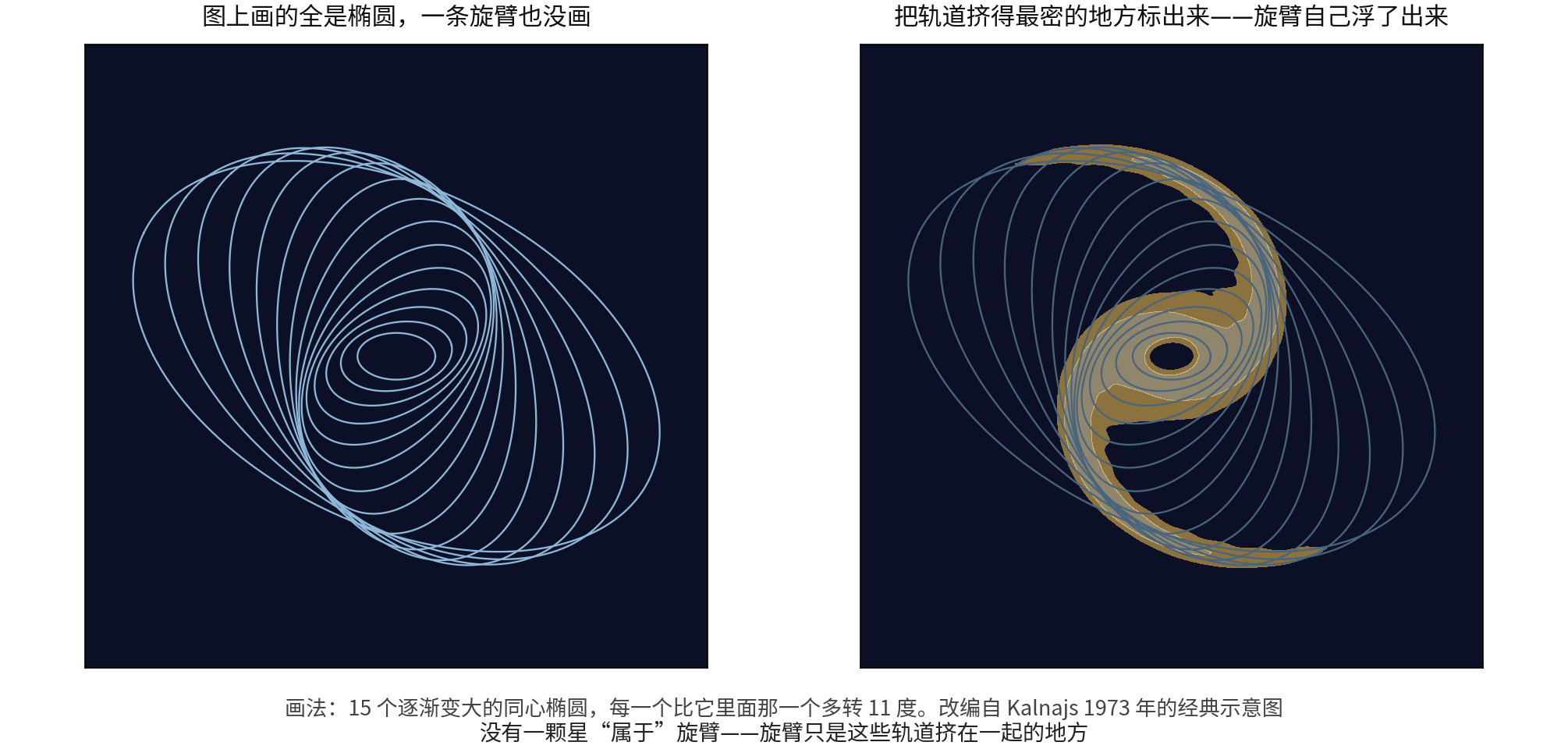
This construction is adapted from Kalnajs's classic 1973 diagram as reproduced in Kormendy's lecture notes.
Finally
The light in this image left M74 when there were no humans on Earth, and no apes.
Thirty-two million years ago was the early Oligocene. The University of California Museum of Paleontology at Berkeley gives the era's landmarks: the earliest long-trunked elephants and the first horses had just appeared, along with many new grasses that would take far longer to spread into grasslands.
That light traveled for more than 30 million years to rest on a retina for a few thousandths of a second.
And one fact is pure luck. M74 did not pose for us; it merely happens to face Earth. Tilt it a little farther sideways and today's image would not exist. Neither would this article, and the mystery of those two arms might have taken longer to draw serious attention.
On a clear night after eight or nine o'clock, M74 lies southwest of the two bright stars of Aries, near Eta Piscium.
Most observers will see almost nothing. That is all right. Knowing what is there is itself strange and remarkable.
Sources: NASA Astronomy Picture of the Day for August 30, 2026; Lin & Shu, The Astrophysical Journal 140:646 (1964); Dobbs & Baba, PASA 31:e035 (2014); Grand et al., MNRAS 548(4) (2026); Masters et al., MNRAS 487(2) (2019); Shabani et al., MNRAS 478(3) (2018); Abdeen et al., MNRAS 512(1) (2022); Sakhibov et al., MNRAS 508(1) (2021); Smartt et al., Science (2004) and Maund & Smartt, Science 324 (2009); Fraser et al., MNRAS Letters 439(1) (2014); Jang & Lee, ApJ 792:52 (2014); ESA/Hubble image notes heic0719a, potw2009a, potw2235a, potw2347a and potw2518a; ESA/Webb potm2208a and potm2208b; NASA's Hubble Messier catalog page for M74; NASA Cosmic Times, "The Great Debate"; the Carnegie Science plate archive, M31 VAR!; Case Western Reserve University's astronomy course page; Tsinghua University's biography and official obituary of Lin Chia-Chiao; Sonoma State University's Bruce Medal biography of Frank Shu; Kormendy's lecture notes, Secular Evolution in Disk Galaxies, reproducing Kalnajs (1973); Galaxy Zoo / Zooniverse; the National Astronomical Data Center / Chinese Virtual Observatory; and the University of California Museum of Paleontology's Oligocene page.