
The Triangulum Galaxy, M33; a measurement wrong by a factor of 650; and why people in China cannot see it - a problem that has nothing to do with its altitude.
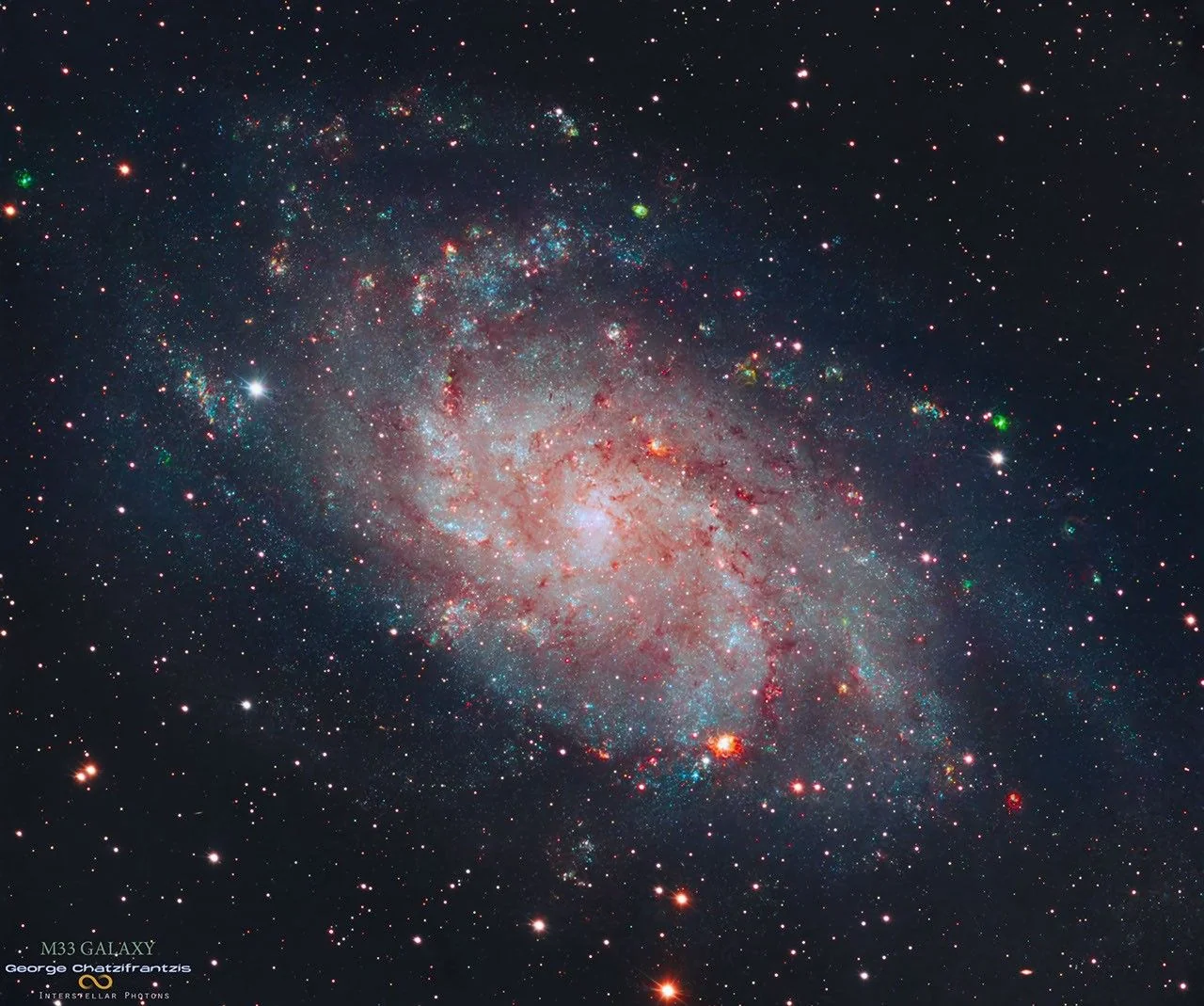
Image: NASA Astronomy Picture of the Day (APOD) | Image credit and copyright: George Chatzifrantzis | Today's page
Today's NASA Astronomy Picture of the Day is a whirlpool facing us head-on.
It is Messier 33, in Triangulum, a small and inconspicuous constellation whose three moderately bright stars form a narrow triangle in the autumn sky. The galaxy is turned face-on to Earth, so we do not see a thin edge but the full disk spread open. Its spiral arms are loose, less like a tightly wound spring than ribbons flung outward. They hold two colors: blue where young stars gather in clusters and pink where clouds of gas are making stars.
Look outward from the center and one especially large, bright pink region appears. This is NGC 604, the most luminous stellar nursery in M33.
But the story here is the least astronomical thing about this galaxy.
One Man Measured Something That Did Not Exist
In 1923, the astronomer Adriaan van Maanen published a paper in The Astrophysical Journal, ApJ 57, 264. His method was straightforward: place two glass plates of M33, photographed 12 years apart, side by side and compare their bright points one star at a time to see whether they had moved.
His result said that they had.
He reported a "rotational component" of 0.020 arcsecond per year, with an uncertainty of plus or minus 0.001 - a precision that looked reassuring. Values at different radii ranged from 0.012 to 0.024 arcsecond per year, implying a rotation period of 60,000 to 240,000 years. His conclusion was direct: the displacements represented real internal motion, which meant that spiral nebulae, though much larger than the solar system, were small compared with the Milky Way.
In other words, these whirlpools were not distant island universes comparable to the Milky Way. They were inside our own home.
That was the central astronomical question of the time. On April 26, 1920, Harlow Shapley and Heber Curtis held their famous debate in Washington: were the spiral nebulae clouds within the Milky Way, or remote galaxies as large as the Milky Way itself? Shapley argued for the former. In the expanded versions each man later published, Shapley did cite van Maanen's rotation measurements and specifically named M33. His reasoning was that if the spirals truly rotated, and rotated so quickly, they could not possibly be as distant as the opposing theory required.
(The chronology needs to be explicit. The spoken debate took place in 1920; the M33 paper appeared in 1923. Shapley's printed version cited preliminary results from around 1921. He did not hold up M33 on the stage in 1920.)
Three years later, in 1926, Edwin Hubble published "A Spiral Nebula as a Stellar System: Messier 33," ApJ 63, 236. He found 42 variable stars in M33, 35 of them classical Cepheids with periods from 13 to 70 days. A Cepheid is a star that effectively declares its own distance: its true luminosity is strictly related to its pulsation period, so measuring that period and its apparent brightness yields the distance. Hubble calculated 263,000 parsecs, or 850,000 light-years as he gave it in the paper.
Eight hundred and fifty thousand light-years is more than eight times the diameter of the Milky Way. That figure condemned van Maanen's result outright. At such a distance and with such a large apparent size, M33 had to be a system on the scale of our own Galaxy. No system that large could rotate at 0.02 arcsecond a year; the stars at its edge would have to travel faster than light.
For completeness, Hubble was wrong too, by a factor of 3.2. Today M33 is placed about 2.7 million light-years away. Astronomers of his era did not know that Cepheids fell into two populations with different period-luminosity relations, so the entire scale was too small. Science did not correct itself all at once.
Eighty-Two Years Later, Someone Measured the Real Rotation
In 2005, a five-person team published "The Geometric Distance and Proper Motion of the Triangulum Galaxy (M33)" in Science, volume 307, pages 1440-1443.
Using the Very Long Baseline Array, they observed not stars but two water megamaser sources, M33/19 and IC 133, on opposite sides of the galaxy. Water megamasers are extraordinarily compact, bright points of microwave emission whose positions can be measured with extreme precision. The team measured the proper motion of each point and subtracted one from the other.
The difference was the rotation of M33: 30.8 plus or minus 4 microarcseconds per year, corresponding to a linear velocity of 106 plus or minus 20 kilometers per second.
Put the old and new values in the same units. Van Maanen reported 0.020 arcsecond per year in 1923, or 20,000 microarcseconds per year. The 2005 measurement was 30.8 microarcseconds per year.
20,000 / 30.8 = 649. His result was too large by a factor of 650. The paper's own description is more restrained and more devastating: three orders of magnitude too large. In periods, van Maanen gave 60,000 to 240,000 years. With a radius of 8,000 parsecs and a speed of 110 kilometers per second, M33 actually takes about 450 million years to complete one turn.
The paper contains one of the best sentences I have read in an astronomy paper this year. It discusses no physics, only time:
More than 80 years after van Maanen's observation, we have measured the rotation and proper motion of M33.
Van Maanen was neither a fraud nor an amateur. He was among the most experienced plate measurers of his day. His work was laborious and meticulous: find the same star on two photographic plates and measure a displacement of a few micrometers. The nonexistent rotation grew out of systematic error. Exactly how it grew is addressed by the most authoritative historical research, but that work is behind a paywall and I have not read the original. So this article makes only the claim that can be established: the magnitude he measured was physically impossible, and the reason it was impossible could be understood only after someone knew how distant and how large the galaxy truly was.
That is the real story behind this photograph: a deeply serious person used a reliable method to measure something that did not exist. Eighty-two years later, another group used a wholly different method to measure the real thing. No one in the intervening years was a villain.
The Milky Way Has Nothing Like That Pink Cloud
Return to the brightest pink region in the photograph.
In its official Webb release, the European Space Agency gives NGC 604 a diameter of about 1,300 light-years. It contains more than 200 of the hottest and most massive kinds of stars, types O and B; an O-type star can exceed 100 solar masses. The region is about 3.5 million years old.
The Orion Nebula makes a useful measuring stick. It is the misty patch visible to the naked eye on winter nights in the Northern Hemisphere, about 24 light-years wide. NGC 604 is 54 times wider and 6,300 times brighter.
ESA added that such a concentration of massive stars is exceptionally rare in the nearby universe. In fact, there is no comparable region in the Milky Way.
To see a stellar nursery that large, we must send our gaze 2.7 million light-years away.
Two Things That Remain Unsettled
APOD says that M33 itself is thought to be a satellite of the great Andromeda Galaxy.
That statement is now doubtful. In 2019, a team used proper-motion data from Gaia and Hubble to integrate the orbits of M31 and M33, publishing the result in ApJ 872, 24. Their findings favor another possibility: M33 may be falling toward M31 for the first time. In other words, it may never have completed an orbit around M31. It would not be an old satellite, but a new arrival. The matter remains unresolved.
The second issue is even more interesting: the measuring stick itself has not been measured precisely.
APOD is right that carefully observed variables in M33 helped turn it into a yardstick for the cosmic distance scale. But place the distances obtained by different methods side by side:
| Method | Distance |
|---|---|
| Water-megamaser geometric distance (2005) | 730 kiloparsecs = 2.38 million light-years |
| Tip of the red-giant branch (2004) | 794 kiloparsecs = 2.59 million light-years |
| Cepheid photometry (2023) | 840 kiloparsecs = 2.74 million light-years |
| Mean of 102 estimates in NED | 883 kiloparsecs = 2.88 million light-years |
| Eclipsing binary (2006) | 964 kiloparsecs = 3.14 million light-years |
The largest value exceeds the smallest by 32 percent, and the error bars at the two ends do not overlap. More awkwardly, the smallest value, 730 kiloparsecs, is also the one least dependent on a "standard candle." It is a purely geometric measurement and requires no assumption about the luminosity of any class of star. The contradiction has not been cleanly resolved.
APOD's "about 3 million light-years" is therefore slightly high and close to the eclipsing-binary end. A more conservative range is 2.7 million to 2.9 million light-years.
A ruler still being calibrated is still a ruler. That is how astronomy advances.
Altitude Is Not the Problem Anywhere in China
M33 has a declination of +30.66 degrees. The maximum altitude of an object from any location is 90 degrees minus the absolute difference between the observer's latitude and the object's declination. The results are these:
| Location | Latitude | Maximum altitude of M33 at culmination |
|---|---|---|
| Shanghai | 31.2 degrees N | 89.4 degrees |
| Ngari, Tibet | 32.3 degrees N | 88.3 degrees |
| Guangzhou | 23.1 degrees N | 82.5 degrees |
| Lenghu, Qinghai | 38.6 degrees N | 82.0 degrees |
| Beijing | 39.9 degrees N | 80.8 degrees |
| Sanya | 18.3 degrees N | 77.6 degrees |
| Mohe | 53.0 degrees N | 67.7 degrees |
Shanghai's latitude is almost identical to M33's declination, so on every clear night the galaxy passes almost directly over the city.
Set this table beside the Bortle Class 4 condition that the object be more than 50 degrees high, and the conclusion is clear: people in China fail to see M33 not because it is too low, but simply because the sky is too bright.
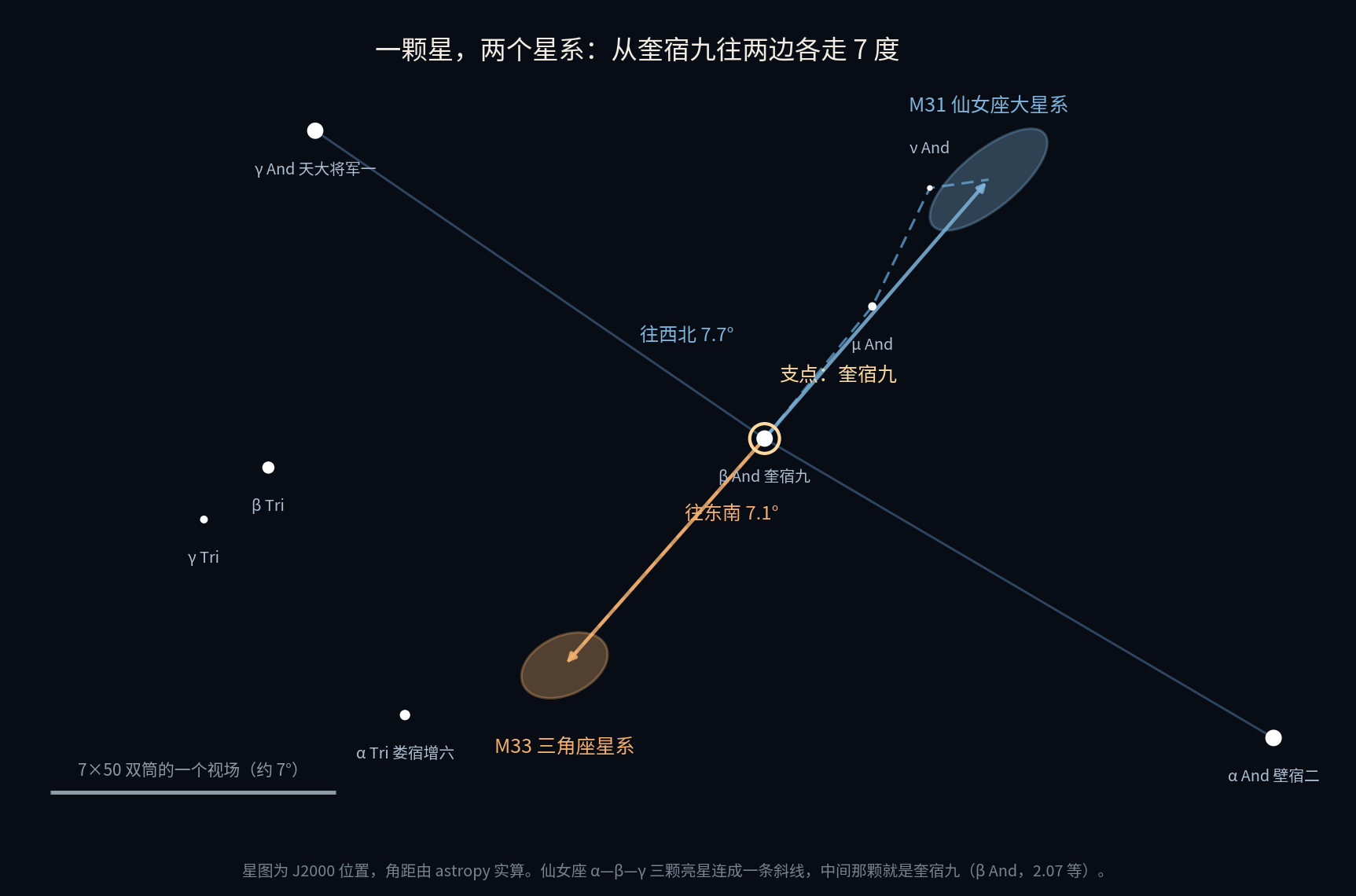
From Mirach, or Beta Andromedae, magnitude 2.07, the Andromeda Galaxy M31 lies about 7.7 degrees to the northwest and M33 about 7.1 degrees to the southeast. The two galaxies hang at almost equal distances on opposite sides of the same star.
China Passed a Law to Preserve a Patch of Darkness
The figure of 22.3 for Lenghu mentioned above comes from a 2021 site-selection paper in Nature, "Lenghu on the Tibetan Plateau as an Astronomical Observing Site," by first author Deng Licai and colleagues, volume 596, pages 353-356.
The study monitored Saishiteng Mountain near Lenghu in Mangya, Haixi Prefecture, Qinghai, at an elevation of 4,200 meters, continuously for three years. Its key measurements were a new-moon night-sky background of 22.3 magnitudes per square arcsecond; median seeing of 0.75 arcsecond, with about 75 percent of measurements better than 1 arcsecond; photometric conditions on 70 percent of nights; and atmospheric precipitable water below 2 millimeters during 55 percent of nighttime hours. The conclusion was that Lenghu was suitable for astronomical observation and filled a longitudinal gap in the Eastern Hemisphere.
Telescopes then began moving onto the mountain. By May 2024, the Lenghu observatory site had attracted 43 telescopes and more than ten institutions, including the National Astronomical Observatories, Purple Mountain Observatory, Tsinghua University, Peking University and the University of Science and Technology of China. The 2.5-meter Wide Field Survey Telescope, or WFST, began its survey in September 2023. It is currently the most capable instrument of its type in the Northern Hemisphere for making time-lapse images of the sky.
Before the telescopes, however, came a law. In October 2022, local regulations protecting the dark night sky in the Haixi Mongolian and Tibetan Autonomous Prefecture of Qinghai were approved, the first of their kind in China. Haixi is the prefecture that contains Lenghu.
The significance may be more worth explaining to a child than any telescope: darkness is a natural resource that requires protection. One prefecture wrote a law to preserve the dark above it.
China currently has six places included in the World List of Dark Sky Protected Areas. Recognition comes from the Dark Skies Advisory Group of the International Union for Conservation of Nature, while nominations were advanced by the Starry Sky Working Committee of the China Biodiversity Conservation and Green Development Foundation. The sites are Ngari and Nagqu in Tibet, both designated in March 2018; Yeludang in Jiangsu; Taihang Honggu in Shanxi; Geyuan in Jiangxi; and Zhaojin in Shaanxi.
Ngari lies at 32.3 degrees north, only 1.7 degrees from M33's declination. There, M33 passes almost directly overhead. Beneath a Bortle Class 1 or 2 sky, it is not "barely visible" but "obvious."
Sources: NASA Astronomy Picture of the Day for September 18, 2026; van Maanen, ApJ 57, 264 (1923); Hubble, "A Spiral Nebula as a Stellar System: Messier 33," ApJ 63, 236 (1926); Brunthaler, Reid, Falcke, Greenhill and Henkel, "The Geometric Distance and Proper Motion of the Triangulum Galaxy (M33)," Science 307, 1440 (2005); printed Shapley-Curtis debate, NRC Bulletin (1921); van der Marel et al., "First Gaia Dynamics of the Andromeda System," ApJ 872, 24 (2019); Bonanos et al., ApJ 652, 313 (2006); ESA/Webb release weic2407 on NGC 604; John Bortle, "The Bortle Dark-Sky Scale," Sky & Telescope, February 2001; Deng Licai et al., "Lenghu on the Tibetan Plateau as an Astronomical Observing Site," Nature 596, 353 (2021); WFST official website; National Science and Technology Innovation Center report on the Lenghu site, May 2024; reports by the Qinghai channel of People's Daily and China News Service on Haixi's dark-sky legislation, October 2022; Tibet Autonomous Region Department of Culture and Tourism report on dark-sky protected areas, March 2018; ScienceNet report on China's World List of Dark Sky Protected Areas, March 2023. Star-chart angular distances, culmination altitudes, opposition date and lunar phase were independently checked with Astropy