
The same dust appears as a dark patch to Hubble and a field of glowing red to Webb. It is there because this galaxy once swallowed another.
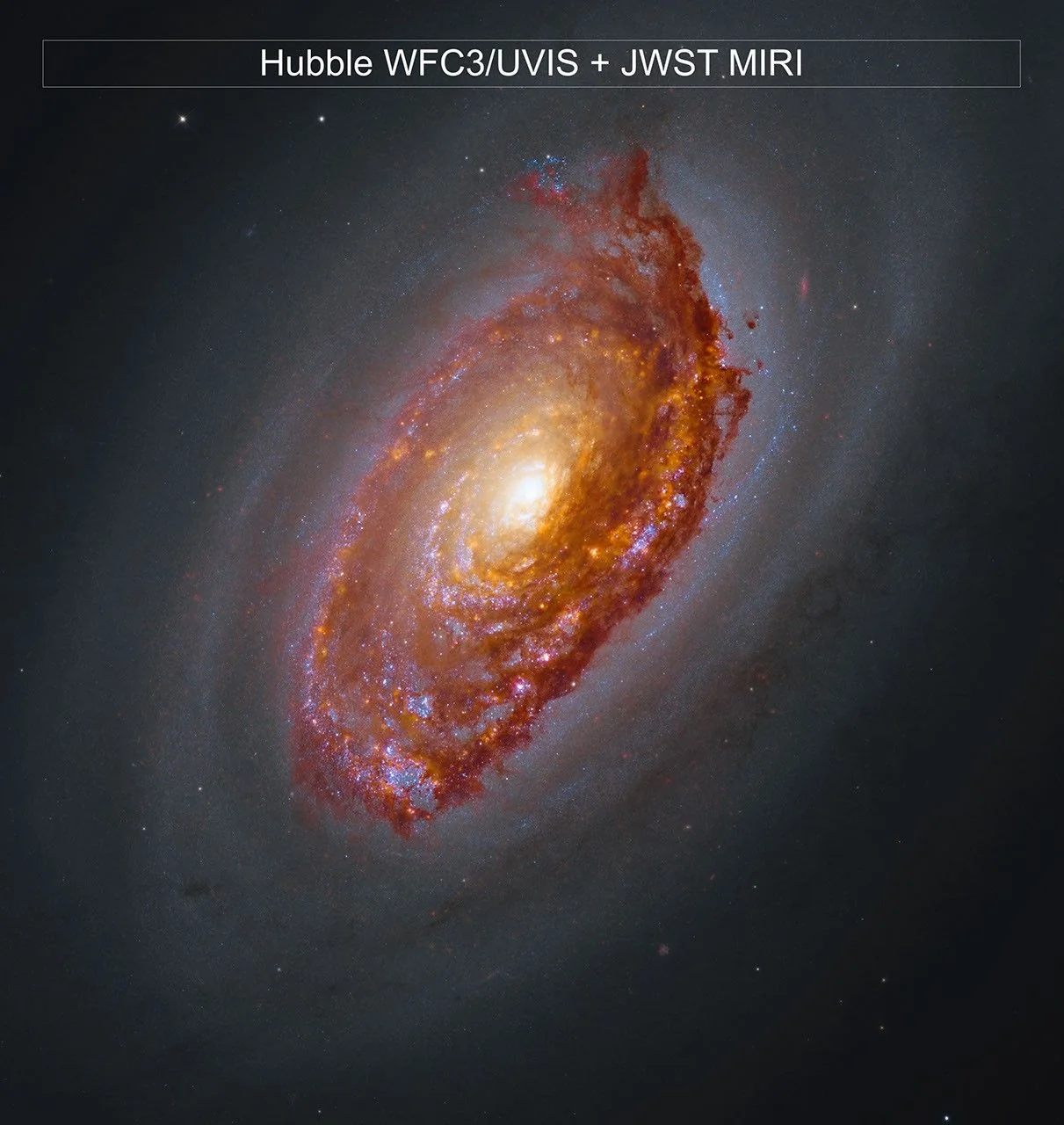
Image: NASA Astronomy Picture of the Day (APOD) | Image credit: NASA, CSA, ESA, F. Belfiore (ESO), J. Lee (STScI), A. Leroy (OSU), and D. Thilker (JHU); processing: G. Kober (NASA/Catholic University) | Today's page: https://science.nasa.gov/image-article/apod-2026-september-16-webbs-view-of-m64/
Today's APOD opens with a beautiful line: "Sometimes, where Hubble finds darkness, Webb sees the light."
Both telescopes are looking at the same thing: the lane of dust crossing the bright center of M64.
In visible light, dust is an obstruction. It stands between the stars and you, absorbs the light behind it and leaves a dark patch. That patch gave the entire galaxy its nickname: the Black Eye Galaxy.
But the energy absorbed by dust does not vanish. It becomes heat and is radiated again at mid-infrared wavelengths, which Webb's Mid-Infrared Instrument, or MIRI, can see. The red in the image is not something else. It is the darkness itself, now emitting its own light.
If you remember one sentence, make it this: the darkness Hubble sees is dust blocking the stars; the red Webb sees is the same dust, heated until it begins to sing.
And it sings a few fixed notes.
The Vibrational Frequencies of Interstellar Soot
There is another layer to the story, more interesting than heat alone.
Interstellar dust contains a family of molecules called polycyclic aromatic hydrocarbons, or PAHs: flat molecules assembled from tens to hundreds of carbon atoms. In plain language, they are interstellar soot, chemically akin to the black residue on a barbecue grill.
Their emission is not blackbody radiation. A PAH molecule absorbs an ultraviolet photon and becomes excited, then relaxes through the vibration of its chemical bonds. Because the bonds determine the frequencies, the molecule emits at a few fixed wavelengths: 3.3, 6.2, 7.7, 8.6 and 11.3 microns.
MIRI has two filters aimed directly at those wavelengths: F770W at 7.7 microns and F1130W at 11.3 microns. In NASA's official documentation, the notes column for both filters simply says "PAH."
So the red is not the red of a temperature. It is a molecule speaking at its native frequencies. Two channels in MIRI's design were set aside specifically to hear it.
It Has Three Names, and Two of Them Are Arguing
M64 is also NGC 4826, in the constellation Coma Berenices, with an apparent magnitude of roughly 9. Catalog values range from 8.8 to 9.8 because they use different photometric bands and different definitions of total and central brightness.
Its names have a history of their own.
On December 3, 1992, Nature published a paper whose title used another nickname outright: Counter-rotating gaseous disks in the "Evil Eye" galaxy NGC4826.
Two years later, an astronomer published her own kinematic study in The Astronomical Journal. Its title was Kinematics of NGC 4826: A Sleeping Beauty Galaxy, not an Evil Eye.
Her name was Vera Rubin, the astronomer whose galaxy rotation curves provided crucial evidence for dark matter.
Renaming a galaxy in the title of a peer-reviewed paper is about as genteel and stubborn as astronomical protest gets. The earliest traceable source for the nickname "Sleeping Beauty Galaxy" is Rubin's title.
Two Streams of Gas Moving in Opposite Directions
What did the 1992 Nature paper find?
M64 has two gaseous disks, and they rotate in opposite directions.
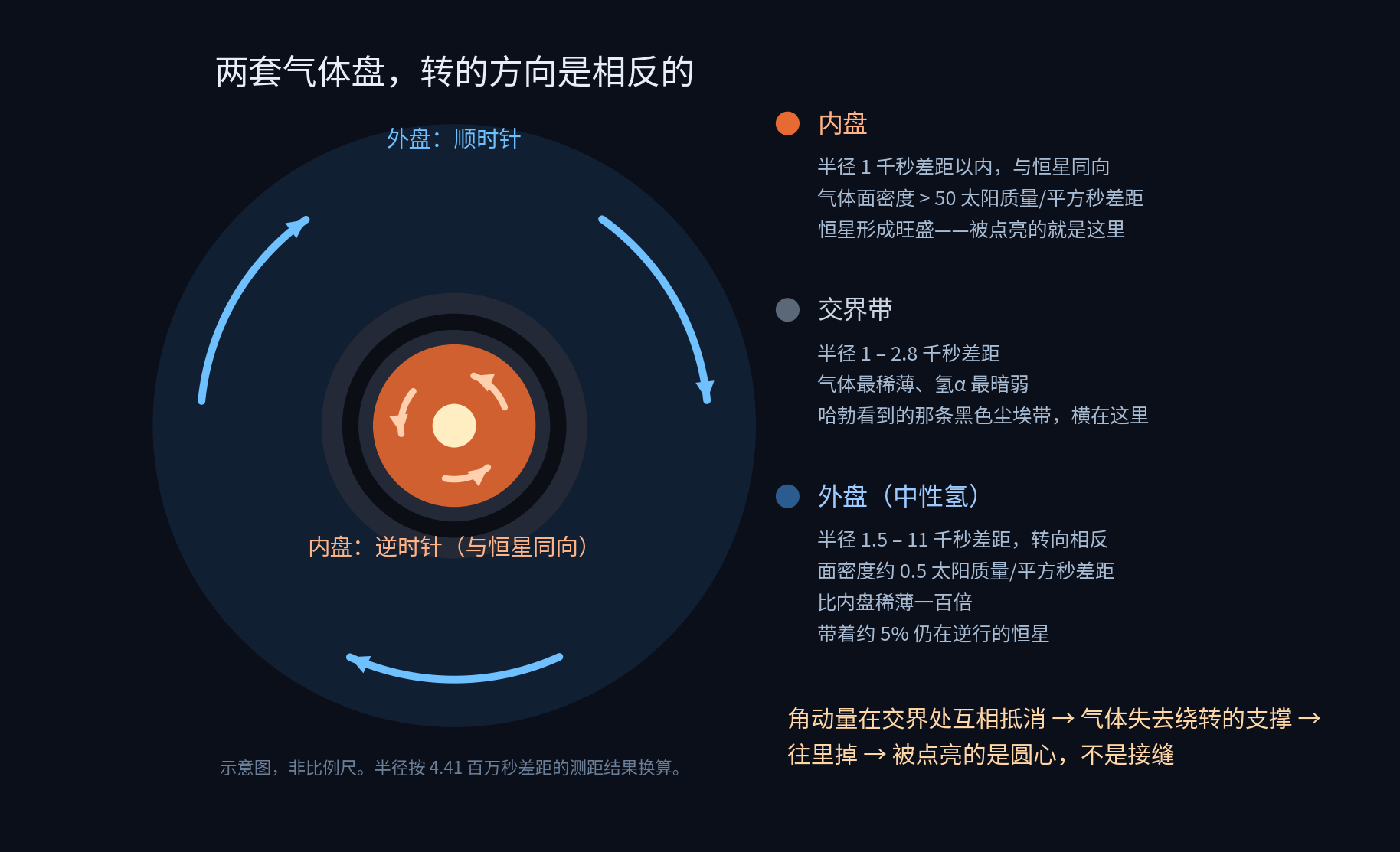
The figures, drawn from a 1994 follow-up paper and later reviews, are these:
Inside a radius of 1 kiloparsec, the gas rotates with the stars. Its surface density exceeds 50 solar masses per square parsec, and star formation is vigorous.
From 1.5 to 11 kiloparsecs, neutral hydrogen forms an enormous outer disk rotating in exactly the opposite direction. Its surface density is only 0.5 solar masses per square parsec, one hundred times thinner than the gas inside.
Between them, from 1 to 2.8 kiloparsecs, lies a low-density transition ring.
Using the latest distance measurement, 1 kiloparsec spans about 47 arcseconds on the sky and 11 kiloparsecs about 8.6 arcminutes, a good match for the galaxy's apparent diameter of 10 arcminutes.
The two disks contain roughly the same mass of gas, about 100 million solar masses each. The most revealing detail is that beyond the dust lane, about 5 percent of the stars rotate backward with the outer gas.
Gas did not arrive alone. A small population of stars came with it, and they remain in retrograde motion today.
Astronomers Considered an Unsettling Possibility
The authors of the 1992 paper wrote cautiously. The discovery, they said, "raises the possibility - long advocated by Schweizer - that even spiral galaxies may have undergone significant merger-driven structural evolution."
Notice the three layers of qualification: it raises a possibility, someone else had already suggested it, and it may have happened.
Rubin kept the same question open two years later, calling M64 an excellent place to study the long-term effects of "gas accretion or galaxy mergers" on a disk galaxy.
The issue is still unresolved. In March 2026, a Nanjing University team used Sloan Digital Sky Survey MaNGA data to assemble a sample of 147 galaxies with counter-rotating stellar disks, about 1.5 percent of the MaNGA sample. Their conclusion favored gas accretion over mergers, based on the galaxies' bulge-dominated structures, low molecular-gas content and low-density environments.
Another statistic is worth remembering. Among the nearly 10,000 galaxies observed by MaNGA, only a little over 100 have clearly counter-rotating stellar disks: about 2 to 3 percent of lenticular galaxies and less than 1 percent of spirals. M64 belongs to a very small minority.
One Point Worth Clarifying
Today's APOD says that where the two streams meet and compress, they "create regions of enhanced star formation." That account comes from a widely repeated 2004 Hubble Heritage release and makes an appealing picture.
But the original 1994 radio observations describe the boundary ring, from 1 to 2.8 kiloparsecs, as a region of low gas surface density with faint, diffuse Hα emission. Hα traces star formation. Faint and diffuse means star formation is weak, not strong.
The intense star formation is actually at the center. Inside a radius of 700 parsecs lies more than 300 million solar masses of molecular gas, and stars are forming rapidly.
The chain of cause and effect that best fits the observations is longer, and more elegant:
Incoming counter-rotating gas meets the existing gas -> their angular momenta cancel -> the gas loses the rotational support holding it up -> it falls inward -> the stellar factory at the center is fed.
The boundary is not what lights up. The center is.
Even Its Distance Is Still in Dispute
M64 is a nearby galaxy, but astronomers still disagree about how nearby.
The tip of the red giant branch method, one of the most direct and reliable ways to measure distance, gives 4.41 ± 0.19 megaparsecs, or about 14.4 million light-years.
The surface brightness fluctuation method gives 7.27 megaparsecs, or about 23.7 million light-years.
NASA's own Messier catalog page says 17 million light-years.
The extremes differ by nearly a factor of two.
No one has simply made a mistake. Different cosmic rulers have different ranges of validity and different systematic errors. The disagreement has consequences. The conversion above, in which 1 kiloparsec corresponds to about 47 arcseconds, becomes 28 arcseconds if the other distance is used. Change the distance, and the true size of everything in the galaxy changes with it.
"Astronomers are still arguing over the distance to a nearby galaxy" is not an embarrassment. It is astronomy being honest.
Who Saw It First, and Who Was Remembered
There is one more piece of history worth telling.
On March 23, 1779, the English astronomer Edward Pigott became the first person to see M64. He did not publish the discovery until January 1781.
Twelve days later, on April 4, 1779, the German astronomer Johann Elert Bode independently discovered it and published his finding that same year.
On March 1, 1780, Charles Messier became the third person to see it and entered it in his catalog.
Today, the entire world calls it M64.
Pigott saw it first, Bode published first, and Messier arrived last but gave the galaxy the name that endured. Seeing first and being remembered have never been the same thing.
Our Own Past Was Not Quiet Either
M64's collision is estimated to have happened more than one billion years ago. It is long over.
What about the Milky Way's?
About 10 billion years ago, the Milky Way swallowed a galaxy slightly larger than the Small Magellanic Cloud. In 2018, two independent teams identified it at the same time using data from the European Space Agency's Gaia satellite. One team nicknamed it the "Gaia Sausage" for its elongated distribution in velocity space. The other named it Gaia-Enceladus and showed that the merger, with a mass ratio of about four to one, heated the Milky Way's original disk into today's thick disk.
How much of the stellar halo did it supply? That figure remains disputed. Some estimates say no more than one-quarter; others say more than half.
More unsettling is the fact that this is not all in the past.
In 1994, three Cambridge astronomers reported in Nature that they had found a large group of stars moving together toward the Galactic center, belonging to "a dwarf galaxy closer to our own than any galaxy previously known." It was elongated and tilted toward the Galactic plane, which, in the paper's words, "suggests that it is undergoing some tidal disruption before being subsumed."
That was the Sagittarius Dwarf Galaxy. Our galaxy is tearing it apart and swallowing it now.
When APOD says that spiral galaxies really do undergo mergers, the most immediate evidence is not 14 million light-years away. It is beneath our feet. We happen to be inside the merger.
There is also an update that has not yet traveled far in Chinese-language coverage. The familiar claim that the Milky Way will inevitably collide with Andromeda in four billion years was downgraded in June 2025. A team recalculated the future using new Gaia and Hubble data and included the previously neglected gravity of the Large Magellanic Cloud and M33. M33 raises the chance of a collision; the Large Magellanic Cloud's nearly perpendicular orbit lowers it. Their conclusion was that the chance of no merger at all within the next 10 billion years is close to 50 percent. The future of the universe looks more like a coin toss than we thought.
This Family History Was Measured at Xinglong, Hebei
The Milky Way's merger history does not require a space telescope. It is overhead, if you have a machine capable of taking spectra from thousands of stars at once.
The Large Sky Area Multi-Object Fiber Spectroscopic Telescope, or LAMOST, also known as the Guo Shoujing Telescope, is such a machine. It stands at Xinglong in Hebei.
In 2022, Wu Wenbo, Zhao Gang, Xue Xiangxiang and colleagues at the National Astronomical Observatories of the Chinese Academy of Sciences combined LAMOST K giants with blue horizontal branch stars from SDSS and data from Gaia. They arrived at a specific figure: the Gaia Sausage contributed about 41 to 74 percent of the stars in the stellar halo within 30 kiloparsecs of the Galactic center. After known substructures were removed, it still accounted for 30 to 63 percent within 25 kiloparsecs.
The same team also produced a more vivid result. In 2019, a Chinese-Japanese collaboration led by Zhao Gang reported in Nature Astronomy that it had found a star whose identity did not fit. It was unusually rich in rapid neutron-capture elements and deficient in α-elements. That chemical recipe could not have arisen in the Milky Way's own environment. It could only have formed in a dwarf galaxy.
In the paper's words, such stars "provide the clearest chemical signature of past accretion events in the Milky Way."
In plain language: they found an immigrant.
Sources: NASA Astronomy Picture of the Day for September 16, 2026; NASA, "Black Eye Galaxy" image page (June 12, 2026); Braun, Walterbos and Kennicutt, Nature 360:442 (1992); Braun et al., The Astrophysical Journal 420:558 (1994); Rubin, The Astronomical Journal 107:173 (1994); García-Burillo et al., Astronomy & Astrophysics 407:485 (2003); Corsini, review of counter-rotation in disk galaxies; Anand et al., MNRAS 501:3621 (2021); Bao et al. (2026, arXiv:2603.04044); Bevacqua et al., MaNGA counter-rotation statistics; Belokurov et al., MNRAS 478:611 (2018); Helmi et al., Nature 563:85 (2018); Ibata, Gilmore and Irwin, Nature 370:194 (1994); Sawala et al., Nature Astronomy 9:1206 (2025); Wu, Zhao, Xue et al., The Astrophysical Journal 924:23 (2022); Xing, Zhao et al., Nature Astronomy 3:631 (2019); the STScI JWST User Documentation MIRI filter table; NASA's Hubble Messier catalog page for M64; and observing guides from Skyhound and FreeStarCharts.