
A white dwarf sits on the nose of a lion. NASA's official description offers one piece of advice: do not poke it.
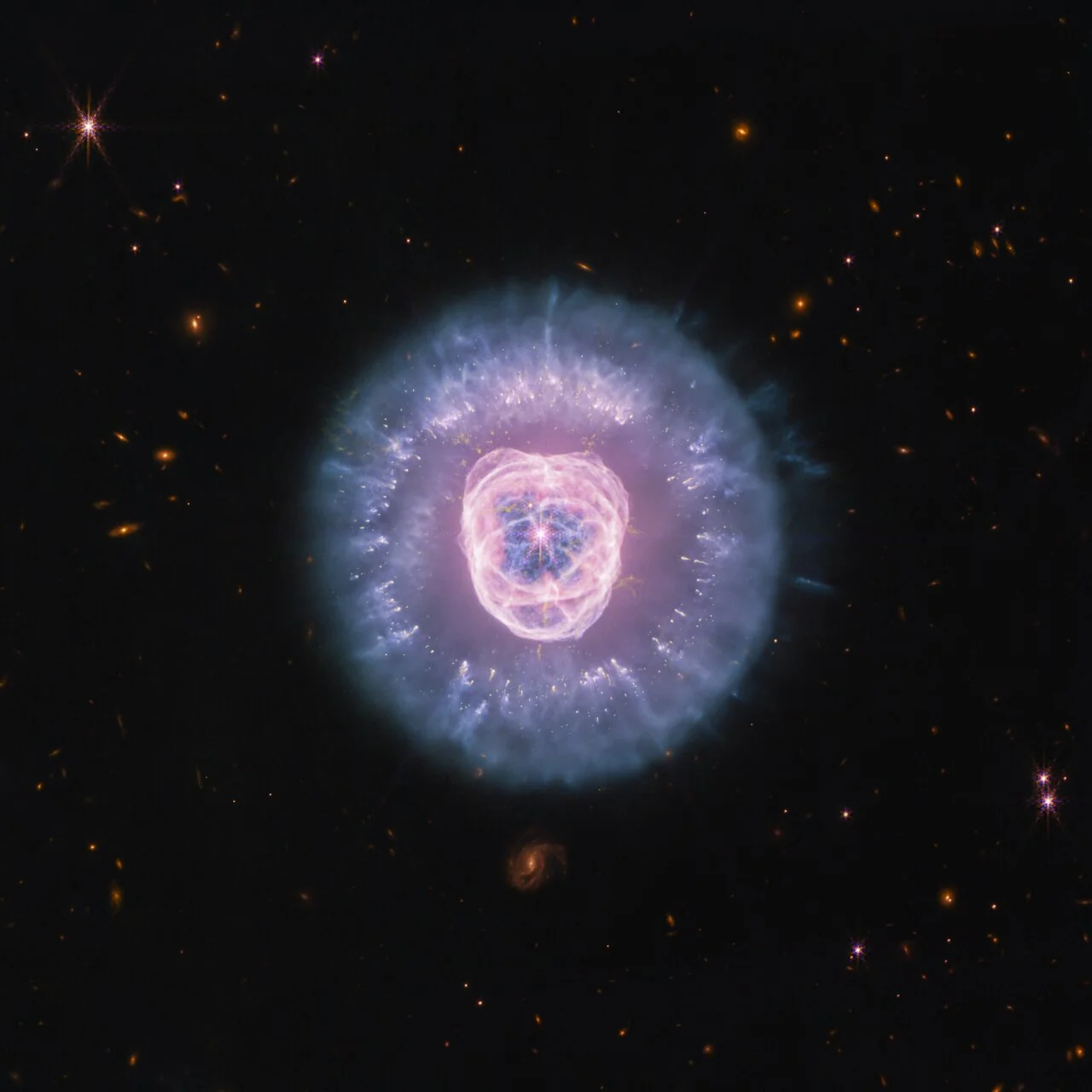
Image: NASA Astronomy Picture of the Day (APOD) · Image credit: NASA, ESA, CSA, STScI; image processing: Alyssa Pagan (STScI) · https://apod.nasa.gov/apod/ap260826.html
Today's APOD opens with a question: "Are we seeing the future of our Sun?"
At the center of the image is a lion's face. A shaggy mane fans outward, ending in wisps like comet tails; in the middle of the face is a round, luminous nose. This composite from the Webb Space Telescope's Near-Infrared Camera, NIRCam, and Mid-Infrared Instrument, MIRI, shows an object cataloged as NGC 2392.
That nose is the corpse of a star.
It Did Not Explode. It Undressed
First, the easiest confusion to clear up: this object is not a supernova remnant.
NASA's official release explains the distinction unusually well. Massive stars end their lives in supernova explosions, but such events are rare. Most stars in the universe have lower masses, like the star at the center of NGC 2392. When a low-mass star can no longer support itself through nuclear reactions in its core, it becomes unstable and begins to pulse, losing mass by casting off its outer layers. Those layers become shells of gas and dust: a planetary nebula. Radiation from the star pushes the expelled material outward, leaving behind a very hot core, or white dwarf.
It did not burst apart. It took off its layers one by one.
Why does that shell become such a regular spherical bubble? The answer appeared in a three-page paper in The Astrophysical Journal in 1978. Sun Kwok and two coauthors proposed that a red giant first blows a slow, dense stellar wind, laying down a large cloud of cool material around itself. As mass loss continues and exposes the hot core, that bare core produces a faster, thinner wind. It catches the slow wind from behind and plows into it, sweeping the material into a dense shell. Ultraviolet radiation from the central star ionizes the shell and makes it glow. A planetary nebula is born.
Kwok later gave the process a more vivid name in Scholarpedia: the snowplow effect. It works like a plow piling loose snow into a wall.
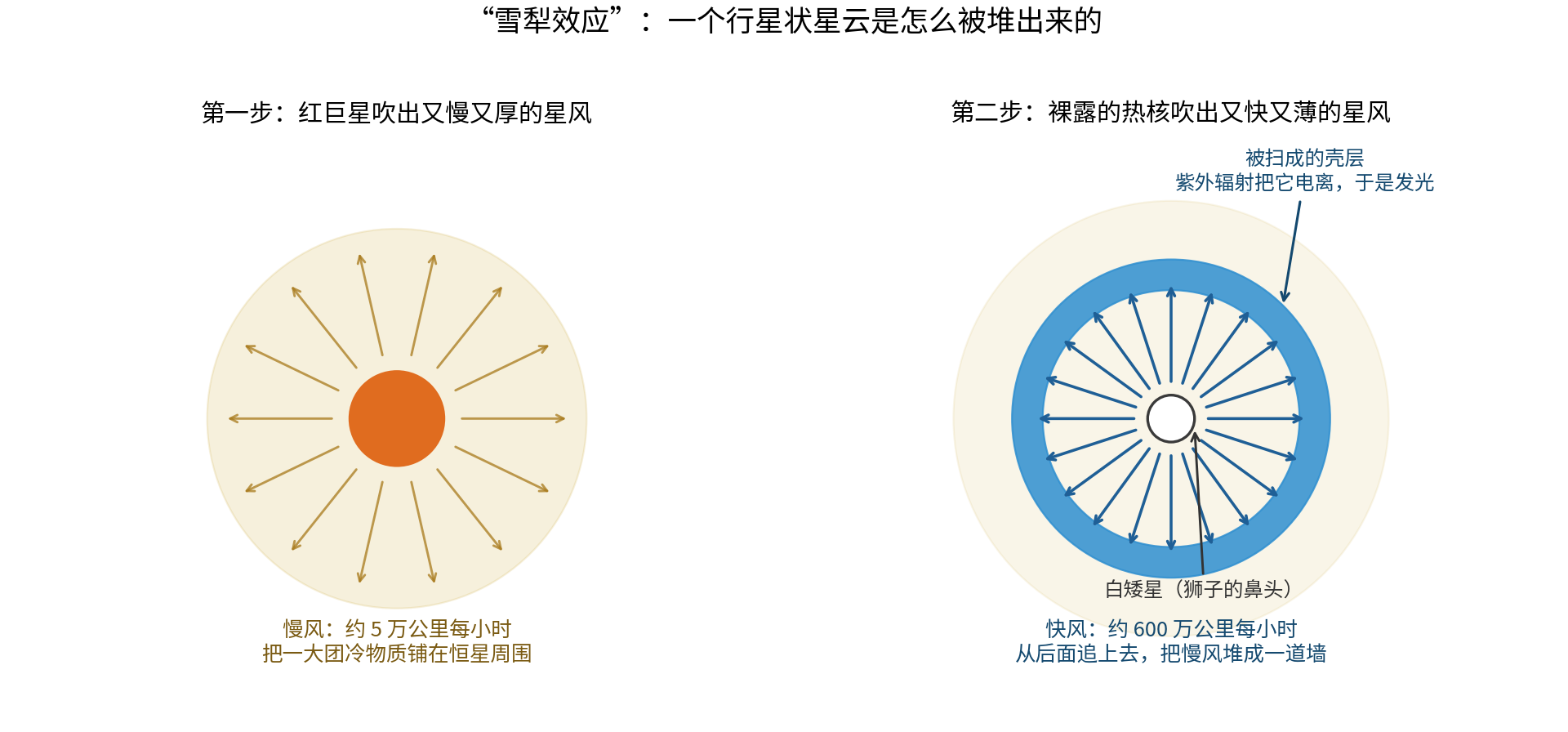
For NGC 2392, the Chandra X-ray Observatory gives two wind speeds. The slow wind expelled during the red-giant phase travels at about 50,000 kilometers per hour. The fast wind from the exposed core travels at about 6 million kilometers per hour. One is 120 times faster than the other.
Webb's official description identifies the mane as the inner wall of a dust shell illuminated by the central white dwarf. The comet-like clumps at its edge are dense knots of dust that have survived radiation from the stellar core, shielding material behind them: a row of tiny barricades.
Two Ten-Thousand-Year Spans
This is the story's neatest symmetry, and its easiest detail to get wrong.
Ten thousand years backward: Hubble's official material said the nebula "began forming about 10,000 years ago." Peer-reviewed support comes from a 2012 morphokinematic model that gave the outer shell a kinematic age of about 9,300 years, based on an expansion speed of 16 kilometers per second.
Ten thousand years forward: Webb's new official release says astronomers estimate that the lion will finally disperse in about 10,000 years, a remarkably short interval on astronomical timescales.
Two spans of ten thousand years, pointing in opposite directions, with the present caught between them.
Humanity happened to build telescopes at precisely this moment. In January 2000, Hubble opened its eyes after the perilous December 1999 servicing mission that replaced all six gyroscopes and rescued it from the verge of paralysis. NGC 2392 was among the first objects it photographed. In August 2026, Webb looked at the same lion again in infrared light.
How brief is the planetary-nebula phase? A 2022 review gives a typical lifetime of roughly 25,000 years. A star can live for billions of years; this phase occupies only about one ten-thousandth of its life. So although roughly 90 percent of the Milky Way's stars will eventually pass through it, only a few thousand are visible at any one time. About 3,800 have been confirmed, while theoretical estimates range from 6,600 to 45,000, depending on whether the calculation uses single-star or binary-star models.
They are scarce not because they seldom happen, but because they do not last.
One Object, Three Names, None Official
Now for the object's real story.
William Herschel discovered it at Slough, England, on January 17, 1787, and cataloged it as H IV.45. His original note described a ninth-magnitude star, considerably bright in the center, with nebulosity evenly spread around it. In 1888, J. L. E. Dreyer included it in the New General Catalogue, where it became NGC 2392.
For more than two centuries, however, people rarely called it by that number. Because it resembled a face inside a fur-lined hood, it acquired the nickname "Eskimo Nebula." Its mane also earned it the name "Clown Face Nebula."
On August 5, 2020, NASA announced that it would stop using the nickname "Eskimo Nebula." The agency said the term had colonial and racist roots and was a name imposed from outside. It retired "Siamese Twins Galaxy" for NGC 4567/4568 at the same time. Thomas Zurbuchen, then associate administrator of NASA's Science Mission Directorate, said the goal was to align every name with the agency's values of diversity and inclusion because science belongs to everyone.
NASA did not remove its old image page. Instead, it added an editor's note at the top: as of August 1, 2020, NASA no longer refers to NGC 2392 as the "Eskimo Nebula," because the term may be considered insensitive and offensive. The note says August 1, while the formal statement was published on August 5, a small discrepancy between the two dates.
So who chose the new lion?
The answer is unexpectedly simple: we do not know.
NASA, the Space Telescope Science Institute and the European Space Agency all used the nickname Lion Nebula in their official releases of August 10, 2026. Today's APOD, however, says Lion's Head Nebula, an editorial choice within NASA itself. No document explains who proposed replacing "Eskimo" with "lion," in what year, or through what process. There is no NASA naming announcement, institute explanation, paper or International Astronomical Union resolution. The earliest known public use is on the February 2021 page for a university television station's skywatching program, and even that article says only that "some" use the name, without giving a source.
There is a further problem: Lion Nebula was already taken. Sh 2-132 in Cepheus has long carried that nickname among astrophotographers, including in the Sky & Telescope gallery. English Wikipedia now treats Lion Nebula as a disambiguation term.
That is the central point: astronomy has no official authority for the nicknames of deep-sky objects. The International Astronomical Union's Working Group on Star Names has jurisdiction over the proper names of stars, not nebular nicknames. Its 2020 annual report does not mention the Eskimo Nebula, NGC 2392 or NASA's decision that August. NGC 2392 is a catalog designation, not a name conferred by the IAU. When NASA said it would use the official IAU designation, it meant returning to that string of letters and numbers.
Over two centuries, one object has been called an Eskimo, a clown and a lion. Not one of those names was ever official.
A Chinese Name With an Authority Behind It
That makes the next contrast especially satisfying.
On June 30, 2017, the IAU Working Group on Star Names formally approved "Tianguan" as the proper name of Zeta Tauri. Chinese-derived names approved in the same group included Tianyi, Taiyi and Taiyangshou. They come from the constellations of ancient Chinese astronomy and now appear in the official international catalog of star names, complete with identifiers and approval dates.
Why does Tianguan matter? Because in 1054, a guest star appeared beside it.
The Song Huiyao records: "On the jichou day of the fifth month of the first year of Zhihe, it appeared several cun southeast of Tianguan and gradually vanished after more than a year." That date was July 4, 1054. The report by the Imperial Astronomical Bureau preserved in the Xu Zizhi Tongjian Changbian is more specific: "Visible by day like Venus, with pointed rays in every direction, reddish white in color; it was seen for twenty-three days." At night it remained visible until the third month of the first year of Jiayou, about one year and ten months in all.
A note on those quotations: the famous phrase "visible by day like Venus" comes from the Xu Zizhi Tongjian Changbian. The Song Huiyao contains the shorter account. Popular Chinese science writing often attributes both to the same book; they are kept separate here.
The remnant of that guest star is today's Crab Nebula, M1.
But it is entirely different from today's lion. The decisive difference is the mass of the progenitor star. The Crab's progenitor was a massive star that blew apart all at once in a core-collapse supernova, leaving a neutron star at the center; its ejecta move at thousands of kilometers per second. NGC 2392 came from a roughly Sun-like star. It did not explode, but slowly shed its outer layers, leaving a white dwarf at the center; its slow wind moves at only a few tens of kilometers per second.
One was visible to Northern Song astronomers in daylight for 23 days. The other cannot be seen with the naked eye. At magnitude nine or ten, it requires a telescope.
The story has a fitting coda. China launched the Tianguan satellite, the Einstein Probe, on January 9, 2024. An official Chinese Academy of Sciences account explained that the 1054 event, "one of the most important astronomical events in human history," became known in the history of science as the "Chinese Nova," and that its remnant, the Crab Nebula, is M1 in the widely used Messier Catalogue of 1771. Equipped with a Wide-field X-ray Telescope and a Follow-up X-ray Telescope, the satellite has already produced the first all-sky X-ray map made with independently developed Chinese instruments, along with 60 confirmed transient sources and more than 1,000 candidates.
A thousand years ago, Chinese observers recorded a guest star beside Tianguan. Today, a satellite named Tianguan waits in the sky for the next one.
The White Dwarf Is Actually Two Stars
The official account needs one correction.
Every official release, including the one from 2026, says that a white dwarf sits at the center. In the peer-reviewed literature, the picture is more complicated and more interesting.
In 2019, a research team used a high-resolution spectrograph on the 1.2-meter Flemish Mercator Telescope to measure radial velocity and directly detect a companion. The paper's abstract gives a strikingly precise figure: an orbital period of 1.902208 +/- 0.000013 days. This is a close binary that has passed through common-envelope evolution. The companion is a hot white dwarf at about 43,000 K. Such a companion is also needed to explain the nebula's emission lines, which require exceptionally high energies to excite.
Strictly speaking, the primary at the center is not yet a white dwarf. It is a hot post-AGB central star evolving toward that state, with a temperature of about 47,000 K and a spectral type of O6f.
So the nose we were warned not to poke contains two stars, orbiting each other in less than two days.
The Official Releases Give No Distance at All
One more silence is worth noticing.
NASA's and ESA's new releases give no distance for the object.
That is not an oversight. Distances to planetary nebulae have long been notoriously difficult to measure. Older material put NGC 2392 at 3,000 light-years; Hubble's official caption from 2000 said 5,000; Chandra material from 2013 said 4,200. Only with parallax measurements from Gaia has the estimate settled at 1.7 to 1.85 kiloparsecs, or roughly 5,600 to 6,000 light-years.
The familiar figure of 3,000 light-years predates Gaia and should no longer be used. The official writers chose to omit the figure altogether from a public release. That choice is itself a lesson in how science handles uncertainty.
Is This Really the Sun's Future?
The answer to APOD's opening question lies in a 2018 paper in Nature Astronomy.
The background was a long-running contradiction. Stellar models predicted that only stars more massive than roughly twice the Sun could produce a bright planetary nebula. Yet old stellar populations, including elliptical galaxies, contain bright planetary nebulae everywhere. The new models resolved that contradiction. The abstract's final sentence predicts that the Sun will form a planetary nebula at the end of its life, but a faint one.
Albert Zijlstra, one of the paper's authors, placed the dividing lines this way: stars below 1.1 solar masses make fainter nebulae; stars above 3 solar masses make bright ones. The Sun is 1.0. It falls just below the line for the bright category.
The precise answer, then, is that the Sun will form a planetary nebula, but a very dim one. It does not just qualify; it just fails to qualify for the bright class. And this remains a model prediction, not an observational result.
As for the timetable, NASA says the Sun formed about 4.6 billion years ago and has not yet reached the midpoint of its life. It has about 5 billion years left before becoming a white dwarf. As it begins to die, it will swell into a red giant large enough to engulf Mercury and Venus and possibly Earth. NASA says "possibly," and that qualification matters.
One final claim also needs precision. It is common to hear that the carbon in our bodies came from nebulae like this one. That is only half true. In a 2020 study of the origin of the elements, lead author Chiaki Kobayashi said that half of all carbon comes from dying low-mass stars and half from supernovae. Dust is the safer claim: NASA's new release itself says that stars at this stage of life produce a large fraction of the observable dust in the universe.
Sources: APOD page for August 26, 2026; NASA/STScI/ESA release "Lion Nebula Roars to Life With NASA's Webb" of August 10, 2026 (release 2026-127 / weic2616); ESA/Webb image page and filter table; STScI observing program 9548; NASA, "NASA to Reexamine Nicknames for Cosmic Objects" (August 5, 2020); the 2020 annual report of the IAU Working Group on Star Names and the IAU Catalog of Star Names; Kwok, Purton & FitzGerald (1978), The Astrophysical Journal, and Sun Kwok's planetary-nebula entry in Scholarpedia; Chandra X-ray Observatory material on NGC 2392; Hubble's 2000 NGC 2392 image page and fact sheet; Garcia-Diaz et al. (2012); Guerrero et al. (2021); Miszalski et al. (2019), PASA; Singh et al. (2025); Gesicki, Zijlstra & Miller Bertolami (2018), Nature Astronomy, and the University of Manchester release; Kobayashi, Karakas & Lugaro (2020), The Astrophysical Journal; Parker's 2022 review of planetary nebulae and the HASH database; Le Du et al. (2022), Astronomy & Astrophysics 666, A152; Manuel et al. (2026), Astronomy & Astrophysics 710, A68; official Chinese Academy of Sciences reporting on the Tianguan satellite, or Einstein Probe; relevant records in the Song Huiyao, History of Song and Xu Zizhi Tongjian Changbian; the Science China Gemini entry; the freestarcharts observing guide to NGC 2392; and the University of Maryland profile "UMD Astronomy Alum Alyssa Pagan Brings Space Images to Light."