
The crab in this photograph has nearly disappeared. It has not hidden behind the background. It has put part of the background directly onto its body.
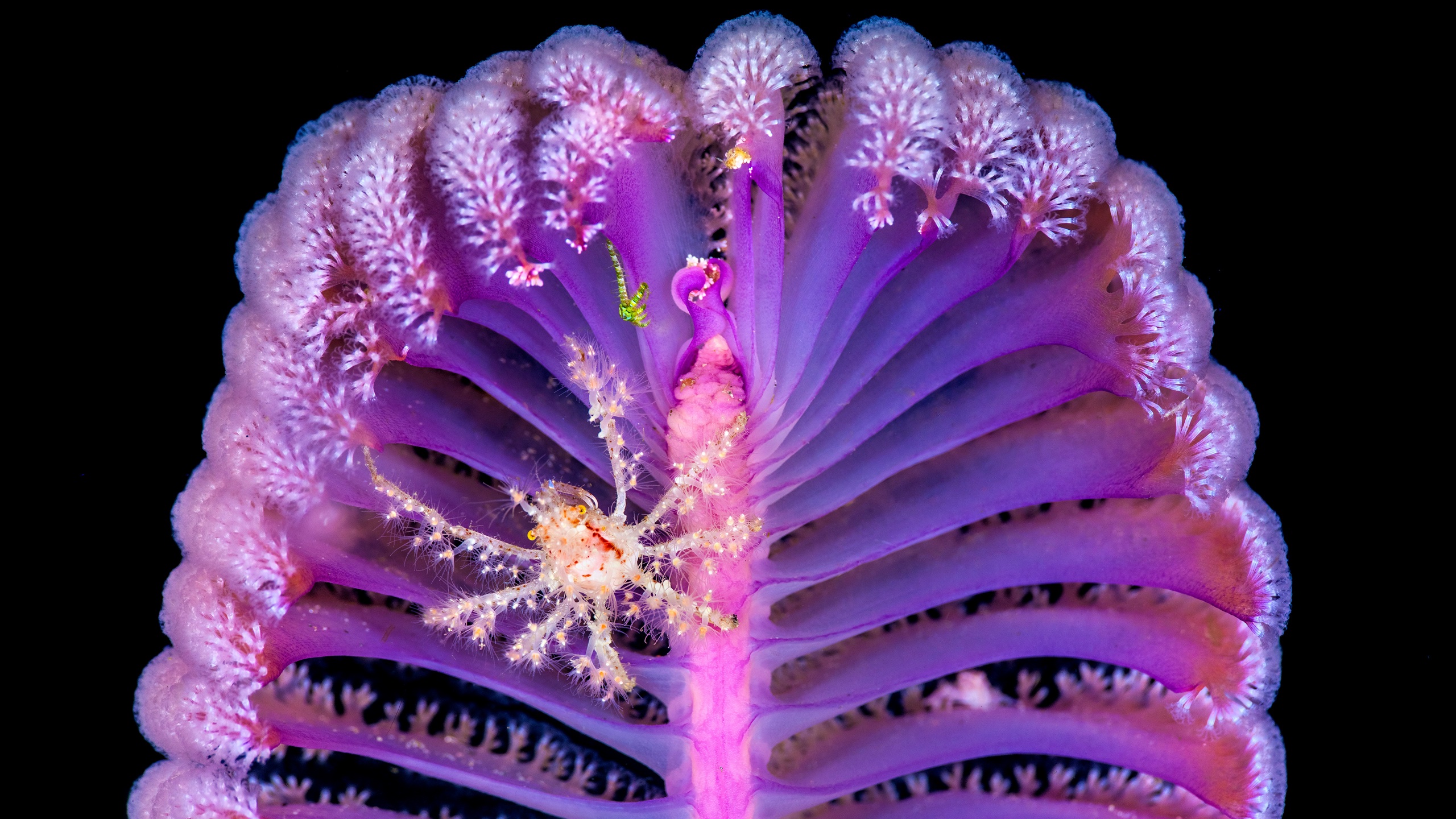
Image: Bing Daily Wallpaper | Decorator crab on a sea pen, Komodo National Park, Indonesia | Photography: Alex Mustard/Nature Picture Library | Original page
This is not an animal that relies only on a fixed body color for concealment. Decorator crabs actively collect algae, sponges, anemones, and other material from their surroundings, then fasten it to their shells and legs.
The featherlike structure beneath this crab is not a plant either. A sea pen is a cnidarian colony made up of many small, anemone-like polyps. One specialized polyp forms the central stalk and anchoring base; others handle feeding, reproduction, and the movement of water through the colony.
Camouflage That Has to Be Installed
Tiny hooked bristles cover a decorator crab's carapace. The crab cuts or gathers suitable material with its claws and presses it onto those bristles. The hooks work like miniature hook-and-loop fasteners, holding pieces of algae, sponge, and other organisms in place.
Matching the background's color is only part of the effect. The attachments also disrupt the crab's recognizable outline, making a complete animal harder for a predator to pick out from a complicated seafloor. Some decorations remain alive. A stinging anemone may provide defense as well as concealment.
Camouflage, in this case, is not entirely a pattern inherited and fixed on the body. When the surroundings change, a decorator crab can select different material. It carries an appearance that can be revised.
Moving the Outfit to a New Shell
A hard shell cannot grow continuously with the animal inside it. A crab must shed its old exoskeleton and form a larger one. That creates a problem: the camouflage remains attached to the discarded shell.
Monterey Bay Aquarium describes decorator crabs removing anemones, sponges, and other living decorations from an old shell and transferring them to the new one. Reusing a familiar covering saves the time needed to collect everything again and helps restore concealment while the new shell is still vulnerable.
A molt is therefore more than a change of exoskeleton. It resembles a move: the body gets a new exterior, then carries useful pieces of the old arrangement across one by one.
A Sea Pen Is a Colony of Animals
The sea pen makes the crab's disguise especially difficult to read. It resembles a plant rooted in the seabed, but it is a coordinated group of animals. The central stalk holds the colony in sand or mud, while polyps along its sides take food from the passing water.
When a decorator crab rests on such a host, projections on its body, its attached material, and the sea pen's branching form blend together. The photograph's underwater "garden" is built by several animals at once: the sea pen polyps form the setting, and the crab rearranges nearby life across its own body.
Komodo Is More Than Its Dragons
Komodo National Park is best known for the Komodo dragon, but more than 70 percent of the biosphere reserve is marine. UNESCO records more than 260 species of reef-building coral, 70 species of sponge, and over 1,000 species of bony fish in its waters, along with many crustaceans, mollusks, sea turtles, dolphins, and whales.
This image shows one small relationship inside that diversity: a crab, a sea pen, and a disguise assembled from the immediate environment. Biodiversity is more than a count of species. Animals also use other organisms as habitat, protection, and even part of their visible form.
Sources
Bing Daily Wallpaper: Original page; Monterey Bay Aquarium: Decorator crab; Monterey Bay Aquarium: Sea pen; Smithsonian Ocean: Decorator Crab; UNESCO: Komodo.