
A small pink boat slips along a waterway in Xuancheng, China. The trees crowd close on both sides, their crowns red, orange and yellow, with patches of green still holding on. Bing's November 4 photograph makes autumn look like a river you could paddle into.
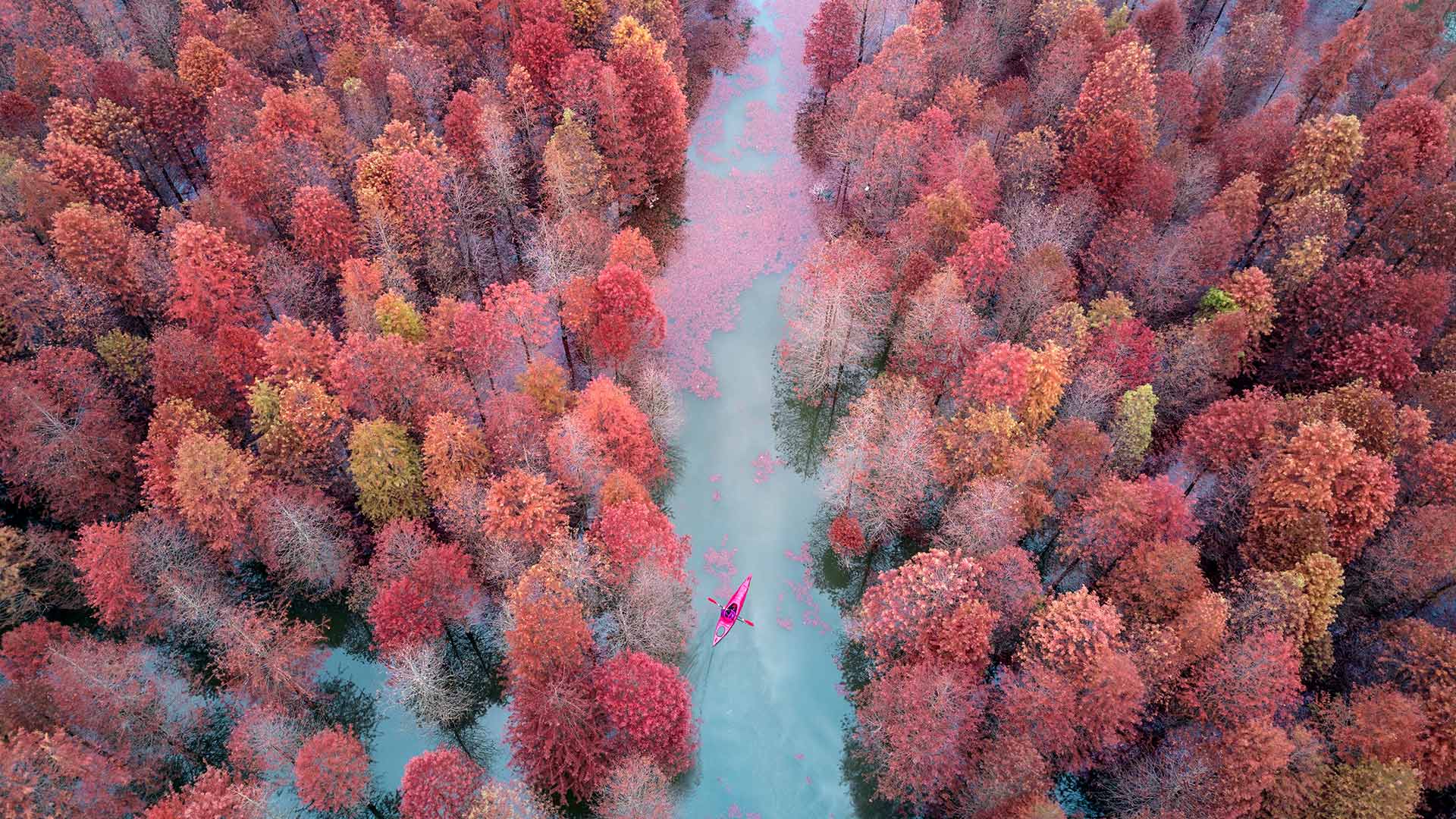
Image: Bing daily wallpaper · Credit: Boaters among autumn-colored baldcypress trees, Xuancheng, Anhui, China (© Jackal Pan/Getty Images) · Original page
Baldcypress has soft, feathery needles, but being a conifer does not make it evergreen. Its foliage turns reddish brown before falling. Reflections extend the crowns downward, giving the forest another layer of color on the water.
What happens to the green?
Chlorophyll makes leaves green and helps capture light energy. As leaves age in autumn, their chlorophyll content falls and the balance of pigments changes. Some trees also accumulate red anthocyanins. A forest can therefore hold several stages of color at once, without every tree changing on the same day.
Researchers have measured this process in baldcypress. A 2014 study in the Journal of Zhejiang A&F University tracked chlorophyll, anthocyanins and soluble sugars during the color-changing season. Chlorophyll declined, anthocyanins rose markedly after November 5, and trees growing in water kept their red foliage longer than trees growing on land. Those dates describe that experiment, not a forecast for every tree in Xuancheng this year.
Water or land, sun or shade: even trees of the same species can experience different conditions. Light, reflections and photographic processing also influence the colors in a picture.
Try choosing one branch on a tree near home and photographing it every few days under similar lighting. Leave the leaves in place. Arranged by date, the pictures will show how one tree changes seasons a little at a time.