
Branches weave an orange-red canopy across the sky. Beyond them, sunlight filters through mist onto a blue-roofed pavilion, its reflection almost complete in the still water. Bing's October 22 wallpaper comes from Naejangsan National Park in South Korea.
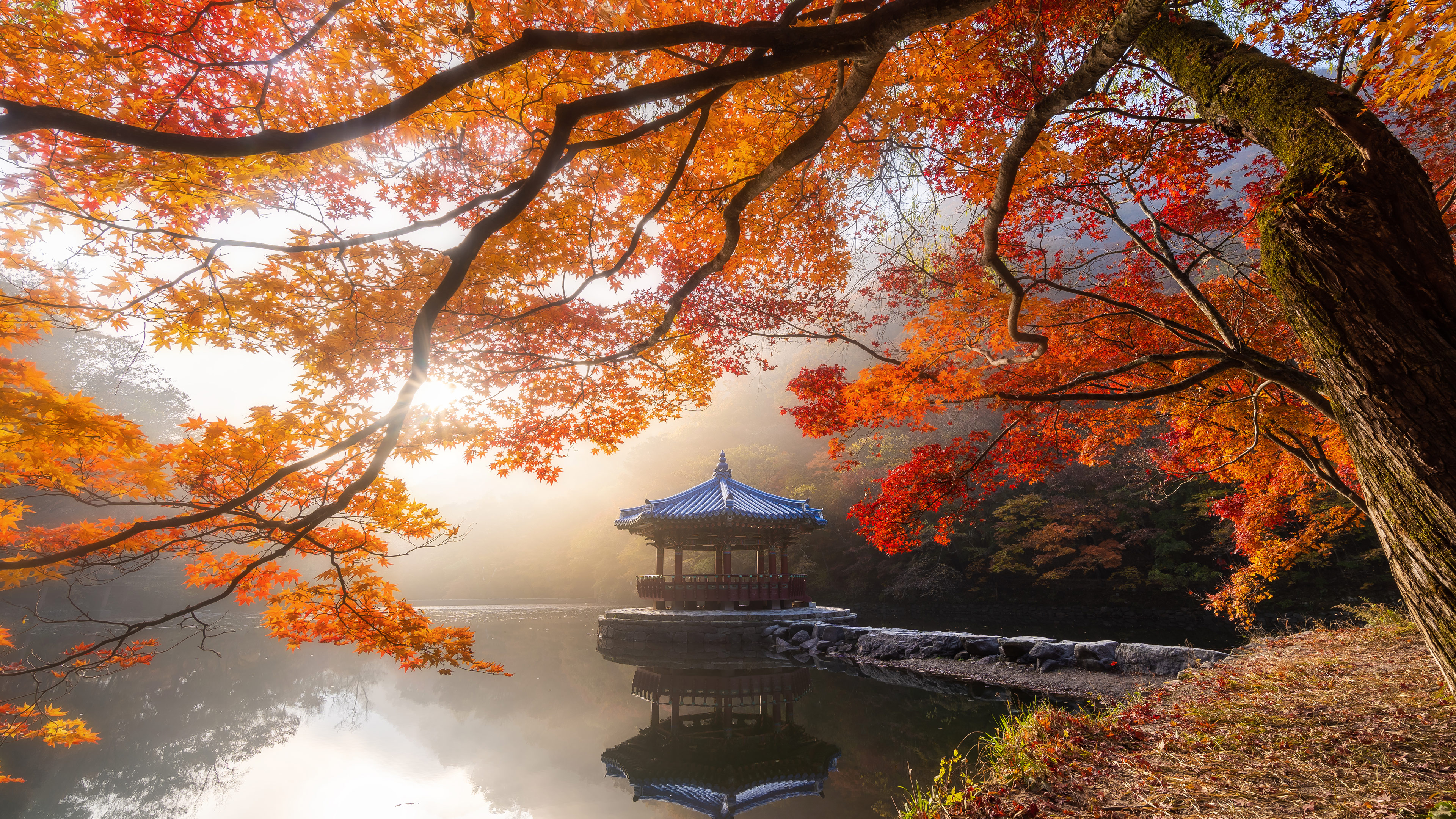
Image: Autumn scenery in Naejangsan National Park, South Korea (© Twenty47studio/Getty Images) | Original page.
The Korea National Park Service records that Naejangsan became the country's eighth national park in 1971. Its highest peak, Sinseonbong, reaches 763 meters. Distinctive rocky summits rise to around 700 meters, with autumn woodland filling the valleys. Uhwajeong, the pavilion in the photograph, is among the park's listed sights.
We often imagine autumn painting a forest. Part of the transformation works by taking a color away.
Chlorophyll makes leaves green and helps them use sunlight to produce sugars. During the growing season, leaves continually replenish it. Yellow and orange carotenoids are already there, but the abundant green often hides them. As nights lengthen and temperatures change, many deciduous trees begin their seasonal transition. Chlorophyll breaks down, allowing those yellows and oranges to emerge, as though a green curtain were being drawn aside.
Red has an additional story. Iowa State University's horticulture guide explains that many species make red and purple anthocyanins in late summer and early autumn. Sugar accumulation, light, and temperature influence their production. Some autumn colors are therefore newly made. Frost is not a universal red paintbrush: an early frost can damage leaves and bring them down before their brightest display.
Even a single tree may carry deep red leaves on one side and yellow ones on the other. Species, sunlight, and the year's weather all contribute. This photograph preserves one autumn moment; it does not establish that every part of the park has reached the same stage today. Check current park notices when planning a visit.
You can watch the process much closer to home. Choose one nearby branch and photograph it from the same position every few days. Record which leaves yellow first, which become red, and how the colors change before the leaves fall. Leave them attached. A month's sequence reveals the transformation that a single beautiful photograph cannot contain.