
At a transparent window, Jessica Watkins reaches into long gloves fixed to a laboratory enclosure. Between her blue-gloved hands are experimental materials; behind her, equipment fills the space station cabin. She is preparing a special kind of printing material, one that contains living cells.
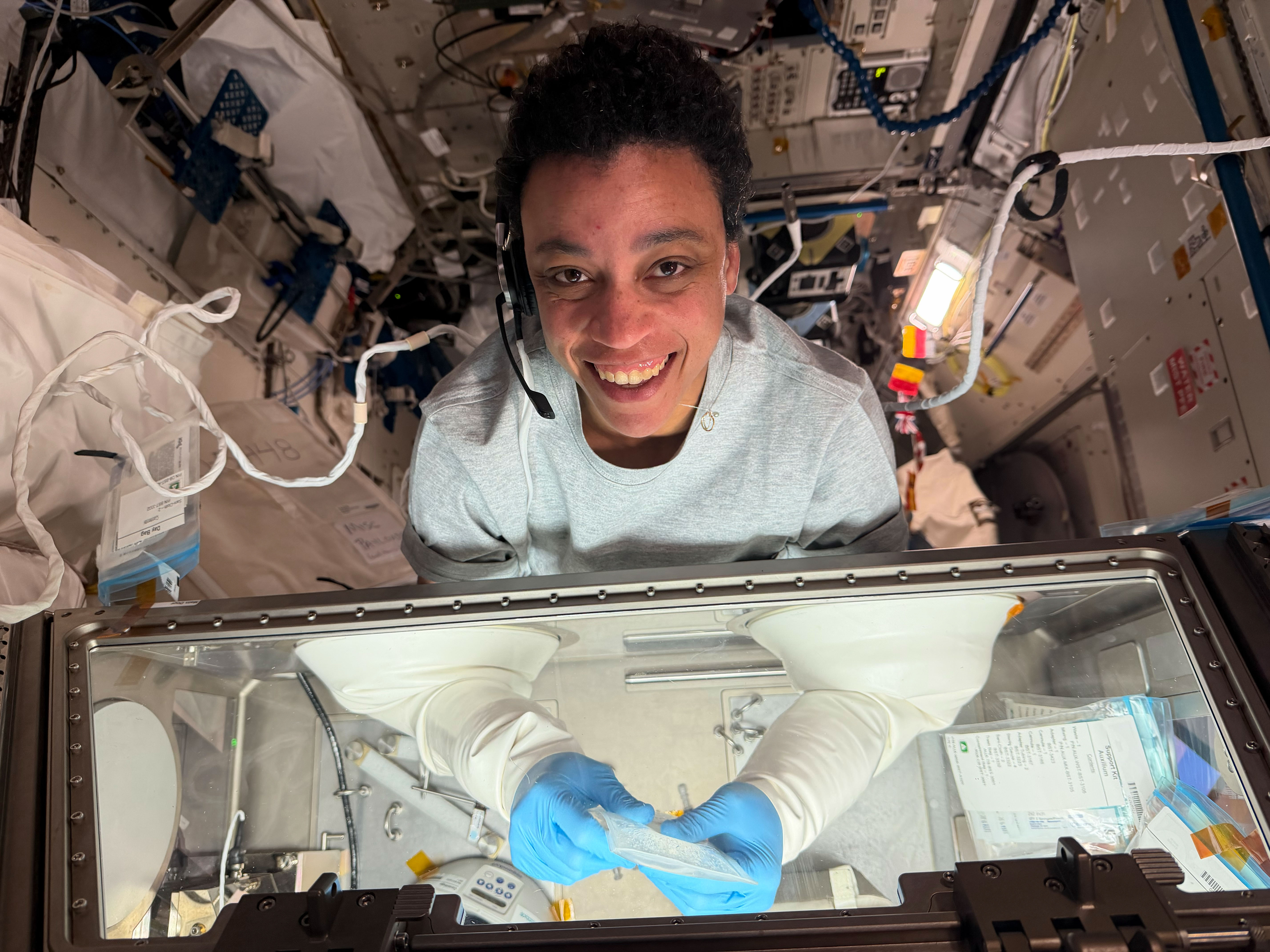
Image: NASA/Anil Menon | Original page.
The photograph was taken on October 9, 2026, and selected as NASA's Image of the Day on October 21. Watkins is working in the Life Science Glovebox in the International Space Station's Japanese Kibo laboratory. She mixes living cell samples with bioink, then loads the mixture into a special cartridge. This is careful preparation before printing.
The investigation, InSPA-Auxilium Bioprinter-Cell Printing, explores whether microgravity can help produce higher-quality cartilage tissue than printing on Earth. Cartilage performs functions including cushioning in joints. Making useful tissue requires much more than reproducing an object's outline.
An ordinary printer positions ink on paper. Bioprinting arranges cells and compatible materials into a three-dimensional structure. The material must be workable, the cells must survive, and tissue must develop. Shape alone does not establish that a construct performs like its counterpart in the body.
Why take this work into orbit? NASA's introduction to 3D bioprinting explains that gravity can deform soft printed structures on Earth, where they often need support. The station's near-weightless environment offers different conditions for studying tissue formation. Researchers still need to test individual printing methods, materials, and tissues.
A July 30 account of related station operations describes another round of work: mixing cartilage cells with bioink, filling cartridges, and loading them into the printer inside Kibo's glovebox. Those samples were to be frozen and returned to Earth for analysis. The account helps connect preparation, printing, and subsequent examination; it supplies background to the work in this photograph.
The important comparisons come afterward. Did the cells survive? Is the tissue structure appropriate? Does it perform reliably? Experimental constructs still need research and validation before they can become clinically useful repair tissue.
To follow the work, search the experiment's name in NASA's Space Station Research Explorer. Pay attention to objectives and results: the question an experiment sets out to answer, and what it actually finds, are different parts of the story.