
Two dark halves of a rocket's protective shell stand open. Between them, a central structure carries equipment wrapped in gold insulation, fitted with solar panels and connected by cables. It resembles a precision rack turned upright.
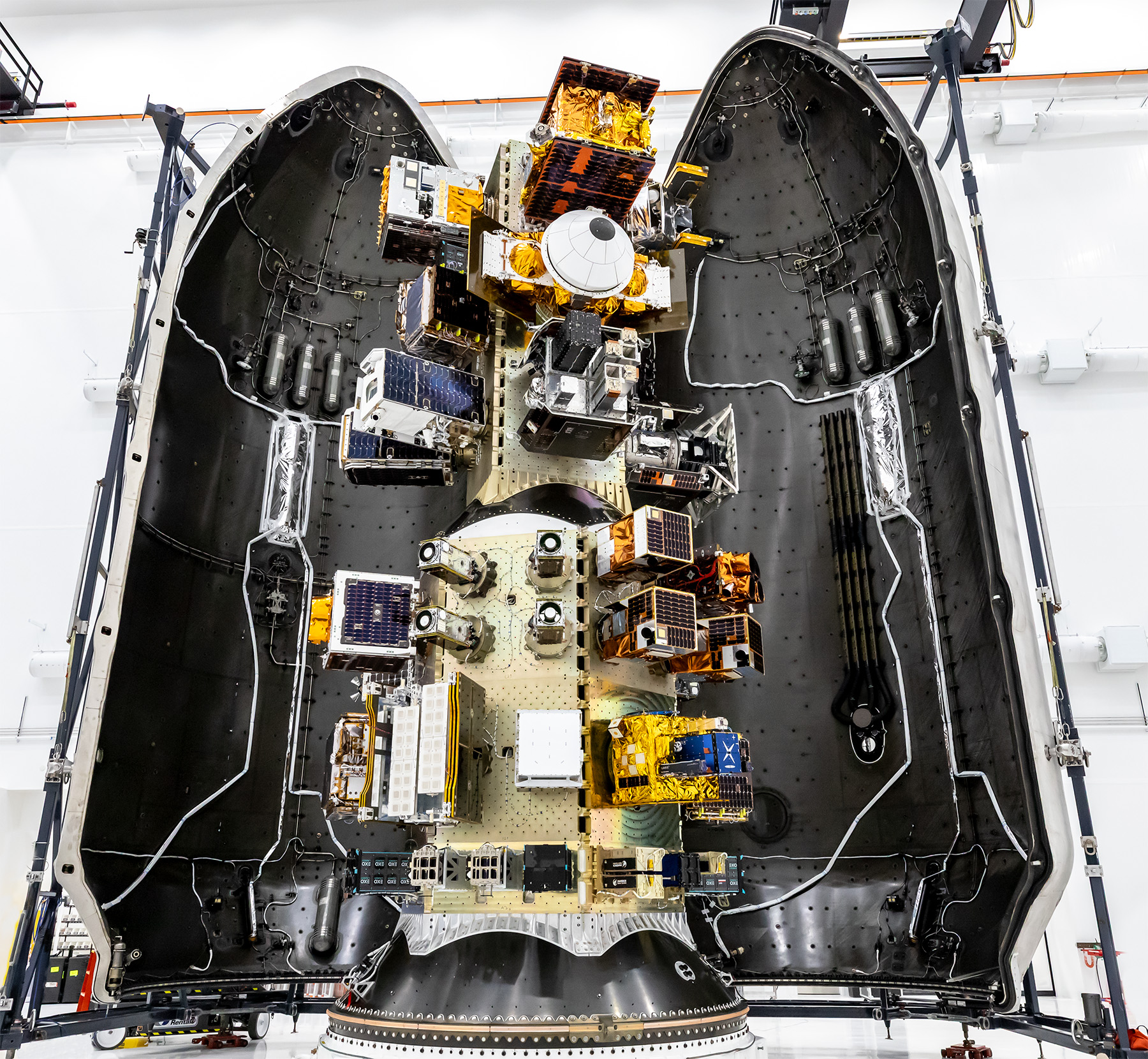
Image: NASA Image of the Day. Image credit: SpaceX. Original page.
NASA published this Transporter-18 photograph on October 13. It shows encapsulation before launch. The payloads lifted off aboard a SpaceX Falcon 9 from Vandenberg Space Force Base, California, on October 1 at 11:32 a.m. PDT.
NASA's launch account identifies three spacecraft supported by the agency, alongside many commercial payloads. Without an annotated inventory, the photograph cannot tell us which box is which.
One propellant supply, two ways to propel
The ASCENT Propulsion Dual Mode CubeSat tests a combination: one chemical thruster for higher-power maneuvers and four electrospray thrusters for lower-power operations. Both draw on a common supply of ASCENT propellant.
The experiment asks whether a small spacecraft can share its propellant and feed system while gaining the advantages of both approaches. "Dual mode" describes the propulsion, rather than two identical satellites in the photograph.
A small telescope studies escaping light
SPRITE was developed and is operated by the University of Colorado Boulder's Laboratory for Atmospheric and Space Physics. It will observe ultraviolet wavelengths difficult to study from the ground, examining how gas, dust and energetic radiation move through galaxies and how radiation escapes between them.
The research team's account connects this to the early universe: how did light ionize previously neutral gas and change the environment through which light travels? SPRITE will study closer targets to help understand these processes, rather than directly photograph the universe's first stars.
Students also participate in instrument construction and mission operations. Fitting a question into a small spacecraft still requires a telescope, detectors, control systems and data analysis to work together.
The mission's 2025 instrument paper specifies a design band of 100-175 nanometers. SPRITE plans to measure escaping ionizing radiation from about fifty star-forming galaxies at redshifts of 0.16-0.4. Cosmic expansion stretches light's wavelength, moving some originally shorter-wavelength radiation into the instrument's range. This is a change in wavelength, rather than a change of telescope focus.
Inspecting a satellite before anyone repairs it
SSPICY stands for Small Spacecraft Propulsion and Inspection Capability. Starfish Space will operate Otter 24C to approach and inspect up to four inactive satellites of U.S. origin in low Earth orbit. It will gather information about their surface condition, geometry and orbital characteristics.
NASA's launch account lists inspections as expected to begin in 2027. Autonomous navigation and propulsion technologies are meant to help the spacecraft approach safely. The resulting data can support future servicing and disposal work; demonstrating inspection is not the same as having refueled, repaired or removed a satellite.
Sharing a launch lets scientific experiments and technology demonstrations travel alongside other payloads, rather than each requiring an entire rocket. Look at the photograph again: find the two protective halves and the central mounting structure, then consider the different jobs the spacecraft must do after leaving the rocket. The NASA small-satellite mission blog offers more to explore.