
A stone staircase climbs into the air and stops. In this photograph, the Milky Way rises behind it, seeming to continue the path. The staircase stands in Chile's Atacama Desert, in the foreground of NASA's Astronomy Picture of the Day for October 13, 2026.
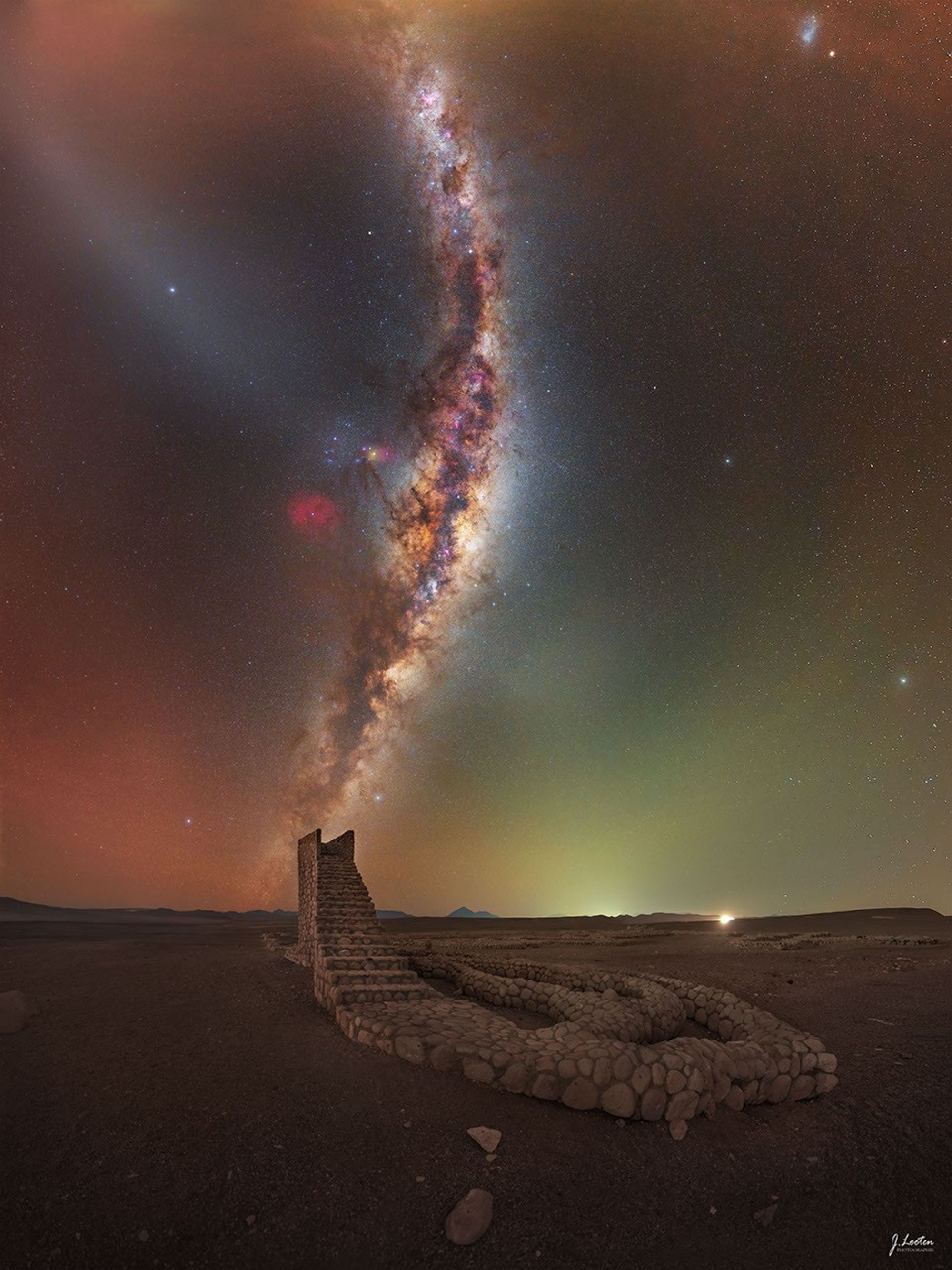
Image: NASA Astronomy Picture of the Day. Credit & Copyright: Julien Looten. Original page.
Julien Looten captured this wide-angle composite in July 2025. The alignment of stairs and galaxy is a photographic composition. Several kinds of light share the resulting picture, each with a different journey to the camera.
First, ask how the picture was made
The photographer's own account gives the staircase another purpose: climbing it provides a higher view of a nearby geoglyph, a design on the ground. Looten wanted it to lead the eye toward the Milky Way instead. He captured a panorama of nearly 360 degrees and projected it vertically. The zenith, directly overhead, lies at the center of the image; the horizon in opposite directions appears along its bottom and top edges.
This is more sky than a conventional view in one direction. Mapping the celestial sphere onto a flat picture affects the Milky Way's curve. Knowing that the center represents the zenith helps us read the panorama. Locating a particular bend precisely on the sky would require the projection and image registration details.
Looten used a modified Sigma fp camera and a Sigma 14mm f/1.4 lens. His material consisted of 50 exposures of 13 seconds each, without tracking or stacking. Those frames form a panorama; they should not be treated as a single patch of sky exposed for a cumulative 650 seconds. Moving the camera and the intervals between frames also take time.
Darkness within the Milky Way
The brightest band belongs to our own galaxy. The Sun sits within its disk, so looking through that disk brings the light of many stars together into a broad, faint band across the sky. In the photograph, dark streaks interrupt it.
Those gaps do not necessarily mean an absence of stars. As NASA's explanation of Galactic dust describes, dust absorbs and scatters light from stars behind it, rather like a translucent curtain. Something that blocks a visible-light view can reveal itself at other wavelengths. The dark parts of the Milky Way carry information too.
Sunlight caught by dust
The pale, slanting band toward the upper left is zodiacal light. Dust plays a different role here. Particles within the solar system scatter sunlight, producing a collective glow too faint to attribute to individual grains. Much of that dust lies near the plane in which the planets orbit, so the light extends along the ecliptic, the corresponding path across our sky. NASA's zodiacal-light image explanation illustrates the same mechanism.
Spica lies within that stripe of light in this photograph. The small, fuzzy patch at the upper right is the Small Magellanic Cloud, a separate galaxy rather than a cloud within the Milky Way.
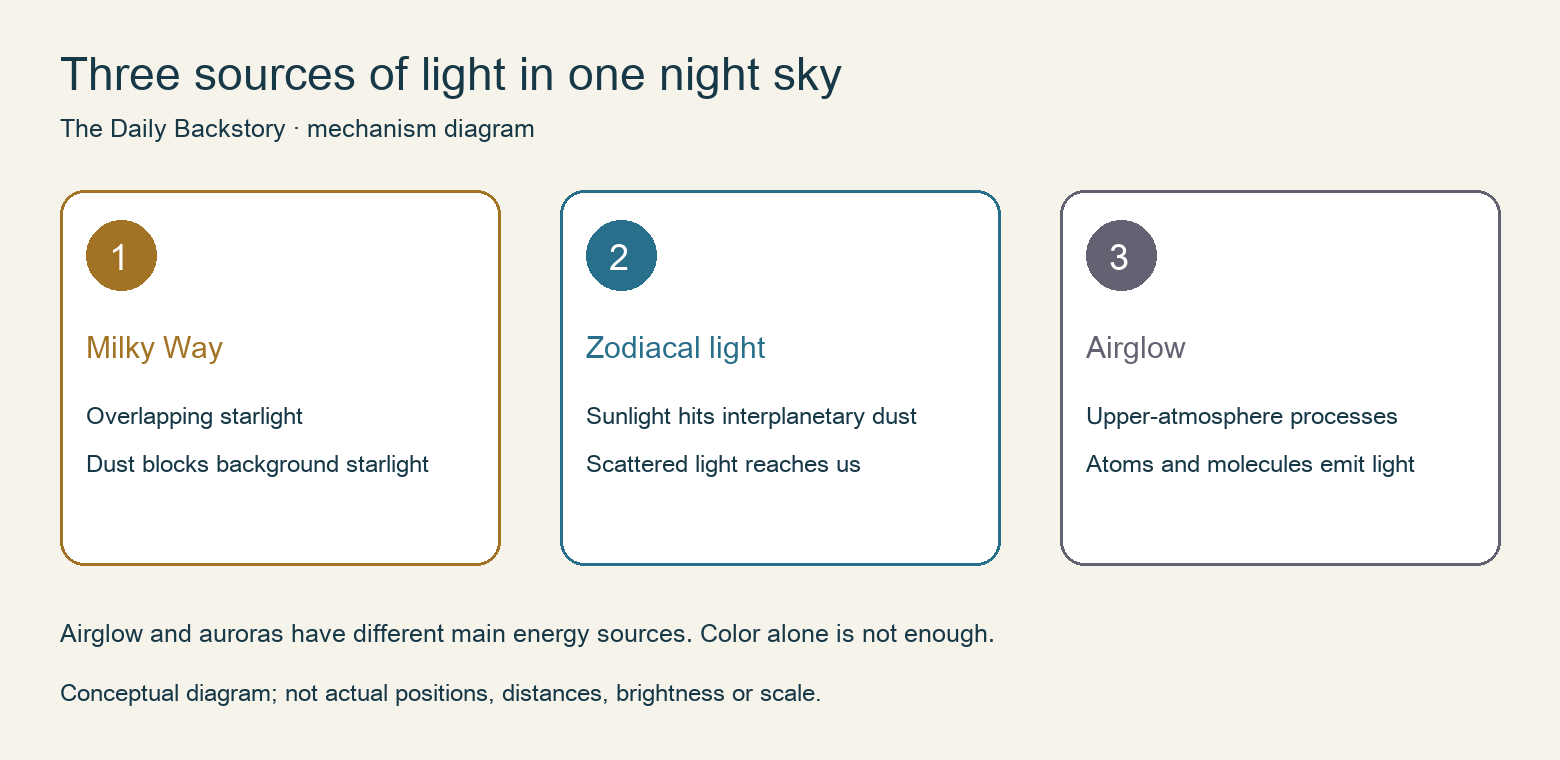
Explanatory diagram: The Daily Backstory. The boxes distinguish mechanisms, not actual positions, distances or brightness.
Light made by Earth's atmosphere
The thin red and green glow comes from airglow: faint light emitted as atoms and molecules in the upper atmosphere release energy. A sensitive camera under dark skies can record it more readily than our eyes.
NASA's account of airglow explains that ordinary solar radiation powers these processes. Auroras are primarily driven by energetic particles originating in the solar wind. Green alone is not enough to identify an aurora.
Airglow is also a scientific tool. Different gases, altitudes and excitation processes favor different colors. Researchers can use that light to investigate the composition, temperature and movement of the upper atmosphere. One faint layer in a desert nightscape offers a way to study our planet.
Along the horizon are the silhouettes of the Andes, Licancabur volcano and the lights of San Pedro de Atacama. A nearby town and a distant galaxy can occupy the same photograph.
To begin looking for these lights yourself, try NASA's guide to the Milky Way's dark clouds. Choose a clear night away from artificial lights, with little moonlight, and look for alternating light and dark texture in the Galactic band. Around the Northern Hemisphere's autumnal equinox, dark skies before dawn offer a chance to seek zodiacal light; seasons and viewing geometry differ between hemispheres. NASA's night-lights guide recommends avoiding moonlight and observing before morning twilight. Airglow and zodiacal light require particularly dark conditions, and the vivid colors in a photograph are no promise of what the eye will see.