
World Space Week starts today. Sixty-nine years ago, humanity put its first satellite into Earth orbit.
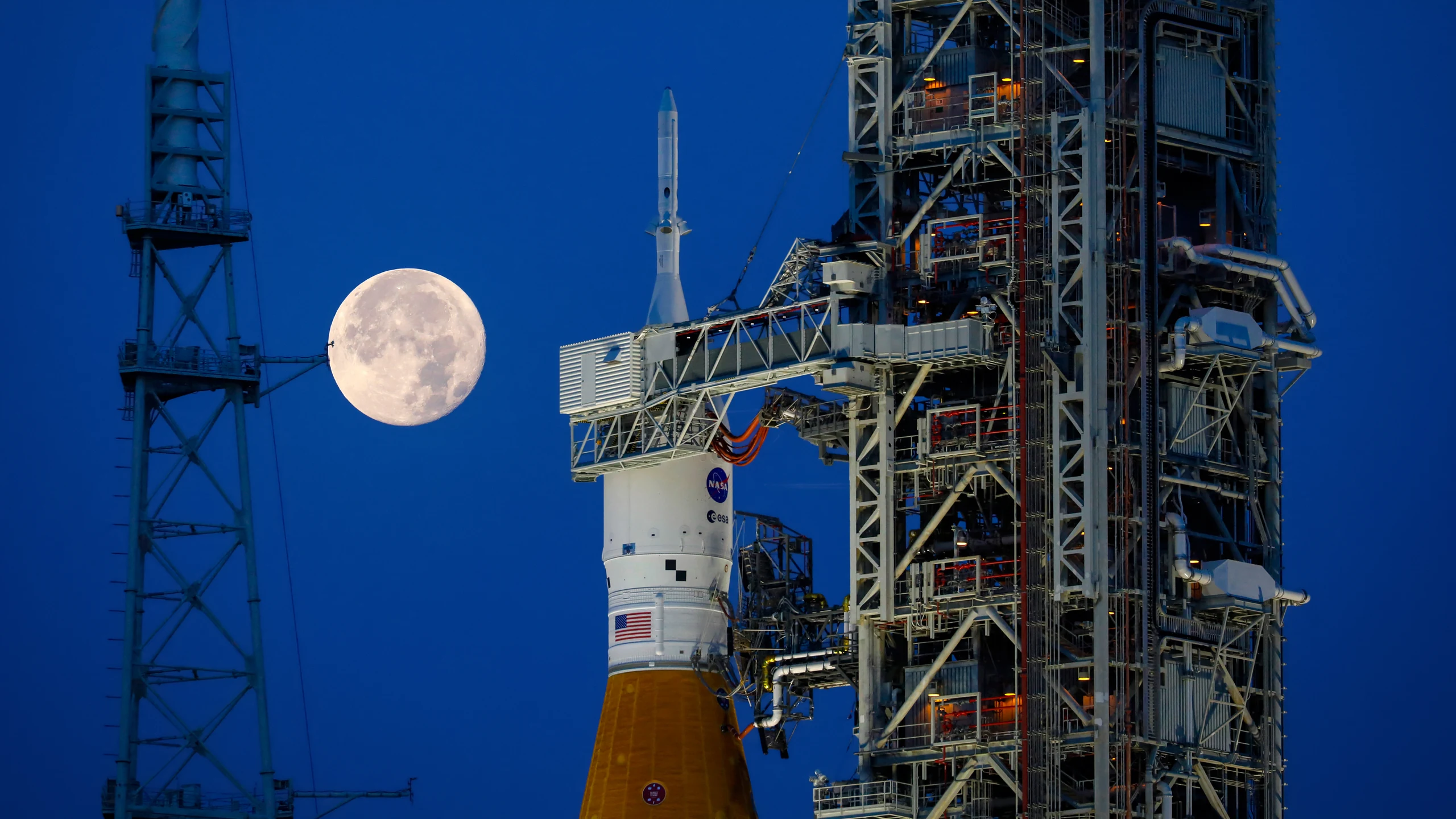
Image: Bing Daily Wallpaper | Artemis I Moon rocket, Launch Pad 39B, Kennedy Space Center, June 15, 2022 | Credit: EVA MARIE UZCATEGUI/Getty Images | Original page

The rocket in today's wallpaper has yet to leave the ground. This is a photograph from 2022, not a live view of a launch. Bing connects it to World Space Week, an observance whose opening date takes us back to a much smaller spacecraft.
Two Dates Bookend the Week
In 1999, the United Nations General Assembly declared October 4-10 World Space Week, celebrating the contributions of space science and technology to human life.
October 4 marks the Soviet Union's launch of Sputnik 1 in 1957. October 10 marks the entry into force of the Outer Space Treaty in 1967. One date is about capability; the other is about rules. The treaty says that outer space, including the Moon and other celestial bodies, cannot be appropriated by a nation.
Sputnik 1 was a metal sphere about 58 centimeters across, weighing 83.6 kilograms, with four antennas extending from it. It had no elaborate scientific instruments, but its radio signals could be picked up on Earth, including by amateur radio operators. An orbit took about 96 minutes.
On October 26, 1957, the batteries ran out and the familiar beeps stopped. The satellite did not immediately fall back to Earth. It kept orbiting until it reentered the atmosphere on January 4, 1958.
How long a satellite can communicate and how long it stays in orbit are different questions.
Gravity Has Not Gone Away
Why does a satellite stay up when a stone tossed into the air soon comes back down?
"It is high enough" is only part of the answer. Gravity is still strong in low Earth orbit. Without the right velocity, an object delivered to the same altitude would fall back.
Newton's cannon thought experiment offers a useful picture. Imagine firing a cannon horizontally from an impossibly tall mountain. At low speed, the ball lands nearby. At greater speed, it lands farther away. With the right speed, Earth's curved surface keeps dropping away beneath the ball as gravity pulls it down. It continues to fall but keeps missing the ground.
An orbit is forward motion combined with continuous falling. Speeds in low Earth orbit are roughly 8 kilometers per second; the exact value depends on the orbit's altitude and shape.
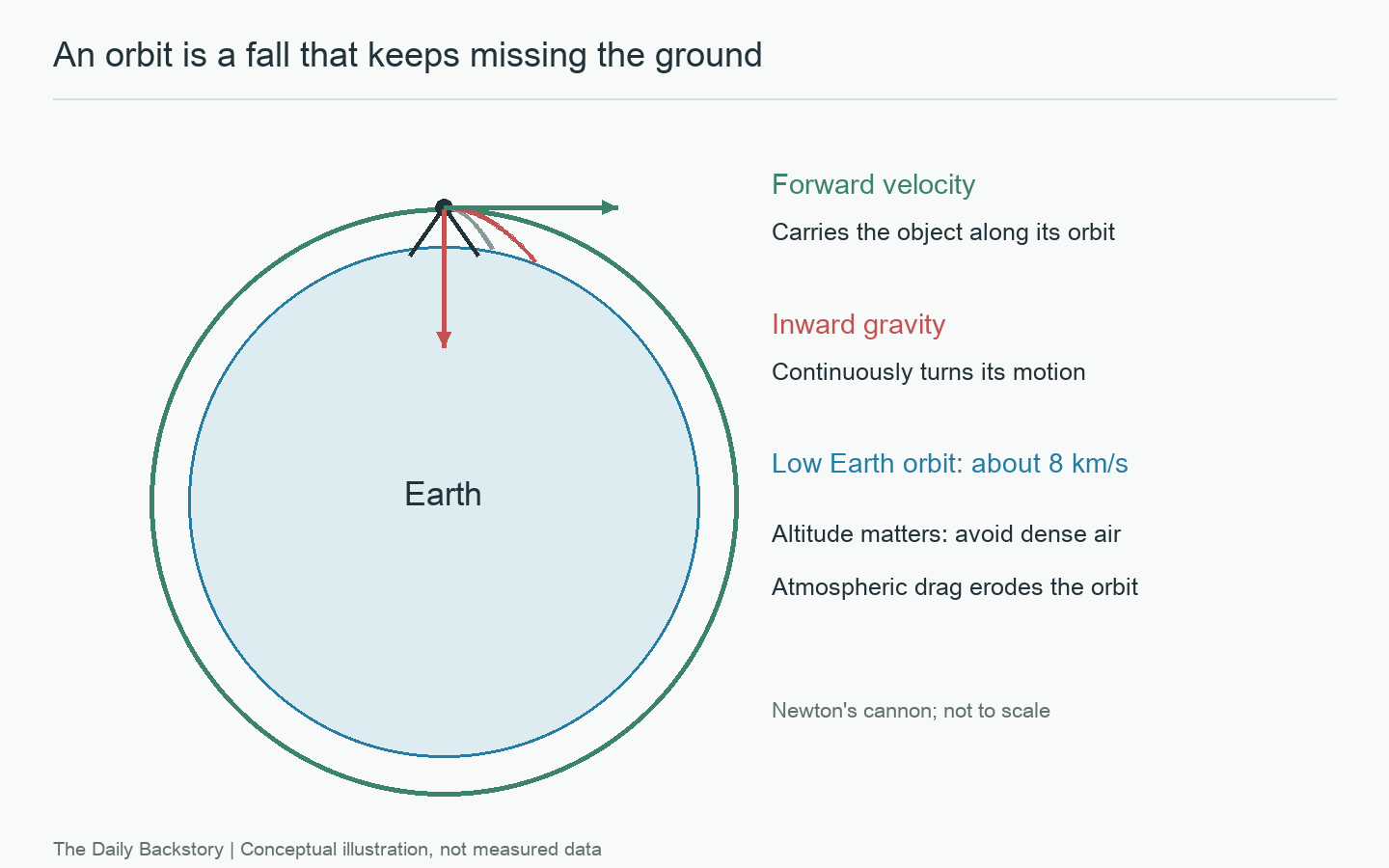
Diagram: The Daily Backstory; a conceptual illustration of orbital motion, not an actual flight path or a drawing to scale.
The thought experiment leaves out an important complication: air. A real rocket must both gain velocity and carry its payload out of the dense atmosphere. Reaching orbit does not grant a satellite an unlimited life.
Two First Satellites, Very Different Lifetimes
On April 24, 1970, a Long March 1 rocket put China's first satellite, Dong Fang Hong 1, into orbit. The 173-kilogram spacecraft broadcast the song "The East Is Red" to Earth.
An aerospace account republished by China News Service records an initial perigee of about 439 kilometers and apogee of about 2,384 kilometers. Those are its launch-orbit figures, not a claim that today's orbit remains unchanged.
An August 2026 article from the China National Space Administration reports that Dong Fang Hong 1, long inactive, is still orbiting. A current CelesTrak query also returns orbital data dated October 4, 2026, for DFH 1, catalog number 4382.
The difference between its lifetime and Sputnik's is not simply a matter of one being more sturdily built. Residual air in lower orbits drags on a satellite and causes its orbit to decay. As it descends into denser air, the decay can accelerate. Dong Fang Hong 1's higher initial orbit favored a much longer stay in space. Mass, exposed area and solar activity also affect the process.
That distinction matters: still in orbit does not mean still operating.
From a Metal Sphere to a Moon Rocket
The rocket in the wallpaper served the Artemis I mission. It launched on November 16, 2022, sending an uncrewed Orion spacecraft around the Moon before its return and splashdown on December 11.
NASA's mission page records Artemis II's launch on April 1, 2026, and return on April 10, after 9 days, 1 hour and 32 minutes. Four astronauts completed a crewed lunar flyby. They did not land on the Moon.
NASA's current mission description assigns Artemis III in 2027 to rendezvous and docking tests in low Earth orbit, with a return to the lunar surface targeted for 2028. These are the plans at publication and may change.
The engineering has grown far more complex since the first satellite. The underlying physics remains recognizable: forward velocity, gravity, and changing an orbit at the right time.
World Space Week can begin with that small shift in perspective. A point of light moving steadily across the sky is not hanging motionless above us. It is flying, and it is falling.
Sources
UNOOSA: the history of World Space Week (PDF); UNOOSA: the Outer Space Treaty; NASA: Sputnik and the origins of the Space Age; NASA: Sputnik's signals and reentry; NASA: Sputnik's development history (PDF); NASA: orbits and Newton's cannon; China News Service: Dong Fang Hong 1; CNSA: Dong Fang Hong 1 after 56 years; CelesTrak: DFH 1 orbital data; NASA: Artemis I; NASA: Artemis II.