
Yellow and red leaves surround a wooden mill, with patches of green still holding on. Water spills over the rocks out front. Beside the wall, a wheel seems to wait for the next flow.
This is Glade Creek Grist Mill in West Virginia's Babcock State Park. Its appearance suggests a surviving nineteenth-century building. In fact, it was completed in 1976, using parts from three older mills.
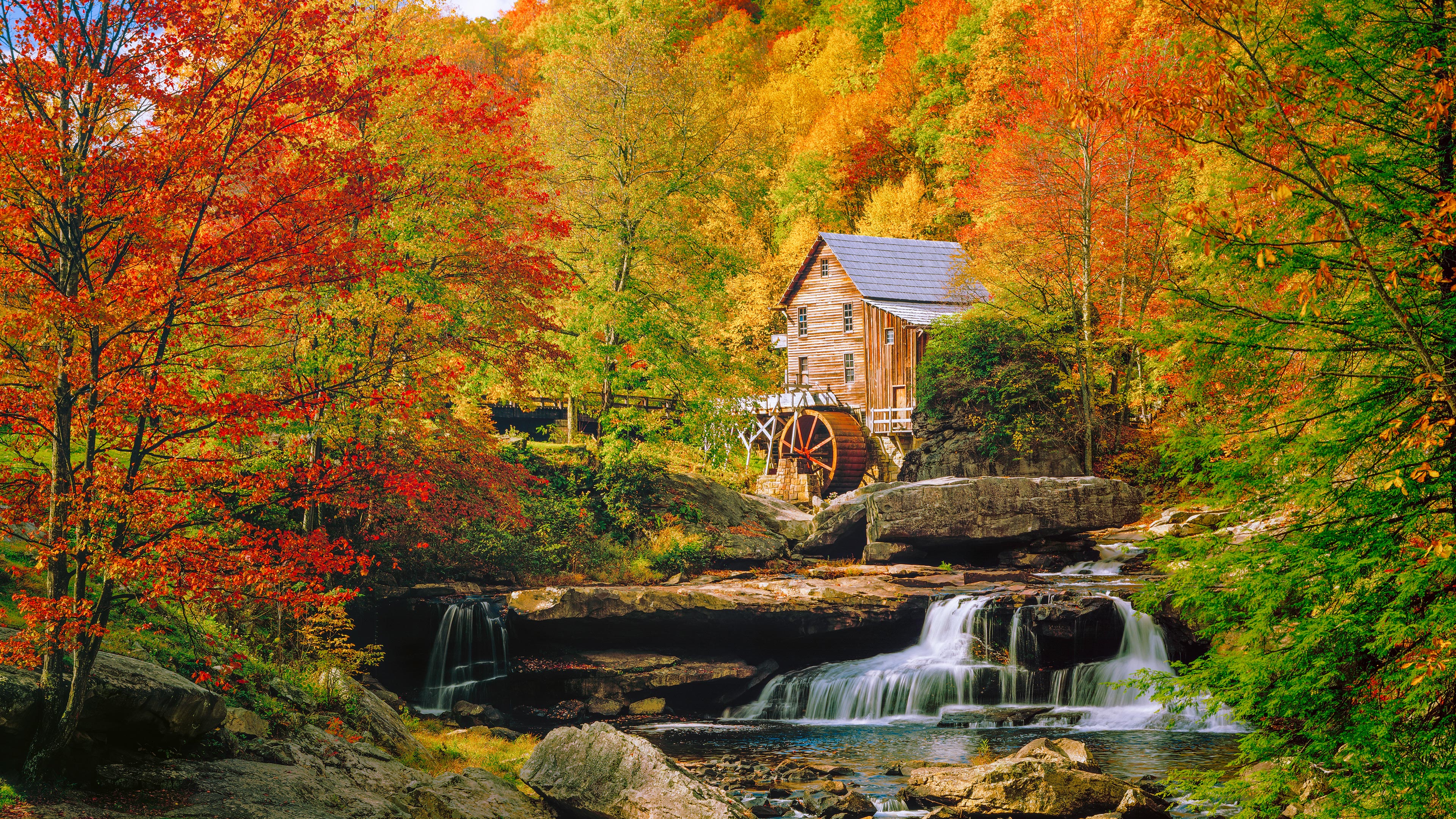
Image: Glade Creek Grist Mill, Babcock State Park, West Virginia, USA. © dszc/Getty Images. Original page.
Three histories in one building
The park's history identifies the pieces. The main structure came from Stoney Creek Grist Mill near Marlinton, which dated to 1890. The wheel came from Spring Run Grist Mill near Petersburg, a mill damaged by fire. Other parts came from Onego Grist Mill near Seneca Rocks.
The reconstruction recreates Cooper's Mill, which once worked nearby. Its original site is now the parking area for the park's administration building. The assembled mill gives a vanished way of working a functioning home again.
How a stream becomes cornmeal
The mill is more than a photographic backdrop. The park's account of its operation follows water through a gate to the wheel, then motion through gears to a grindstone weighing about 900 pounds, or 408 kilograms. Corn is ground between stones and then screened.
This is an overshot wheel: water enters near its top, and the falling water's weight drives the rotation. The stream's downward movement becomes a machine's turning motion. Water passes through; ground grain remains.
A stream cannot be switched on like electricity. The park says cornmeal production and availability depend on stream conditions. A wheel in a photograph does not establish that grain was being milled at that moment.
Another kind of work in the leaves
The yellows and reds behind the building have different origins. A review of autumn leaf research distinguishes two processes. Yellow and orange carotenoids already coexist with green chlorophyll; as chlorophyll declines, they become more visible. Many red and purple autumn leaves synthesize anthocyanins while aging.
Anthocyanins can occur in other seasons too. Plant species, leaf age and conditions all influence pigmentation. The intriguing feature of autumn redness is that some trees invest in making pigments while preparing to recover nutrients and shed their leaves.
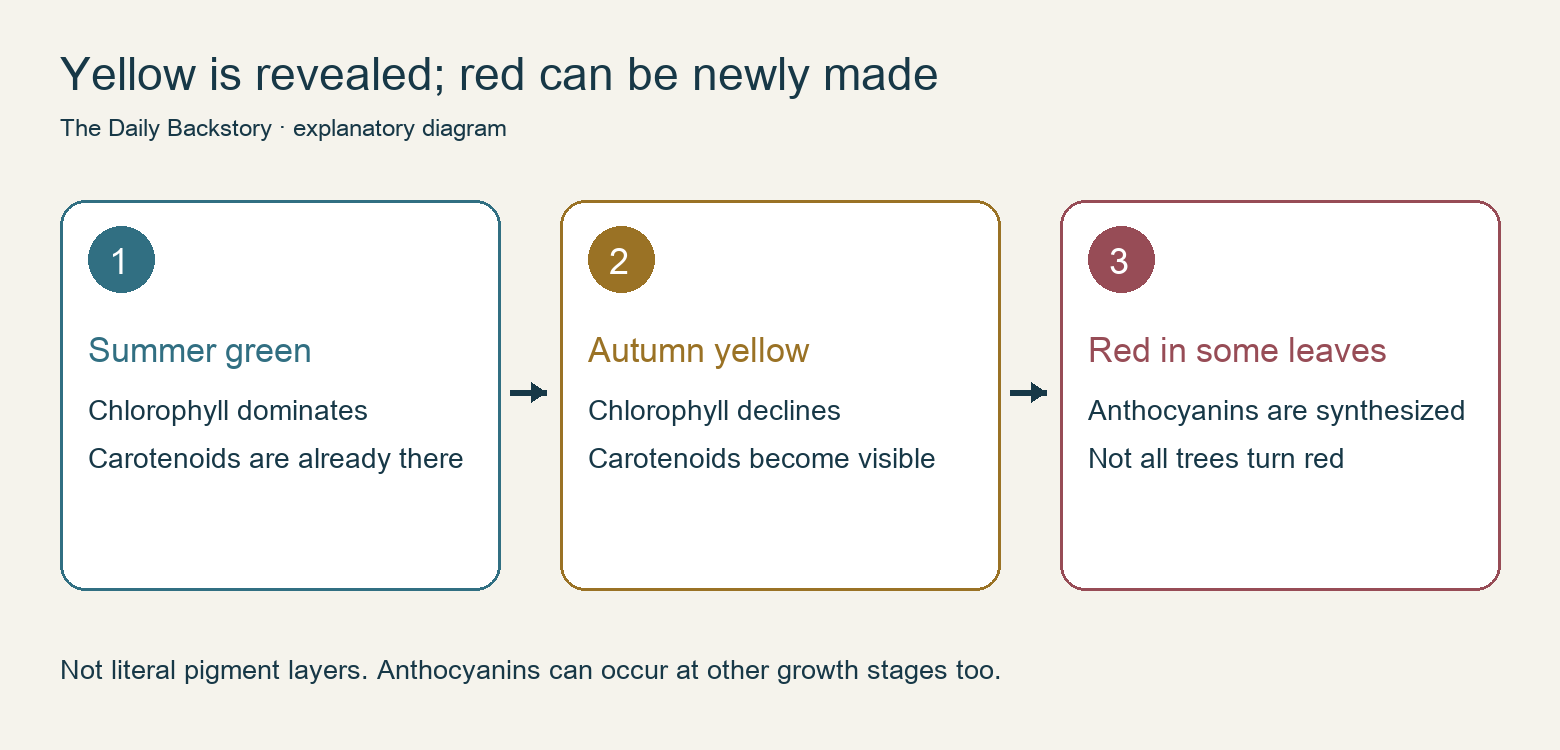
Diagram: The Daily Backstory. Colors illustrate mechanisms, rather than three physical layers of pigment.
Why make pigments before a leaf falls? One explanation is that anthocyanins protect aging leaves from excessive light, allowing more time for nutrient recovery. Another hypothesis concerns insects choosing host plants. A 2019 review by Renner and Zohner also considers eastern North America's strong sunlight, autumn temperature swings and shorter growing seasons. These explanations remain under investigation. They cannot assign one cause to every red leaf in this image.
Relatives across the Pacific
Eastern North America and East Asia have some striking botanical relatives. Tulip trees offer an example: Kew's taxonomic database accepts only two living species in the genus, one in North America and one from China to Vietnam. Distant forests can share a long evolutionary history. This wide photograph, however, does not allow us to identify each tree.
Another forest history lies beyond the picture. US Forest Service research describes how a chestnut blight fungus from Asia left American chestnut functionally absent from eastern US forests. Resistance breeding research seeks to introduce Asian chestnuts' disease resistance into American chestnut. This is a particular history of pathogen spread and host responses, rather than a rule that relatives share every disease. It also does not mean American chestnut is extinct.
Before visiting, check the park's current access and services. From a safe spot, trace where the water enters, how it reaches the wheel and where the motion goes next. Following that route adds something to the view of a handsome old building.
Closer to home, choose a deciduous tree you can identify and photograph it from the same position every few days. Record weather alongside color changes. Watch for yellow becoming visible and red appearing; let the tree show you whether its leaf edges change first or the whole blade changes together.