
This Moon looks like a gray stone sphere covered in dents. The broad, dark plains familiar from our sky are scarce, and impact craters cover much of the disk.
It is the lunar far side. NASA's October 10 Astronomy Picture of the Day features a mosaic from the Lunar Reconnaissance Orbiter's wide-angle camera. This is a portrait assembled from orbit, rather than a photograph taken on the publication date.
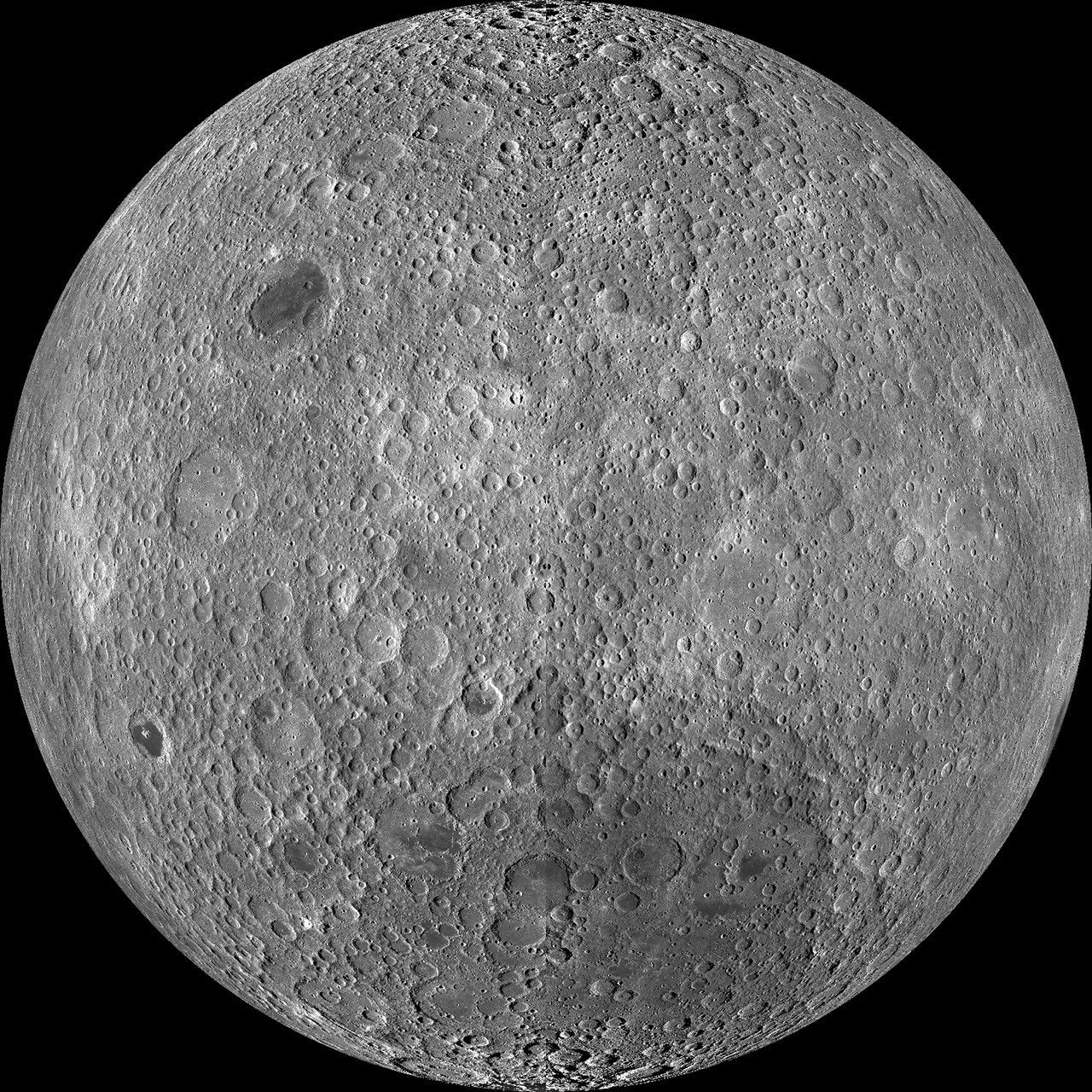
Image credit: NASA / GSFC / Arizona State Univ. / Lunar Reconnaissance Orbiter. Original page.
Far does not mean dark
The Moon takes as long to rotate once as it takes to orbit Earth once. Roughly the same hemisphere therefore faces us. NASA calls this tidal locking. The Moon still rotates, and the far side has days and nights.
At new moon, sunlight falls largely on the hemisphere facing away from Earth. The tilted orbit usually keeps the Sun, Moon and Earth from lining up exactly; otherwise every new moon would bring a solar eclipse. Libration also lets observers on Earth occasionally glimpse small areas beyond the usual limb. Even "we can never see any of the far side" needs that qualification.
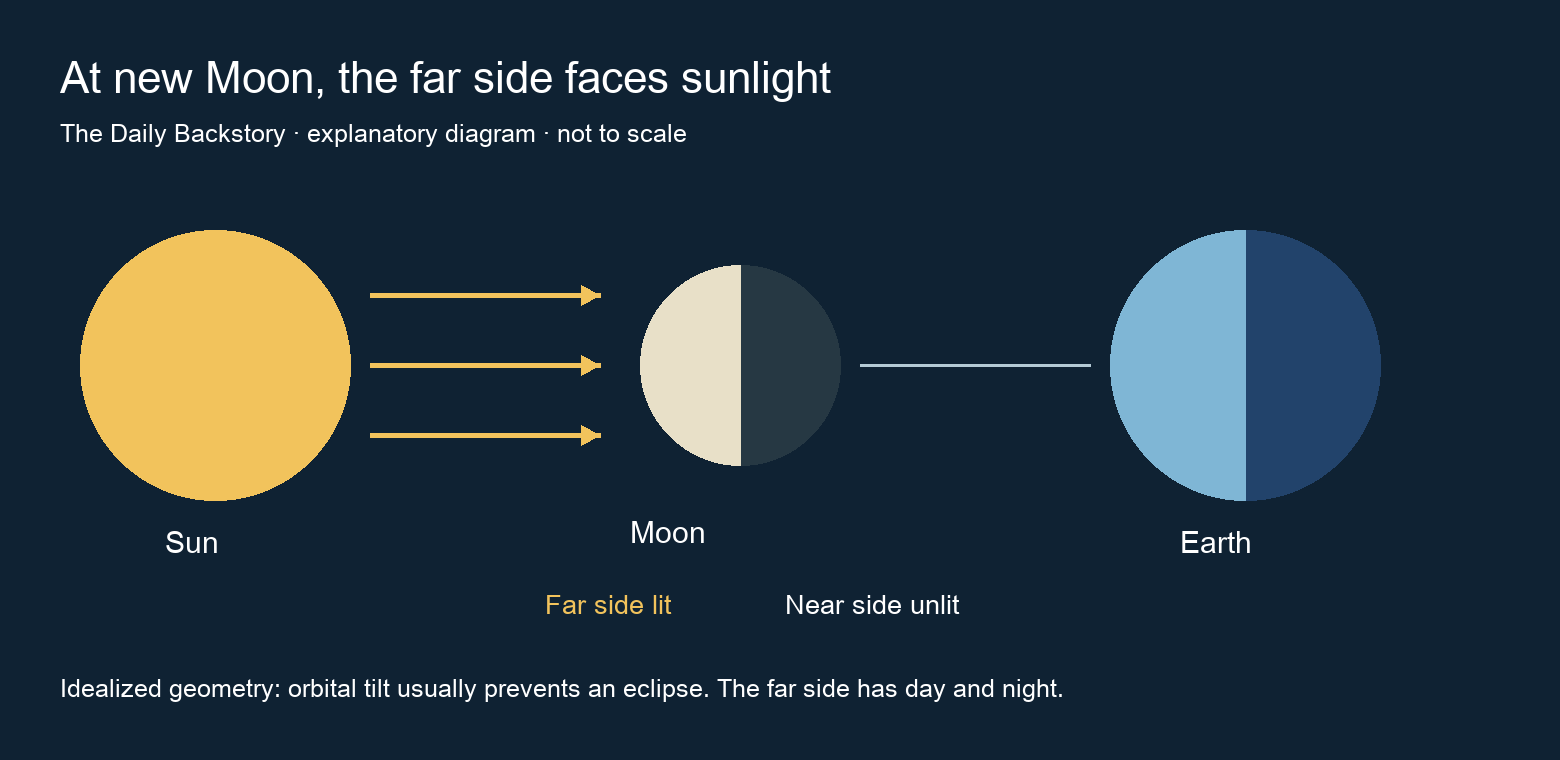
Diagram: The Daily Backstory. Idealized geometry; sizes and distances are not to scale.
Try walking a ball around another ball on a table, keeping the same mark pointed toward the center. By the time you complete the circuit, the ball in your hand has rotated once. Without that rotation, an observer at the center would see different faces.
Where are the dark plains?
The lunar maria are ancient basalt plains made by lava, rather than seas of water. The near side has many large, dark maria. The far side retains more rough, densely cratered highlands.
NASA points to the far side's thicker crust as one possible explanation: magma may have found it harder to reach the surface through a thicker outer shell. "Possible" matters here. One simple cause cannot settle why the two hemispheres developed different crusts and volcanic histories.
A map made from thousands of photographs
The original LROC image description was published on March 11, 2011. This view belongs to a global mosaic assembled from images acquired between November 2009 and February 2011. NASA gives more than 15,000 images for the global map, with about 100 meters per pixel in its highest-resolution version. That is the scale of the original map; the reduced illustration on a phone does not retain that level of detail.
Bringing the far side home
In 2024, Chang'e 6 returned 1,935.3 grams of material from the lunar far side. The National Astronomical Observatories of China confirms that this was humanity's first sample return from that hemisphere. A map shows terrain; rocks let a laboratory ask when it formed and what its interior source was like.
A basalt dating study published in 2024 identified major volcanic activity about 2.8 billion years ago and a high-aluminum basalt fragment about 4.2 billion years old. The ages span at least 1.4 billion years, evidence of a long volcanic history on the far side. They date rocks from the sampled location, rather than every landscape in that hemisphere.
A 2025 water-content study estimated a comparatively dry mantle source for these basalts. Isotope research found a source strongly depleted in incompatible elements and considered explanations including an early primitive source or melt extraction following a large impact. These results concern the source of the sampled rocks. They are neither a survey of the whole far side nor a claim that the lunar surface has no water.
When the Moon is next visible, find its light and dark patches and picture lava spreading across the darker plains. Then use NASA's Moon exploration pages to compare the two hemispheres. One Moon preserves different geological histories for observers on Earth and spacecraft in orbit.