
The rock excavated a crater just 222 meters wide, but loosened the lunar soil across a region 7 kilometers in diameter.
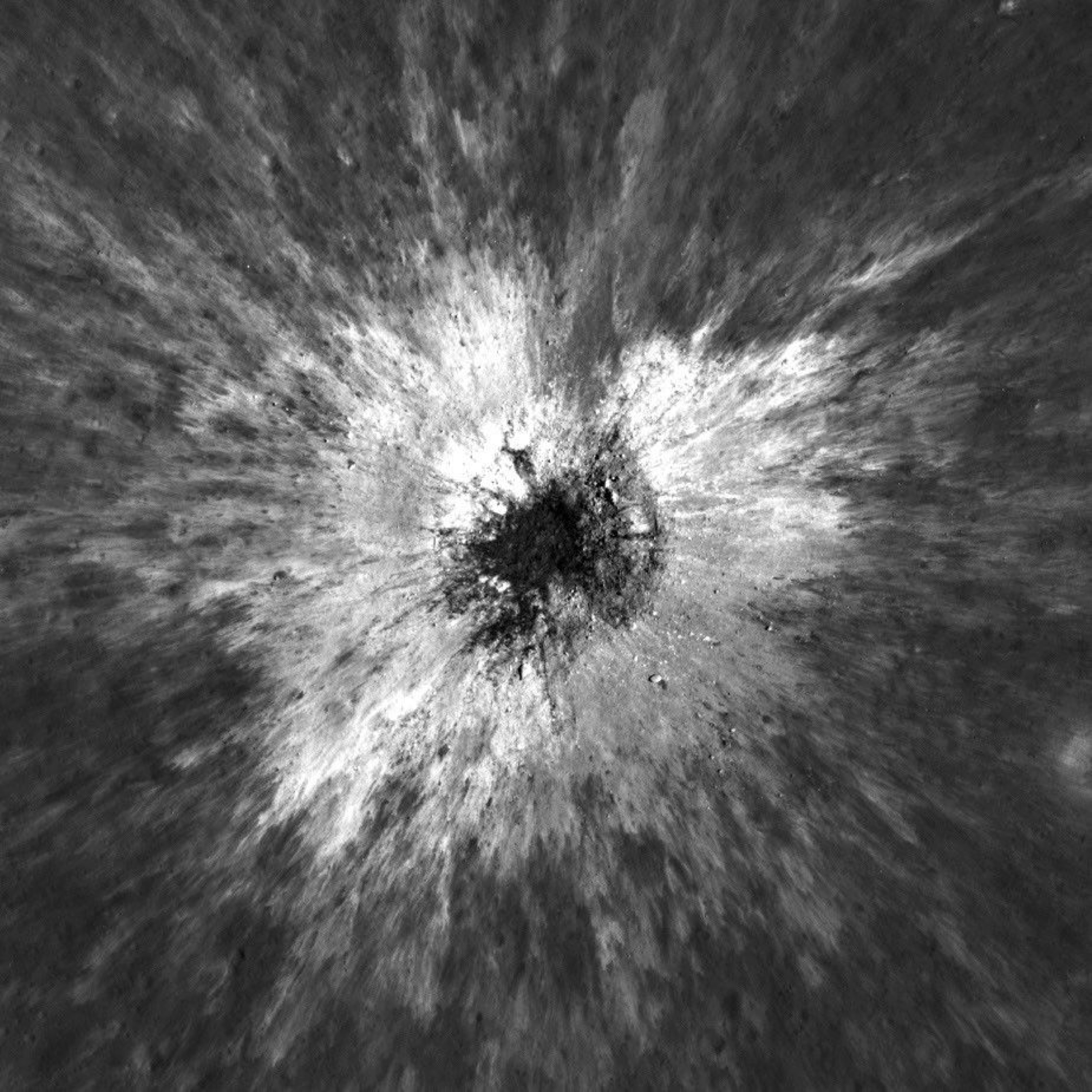
Image: NASA Astronomy Picture of the Day (APOD) | Image credit: NASA/GSFC/Intuitive Machines | Original page
Today's APOD is easy to scroll past: two gray views of the Moon that look almost identical.
The difference is a white speck in the later image.
That speck is new. It was not there before spring 2024. Then a rock hit the surface at more than ten kilometers per second, and there it was.
A Rock the Size of a Building
According to NASA and the Universities Space Research Association (USRA), the crater formed between April 11 and May 22, 2024, a window of 41 days. The Lunar Reconnaissance Orbiter (LRO) photographed the same patch of ground on both dates: no crater in April, a crater in May.
It measures 222 meters across, roughly the length of two regulation soccer fields, with an average depth of 43 meters, about the height of a 14-story building. Researchers estimate that the object that made it was the size of a three- to six-story building.
Robert Wagner, an image-processing specialist at Intuitive Machines, found it. Comparing overlapping images taken at different times is routine work for the LRO team, and often tedious. His account of this particular discovery has been quoted by several news outlets: "I just stopped, dropped everything I was doing, and started investigating what that spot was."
It is the largest new crater identified that formed during LRO's mission. USRA puts its rarity in perspective: a crater this size appears on the Moon about once every 130 years.
A once-in-a-generation piece of luck, then, to catch one forming.
The Bigger Discovery Lay Outside the Crater
That alone would make a good astronomy news story. What turned it into two papers in Science Advances was something else.
Scientists examined data from Diviner, LRO's infrared radiometer, and found a broad region around the crater that was colder than its surroundings during the lunar night.
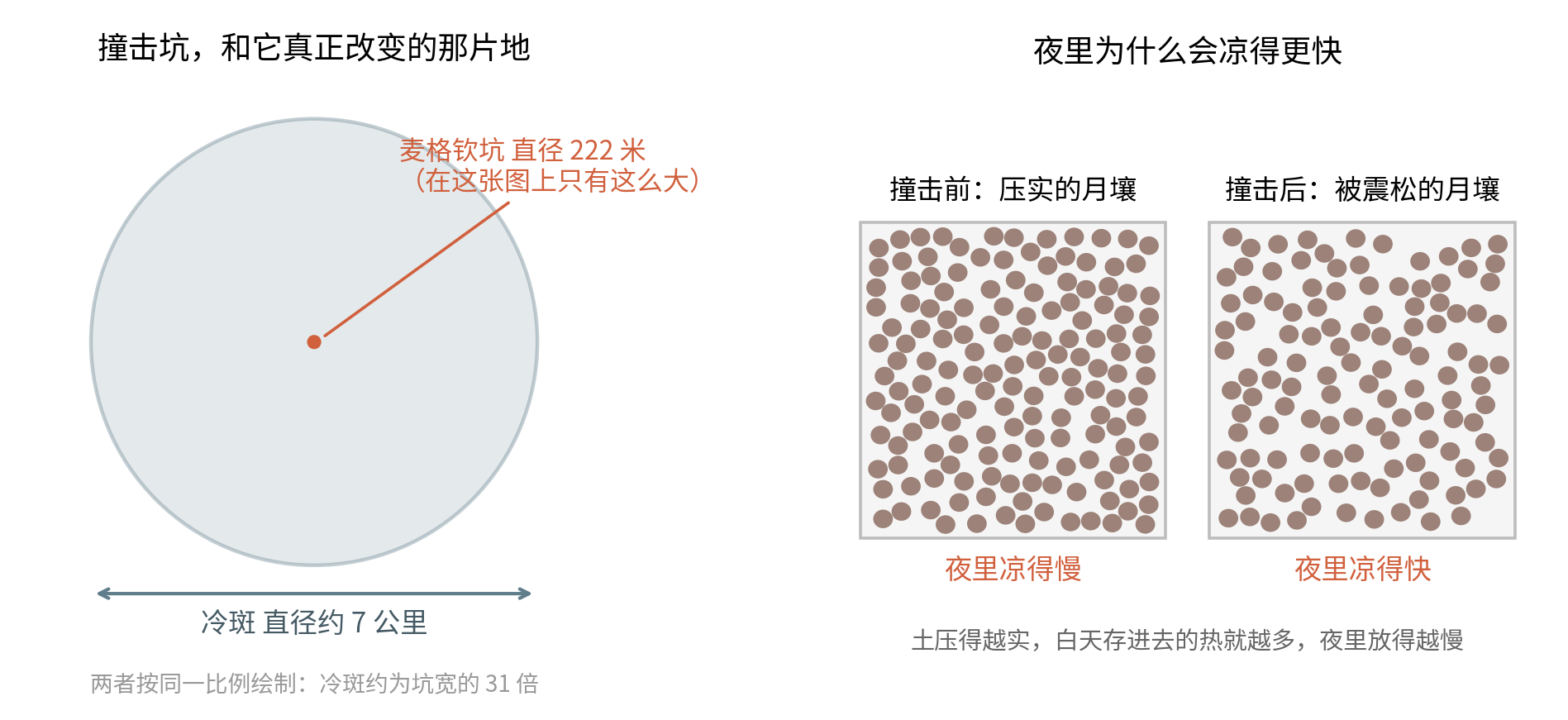
The cold spot measures about 7 kilometers across, 31 times the crater's width. It is roughly 8 to 9 kelvins cooler, a temperature difference of about 14 to 15 degrees Fahrenheit.
The explanation is less mysterious than the image suggests.
The Moon has no air to moderate its temperatures: the surface bakes by day and freezes at night. How quickly the ground cools depends on how much heat it can store during the day, and that ability depends on how tightly the soil is packed. Dense soil behaves more like solid rock, retaining heat and releasing it slowly. Loose soil is full of gaps, stores less heat, and cools quickly after sunset.
The impact shook loose the upper few centimeters of lunar soil across several kilometers. More precisely, the papers report that the observed nighttime cooling is consistent with models in which the density of those uppermost centimeters has decreased.
The rock dug a hole 222 meters wide, but loosened the ground across a region 7 kilometers wide. That change is invisible in an ordinary photograph. It emerges after dark, in the surface temperature.
The finding reaches beyond this one crater. An impact's footprint on the Moon can be far larger than the visible depression. The fine debris covering the lunar surface is repeatedly stirred by disturbances we cannot see. For anyone eventually building on the Moon, laying roads or burying pipes, how loose that soil is, and how far the disturbance extends, becomes a practical question.
Why It Is Called McGetchin
The International Astronomical Union formally named the new crater McGetchin, honoring Thomas R. McGetchin.
Born on July 31, 1936, in La Jolla, California, he earned his doctorate at Caltech in 1968, then studied volcanoes at MIT. A Geological Society of America memorial says he "attracted a group of enthusiastic students who, under his guidance, studied volcanoes in almost every conceivable way." In 1977, he became director of the Lunar Science Institute. Because "Tom always thought big," the institution subsequently became the Lunar and Planetary Institute.
His career was cut short. Cancer first struck while he was at MIT, and he survived. It returned in 1979, forcing him to resign. He died on October 22 that year, aged 43.
Among his contributions was a 1973 paper on how the thickness of crater ejecta changes with distance: how far an impact throws material, and how thickly it deposits it. USRA says the model remains fundamental to understanding crater formation and ejecta distribution.
There is a fitting connection here. One of McGetchin's most important contributions was calculating how far an impact spreads material. More than 50 years later, scientists caught a fresh impact whose influence extended far beyond its crater, and named that crater for him.
Chinese Names on the Moon
Lunar place names are not chosen simply by whoever gets there first. The International Astronomical Union is the single worldwide authority that approves them.
China has followed the same process. According to the China National Space Administration, on February 4, 2019, the IAU approved five names proposed by China using high-resolution lunar imagery from Chang'e 2 and Chang'e 4. The Chang'e 4 landing site became Statio Tianhe. Three nearby craters were named Zhinyu, Hegu and Tianjin, and a highland feature was named Taishan.
The announcement included an easily overlooked total: counting earlier proposals associated with Chang'e 1 and Chang'e 3, China had independently submitted and received approval for 12 lunar feature names by that date.
The Moon now has both McGetchin and Zhinyu. One commemorates a volcanologist who died at 43; the other draws on a Chinese poem thousands of years old. Both names passed through the same approval process.
Sources
- NASA Science, APOD for September 23, 2026, "A New Lunar Crater: McGetchin": Original page.
- USRA Newsroom, LRO discovers a new 222-meter-diameter lunar crater.
- Sci.News, "New Impact Crater Spotted on the Moon".
- Space.com, "NASA just found a giant new crater on the moon".
- The Debrief, the lunar cold spot and soil density.
- Geological Society of America, memorial to Thomas R. McGetchin.
- China National Space Administration, international approval of names for lunar features near Chang'e 4.
- NASA JPL Education, "Make a Moon Crater".