
Salsa, cumbia, and merengue can sound worlds apart. Underneath, there are often just five strokes.
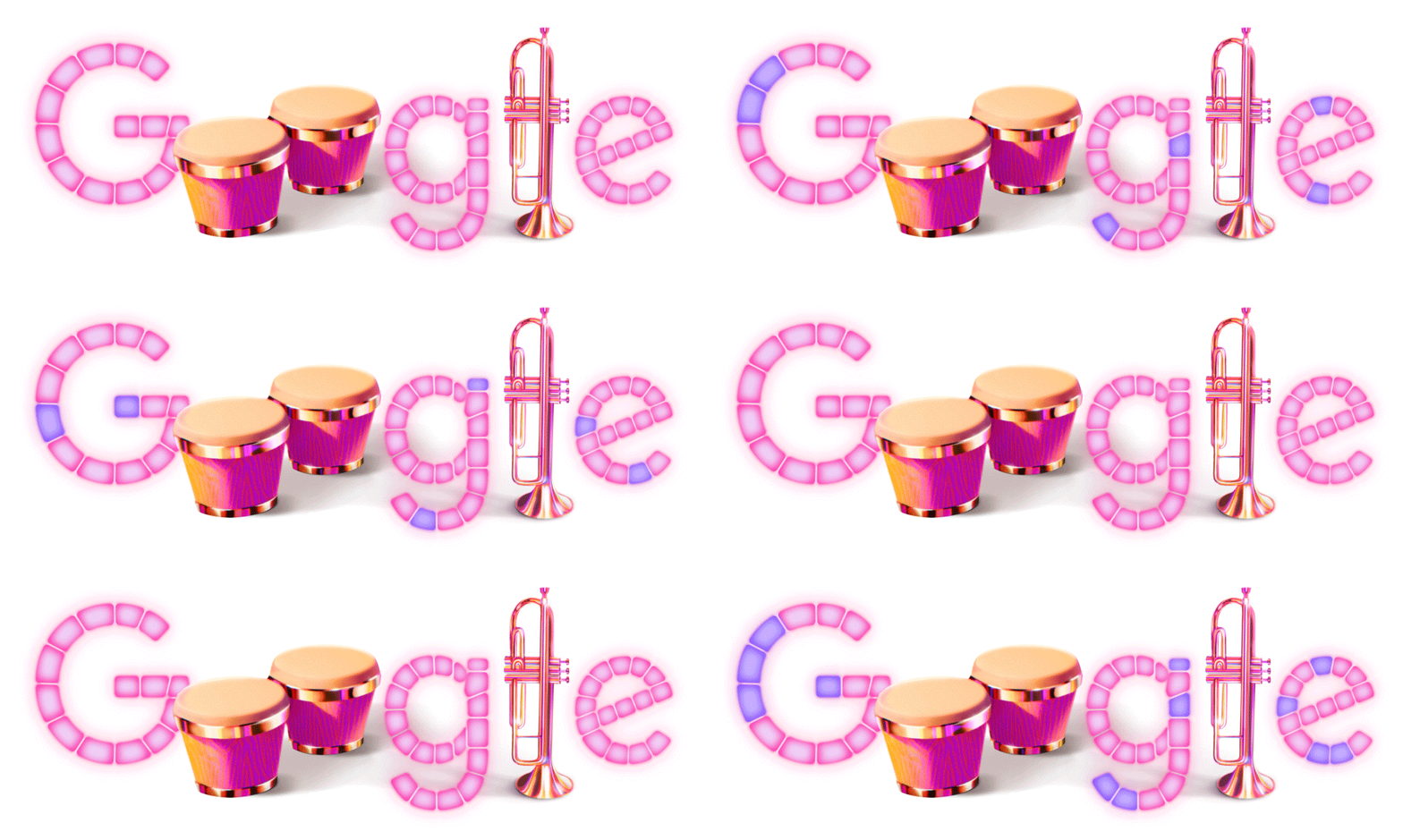
Image: Google Doodle, "The Art of Latin Pop" | Original page
The six colorful letters above Google's search box have given way to a neon-lit room: a pair of bongos, a trumpet, and glowing squares suspended around them.
Those squares are not decoration. Google's official page identifies them as drum pads, the finger-played devices electronic musicians use to build beats. All six letters have become buttons for making rhythm.
Google describes the subject as "Latin pop," music that combines traditional Latin styles such as salsa, cumbia, and merengue with the structures of contemporary pop songs.
It sounds like a straightforward introduction. Yet those three styles sound so different that their grouping raises a question of its own.
Why today?
September 23 is neither a particular musician's birthday nor a song's anniversary. It falls within National Hispanic Heritage Month in the United States, which runs from September 15 to October 15: 31 days.
Why begin in the middle of September?
The Library of Congress's legal research guide traces the answer to 1968, when Congress passed Public Law 90-498, establishing Hispanic Heritage Week. President Lyndon B. Johnson's proclamation explained the timing: five Central American neighbors celebrated independence on September 15, followed by Mexico on September 16.
Those five countries were Guatemala, El Salvador, Honduras, Nicaragua, and Costa Rica. On September 15, 1821, they declared independence from Spain in the same document: one declaration, five countries, a shared birthday. Starting the observance on that date gathered all five into a single commemoration.
Twenty years later, in 1988, Public Law 100-402 expanded the week into 31 days beginning September 15. That makes this year 58 years since the week was established and 38 since it became a month.
Today's Doodle celebrates an observance already underway, rather than one person's anniversary.
The key
Salsa emerged from New York's Puerto Rican and Cuban communities, cumbia from Colombia's Caribbean coast, and merengue from the Dominican Republic. Their tempos, instruments, and dances differ. What connects them?
One answer lies in a Spanish word: clave.
Literally, it means "key." In music, it refers both to a pair of wooden sticks struck together and to the rhythm they play.
That pattern lasts two bars and contains five strokes.
One of the most common versions is son clave. In its 3-2 form, the first bar has three strokes and the second has two. The first bar's strokes fall on beat 1, the second half of beat 2, and beat 4. The second bar's strokes fall on beats 2 and 3. Reverse the order of the bars and it becomes 2-3 clave.
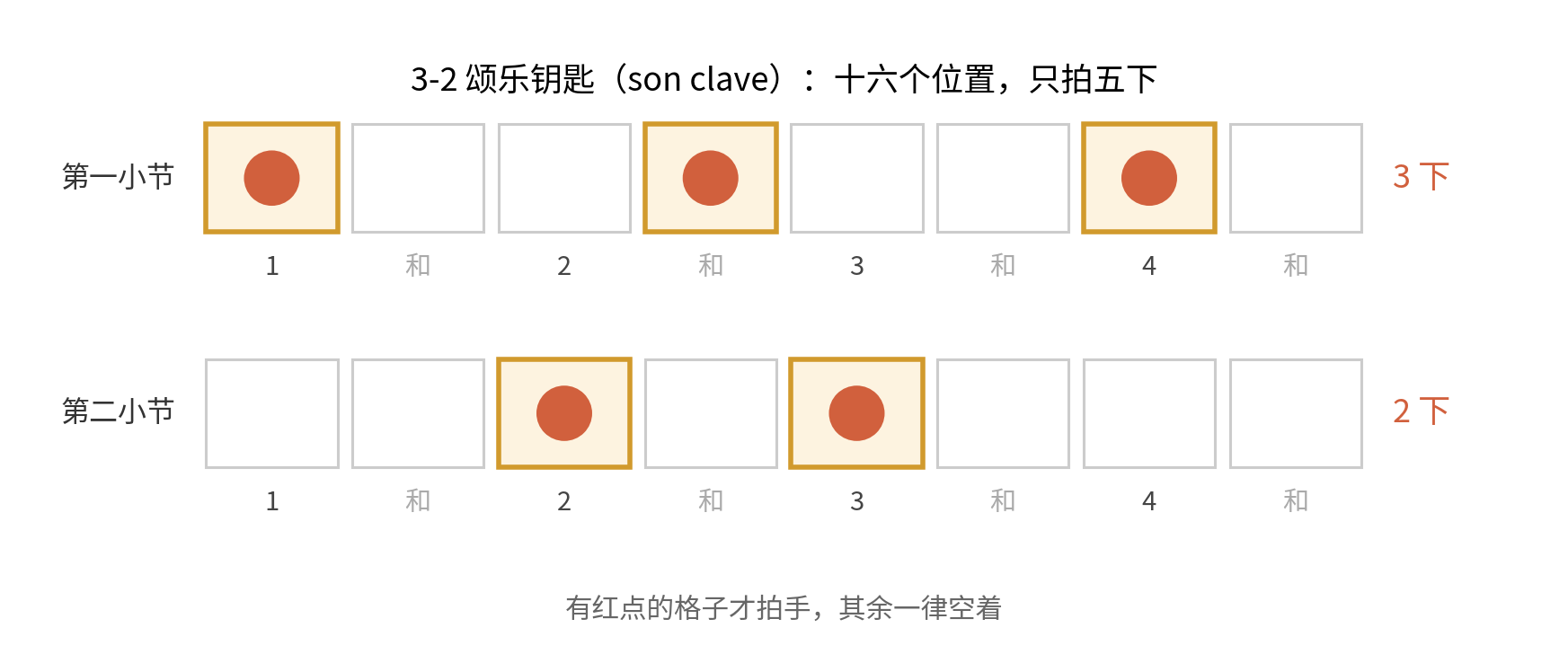
Once those five strokes are established, they anchor the arrangement. Bass lines, drum patterns, trumpet entrances, and the singer's phrasing must all fit around them. Musicians call a phrase that falls out of alignment "out of clave." In a well-rehearsed band, that is a mistake worth stopping to correct.
The surface differences help explain why salsa, cumbia, and merengue sound so unlike one another. Underneath, they often share the same key.
Latin pop can take a hundred forms, yet the rhythmic framework left beneath the instruments often contains just five strokes.
According to the jazz education website Jazzfuel, clave took shape in the drumming traditions of sub-Saharan Africa and crossed the Atlantic to Cuba with enslaved Africans. In shipyards and on docks, they used pairs of hardwood sticks found close at hand to recreate rhythms from home. The sticks produced a hard, bright sound that, as Jazzfuel describes it, "can be heard even above a full band."
Something picked up because it was cheap, durable, and loud became a foundation for an entire musical world.
A "trumpet" with a Chinese past
The trumpet at the center of today's Doodle brings to mind a less familiar musical journey.
During the annual carnival in Santiago de Cuba, in the island's east, a piercing high voice cuts through the street. Locally it is called the corneta china, the "Chinese trumpet."
The instrument is a suona, a Chinese double-reed horn.
According to Cuban outlet CiberCuba, Chinese immigrants brought it to Cuba in the late nineteenth century. In 1915, a young musician named Juan Martínez carried it from Havana to Santiago and introduced it to a carnival procession. The group was Los Colombianos, led by Feliciano Mesa. That was exactly 111 years ago.
Chinese immigrants brought the instrument, but Afro-Cuban communities made it an enduring local tradition. The English Wikipedia entry notes that Cuban players' style more closely imitates a trumpet than the suona's original playing technique. A 2024 University of Victoria thesis on Santiago's "Chinese trumpet" describes it as representing "a musical tradition passed down through generations in Santiago's neighborhoods."
A Chinese instrument crossed to the Caribbean with Chinese migrants, was taken up by Afro-Cuban bands, adopted the voice of a European trumpet, and became a sonic signature of a Cuban city.
Google has drawn instruments under neon lights. But instruments carry histories across borders, collecting more passport stamps than most of the people who play them.
Sources
- Google Doodles, "The Art of Latin Pop": Original page.
- Library of Congress: National Hispanic Heritage Month Legislative History.
- Jazzfuel: Clave Rhythm Explained.
- Berklee PULSE: The Clave.
- CiberCuba: The Chinese Trumpet, Soul of Santiago de Cuba's Carnivals.
- University of Victoria: La Corneta China: A Musical Symbol of Santiago de Cuba.