
A three-millimeter cap, a black stem like horsehair, and a name coined almost two centuries ago.
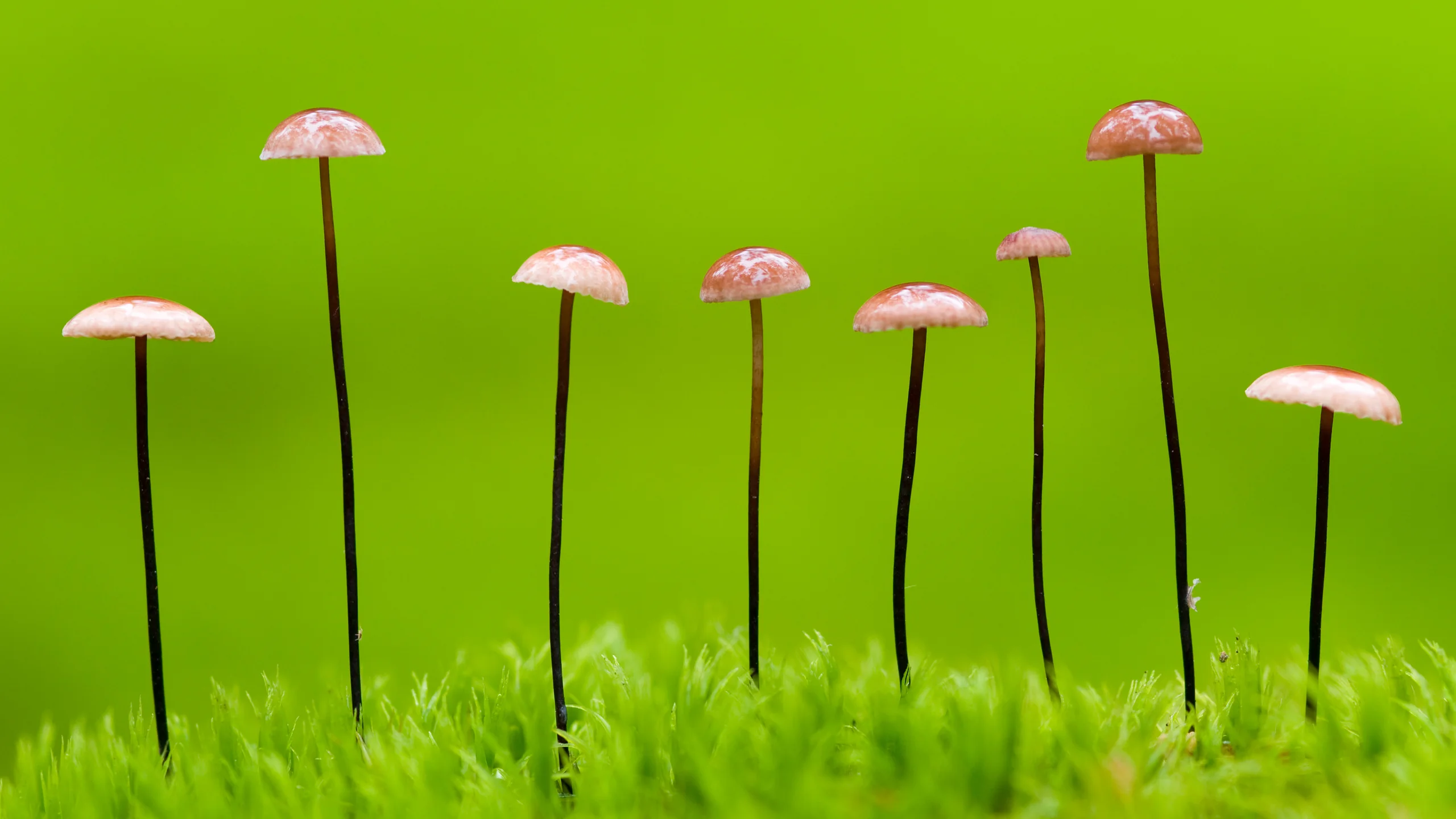
Image: Bing Daily Wallpaper | Horsehair parachute mushrooms, Belarus (© Máté/Nature Picture Library) | View on the Bing homepage (Bing licenses these photographs for wallpaper use only; this article links to the image as a reference.)
Bing calls today's picture The World Beneath Your Feet. The title is really an instruction: do not look up.
Seen at eye level, a Belarusian pine forest might offer only trunks, crowns and patches of light. The real world lies in the five centimeters beneath a shoe: a layer of dry needles that crackle underfoot, crossed by black threads as if someone had stitched the ground. Follow one and it leads to a cap only three to eight millimeters wide. It sits on a glossy stem whose lower half is almost black, with radial grooves across the cap like an old umbrella left in the rain.
The photographer put the camera on the ground. The view is an ant's.
First, the Name, Because There Is an Error
Bing's Chinese caption calls the fungus "horsehair Marasmius," a direct and vivid rendering of the English name. The black stalk does resemble a strand from a horse's tail. But in conventional Chinese taxonomy, that name already belongs to another species: the tropical Marasmius crinisequi, a close relative that lays black cords through cacao and tea plantations. That is how the Chinese Academy of Sciences' Plant Photo Bank of China records it.
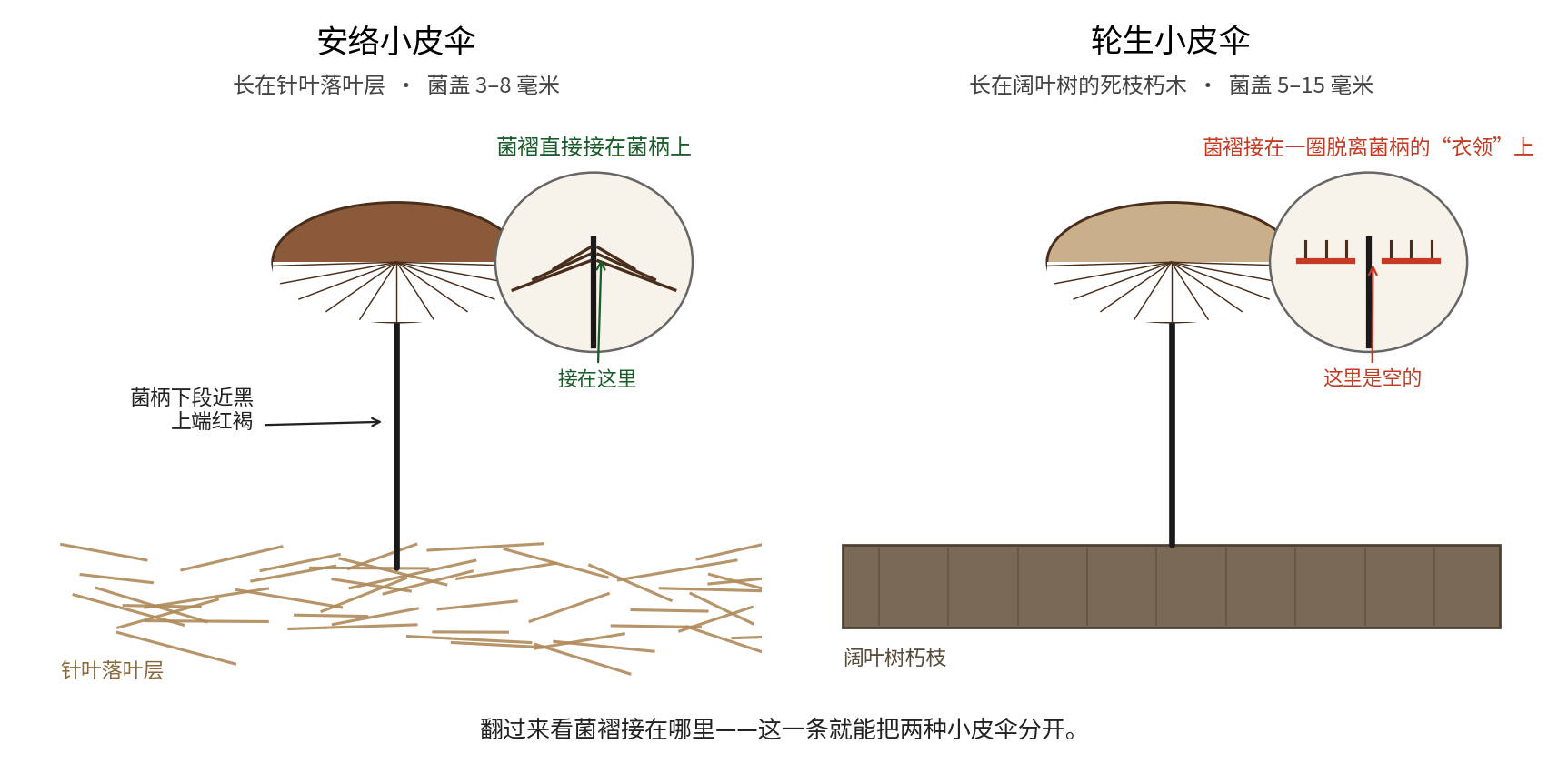
The species in the photograph is Marasmius androsaceus, now also commonly placed in the genus Gymnopus. Its standard English name is Horsehair Parachute. In Chinese it has the unusual name Anluo Xiaopisan, a name associated with medicine. That connection comes later.
For now, one detail matters: this is a mushroom of pine needles, not rotting wood. Even some widely cited British species pages get this wrong, carrying over a description of growth on dead hardwood. Two North American specimen records and two peer-reviewed papers instead point to conifer litter: redwood needles in California, Scots pine needles in Europe and spruce needles in the Czech Republic. It lives on fallen needles.
Its Name Means "Withering"
The genus Marasmius was established by the Swedish mycologist Elias Fries in the 1830s. Its root is the Greek marasmos, meaning withering or wasting, and is related to the medical word marasmus. Naming a mushroom "withered" sounds like an insult.
It is praise.
The defining trait of this fungal group is neither color, smell nor size. It is the ability to dry out and then revive in rain. Fries wrote about this property in his 1838 Epicrisis Systematis Mycologici. It was a key to identifying the genus, not a curiosity added later.
How dry can it become? Dry as paper. The cap curls, its color fades, and the whole fruiting body shrinks into an unnoticed scrap in the litter. Then rain arrives. It absorbs water, swells and recovers its shape. A California fungal guide says members of the group can "revive" after drying. A Pacific Northwest key is more exact: after moistening, they return to their fresh appearance more or less.
That qualification matters. The mushroom does not recover perfectly. Once rehydrated, its first task is to resume releasing spores. One fruiting body can continue working through several cycles of drying and rain.
An ordinary gilled mushroom may grow and decay within days; once the rain stops, its chance is over. This genus follows another strategy. It does not gamble on the weather but works in shifts with it: sunlight sends it dormant as a sheet of paper, rain brings it back to disperse more spores.
The point is not merely that rain revives it. Its survival strategy is the capacity to be revived.
The Black Threads Are Not Its Legs
First, correct a misconception of scale. The "horsehair" stem measures 0.5 to 1 millimeter thick, while a hair from a horse's tail is usually only 0.1 to 0.2 millimeters. The fungal stem is several times thicker. "Horsehair" describes not fineness but a quality of being black, glossy, stiff and tough.
The truly hairlike structures are the black lines around the stems that bind needles together. They are called rhizomorphs.
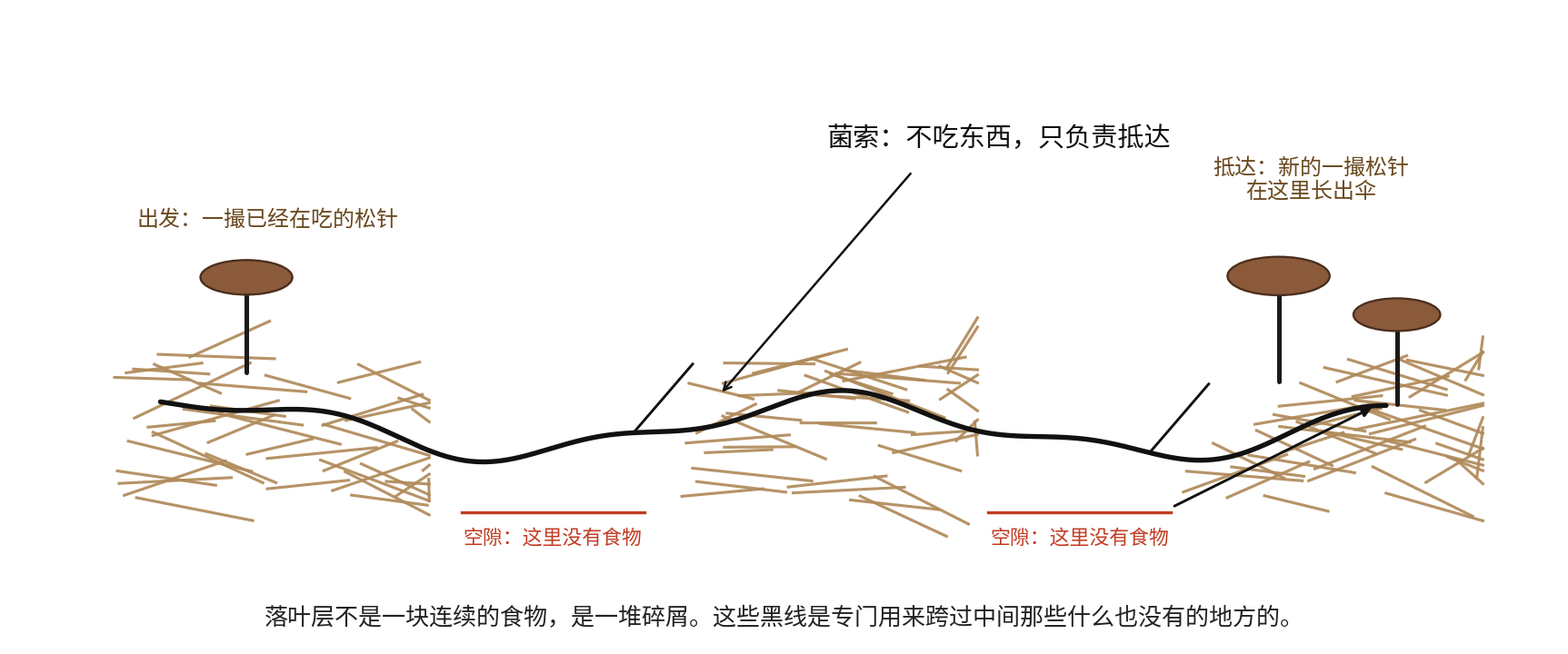
A rhizomorph is a cord woven from fungal hyphae. Where a mushroom appears depends on what its underground mycelial network can reach. Leaf litter is not one continuous meal but scattered fragments separated by empty space. Rhizomorphs exist to cross those gaps. They are cords for reaching the next source of food, not food themselves.
When black lines stitch a clump of needles together, they are not decoration. They are a map being extended.
It Really Does Take Things Apart
A 2001 experiment put numbers on that work. Researchers used fallen Scots pine needles containing 19.8 percent lignin and 26.5 percent cellulose, inoculated them with different fungi, and measured the weight lost after one year.
The natural control lost 36 percent of its weight. The group inoculated with M. androsaceus lost 52 percent.
The extra 16 percentage points are not the central finding. Another fungus, Trichoderma viride, removed 48 percent, yet the concentration of lignin increased in its samples. It ate the accessible sugars while leaving the tough material behind, so lignin became a larger share of what remained. In the M. androsaceus samples, lignin declined throughout the experiment.
One fungus ate the soft portion. The other also attacked the hard part. That is a decomposer at work.
Lignin helps plants hold themselves upright and is among the hardest organic materials to break down. Without fungi willing to digest it, litter would accumulate year after year until forests were buried in their own waste. The tiny cap in the photograph is the aboveground expression of that labor. The cap is an outlet, not the organism's main body.
The 52 percent figure came from a laboratory inoculation with a single fungal species. It is not the turnover rate of an entire litter layer in the wild, which is far more complicated. No reliable figure for that broader process was found.
Belarus, Where Forest Is Food
Bing identifies the location as Belarus, a plausible home for this species.
The Belarusian president's official website says forests cover about 40 percent of the country and that 60 percent of those forests are coniferous. A substantial portion of Belarus is therefore pine and spruce, exactly the habitat of M. androsaceus. The same site gives a figure of 9.6 million hectares of "forest land," which does not align with 40 percent because forest land and actual tree-covered land are different categories. This article does not divide one by the other.
Across the border between Belarus and Poland lies Białowieża Forest, one of the few remaining primeval forests of the European lowlands. The Polish portion entered the World Heritage List in 1979. The Belarusian side was added in 1992, and the site expanded substantially again in 2014. Its present area is 141,885 hectares.
The forest has recorded about 600 mushroom species, according to the national park's official material. The same source says conifer forest accounts for nearly 70 percent of the total, with pine forest alone at 58 percent.
Six hundred species in one forest. Most have never meant anything to people beyond being given a name.
Belarusian attitudes toward mushrooms are not neutral. A 2013 study spanning several European countries divided their cultures into mycophilic and mycophobic groups. Germany, the Netherlands and the United Kingdom fell into the mycophobic group. Belarus, Poland, Russia and Ukraine were explicitly classified as mycophilic countries.
The distinction is not merely comic. In remarks about border policy, Belarus's leader said that before the war, residents near the Ukrainian border "always came to pick mushrooms and berries." The foreign ministry said the forest "was a great help to their families." These remarks came in a political setting, not a statistical report, and are included only as evidence of an attitude.
The Chinese Connection: A Tiny Mushroom Made Into a Painkiller
Return to the Chinese name Anluo Xiaopisan. It sounds like a medicine because it is one.
Since the 1970s, China has used an ethanol extract of this mushroom in pain medication. One product still registered today is Anluotong Tablets, national drug approval number Z42021949, approved in 2007. Its label lists "ethanol extract of the Marasmius androsaceus fungus (and its culture medium)." It says the product promotes circulation through the meridians and relieves pain, and identifies sciatica, trigeminal neuralgia and rheumatic joint pain as indications.
A 2016 pharmacology paper using a chronic constriction injury model in rats said preparations of this kind already had "more than 40 years of clinical use." Half a century has now passed since people began turning this little mushroom from conifer litter into a painkiller.
The same paper makes a more important statement: the precise analgesic mechanism remains unclear.
A substance can be used for more than 40 years, enter a national drug register and be taken every day while its workings remain incompletely understood. That is not an embarrassment. It is what science really looks like: not a finished book, but a litter layer whose edge keeps expanding.
One frequent mix-up should be stopped here. M. androsaceus is not the honey fungus Armillaria mellea. Chinese-language pages, especially machine-translated ones, often substitute the latter for the former. They are different fungi in different genera.
For scale, China is a major producer of edible mushrooms. The national statistical survey for 2023 reported 43.34 million metric tons by fresh weight, including 13.04 million metric tons of shiitake, about 30 percent of the total. Spread across China's population, the full production figure works out to roughly 30 kilograms per person per year.
Why Today? A Holiday That Just Moved
The link in Bing's English caption contains a clue to the date: its search term is National Mushroom Month in the United States. September 1 was traditionally the first day of Mushroom Month, an obvious occasion for a fungal photograph.
There is one problem.
On May 19, 2026, the Mushroom Council, which organizes the observance, issued a release titled National Mushroom Month Moves to June. June, it said, offered a better market opportunity because it was closer to grilling season. This year's Mushroom Month moved three months ago. The U.S. Department of Agriculture's topic page still says that September offers a whole month to vary the ways mushrooms are served; it has not caught up.
The clue appears only in Bing's English-language caption. The Chinese caption links to a search only for the four-character Chinese name Bing uses for the fungus. A Chinese reader therefore sees no trace of Mushroom Month in the interface. No causal claim is being invented here. The observable fact is simply that Bing's hook caught a holiday no longer in that place.
September is nevertheless part of the mushroom season in the temperate Northern Hemisphere. British records for this species run from June through November. September falls inside that span, but it is not the only peak.
Sources: the Bing Daily Wallpaper API for zh-CN and en-US; the Chinese Academy of Sciences Institute of Botany's Plant Photo Bank of China; MykoWeb's California Fungi; the Vancouver Island Mycological Society key to horsehair fungi; Cox et al., Biology and Fertility of Soils (2001); Koukol et al., Plant and Soil (2008); Perry, Desjardin and Stevani, Journal of Fungi (2025); the official website of the President of Belarus; UNESCO World Heritage Site No. 33; the official website of Białowieża National Park; Peintner et al., PLOS ONE (2013); the Anluotong Tablets label, national drug approval number Z42021949; Zhao Sisi et al., Drug Evaluation Research (2016); the Mushroom Council's May 19, 2026 release; China's National Institute of Occupational Health and Poison Control; the China Edible Fungi Association's 2023 statistical survey; the North American Mycological Association; and an Imperial College London secondary-school outreach lesson.