
Four veteran engines, and a one-way farewell.
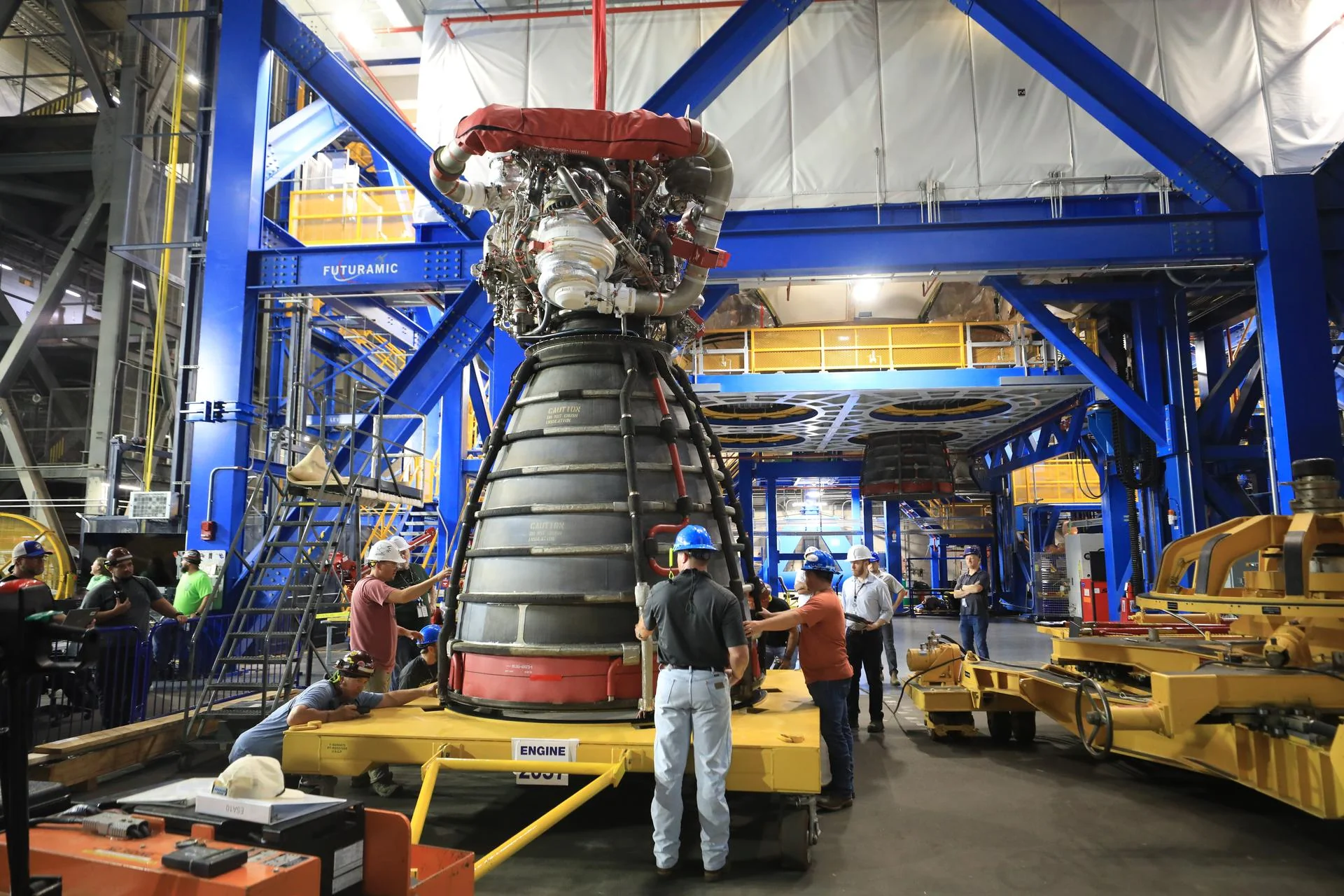
Image: NASA Image of the Day | Image credit: NASA/Clayton Rougelot | Image page
A rocket engine lies on a yellow transporter, its nozzle pointing down beneath a dense mass of pipes. Technicians in hard hats surround it. One steadies it, another watches, and another points the way. Blue steelwork and yellow elevated walkways rise around them.
The photograph was made on Tuesday, August 25, 2026, inside the Vehicle Assembly Building at Kennedy Space Center. NASA technicians were preparing to install four RS-25 engines in the Artemis III core stage.
NASA published their serial numbers: E2054, E2057, E2048 and E2052.
Remember the third one: E2048.
E2048's First Two Flights
E2048 is not new. It is a Space Shuttle Main Engine.
NASA's caption gives part of its history. E2048 helped carry astronaut Randy Bresnik into orbit aboard space shuttle Atlantis on STS-129 in 2009. Earlier, it flew aboard Discovery on STS-95 in 1998.
STS-95 was the mission that returned 77-year-old John Glenn to orbit. NASA says the flight made the space pioneer "the oldest person at the time to fly in space." The date was Thursday, October 29, 1998.
Thirty-six years earlier, Glenn had become the first American to orbit Earth. Thirty-six years later, at 77, he went back. E2048 was one of the engines that took him there.
Then comes 2027.
On June 9 this year, NASA announced the four members of the Artemis III crew: NASA astronauts Randy Bresnik, Andre Douglas and Frank Rubio, and ESA astronaut Luca Parmitano.
Bresnik.
The E2048 that launched him in 2009 is due to ignite beneath him again in 2027.
Both facts come from NASA: the agency says E2048 flew on Bresnik's STS-129, and NASA placed Bresnik on the Artemis III crew. The connection between those statements is this article's inference, not a claim NASA itself makes.
This Time, It Will Not Return
During the shuttle era, these engines came home with the orbiter after every flight. They landed, were removed and serviced, then installed again for another mission. E2048 flew more than once that way.
The Space Launch System is different. Its engines sit beneath the core stage, and the core stage does not return.
NASA's official Artemis I media materials state that the core stage and upper-stage adapter would "fall into the Pacific Ocean, east of Hawaii and west of Baja California."
The same document explains why: "Recovery systems were omitted from SLS elements" to lift heavier payloads, reduce operating costs, and power missions to the Moon and beyond that require maximum performance.
The phrasing matters. NASA is not saying reuse was simply uneconomic. It says the recovery systems were deliberately left out to carry more mass upward. Every unit of mass devoted to recovery is one that cannot be payload.
The engine program makes the manufacturing argument more directly. In one NASA article, program officials say that a shift to expendable engines, together with maturing technologies such as 3D printing, creates "many opportunities for process and manufacturing savings." A NASA contract announcement describes the newer engines as "more affordable and expendable."
The result is this: an engine that has flown, returned, been removed, serviced and installed again will work for a little more than eight minutes, then fall into the Pacific.
It is not being discarded because it failed. It will complete its work and enter the ocean by design.
NASA has not published the flight histories of E2054, E2057 and E2052. None could be established, so none is supplied here.
Eight Minutes and a Drained Tank
Two NASA figures produce a remarkably tidy calculation. First, the engines fire "continuously for more than eight minutes" during ascent. Second, they consume propellant from the core stage's two large tanks at about 1,500 gallons per second.
1,500 x 480 seconds = 720,000 gallons.
Another NASA release says the core stage holds more than 733,000 gallons of supercold liquid propellant.
Eight minutes nearly drains the tanks.
That is design, not coincidence. A rocket does not carry spare propellant without reason because every extra drop becomes dead weight that must also be lifted. As the eight minutes end, the propellant is effectively spent and the core stage has completed the only mission of its life.
"109 Percent": An Old Ruler That Never Changed
The RS-25 can be throttled from 67 to 109 percent of rated power, in one-percent increments. The shuttle commonly used 104.5 percent. SLS uses 109 percent. A newly manufactured L3Harris engine even reached 111 percent during an acceptance test this year.
How can a percentage exceed 100?
Because 100 percent is a baseline established in the 1970s. NASA documents put the rated power level, or RPL, at 469,448 pounds of thrust in vacuum.
The engines became more powerful. The ruler did not change.
The arithmetic shows it:
469,448 x 1.045 = 490,573 pounds, against NASA's shuttle-era figure of about 491,000 pounds.
469,448 x 1.09 = 511,698 pounds, against NASA's SLS figure of 512,300 pounds in vacuum.
At sea level, 100 percent was about 380,000 pounds. Multiplying by 1.09 gives 414,200 pounds, close to NASA's published 416,300 pounds. Three multiplications produce three matches.
So 109 percent does not exceed a physical limit. It exceeds an old reference point. A number can contain history. Someone set a baseline half a century ago, and engineers still use it, even when the result is greater than 100 percent.
Exquisite Machines Producing One-Fifth of the Force
The combined vacuum thrust of four RS-25s is 4 x 512,300, or 2,049,200 pounds. That is the "more than two million pounds of thrust" in today's NASA caption.
The qualification is important: this is vacuum thrust. At sea level, the four engines together produce about 1.665 million pounds, short of two million. NASA's own phrase is "more than 2 million pounds of thrust in vacuum," and that is the basis used here.
Two million pounds sounds enormous until the boosters enter the calculation.
NASA's solid-rocket-booster fact sheet from February gives 3.6 million pounds of thrust for each booster, or 7.2 million for the pair. Each stands 177 feet high, weighs 1.6 million pounds and burns for 126 seconds.
NASA publishes two figures for total SLS liftoff thrust, 8.8 million and 8.4 million pounds. Using 8.8 million, the two boosters supply 81.8 percent. NASA's own fact sheet says the boosters provide more than 75 percent of total SLS liftoff thrust.
Four liquid engines described among the most sophisticated and efficient ever built provide only about one-fifth of liftoff thrust. More than three-quarters comes from two solid boosters that cannot be throttled or stopped after ignition.
The proportion runs against intuition. The precise machinery supplies less force. In engineering, precision often provides control, while brute force provides lift.

More Than 3,500 Degrees Within One Meter
The RS-25 burns liquid hydrogen and liquid oxygen.
A NASA historical document calls liquid hydrogen "the second coldest liquid on Earth" at -423 degrees Fahrenheit, or -252.8 degrees Celsius. The coldest is liquid helium. Liquid oxygen is -297 degrees Fahrenheit, or about -182.8 degrees Celsius.
After ignition, NASA puts the combustion chamber above 6,000 degrees Fahrenheit, or 3,315 degrees Celsius.
The coldest and hottest regions of one machine sit less than a meter apart, across a temperature difference of 3,569 degrees Celsius.
Part of the answer to how the engine survives lies in the fuel. Describing the prelaunch chilldown process, NASA says propellant flows through the turbopumps, bearings, nozzle and other engine components without igniting. The coldest material passes first through the places that are about to become the hottest.
Strictly speaking, that NASA passage describes prelaunch conditioning, not cooling in flight. No explicit description of in-flight nozzle cooling was found in NASA's primary documents, so none is added here.
The RS-25's staged-combustion cycle also contributes to its efficiency by wasting as little as possible. NASA explains that the preburners consume most of the hydrogen and some oxygen, producing high-pressure, temperature-controlled, hydrogen-rich gas. That gas drives the turbopump turbines. The turbine exhaust then enters the main combustion chamber, where the propellant finishes burning.
Other engine cycles discard turbine exhaust. The RS-25 sends it back to burn again.
NASA defines higher efficiency plainly: an engine with higher specific impulse is more efficient because it produces more thrust from the same amount of propellant. NASA does not use a miles-per-gallon analogy here, so neither does this article.
NASA's own comparison for turbopump speed is vivid enough. The RS-25 turbopump turns 580 times per second, nearly 35,000 revolutions per minute. NASA compares that with about 9,000 rpm in NASCAR and roughly 19,000 rpm in Formula One.
Something About Artemis III Has Changed
One common impression needs correcting: Artemis III is not a lunar-landing mission.
NASA reorganized the Artemis mission architecture on February 27 this year. Its release says Artemis III, "now targeted for 2027, will test systems and operational capabilities in low Earth orbit to prepare for the Artemis IV landing in 2028."
NASA's mission page classifies it as a "crewed demonstration mission." Artemis III, it says, will perform objectives in low Earth orbit to validate critical systems needed for future lunar landings, "with lunar landings beginning with Artemis IV." NASA now gives 2028 as the target year for the first landing.
Read today's image caption again and there is no mention of the Moon. The engines will send Orion and its four crew members into low Earth orbit.
That omission is the new mission definition.
Under NASA's current preliminary profile, Artemis III will test rendezvous and docking between Orion and commercial lunar landers from Blue Origin and SpaceX. Astronauts may enter at least one lander test article. The mission will also validate Orion's upgraded heat shield during return.
Artemis II has already flown. In April this year, it completed a nearly 10-day journey around the Moon, the first crewed flight of Orion.
One more detail changed. The Artemis II engines were installed in the core stage at Michoud Assembly Facility in New Orleans. The Artemis III core stage arrived at Kennedy by barge on April 27 this year, and its engines are being installed here in the Vehicle Assembly Building. NASA has not explained the change, so these facts are stated without an explanation.
These events remain in the future. NASA says 2027; that is NASA's date, not a promise from this article.
The Building Around the Engine
The photograph was made in High Bay 2 of the Vehicle Assembly Building.
Construction began in 1965 and ended in 1966. The building is 525 feet high and 518 feet wide, occupies eight acres and encloses 3.66 million cubic meters, making it one of the world's largest buildings by volume. Its foundation rests on 4,225 steel pilings driven 164 feet down to bedrock. It contains 98,590 tons of steel and 65,000 cubic yards of concrete.
Then there are the doors.
Each is 456 feet high, making them the largest doors in the world. Opening or closing one fully takes about 45 minutes.
Press the button, make a cup of tea, finish it, and the door will only just be open.
The photographer is Clayton Rougelot. His name appears as the credit on numerous NASA pages, making him a regular credited photographer at Kennedy Space Center. NASA has not published a personal biography, so that is all that can be said about him here.
At the Other End: Seven Engines and One Thousand Tons
On the same date, February 27, 2026, the China National Space Administration updated its own schedule.
The coincidence has been checked twice: NASA's Artemis reorganization release and the CNSA document appeared on the same day. Each agency used that day to state when it intended to land people on the Moon.
CNSA's wording was that China is "aiming to achieve the first Chinese crewed lunar landing before 2030." Another document says the lunar-landing phase of China's crewed lunar exploration program has begun implementation and plans to achieve the first Chinese crewed landing before 2030.
The three principal flight vehicles have official names: the Long March 10 launch vehicle, the Mengzhou crewed spacecraft and the Lanyue lunar lander. Completed tests include a zero-altitude escape test for Mengzhou, a landing-and-liftoff test for Lanyue and tethered firing tests for Long March 10.
One number from the tethered tests belongs here. CNSA says a first-stage test article fired seven engines simultaneously under conditions "simulating nearly 1,000 metric tons of thrust." The two tethered firings took place on August 15 and October 11, 2025, and lasted a total of 320 seconds.
One thousand metric tons-force is about 2.2 million pounds-force.
The four RS-25s in the SLS core stage produce 2,049,200 pounds, or about 930 metric tons-force.
They are almost the same scale. One system uses seven liquid-oxygen and kerosene engines; the other uses four liquid-hydrogen and liquid-oxygen engines. One side is testing a first stage intended to fly back and land; the other deliberately sends its engines into the Pacific.
Two paths, two sets of tradeoffs. Neither journey is finished.
Sources: NASA's image page Historic Engines Take Their Place on Artemis III and August 27, 2026 mission blog; NASA's Artemis III mission page and February 27, 2026 architecture-reorganization release; NASA's Artemis I media reference; NASA's RS-25 and February 2026 solid rocket booster fact sheets; NASA historical documents and NTRS technical reports; NASA's Vehicle Assembly Building fact sheet; NASA STEMonstrations, Newton's Third Law; L3Harris reporting on 2025 testing of a newly manufactured RS-25; the Smithsonian National Air and Space Museum collection page; China National Space Administration releases of February 27, 2026 and October 11, 2025; and the Beijing Municipal Cultural Heritage Bureau's introduction to the China Space Museum.