
Beneath Mars's curved horizon, a white streak extends from near Arsia Mons like a ribbon pulled out by the wind. NASA's November 2 Astronomy Picture of the Day uses an image from 2018 to introduce a weather process that returns with the seasons.
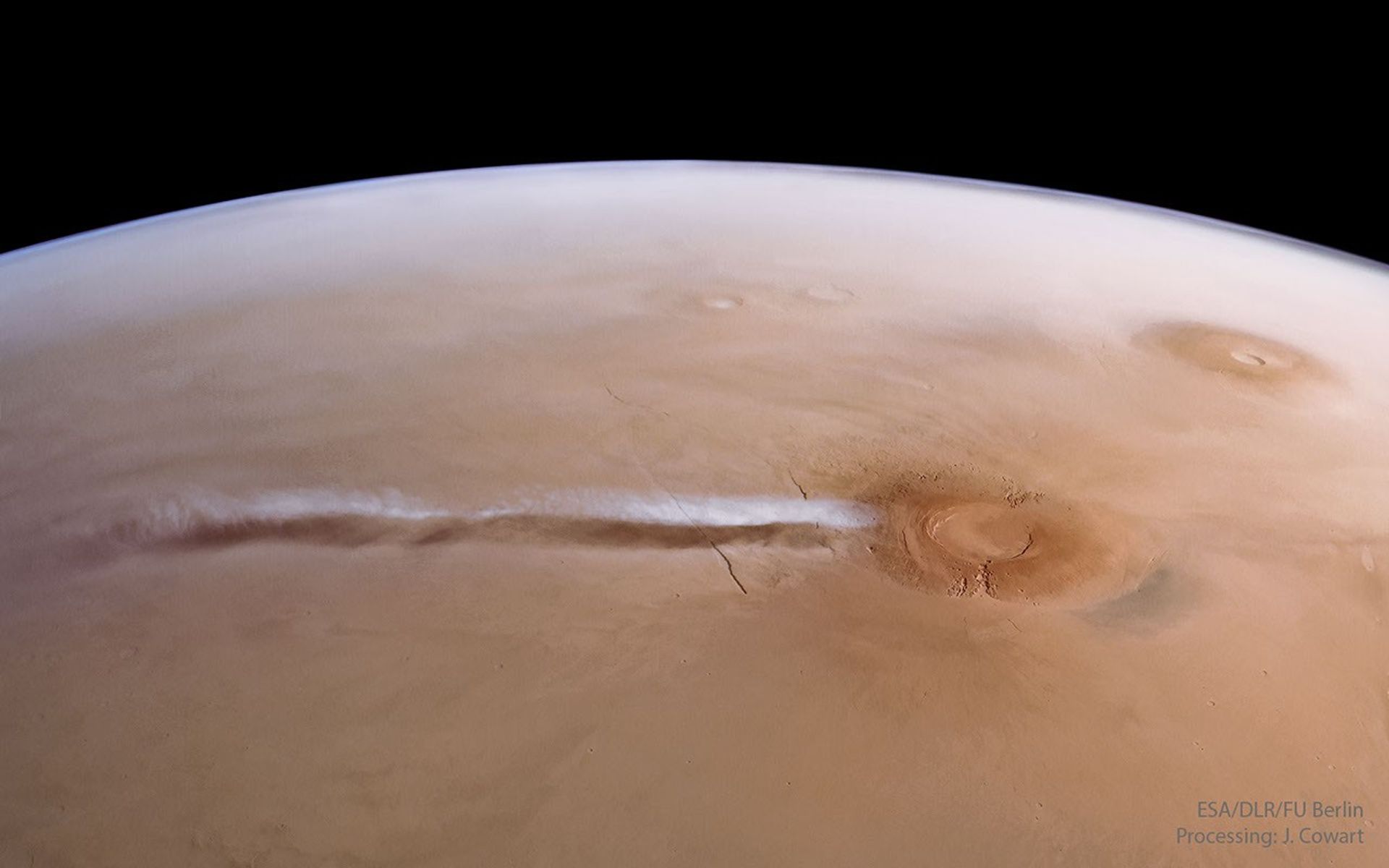
Image: NASA Astronomy Picture of the Day | Credit: ESA, DLR, FU Berlin; Processing & License: J. Cowart | CC BY-SA 3.0 IGO | Original page
The Arsia Mons Elongated Cloud is made of water ice, unrelated to volcanic smoke. It appears on mornings during southern spring and summer, grows and stretches, then disappears within hours. ESA's long-term observations have recorded a tail reaching about 1,800 kilometers long and up to about 150 kilometers wide. An enormous length does not imply a cloud lasting for days. In the right season, the process begins again the following morning.
The Mountain Lifts the Air. What Starts the Ice?
A mountain is an obstacle in the air's path. Wind passing Arsia Mons generates waves that lift parcels containing water vapor. As the air expands and cools rapidly, ice particles can form. That helps explain why the cloud favors a particular place, but leaves a smaller question: how does its first ice particle begin?
Many cloud droplets or ice particles begin with help from dust, sea salt, or another tiny particle. Scientists call that heterogeneous nucleation: a pre-existing foothold on which water can gather.
Conventional cloud microphysics could not reproduce this Martian cloud in the researchers' model. The original study published on October 7, 2026 reports that adding homogeneous ice nucleation, which needs no pre-existing particle, successfully reproduces some of its distinctive characteristics.
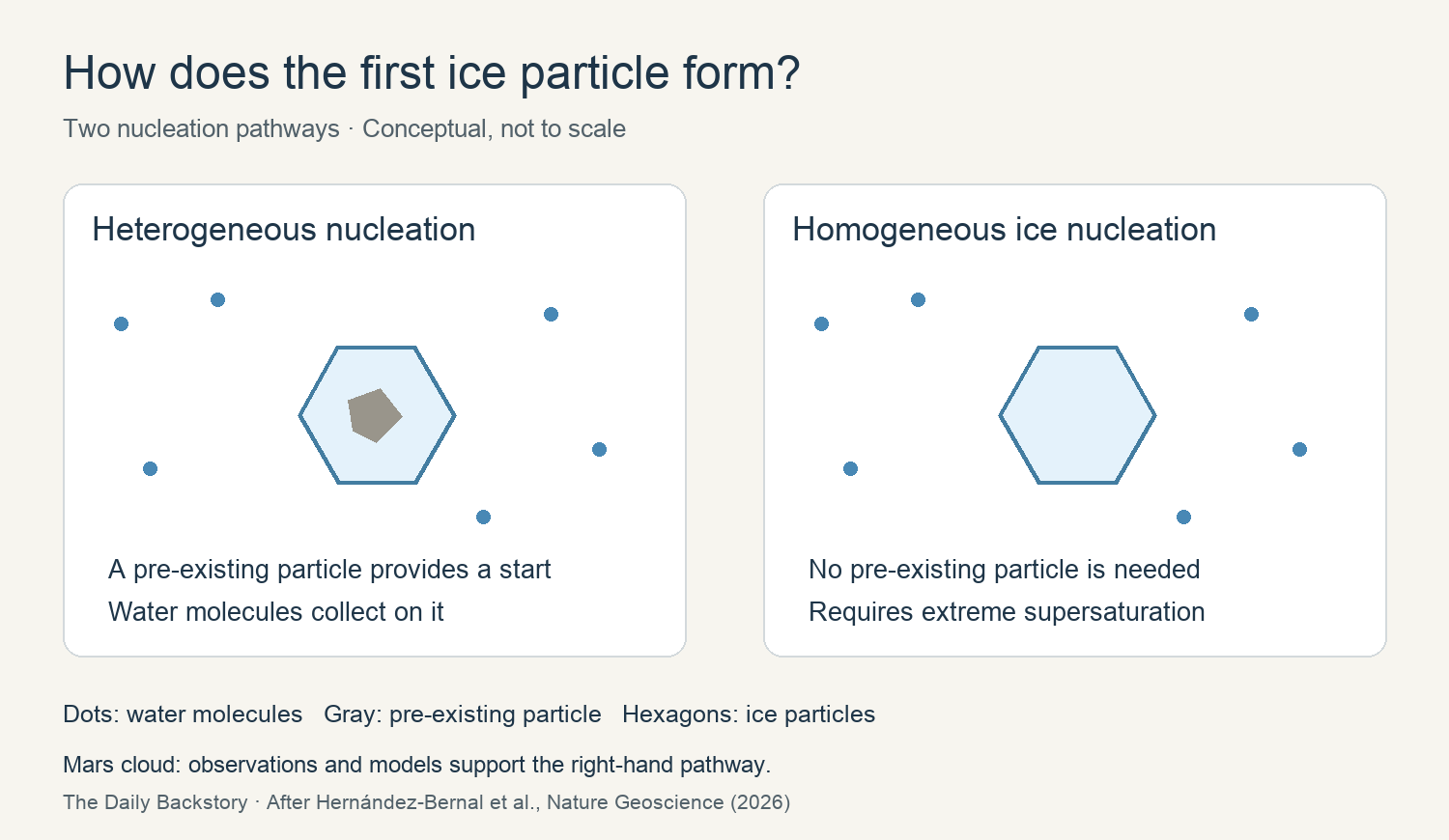
Explanatory diagram: The Daily Backstory, after Hernández-Bernal and colleagues. Dots represent water molecules, gray shapes pre-existing particles, and hexagons ice particles. Not to scale or a depiction of individual nucleation events sampled by a spacecraft.
In the model, rapid lifting and cooling create extreme supersaturation with respect to ice. That compares the amount of water vapor with the saturation value at the very low temperature; it does not mean Mars contains vastly more water vapor than Earth. Under sufficiently extreme conditions, water molecules form ice particles directly. Winds carry the particles westward into a long tail.
ESA's account of the new research notes that some modeled details still differ from observations. The final paper says the results strongly suggest this pathway occurs on Mars. The evidence combines images and meteorological modeling; a spacecraft has not sampled each crystal to inspect its core. Nor does the finding mean Mars has no dust, or that every terrestrial cloud must form in one particular way.
Open ESA's images and simulations to compare the cloud at different stages of its daily life. Then, when you notice a cloud beside a mountain closer to home, separate two questions: what brought the air there, and what allowed its first cloud particles to grow?