
NASA Image of the Day: "Understanding How Martian Auroras Are Made," published July 29
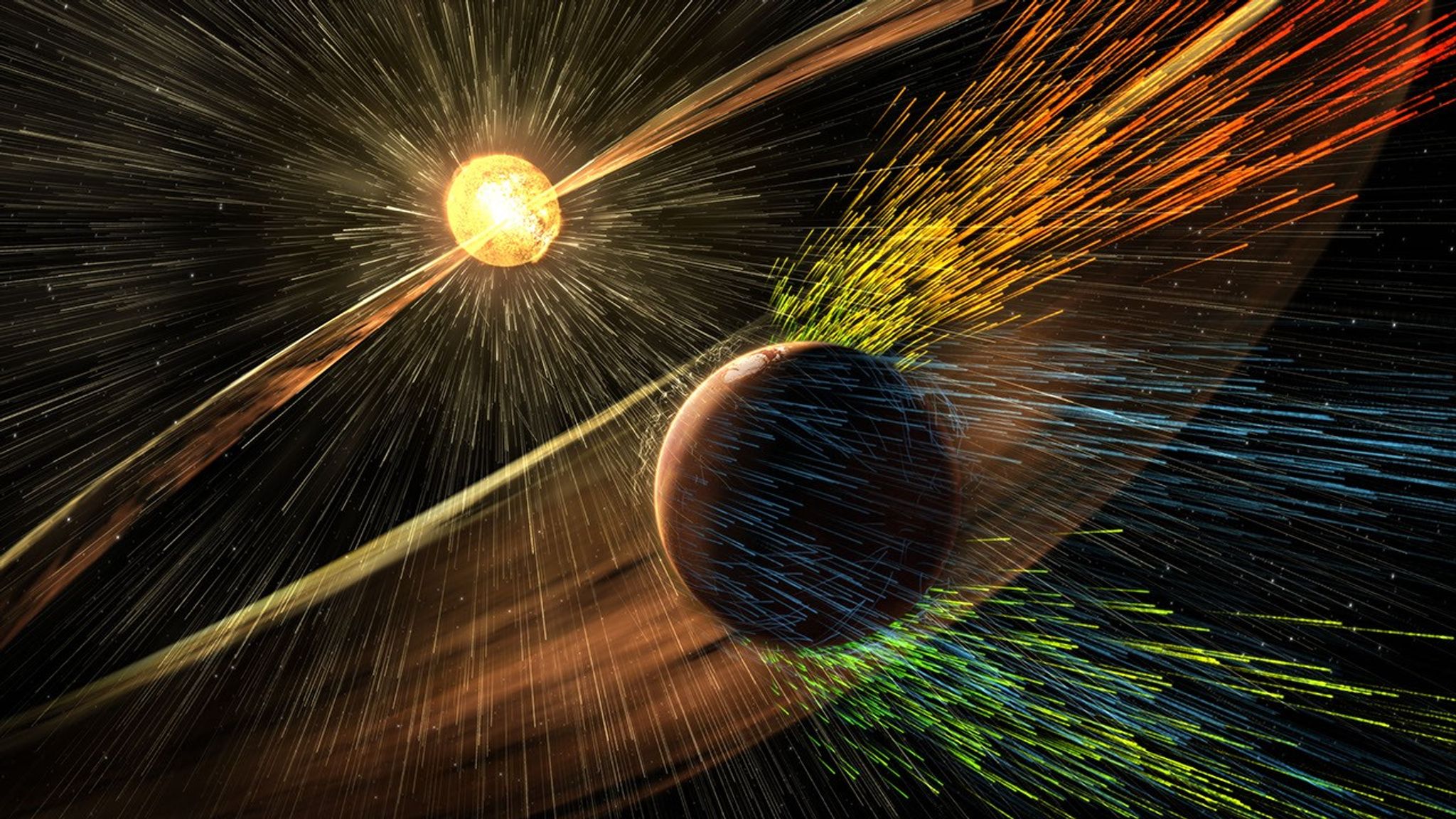
Image: NASA Image of the Day · Image credit: NASA · Image page · Research details.
Today's image isn't a photograph—it's a diagram. But the story behind it is a bit special: the spacecraft that made this discovery is no longer with us.
Its name was MAVEN—Mars Atmosphere and Volatile Evolution—and it had been orbiting Mars since 2014. On December 6, 2025, ground stations suddenly lost its signal; on June 3 of this year, NASA confirmed it could not be recovered and officially declared the mission over. But eleven years' worth of data remained. On July 23, a paper based on that data was published in Nature Communications: certain auroras on Mars are generated by the same mechanism as auroras on Earth.
In the image, the Sun shines from behind Mars while streams of yellow charged particles rush toward the planet, stripping away its rainbow-colored charged particles layer by layer—those stripped particles flow toward you and then scatter off to the right side of the frame. This is one of the processes by which Mars loses its atmosphere, and the very thing MAVEN spent eleven years watching.
How Earth's auroras are lit
Earth is wrapped in a giant magnetic bubble called the magnetosphere—its windshield against the Sun.
When the Sun's magnetic field lines approach this bubble, the field lines on both sides "link up"—physicists call this magnetic reconnection. Once connected, energy and matter are funneled into the entire magnetosphere, all the way into the long tail it drags behind it; at the tail's end, electrons are flung back toward the atmosphere like a slingshot. Those electrons slam into atoms high in the sky, exciting them into glowing—and that's an aurora.
This entire cycle has a name: the Dungey cycle. It doesn't just light up auroras; it drives the currents and plasma flow throughout the magnetosphere.
Mars has no global magnetic field, but it has "fossil magnetism" scattered across its surface
Here's the problem: Mars doesn't have that magnetic bubble.
Earth's magnetic field comes from its constantly churning liquid core. Mars's core went cold long ago. What it has today are small patches of strongly magnetized crust scattered here and there—each one propping up a miniature magnetosphere above it.
These magnetic fields are fossils. About four billion years ago, Mars still had a global magnetic field. Magma cooling in that field locked the field's direction into the rock. Later the global field vanished, and the solar wind began stripping away the atmosphere bit by bit (that's what today's image depicts), but the imprints left in the crust remained—and four billion years later, auroras still light up above those imprints.
MAVEN had long since photographed these auroras: not complete rings around the poles, but small patches hovering above strongly magnetized crust. What was always missing was the final piece—how are those electrons accelerated enough to produce light?
The new study provides the answer: above those miniature magnetospheres, a scaled-down Dungey cycle is running. The same physics, shrunk by orders of magnitude. Lead author Shaosui Xu of UC Berkeley's Space Sciences Laboratory says they knew magnetic reconnection occurred on Mars, but never expected it to take the form of a Dungey cycle. The finding also implies that this mechanism can operate at any scale—there may be other places in the solar system quietly running one too.
Could you see it with the naked eye from the surface of Mars?
Yes.
In March 2024, the Sun let out a massive sneeze—a coronal mass ejection aimed at Mars. At the time, the Perseverance rover happened to have its instruments pointed at the night sky and captured 557.7-nanometer green light—the characteristic emission line of oxygen atoms, the same color as Earth's green auroras. It was the first time humanity had directly observed an aurora from the surface of another planet; MAVEN's particle detectors provided corroborating data for that observation.
And because Mars lacks a global magnetic field, auroras don't have to crowd around the poles. On Earth you need to travel near the polar circles for a chance to see them; on Mars, in theory, you just look up—if people ever live there, this will probably be the first free show they get to watch.
Of course, beautiful things are usually dangerous too: the high-energy particles that light up auroras can also damage electronics and human bodies. Figuring out this mechanism was always about making more accurate predictions for when we eventually send people there.
Shaosui Xu mentioned that during graduate school he once discussed with his advisor whether Mars's crustal magnetic fields might sustain their own cycles; many years later, the answer was provided by his own team. And the data that delivered that answer came from a spacecraft that will never respond again—it has been silent for over half a year, yet it's still solving problems for us.