
The "Treasure Chest" in the Carina Nebula, photographed with the James Webb Space Telescope's NIRCam
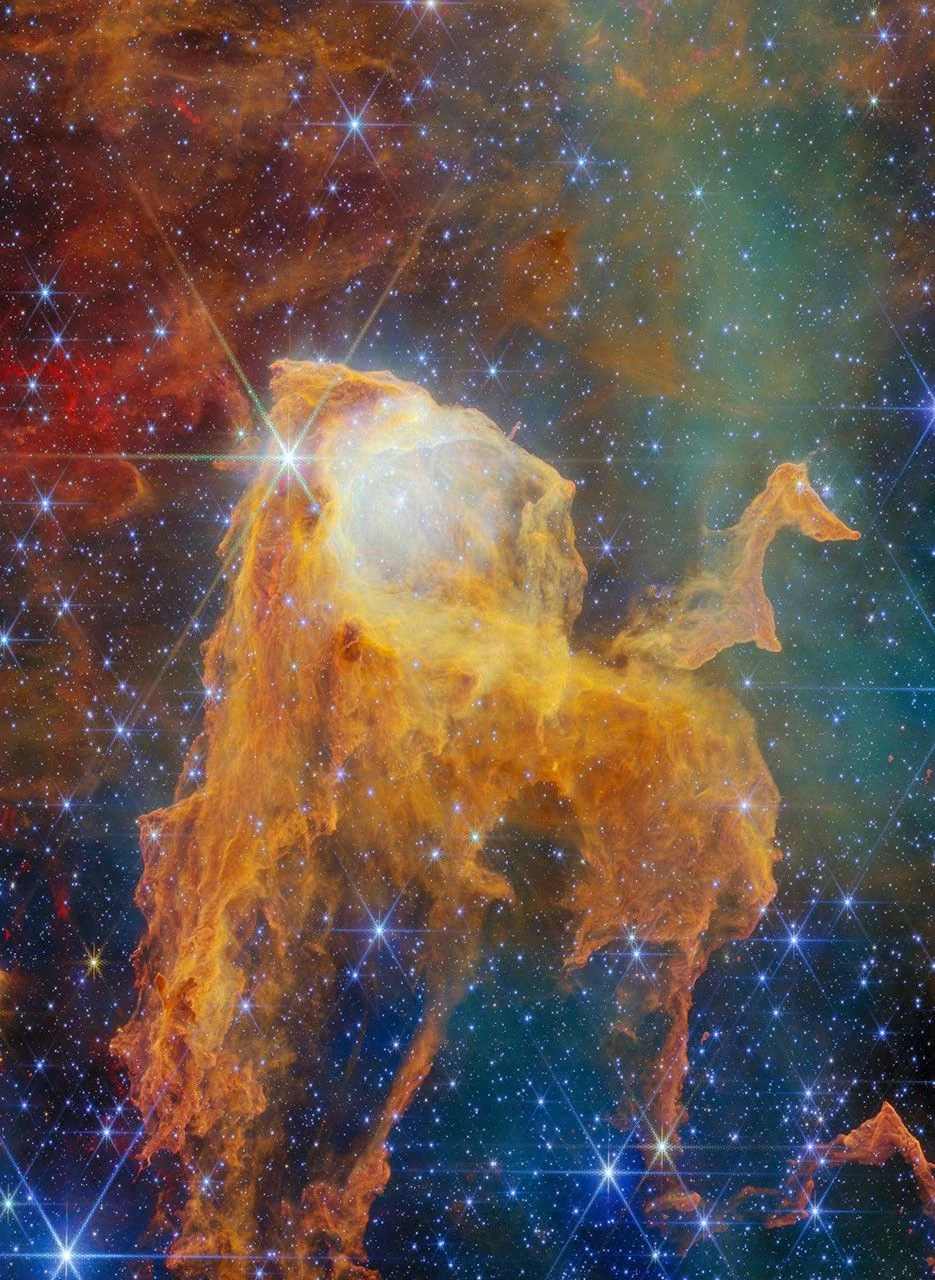
Image: NASA Astronomy Picture of the Day (APOD) | Image credit and copyright: ESA/Webb, NASA & CSA, M. Reiter; acknowledgement: M. H. Özsaraç | Today's page
A chest stands open, full of stars.
The metaphor was not invented after the fact. In 2005, three astronomers published a paper in The Astronomical Journal with the perfectly serious title "Opening the Treasure Chest: A Newborn Star Cluster Emerges from a Dust Pillar in Carina." A footnote in the paper reads:
Treasure chests are commonly found in sunken ships at the bottom of the ocean. In keeping with this theme, we point out that there is a nearby molecular cloud whose shape begs the name "the Seahorse Nebula."
Astronomers gave the things they saw an entire set of undersea treasure-hunt names. The chest's formal designation is G287.84−0.82, but since that paper, the world has known it as the Treasure Chest.
The cluster itself was first uncovered in data from the 2MASS survey. The three astronomers made the high-resolution follow-up study - and supplied the name. Sometimes the latter travels farther.
What Is Actually in the Image
Webb made this picture with four filters on its Near-Infrared Camera, or NIRCam. Two deserve particular attention. The 1.64-micron filter isolates light from [Fe II], a marker of shocks that glows where jets strike gas. The 4.7-micron filter captures molecular hydrogen, the heated skin of the pillar.
In other words, the observers did not simply choose a few attractive wavelengths. They selected two specific spectral lines to see the commotion around newborn stars. Megan Reiter of Rice University leads the observations. Her Webb program studies how young stars draw in gas from their surroundings and then eject it again.
The photograph covers a field of 4.26 by 5.83 arcminutes. At a distance of 7,500 light-years, that becomes 9.3 by 12.7 light-years. The Sun is 4.25 light-years from its nearest stellar neighbor, Proxima Centauri. This one frame could hold two or three Sun-to-Proxima distances.
The open cavity at the head of the chest has a radius of about 0.9 light-years, or more than 57,000 astronomical units - roughly 955 Neptune-orbit diameters. The hole is large enough to swallow the solar system together with its sphere of gravitational influence and still have room to spare.
As for the treasure inside, the paper counted at least 69 stars. The official figure of "about 70" is therefore a lower limit, not an estimate. Two-thirds show infrared excesses, evidence of protoplanetary disks still surrounding them. Planets are gathering material there. The brightest star, CPD−59 2661, has spectral type O9.5 V and a mass about 19 times the Sun's.
In visible light, these stars are completely invisible. The paper measured as much as 50 magnitudes of extinction through the cloud, reducing visible light to roughly one part in 100 quintillion. Infrared is essential here not because it makes a prettier picture, but because visible light sees nothing but darkness.
Why It Became a Pillar, and How the Lid Opened
This is the part most worth understanding.
First: light is boiling the gas away. Ultraviolet radiation from nearby massive stars strikes the cloud's surface, ionizing and heating the gas and cooking it layer by layer into interstellar space. The process is called photoevaporation. When Hubble released its image of the Pillars of Creation in 1995, the official announcement offered a useful analogy: as wind blows sand away, heavier rocks buried in it are exposed one by one.
Second: the part left behind takes its shape from the star. A simulation study put it plainly: "The pillars generally resemble fingers pointing toward the ionizing source." The Treasure Chest is a textbook example. The paper specifically notes that its unnaturally straight eastern edge points toward η Carinae and the Trumpler 16 cluster.
How far away are they? ESA gives 39 light-years. I independently calculated the angular separation from their coordinates and obtained 17.81 arcminutes, which projects to 38.86 light-years at a distance of 7,500 light-years - within four parts in a thousand of the official figure.
There is disagreement over why the pillar survives. One camp, represented by Mackey and Lim in 2010, showed that a dense clump can simply block the radiation and leave a shadow behind it. Another, represented by Gritschneder and colleagues, argues that no preexisting clump is needed: radiation travels through low-density channels in a turbulent cloud, compressing the denser material that remains into pillars.
Both camps agree on the result: the pillar's orientation is set by the direction of the star.
So this much can be said with confidence: every shape in this image is an arrow. Follow the pillar's point and you reach the thing slowly burning it away. Every pillar in space grows toward what is killing it.
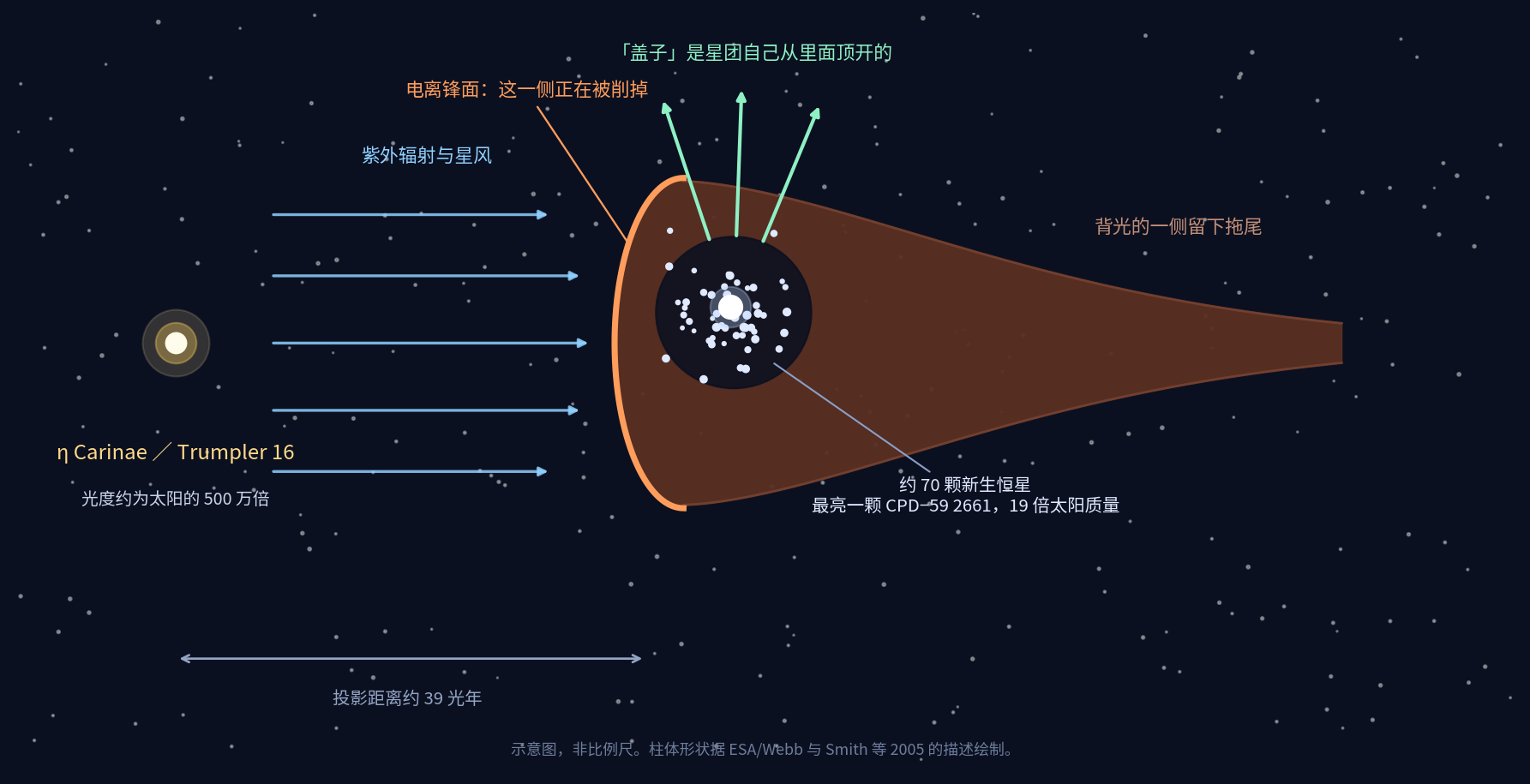
Third, and best of all: the lid was not pried open from outside. It was pushed open from within.
One line in the paper is almost cinematic. The dense bubble of ionized gas inside the pillar head is "probably in the early stages of breaking out of and destroying the head of the dust pillar." ESA's account is more balanced: outside radiation and stellar winds have "largely shaped the Treasure Chest as seen today," while the embedded cluster is also eating through the cloud from the inside.
The outside erodes; the inside pushes. We have caught the instant when the lid is opening.
Twenty Years Later, the Story Was Told Backward
The 2005 paper proposed that nearby massive stars might have "triggered" the birth of the cluster: the stars compressed the cloud, and the cloud collapsed into new stars. It is intuitive and became a popular account.
But ESA's "most likely scenario" in the new release reverses the sequence. The cluster formed first inside a cloud much larger than today's Treasure Chest. Strong stellar feedback then cleared away all the less dense gas around it, leaving only the densest piece.
In other words, the Treasure Chest is not a cradle but a remnant. The cluster did not grow inside the pillar. A much larger cloud was blown away, and this is the last piece the cluster still holds.
The same object, studied by the same group with a different telescope 20 years later, acquired the opposite chain of cause and effect. That fact is more valuable to tell a child than any single conclusion: science is not a list of answers. It is a scene still being rewritten.
Age brings another caution. You may read that the cluster is only 1.3 million years old, but ESA's page adds candidly that earlier estimates put it at just 100,000 years. The figures differ by a factor of 13, and neither age was measured by Webb; both come from cited literature. The price of studying something newborn is not yet knowing exactly how old it is.
Whether 1.3 million or 100,000 years, the cluster is absurdly young. At the higher estimate, if the Sun's 4.6-billion-year life were compressed into the lifetime of an 80-year-old person, this cluster would have existed for only a little over eight days.
The Thing Burning It Away
Thirty-nine light-years to the northwest lies η Carinae.
It is a binary system whose primary has about 100 times the Sun's mass and five million times its luminosity. That figure belongs to the primary alone, not to the combined system. It is the brightest object in the entire Carina Nebula.
Its most famous event came in the 19th century: it suddenly brightened.
There was a brief eruption in 1838 and another in late March 1843. In January 1845, η Carinae reached an apparent magnitude of about −1.0. It outshone Canopus and briefly became the second-brightest star in the sky, behind only Sirius. It then spent more than a century slowly fading again.
The eruption expelled at least 10 and perhaps as many as 40 solar masses of material, forming a two-lobed dust cloud called the Homunculus Nebula. It is now about one light-year long and is still expanding at 2.1 million kilometers per hour.
That makes η Carinae one of the rarest things in the sky: a stellar-scale eruption for which people left written observations and whose wreckage can still be seen directly. The magnitudes recorded by observers in the 1840s and the hourglass-shaped cloud photographed by telescopes today are the before-and-after images of the same event.
A Slightly Cruel Note About Time
Now place several lifetimes side by side.
The pillar itself can endure for roughly one to three million years. The pillars in the Eagle Nebula have a measured age of about three million years; the Treasure Chest cloud has a dynamical age of around one million. The 19-solar-mass O star inside the chest will spend about 10 million years on the main sequence before ending in a core-collapse supernova and leaving a neutron star. The inconspicuous, solar-mass stars inside will burn for 10 billion years.
Set those three numbers in a row, and the conclusion is a little cruel:
The pillar that made these stars will die before the stars it made. The nursery disappears before its children, and it disappears completely. Ten billion years from now, nothing will remain to show that these stars once belonged to the same chest.
The least conspicuous small stars inside will outlive the cloud that made them by three thousand to ten thousand times.
A Telescope in China Is Counting Something Else
One last story is unfolding in China.
At Delingha in Qinghai, Purple Mountain Observatory operates a 13.7-meter millimeter-wave telescope. Since November 2011, it has been doing something extraordinarily laborious and extraordinary in its ambition: making a portrait of the Milky Way's molecular clouds. The project's Chinese name means "Milky Way Imaging Scroll Painting."
It observes spectral lines from three carbon monoxide isotopologues at once. The first data release arrived in December 2025: 2,310 square degrees of sky, from which 103,517 molecular clouds were extracted, totaling 48.84 terabytes. The data are public, and anyone can download them.
The telescope cannot see today's Treasure Chest. Delingha is at 37 degrees north, like Beijing, and the Carina Nebula never rises within its reach.
But it can see the Pillars of Creation. The Eagle Nebula's Galactic longitude is 16.9 degrees, directly inside the survey area.
That gives us a useful contrast. Webb photographs the fire already burning inside the pillars. The telescope at Delingha measures the stack of fuel from which such pillars are made: carbon monoxide molecules colder than −260 degrees Celsius, dark in visible light and humming only at millimeter wavelengths.
Ten years. More than 2,300 square degrees. More than 100,000 clouds. This is China's catalog of what stars look like before they are made.
Sources: NASA Astronomy Picture of the Day for September 17, 2026, at science.nasa.gov; ESA/Webb's August 6, 2026, Picture of the Month, "Webb opens a Treasure Chest filled with stars"; NASA, "Webb Opens Treasure Chest"; Smith, Stassun and Bally, "Opening the Treasure Chest" (The Astronomical Journal 129: 888-899, 2005); Mookerjea et al. (A&A 626: A131, 2019); Mackey and Lim (MNRAS 403: 714, 2010); Gritschneder et al., numerical simulations of pillar formation around H II regions; McLeod et al. (MNRAS 450: 1057, 2015); Smith and Frew's revision of η Carinae's historical light curve (MNRAS, 2011); NASA Scientific Visualization Studio's η Carinae page; NASA/STScI releases for the 1995 Hubble Pillars of Creation image and the 2022 Webb version; NASA's Messier 42 page; Megan Reiter's Rice University faculty page; Yang Ji et al., "The Milky Way Imaging Scroll Painting Survey: Data Release 1" (arXiv:2512.08260); and the National Astronomical Data Center's Milky Way Imaging Scroll Painting resource page.